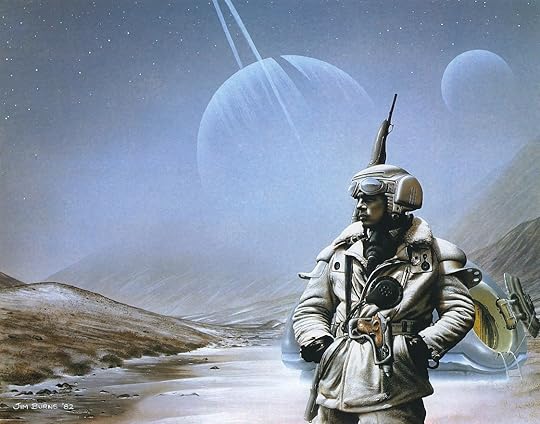
Carl Bok is a citizen of Springworld, the heavy-gravity planet with monstrous and dangerous flora and fauna. Carl is well over two metres tall and weighs-in at 180 kilograms. Now Carl has won a scholarship to Starschool. He'll spend a year on this touring school, visiting sixteen of the colonized planets. This will be the experience of a lifetime.
It's tough enough for Carl as the poor scholarship student among the rich kids. His problems get worse when they arrive at Earth. Carl finds himself in urgent need of big money and, since he's a pretty tough guy, becomes a paid fighter. He has to fight dangerous and deadly human and animal opponents. His fellow students, B'oosa, Miko, Alegria and Francisco "Pancho" Bolivar, get caught up in his exploits. And then there are the aliens.
Haldeman is the author of 20 novels and five collections. The Forever War won the Nebula, Hugo and Ditmar Awards for best science fiction novel in 1975. Other notable titles include Camouflage, The Accidental Time Machine and Marsbound as well as the short works "Graves," "Tricentennial" and "The Hemingway Hoax." Starbound is scheduled for a January release. SFWA president Russell Davis called Haldeman "an extraordinarily talented writer, a respected teacher and mentor in our community, and a good friend."
Haldeman officially received the Damon Knight Memorial Grand Master for 2010 by the Science Fiction and Fantasy Writers of America at the Nebula Awards Weekend in May, 2010 in Hollywood, Fla.
I read this book back in HS and it is one that crosses my mind from time to time. That a book is remembered and thought of 30 years later says something for how good it is.
One of my favorite authors is Poul Anderson and he is frequently criticized for being a "good idea" sci-fi writer, meaning that he comes up with great ideas, but the story is only passable. I can think of only one PA novel that I can concede this point, and I could see someone saying the same about There Is No Darkness. Just as I defend Anderson against this criticism, so must I also say that although this is a great concept, the story is also very good.
Haldeman builds a world where the natives of a planet have physical attributes representative of their home. His world building is spot on and this is very good SF. We see a future where humanity has colonized several planets and the people have begun to show distinguishing traits and sperating cultures - perhaps an early inspiration for the Expanse and Titanborn series? Our hero is a "Springer" from Spring World and is a physical giant compared to other humans and we follow his bildungsroman adventures.
This is a reread, but the first one in over a decade. I can't believe I didn't list it here since it is one of my favorite books by Haldeman. It's a coming of age story about a young giant from Spring World sometime in the far future. He's like many other young men & manages to get into a fair amount of trouble as he figures out where he belongs in the world - well, many worlds in his case. He's kind of a college student on a space ship that travels around visiting planets which gives it an interesting curriculum. That makes Carl's problems pretty interesting, not to mention deadly, too.
Definitely Haldeman at his best. Highly recommended.
There Is No Darkness is the only collaborative novel from the Haldeman brothers, Jack and Joe. It's a fix-up of several adventure novellas, and was a YA novel before there was a category for such things. It's a good coming-of-age story centered around the students on the spaceship Starschool, who discover themselves as they explore different planets.
A competent SF adventure, but a lesser novel for Haldeman. This is a fix-up novel of three stories. Typical for this format, not all parts are as strong. The central idea of the Starschool, a starship full of students that tour various plants as part of their curriculum, is quite engaging. However, some of the episodes seem pretty mundane. The first feature Earth where gladiator events have made a comeback. Not sure why though. The next episode is similar but better. A planet with flora and fauna that is so lethal is a military training school, but also hosts interplanetary wars. A group of the students are kidnapped and find themselves pressed into service in one of these wars. Finally, the students visit a vast alien artifact where the races of the universe each have essentially embassies. For some reason, the students trigger one alien race to finally reveal themselves after centuries. Again, why this happened is not explained. Fine light reading, but the ideas are pretty weak. Be warned, the Ace paperback is missing a good chunk of the book while another chunk is duplicated. I was able to find the missing text online (but I forgot the link).
The ultimate coming-of-age story combined with the strangest school trip, and it all started with an extra charge on a Springer when the Starschool tried to land at a specific spaceport.
Carl Bok might be a poor country boybut he has his pride, and he thinks he can use his unusual size to earn back the money fighting professionally (albeit illegally). Size isn't everything, however, and he quickly learns that he must rely on his wits and friends if he wants to be successful.
But this isn't about weird cagematches, or even about space travel. It's an exploration of several planets, with different customs, different aliens, and different dangers, and the similiarities that are discovered. And it's the story of how a school trip with a scholarship boy changed lives.
Disclaimer: I received a free copy from NetGalley in exchange for an honest review.
First, let's remember that this was written in the early 1980s, as a set of novellas. Publication year 1983 is 35 years ago.
Also, it's perhaps/probably aimed at a somewhat younger audience. It follows a young man through Starschool (and no, he doesn't meet a young Jim Kirk or Ender Bean).
Our hero is a bit dim, but that actually improves the story. One of his classmates is annoyingly capable, but it's tolerable.
In the end, this is a straightforward series of action adventures, capped by a section that actually adds some depth as the team visits a set of nested spheres that allow for multiple civilizations. This is vaguely similar to Jack Chalker's Well of Souls setup, and allows the authors a lot of room - as long as they don't have to explain the logistics of building such a thing.
If you've just read a Hannu Rajaniemi or a China Miéville, this would be a good light relief.
Eine Kollaboration von Joe Haldeman mit seinem ältern Bruder Jack.
Der 2,50m große Carl Bok vom Extremplaneten Springworld darf dank eines Stipendiums auf dem Schulschiff "Starschool" mitfliegen, das von Planet zu Planet reist, um Führungskräfte auszubilden.
Die erste Episode auf der Erde ist reine Action-Unterhaltung ohne jeglichen weiteren Anspruch. Die zweite Episode schildert einen Krieg aus Sicht eines Infanteristen (Krieg ist ja das Paradethema von Vietnamveteran Joe Haldeman). Das ist eindrücklich geworden. So wird der Gewissenskonflikt geschildert, wenn ein Soldat sich fragt, ob er wirklich auf einen Gegner schießen soll, gegen den er persönlich ja überhaupt nichts hat.
Die dritte Episode ist Hard-SF mit einigen Wow-Ideen, die aber bei etwas Nachdenken arg logik-löchrig sind. Insgesamt leider nur durchschnittlich.
Carl Bok, a large, tough boy from Springworld, has adventures at Starschool.
This was a re-read of a book from probably twenty years ago that I couldn't get through this time around. I'm changing my original four star rating (which I had based on a vague memory) to a three - based solely on this read it would be a two, but I did like it when I first read it. The problem with the book is that it consists of three novellas that are all superficial stories. In the first, Carl feels he needs to pay back a debt so he decides to fight a bull, and then a shark, and then a polar bear, and then a gladiator team. In the second, he and his fellow students on dropped on the world of Hell and go through a boot camp. And in the third - I don't know, because I just didn't want to continue. If you're ok with a touch of stupidity (Carl's willingness to fight dangerous animals, including man) and want a mile-a-minute action book, you might like this.
Joe and Jack Haldeman’s “There Is No Darkness” (1983) has features that have a lot to do with how much of science fiction has traditionally been marketed. It is a revised and retitled edition of a book titled “Starschool” (1979), which was a better title than the Shakespearean tag used in the revision. Pieces of “Starschool” originally appeared as stories in three different magazines. These stories have a common set of characters, which permits the common strategy for turning short magazine fiction into novel-length books. Since novels always sell better than short story collections, such works are almost always called novels rather than short story collections. Grafting these stories together is not always smooth, and one keeps thinking that Heinlein could have done it better and, in fact, did do it better in several places. All that being said, the stories are entertaining, and I give the Haledmans credit for their depiction of an interesting multispecies space habitat.
Definitely old school SF—but it doesn’t scratch any nostalgia itch for me. The sections don’t really coalesce and I lost interest. It has some decent gladiator style fights and an interesting idea for a final world. It wasn’t enough.
If, like me, you think this is going to be about Starschool in any meaningful way—you’d be mistaken. None of the themes or tropes are present. That was disappointing and likely made me enjoy this less.
The writing isn’t terrible so if the plot is up your alley, I’d say you could do worse.
If you are a science fiction fan, this is an enjoyable read. It's one of the few books that I pick up every few years and re-read. It's the story of a young man who enters an inter-galatic academy. I think what appeals to me most are the different worlds and creatures that he encounters. The plot also is paced well with elements of suspense.
This was a very odd book. I enjoyed reading it, and certainly found myself interested in the action, but it felt very hollow.
Fundamentally, the POV character is a cipher. There's very little personality that comes through, and no emotionality at all -- he seems to lack any kind of internality. Even when he's in fear of his life or in desperate circumstances, the narrative distance doesn't let you get inside his thoughts in any significant way. During the first third of the book, the action is significantly driven by an ethical stance he takes -- but there's no feeling behind it detectable on the page. He just says, over and over, that he has to do this.
The other big void is the framework of the school. The main character is the first person from his hardscrabble planet to get into this highly exclusive school geared toward shaping future planetary leaders -- but he doesn't act like it. This partially ties in with the lack of internality and the remove of the narrative distance, but it also comes across in his presented words and actions. He doesn't come across as being particularly driven as a student, either to improve himself overall or to learn. He doesn't show much in the way of leadership skills. The story never delves into what it means to him to be the first Springworlder to attend this school, nor what he had to do to make it. If this is really the novel's equivalent of Oxford or Harvard, one would expect he had to make a serious effort to get in! But it never comes across.
The story is based around a set of expeditions from the school to different planets, each of which is intended to shape the students' development and education. However, he spends these expeditions on decidedly non-educational pursuits, and the first one deliberately defying instructions. For a first-generation, first of his world student, he's decidedly blithe about risking his status as a student, as well as his life. Because of the focus on the expeditions and the narrator's disinterest in using them for education, the fact that he is a student and has a powerful school behind him also only serves as a convenient deus ex machina when he finds himself in over his head in his extracurricular pursuits.
At the end of the day, the book is entertaining, but I found that the vagueness of the POV character's... well, character, made it less compelling than it otherwise might have been.
This book is divided up by which planet they are on and each has its own character which in some ways makes the entire book feel cobbled together rather than a single narrative arc. The first section involves the protagonist who is an idiot fighting assorted animals/ people. It seems odd to write that in a review but that is what happens and the entire section is barely readable. The second section reads perhaps more like Heinlein (space cadet/ starship troopers) but despite the sense of peril it just doesn't seem to fit. The final section is a considerable improvement with a hard sci fi setting (interestingly possibly the inspiration for Ian M Banks 'Matter'). Some interesting aliens but weak overall narrative. 2 weak sections and one medium one with poor narrative overall. Probably not worth reading.
Carl Bok is a young man from Springworld, which is a planet on which humans can barely live. Springers come big because they have to deal with high winds and nasty animals. Carl gets a chance to go on Starschool, a ship that takes its students to other worlds to experience other cultures and histories and to learn. Because of his size and value system and wanting to pay off a huge landing tax, Carl gets himself into trouble on a variety of worlds.
Wow, I think I tried to read this years ago and stopped, and now I remember why: basically it's boring. Divided into several novelette length sections it feels clunky, disjointed and far below the standards set by Joe Haldeman and his brother, too.
I think it's a Young Adult novel but it doesn't read like YA so don't let that put you off. However, its a bit uneven, really just a collection of incidents with an ending that seems too rushed. Still, it's Joe Haldeman so you know what you're in for - a fun ride.
I think I saw this in a list of novels James Nicoll wrote on Tor.com, perhaps something to do with future America? It was okay, clearly Heinlein’s Space Cadet was an influence
Loosely connected series of adventure stories featuring a team of students sent in “field trips” to various planets. A fun little diversion. Choppy but always engaging and easy to read.
This was a very enjoyable and very fun book! Basically it's about a group of students (told from the perspective of one "rugged individual" from a backwoods planet) who are part of a travelling "starschool" and it details the unique adventures they have as they visit different planets. I'm only disappointed in is that the plot length (and appropriate detail) only gave room for them to visit three different locations. I would've loved to see this concept stretched over many more unique locations. Also, the story ended fairly abruptly and without a whole lot of words put into fleshing it out. So it may not have been the best-composed of Haldeman's books, but it was certainly very enjoyable and still quite well-written.
The adventure and plot and some of the main characters reminds me a lot of Heinlein's classic books (particularly his "juveniles"), but the subtlety/quality of the writing and method of dealing with some of the social issues is uniquely Joe Haldeman, and that's a great combination for a very enjoyable read! It wasn't as deep or coherent as some Haldeman, but it was more easy to jump into and more adventurous than some, while still having plenty of shorter plot-arcs that were whole in their own right.
I would recommend this for anyone interested in an enjoyable sci-fi planetary action/adventure, with a minor amount of social commentary thrown in as well.
I received this free from NetGalley and the publisher for a review. Carl Bok, a teenager from a planet so dangerous the inhabitants have to be genetically engineered to survive, is given the opportunity to attend a school that is basically a spaceship, to learn and visit other planets. I really enjoyed this book. Though it was originally written a few years ago, it is still good story-telling and it does have a moral tone to it. The only reason I gave it 4 stars instead of 5, is that the ending felt a little rushed and I think this would have made a great series.
Carl Bok is one of the first students from Springworld to visit Earth with a scholarship to Starschool, and he sticks out like a sore thumb because of his immense size. Finally escaping the grueling farm work of his inhospitable home planet, Carl undertakes a series of adventures while visiting sixteen colonized planets, including becoming a professional fighter on Earth, learning how to be a solider on war-torn Hell, and meeting new alien races on the artificial planet Construct.
Brothers Joe (author of Hugo and Nebula award-winner The Forever War) and Jack Haldeman (science fiction writer and biologist) collaborated together to create a series of intergalactic adventures in this coming-of-age tale of an obtuse yet honorable teenage boy. Originally published as separate novellas and later compiled into a novel, There Is No Darkness is particularly disjointed, though I find each section more interesting than the last.
The Earth story primarily follows Carl's disobedience of school rules to professionally fight for money to pay back his high weight tax upon entering Earth. It's full of animal wrestling and bloody fighting. Although the school doesn't expect Carl to pay back his debts, his obsession with earning money in ever-increasing dangerous fighting events comes off as obstinately simple-minded.
Carl's time on Hell contains some unexpected twists, but it's hard to imagine any school dropping off their university students to complete a boot camp for soldiers. A very short synopsis of the planet, disguised as curriculum notes, indicates that Hell is the planet where other worlds rent space to fight their wars, which is an intriguing concept that isn't explored any further.
The artificial planet of Construct is the first section that actually feels like a science fiction book. Carl and his friends explore a world of seemingly infinite artificial worlds designed for all manner of alien species, until one of their friends is lost. Again, there are several good ideas within this section, but the actual story just isn't one in which I'm particularly interested.
Recommended as an action adventure for pre-teen and teenage boys!
"There is no Darkness" by Joe Haldeman (author of "The Forever War" and many other science fiction books) and his brother Jack Haldeman (a scientist and a writer) follows the story of Carl Bok, a student from the planet Springworld, as he makes friends and has adventures during a sort of interplanetary study abroad experience.
The worldbuilding in this novel gives tastes of the fascinating. Our protagonist Carl, for example, is much taller and heavier than normal humans because of the conditions on the planet where he was born. He is a giant among others and stands out immediately. There are fascinating hints about the spread of language throughout this galaxy, including the fact that English is a dying language spoken on one planet (Springworld, helpfully) and some places on Earth. The students visit many planets as part of this program, one of which is Earth, which has turned into a socialist society with heavy taxes and endless social support (including fascinating medicine). Another planet that they visit, Hell, is a military training and battleground.
The plot of the story is what left me a little bit wanting. Carl continually misbehaves and breaks the rules of his program, getting into gladiator fights on Earth to pay an entrance tax (which was an annoying premise and made me want to just punch him in the gut until he stopped being so stupid and getting people killed) and somehow getting kidnapped and conscripted into a war on Hell. Yet somehow they manage to wind up in a very privileged position by the end of the book in a turn that seems incredibly unexpected and like it was just a good way to wrap things up by having these troublemakers become near-omniscient beings with psychic communication powers thanks to getting in trouble with some lobster-aliens. I really just found the ending to be unfortunate; the troublemakers are rewarded with great knowledge and power, and they just got some poor unfortunate bystanders killed along the way.
Overall, it was a fun read at times and annoying at others. The universe gives glimpses of intriguing details but never dives in too far. The plot is lacking in depth or nuance. I'd recommend this book for someone wanting a light sci-fi read that they don't have to think too hard about.