Max Ravenhill was perfectly happy with his life as a history professor until he met Cassandra. Told that he was more than a thousand years old and had known Cassandra and her fellow Wardens all that time, that his life as Max was pure fiction implanted in his mind, and that he was being pursued by the Hunt and his only chance for survival was to flee to the realm of Faerie, Max can only assume that Cassandra is crazy-or he is. But soon it becomes all too clear that at least part of what she says is true. And unless he goes with her, he won't live long enough to separate the truth from the lies.
Violette Malan lives in a nineteenth-century limestone farmhouse in southeastern Ontario with her husband. Born in Canada, Violette’s cultural background is half Spanish and half Polish, which makes it interesting at meal times. She has worked as a teacher of creative writing, English as a second language, Spanish, beginner’s French, and choreography for strippers. On occasion she’s been an administrative assistant and a carpenter’s helper. Her most unusual job was translating letters between lovers, one of whom spoke only English, the other only Spanish. She can be found at violettemalan.com.
The premise of the book will be familiar to more experienced fantasy readers. History professor Max Ravenhill discovers he's not who he thinks he is. He's not even human. He's an exile from the lands of the Fae, guardian of the Talismans that can select the next High Prince and end the cycle of death and corruption. Now, as Max's exile comes to an end, the Basilisk Prince is determined to capture him and use the Talismans to make himself High Prince.
It took me a few chapters to get into the book. Malan jumps right into the action with a fairly brutal (off-screen) massacre, and it also took me a while to grasp the fantasy side of her worldbuilding. It wasn't until a few chapters into the book, when Max and his protector Cassandra left our world and returned home, that I started to wrap my brain around everything.
With that said, I enjoyed the book a great deal by the end. Max and Cassandra were fun, and it was interesting to see the relationship between the guardian (who knows what's going on) and Max (whose memories have been altered, so he doesn't even know Cassandra at first). Malan even gives us glimpses of "humanity" from the Basilisk Prince, and I always like conflicted characters.
While some elements of the story felt familiar, others were intriguingly original. I enjoyed Malan's take on enchanted weapons and armor, and the creative ways they can be used. Her revelation about the Hounds (hunting beasts, from the original Hunt) was fascinating enough I wanted her to spend more time on it.
Actually, that was my biggest frustration. Some of Malan's most fascinating ideas seemed to get skimmed over. I wanted to learn more about the Naturals and the Solitaries, the other "races" of Max's realm. I wanted to understand guidebeasts better. And if the biggest complaint about a book is, "I wanted more," then I think that's a pretty positive thing.
How did I miss this book? I loved THE MIRROR PRINCE. Fresh, intriguing, with a powerful and fascinating new fantasy world. I picked this up after reading the sequel, SHADOWLANDS, and am only disappointed it took me this long. Highly recommended. Particularly to fans of Mercedes Lackey. Something about Malan's worldbuilding and the story flavour remind me of her Companions series. But don't be fooled. This is something new -- even if, like me, you're only discovering it now.
As Jim Hines said, for those that are experienced fantasy readers you will see a lot of similar motifs running through this story that you have see before. However, don't think that it is the same. The key word is similar and it's different enough to make the book feel like a hug from an Aunt you don't see very often but who always gives you a present and smells like apples.
It also has Celtic Mythology motifs (the three gifts and the stone of kings) as well as British mythology.
The story though is really about being human and what it means to give up everything you hold dear to save someone/thing else. Max Ravenhill is the Guardian of the Talismans - the artifacts that will proclaim who the next High prince is, but the Basilisk Prince, his old friend and the new arrogant and evil faux-ruler, has Banished him and Exiled him into a land we all know as our reality. When the Wild Hunt comes to take him, his protector- Cassandra who has known him for over a thousand years and through all of his lives has been his love (except for the last six lives) and whom loves him, saves him and takes him back to their own world.
Confusion, heartache, betrayal, love and joy ensue. However, at the end of the day, the once stubborn and proud Guardian has learned a lesson due to his time spent as a human (loving, living and losing as a human which we all know has a different view compared to any of other creatures that we meet in Fantasy and Sci-Fi and truly these feelings are seen through the evolution of the Human History).
I will leave it to you to read what that lesson is and how Cassandra and Max learn to trust themselves in order to trust each other.
I found this on the clearance rack at my local big-box bookstore and I cannot walk away from a $2 book. This tells the story of a college professor in Toronto whose life is turned upside down when he learns he is an exiled prince from the land of the Sidhe – faeries – and who is being hunted for the talismans he protected in his past life.
Had I read this as an ebook with no inside cover blurb, I might have looked at this book differently. As it were, the blurb didn’t really sell the book properly, as what it described was not what it was really about, which was the impending war between two factions of the Sidhe – a term which wasn’t even mentioned in at least the last 2/3 of the book. It starts off as regular-joe-goes-into-a-fantasy-world, but quickly transitions into standard fantasy, and for reasons I can’t quite define, I couldn’t really get into the fantasy part of this book. It was as though someone who doesn’t normally write fantasy was giving it a shot. The setting didn’t really draw me in and I wasn’t overly interested in the characters. Also, while its presence in the setting seemed natural enough, the use of Capitalized Words for titles/terms/emphasis was a bit overdone. It didn’t have quite enough of a fairy tale quality to it to count as that, but it wasn’t fleshed out enough to make good standard fantasy. Again, it wasn’t a bad book, and I certainly don’t begrudge the price tag. But, it’s not an immediate recommend.
If you are looking for a new take on faerie, give this book a try. Malan's Riders, Solitaries, and Naturals fall somewhere between Tolkien's elves and the traditional faeries of European folklore. They took me a little getting used to, but once I did, I found myself entranced by the winning characters and depth of world-building in this book. There's adventure, there's a bit of romance, and of course there's magic; it's a fast-paced, entertaining read that also raises some interesting questions about identity. One minor complaint; Malan uses onomatopoeia oddly. You're reading along and suddenly SLAM! you feel like you've walked into an episode of Batman. It's certainly not enough to make me stop reading, but it's distracting nonetheless.
I rated this a two because the themes did not offend me, and it had a plot that I found interesting enough to finish the book. I thought about not finishing it a few times.
I liked the plot. I think it could have been draw out into a trilogy. Book one: Cassandra is warned about trouble, and she and Max meet in the Shadowlands in their current lives, with flashbacks to their previous lives, including their lives in the fae lands, leading up to the big reveal at the end as to who Max is and the fight with the Hound. There could be some split POV, if needed, to the Basilisk Prince and Twilight's escape. It could end on them waking up at Griffinhome. Book Two: Moving into the fae lands, learning more about the Basilisk Prince, meeting Lightborne, Blood on the Snow, the Lady in the Lake, and the Ents, and Max's kidnapping and escape from the Basilisk Prince. It could end on Max realizing who he is. Book Three: All about getting to the Talismans, more character development with Lightborne, and then the ending.
I thought the descriptions could be a little clunky, often struggling to orient myself to the scene and who was in it. Reading the words, I felt like a trying to make a narrative out of a dream, at times, as things seemed to float in and out of scenes. As it was written, it felt like a script for a movie, where I wanted actors to fill in the tones and emotions of the scene and something to breathe to life the visuals I wasn't always quite getting. I was frustrated by everyone having more than one identifier particularly with the shifting POV, as it would take me a beat to figure out whose POV and where they were. I recognize that some of my confusion may have been due to my own issues with attentiveness, but counter that there are books that hold me in their grip more effectively. It may be a matter of taste and writing style.
I don't think I ever quite understood what fara'ip was, other than a guess that it was like kin, or like family, but also not, more than, but not necessarily bound?
I found the random capitalization confusing. I didn't understand that darkwood or darkmetal meant wood from non-sentient beings until the last third of the book. I'm not entirely sure I understand what a Singer is or the difference between a Rider and a Wild Rider (because both a Rider and a Wild Rider got to go to the choosing).
I was highly annoyed that Cassandra was kidnapped while the men characters went about making plans and strategizing. She wasn't helpless and she used her powers wisely, so I didn't throw the book across the room, but I didn't love how she didn't really get to participate and strategize in the final battle. Instead, she was all smiles and faith in Max, even though she was the one who'd kept him safe for how many hundred years (and knew about Venice!)
I wish she and other women characters had a more active role in the story as planners and doers, rather than reacting to circumstances. Honor of Souls really disappeared halfway into the book, Twilight was briefly on camera, and Moon was a "villain" but also not really a villain. Lightborne or Windwatcher could have been written as women without taking away from the story.
If this book was made into a movie or 6-10 episode Netflix arc, I would watch it, as I'd like to see what would happen if actors, costume and set designers, and the other artistry of the industry breathed life into this world, because it is a neat world.
This entire review has been hidden because of spoilers.
I picked this novel up when I was at a convention with a writing bent back in the late 2000s. I believe it was Polaris or Reversed Polarity. Wherever it was, I bought this directly from the author (who generically signed it, too! Hello resale value!) when it was still pretty fresh. And then for over a decade it matured behind its crisp and un-lined spine until I took it from my shelf and gave it a read.
And...well...it was a neat story for sure! I really enjoyed the fey world that Malan put together here and it was, however initially distracting, neat to see Toronto of all places be the main human world location in a story. Plus, as cliche as the relationship may be, I really felt the chemistry and connection between Max and Cassandra. It worked for me!
However. The narrative voice in this book could go from helpful to obstructive within a few paragraphs. There are many points on which it felt that Malan didn’t trust me to understand an implication or an atmosphere or remember a 50-page-old detail and so she spelled it out. Maybe writing like Terry Goodkind (only at times here, thankfully!) was just how authors trying to break into mainstream fantasy were told to do it in the 2000s.
Also, considering that this book runs from the search for a lost interdimensional royal, through the raising stakes of a world at risk, all the way to the true royal being restored to the throne, I could never shake the sense that someone had taken an outline for a series and mistaken it for the outline of a single book. Perhaps Malan just wanted to give her readers a taste of the kind of confusion her erstwhile earthling hero felt being thrust into a world of magical lands, magical creatures, and magical practices.
Oh, and partially flattering to me and detrimental to the book, there were parts where the prose reminded me of my own writing from the late 2000s: solid here and there but often leaving the impression of something threadbare, or of a soup with a thin broth.
Now, it’s probably just a matter of my personal taste in fantasy (when I realized that it was an alt-world story, my expectations sank pretty low), but the preview for her Dhulyn and Parno series seemed more well-paced and well-written to me than The Mirror Prince.
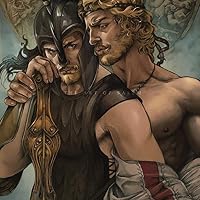
One more small note: it’s too bad that we don’t see covers like this one anymore. There’s just something real cool about seeing characters in their story-important duds posed around each other in a way that becomes more and more meaningful as I read that goes a long way for me. Every time I looked at the cover, even while in the midst of the slower parts in the novel, I felt my excitement to read about Max and Cassandra’s quest to restore balance to The Lands renewed.
Originally I bought this book because I thought it was part of Malan's Dhulyn and Parno series (though I'm not sure what convinced me of that), but found out pretty quickly it was its own stand alone fantasy. This is almost my dream come true set-up, but the problem is that its a set-up I've seen quite often in the last decade in young adult fiction. The 'hidden faerie royalty' plot has been beaten to death it sometimes feels like.
In all honesty I enjoyed the human-Max better than later as he regained his memories of being the Guardian Prince, Dawntreader. Its not that he changed for the worse personality-wise, but more I couldn't connect with him as much. Cassandra was hot and cold for me, but a lot of that had to do with a past history with Max that isn't fully explored. She did her job, she did it well, but she resented it a lot of the time, having wished to avoid Max as much as possible. I liked Max and Cassandra's interactions in the beginning, as he tried to convince himself she was the crazy one, she tried to convince him he needed to listen regardless and they both tried to fight their attraction.
I had trouble staying focused while reading the book, my mind kept wandering and I kept wanting to just stop reading, but once I start a book I finish it. Its not that the world wasn't interesting or I wasn't interested in the final battle between the Basilisk Prince (the bad guy) and Max, I just didn't have enough interest. The characters didn't feel real to me, so I didn't feel the suspense or shock that the author was trying to convey at times.
I much prefer the Dhulyn and Parno series by Malan. As a first novel I think this had a lot of potential, but fell flat where the characters were concerned, so that kept this from being a book I could really enjoy.
Max Ravenhill is a history professor who discovers that he may have had past lives. When he sees Cassandra accross a room he is drawn to her but he doesn't realize that he has been in love with this woman during many of his existences.
Cassandra saves him from an attack by the Hound (The Hunt) when she kills it. As she looks for the other guardians (two) she finds that only she is protecting Max. At this point she tells Max that he is the Guardian Prince in a place he has no idea exists. With his life in danger, she convinces him to return to the land where he was born and grew up. The tale spirals out from there, is fast moving and exciting. I found this a remarkable read with a well developed plot.
The author created a world with interesting characters with depth. Even the personalities of secondary characters add so much to the story. I was surprised that I had not heard about this book but it's a remarkable writing. And, I was delighted to discover that there is a sequal called Shadowlands focusing on humans rather than mythical characters. This will be my next read and if it's as exciting as this read, I'll be in heaven.
I liked this. I picked it up today at a used bookstore and devoured it in one sitting. I found The Mirror Prince to be well written, with compelling characters, a tightly done plot, and an interesting world. The twist at the end made me happy. I wish there could have been a touch more world building, but I understand that more might have bogged the book down. The ending was satisfying, and I would recommend the book. 4 stars.
Totally enjoyable with fresh ideas and interesting take on the fearie world. I particularly like the dra’aj energy concept. There are a few things the story that could be explained or explored further (especially the concept of guidebeasts) but easy to ignore any of the small annoyances and just enjoy the story. I look forward to exploring more of this author.
This is an action packed fantasy set in Toronto and the faerie world. Interesting and complicated world building makes understanding what is going on challenging throughout. I guessed the ending which always annoys me. There is a sequel, but I am not sure I liked it enough to read a second book. 2020 reading challenge-a book by an Australian, Canadian, or New Zealand author (Canadian)
An excellent, well crafted story! Great characters and a satisfying end. Can’t wait to read the second story in the series, as well as other books this author has written. If you love fantasy, I would highly recommend this one.
I really enjoyed this story. The characters were fun and the story was fun. Lighthearted to a point but also some pretty good serious points.the fantasy and world building was pretty good... I would not mind getting more of this story and world.
This book lost me in the first two pages, when characters were introduced that were identified primarily by smell — hyacinth, oranges, new-mown hay — and labeled in text by the same identifying words: 'He smiled at Oranges.' I couldn't stand it. If a character walks into a room and is immediately overcome by the scent of hyacinth wafting from the guy standing in the far corner, I picture a scene where everybody ought to fall down gagging at the perfume bomb that has clearly just gone off. I don't picture a subtle introduction to the otherness of special elf senses which is, just as clearly, what the author had been going for.
I might accept a set-up like this if the point-of-view character was a shapeshifter (or a non-humanoid alien), where special senses could be a logical extension of the character's inhumanity — He's a werewolf; it follows that he has a wolf-sharp nose — but elves are not classically known for their sense of smell. As a general requirement, the author would have to do a lot of heavy lifting, background-wise, to explain to me this special sense (or perhaps more to a point, explain why this individual is strongly exuding an odor), but this is never done. The detail is handwaved. The heroine enjoys that the hero smells of vanilla, and that's about the limit to the importance of this detail.
I did read on past those two pages, but I skimmed large chunks. This is Malan's first published novel; it really showed the lack of polish from an experienced author. It felt very much like a freshman effort, where a writer is just learning how to expand an idea into a full novel. The novel's there; the writer succeeded, but only by adding in every school-taught writerly trick regardless of how it fit in the story. It's sad in that The Mirror Prince has a lot going for it. The mix of races fascinated me, and I genuinely enjoyed the focused attention on female characters, but Malan added so many flourished details that there didn't seem to be room to develop the parts that tugged on my interest. It was an ambitious novel where a more restricted story might have flowed a bit better.
Two stars. It wasn't terrible, but I'd recommend it only to passionate fans of Malan who wish to read every word she's written.
After reading the Sleeping God, my mother picked this book up and I of course read it immediately. It is not in the Dhulyn and Parno universe, but rather set up in our current one, only Earth is accessible via a portal, called the Shadowlands, and in the end, not that important (take that, earthling egos!). In a way, not having a new universe is appealing, it gives you reference points so that you always know what's going on, though of course the new concepts still need to be explained. The main character was almost too perfect, even though they tell you he's made bad decisions, that who he used to be was not perfect and partially caused this "ending" that is occurring. However, it's still relatively straightforward, and nothing to upset anyone as opposed to books I enjoy where people you love are offed or given unpleasant endings of various types. We all like the bad guys to get their comeuppance, it's just sometimes it's a little too pat. In this book she does it well enough to make me wish for a followup, and I'm looking forwards to the next Dhulyn and Parno (which I'm already reading).
I had a couple of problems with this book. Of course Max has been someone important in all his previous incarnations. He was Sir Francis Bacon and friends with Shakespeare, adviser to kings. That kind of thing gets old. Why, when someone has lived multiple lifetimes, especially if they have no knowledge of other lifetimes, are they always someone really important. Was he never just a random peasant? I guess I can see why his Wardens would want him higher class, though you'd think anonymity would be good, too, since he can't be killed (and doesn't age?). Can they implant false memories in the minds of others, too? How else to explain that to those kings and queens he was advising. How did Max not notice?
I also found the names really irritating. For some reason it was harder to keep track of people when the names were two or three words long.
The plot itself was typical fantasy fare with no new twists or innovations.
The idea that our world is a mirror to a world of fantasy is not an uncommon one, yet this is touched on in a refreshing manner through the character of Max Ravenhill. Yet that is not the character that I would bring to life. Cassandra, whew, now she is a different story. The reading of her character makes me feel dirty and a bit creepy because if she were real, she'd be hot. The story is not a classic fantasy shifting from our world to theirs, its a German blitz,(a good one) into a world caught so far in turmoil and strife the only way to approach it is head on with plenty of dazzle. I have to admit many reader will put it down for the premise is not a very common one and most fantasy readers will find the flow wanting of a traditional jump on the dragon and go but those that can handle it, the novel is well worth the seven dollars I bought it for.
I moved through this one pretty quickly once I got started. It's nice to read a fantasy novel without the expectation that it's going to be a trilogy (or more) and it did end on a solid note. The characters were interesting enough, and it was a great bad guy. However, there were lots of unanswered questions; it didn't seem like they were unanswered deliberately, but more that the author sort of forgot to tie up those threads (particularly things that happened earlier in the book). Also, the usage of made-up words for certain terms got a little old and seemed unnecessary--if it's armor, just call it armor, even if it is magical in your world.
It's been a while since I read this book, but I remember it as being a pleasant read, although it seemed to have a strong Mary Sue element in one of the female characters who seemed to be in there to represent a "normal" love interest. I wasn't buying it. There is probably a 2nd novel to wrap up the story, as this seemed to kind of cut off at the ending, but it never showed up that I recognized on the Sci Fi book club, and I guess I just didn't care enough to find it.
If this sounds kind of tepid...well, I guess that's my feeling about the story.
I've never seen/heard of this book outside of the internet, so I can see why I never read it before. Also, if I'd seen the cover first, I probably would have stayed away. Luckily, I started reading before I looked at the cover (yay ebooks). Anyway, this was pretty much standard fantasy, though with some Celt-y angles. I guessed the ending early, which was slightly disappointing and the middle was a bit slow but overall it was pretty good book.
Mmm. This was actually a fairly entertaining book, with some interesting development of "standard" fantasy themes, that suffurs tremendously from somewhat ambiguous point-of-view (it seems to bounce around a lot, even occaisionally within a scene, inhibiting my ability to immerse) and a profusion of vocabulary, all of it either Capitalized or italicized (with apostrophes for good measure).
Basically, it's a solid tale somewhat obscured by the method of telling.
The Mirror Prince starts a little slow as the characters are not immediately compelling but as the story progresses your grow attached to the characters and that's when the book starts to gain momentum. The story is fast-paced and has a couple of interesting concepts but never really flourishes with imagination. The prose is solid and the characters both well-defined and authentic. I found it an enjoyable read with very little to really fault it for.
Boy was this a slow start!!!!! first of the names of the characters are all terrible, for example things like "Sword of Truth" Blood on the Snow" "Twilight Under the Moon" so it was difficult to keep track of the characters. its was a super slow start for days i just didn't want o read it. but once it picked up it was pretty good. I like the twist with the "hounds" being corrupted riders and all that was cool and i want to see that explored more.
This entire review has been hidden because of spoilers.
This book reminds me why I love standalone fantasy. Malan’s Lands were fully developed and populated with rich characters, and the story was action-packed with a little bit of romance. While some of the story may have been used by other writers in the past, Malan used them in new ways, making the old seem fresh. A wonderful piece of fantasy.
This was one of those, pick up at the cheap place. Not that that means a book isn't any good. I've seen BNAs in the same spot. But you don't truly know what you are getting.
This was well written and quite compelling. A sort of Hamilton without the lurid sex scenes so much better for it. I'd definitely read more of hers.
I liked many things about this book: the world she created, the main characters, the unique use of our own world as a reference point. I was a little disappointed by the ending. It felt rushed and under-developed. The importance of many of the events was never explored. As a result, we missed an opportunity to learn a bit more about those events and what they meant to the characters.
I wanted to give Mirror Prince 4 stars, but I am not a fan of books with multiple POVs, and the names added to the confusion (the names may just be confusing to my aging brain). I enjoyed the book enough to want to read Shadowlands, but I do not like this story as much as Malan's other series. Malan introduces several intriguing points, but skips over them without further development.