The Wump World was a small world, very much smaller than our world. There were no great oceans, lofty mountains, giant forests, or broad sandy deserts. The Wump World was mostly grassy meadows and clumps of leafy green trees with a few winding rivers and lakes. But the Wump World was just perfect for the Wumps. They had no enemies and no worries and always had plenty of tender grass to eat and a bumbershoot tree or two for shelter from the dew. They lived a simple contented life. Then suddenly, smash bang from outer space zoomed a myriad of huge iron and steel monsters. Puffing fire and spitting smoke, they swooped down to land. Metal legs sprang from their bulging sides, doors flew open, and ramps shot to the ground. Down the ramps came hordes of tiny strange busy creatures. These were the people from the planet Pollutus. The Wump World would never be the same again. Bill Peet, through his uniquely humorous pictures and words, here tells a deceptively straightforward story about the lovely Wump creatures and how they became victims of persons and events beyond their control. The message is a simple one that will appeal to young and old alike for each of us to share to some extent the problems of the Wumps.
Bill Peet was an American children's book illustrator and a story writer for Disney Studios. He joined Disney in 1937 and worked on The Jungle Book, Song of the South, Cinderella, One Hundred and One Dalmatians, The Sword in the Stone, Goliath II, Sleeping Beauty, Peter Pan, Alice in Wonderland, Dumbo, Pinocchio, Fantasia, The Three Caballeros, Snow White and the Seven Dwarfs, and other stories.
After successes developing short stories for Disney, Peet had his first book published, Hubert's Hair Raising Adventure.
The happy little wumps - cute, capybara-like creatures - are the only inhabitants of a lush green planet, brimming with rivers, lakes, edible grasses, and bumbershoot trees.
So, of course, someone MUST come along and ruin everything.
Strange blue creatures called Pollutians arrive, and the wumps are driven underground as their home is soon destroyed by giant machinery, freeways, and skyscrapers. Before long, the planet is so befouled, the Pollutians leave on spaceships to wreck another world.
There is no Lorax in Peet's bittersweet cautionary tale, and it's pretty clear which species the Pollutians are supposed to be. Rather than try to fix the planet we're destroying, some of us are talking about starting over on another one.
Much like the 1970s, this is a strange book. It’s heavy on the moral too. This is a great story around Earth day or anytime to remember the good Earth.
Wump World is a small world with only rivers, trees, lakes and grasses. The only creatures are happy little Wumps. One day the world is invaded by the blue peoples from Pollutus. They had to leave their world and find another. They come in and ruin this world with buildings and smog and concrete. All the grasses and trees are torn down. It’s a heavy handed allegory.
I believe our environment is important, but the Lorax is a much better tale about this, yet it’s good to have more than one. The wumps do find one patch of trees and grass left and they know eventually the skies will clear and the buildings will fall and they are happy once the people of Pollutus move on to another world.
I didn’t really find this story fun. It was quite a downer really and I didn’t feel the ending was that uplifting either.
The nephew read this and he didn’t react much too it. He thought the people of Pollutus were gross and nasty and he didn’t like them. We aren’t supposed to. The wumps were cute for him. He thought the ending kind of sucked - his words. He gave this 2 stars
So I've had this book since forever. I remember really enjoying it as a child and it still holds its old charm for me as an adult.
For those not in the know, this is a wump (or more specifically, several wumps):
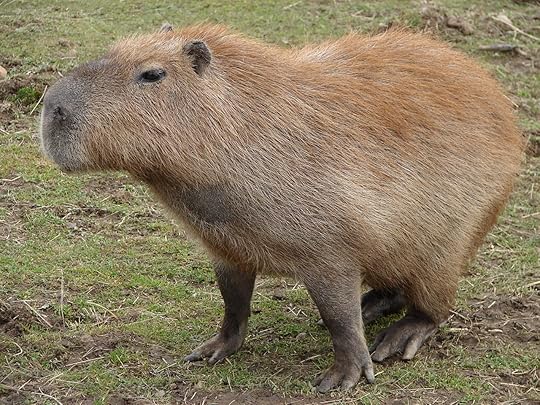
They are likely the reason I find Capybaras awesome. For those ignorant of these fair beasts, here is a picture of one:
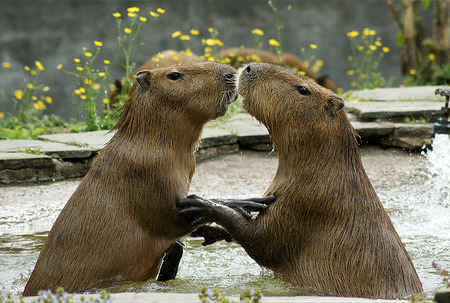
Here is a picture of a family of them:
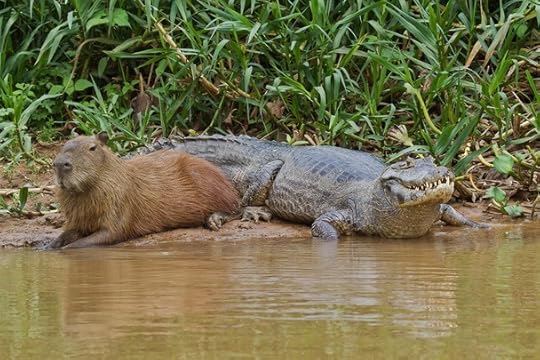
And here is one with a caiman:
OK, maybe I am just using this review as an excuse to post Capybara pictures, but the resemblance is striking.
Anyway, since this site is called GoodReads and not GoodLargeRodents, suppose I should talk about the book.
It is a very straight forward environmental parable about the perils of resource exploitation and non-sustainable economic growth wrapped up in a Manichean conflict between nature and industry with our poor wumps stuck in between.
The villains of this morality play are the aptly named "Pollutians", refuges from a previous planet they spoiled. Having learned nothing from their previous lifestyle they continue their non-sustainable way of life, driving the poor wumps underground. The Pollutians use up the planet's resources, foul its environment, and generally make a mess of things. However, instead enacting policies and changes to their way of life, the Pollutians instead send out scouts to find a new planet. The Pollutians leave when they find such a planet, letting the wumps reclaim their broken planet. Since this is a children's book it naturally turns out alright as nature finds a way to overcome the Pollutians damage and the wumps return to their idyllic lifestyle.
On the surface this is a good lesson to teach children: respect the environment and don't pollute. I certainly would want these values instilled in the next generation. However, the wumps in this book are very passive. They cannot and do not resist the Pollutians, fleeing to underground caverns. If the Pollutians never left they would still be down there, living out their dark and meager existence. A better lesson for children is to be proactive in dealing with problems and not hide underground waiting for the solution to happen on its own.
Further, the ending also teaches a level of passivity. The Wump World is able to naturally repair the damage caused by the Pollutians. But this is not always the case in the real world. Environments have been permanently damaged by pollution and resource exploitation. Waiting around for nature to fix it or for the industries that damaged the environment to leave the planet are not reasonable responses to real world problems. Extractive industries won't pick up and leave the planet, they will pick up and move to a different part of the planet. Without environmental protections we could very well end up like the Pollutians of Wump World, but without the benefit of interstellar travel.
So by all means read this book to your children, but be sure to stress the importance of a being proactive in solving problems.
OK, that is kind of a bummer to end on. How about more Capybara pictures!!!!!
(SPOILERS) I really liked some things about this book, and I had a few issues with other aspects. It tells the story of the gentle (and adorable!) Wumps, the only creatures to inhabit a small and grassy planet, and the Pollutians (from the planet Pollutus) who come to take over (their arrival looks like something out of "Avatar"!!!) turning the green world into a concrete jungle and polluted mess. The poor little Wumps have to hide in caves underground for many years--until the Pollutians destroy the planet so much they flee to find another planet to destroy--ahem, call home.
I'm giving the book four stars as it was written in 1970--I'm guessing it was a lot more "revolutionary" in terms of content back then and also didn't have quite as much competition in the environmental picture book category. The illustrations are great--I love the darling Wumps and the destruction by the Pollutians is absolutely disgusting. And it's written well style-wise.
BUT...
It is SO heavy-handed in terms of message!!! I mean, Pollutians from the planet Pollutus... not hard to figure out what they'd be like, huh? Also, some might argue that they never even SEE the Wumps, so maybe they don't know they are messing up the homeland of another species--though surely the destruction of the plant life is something they ought to have noticed. I was not a fan of the ending of the book--the Pollutians just up and leave the planet when they find another one that they haven't messed up. Didn't they learn ANYTHING!? Have they no RESPONSIBILITY!? I much prefer the stories that show some sort of positive outcome to the pollution etc going on in the world--one of the reasons I love the movie "Wall-e" so much is that the humans have to wake up and take responsibility in the end. Of course, this could be a great springboard for discussion with kids: What if there HADN'T been another planet for the Pollutians to run to? Should they have abandoned their mess? Was it okay for them to move to the Wump planet (given that they thought no on else lived there)? How might they have been more caring of the land?
Even with my gripes, kudos to Bill Peet for creating the adorable Wumps and crafting an environmental tale that is still thought-provoking almost forty years later. Sad to see that the tale is still as relevant today as it was back then!!!
This is a very 1970 book. The first Earth Day was in the spring of 1970, and I was mostly involved in it because that was the semester I was editor of the school paper and we covered it extensively. I don’t remember this book though.
The wumps are probably the cutest fictional creatures I ever did see. I love the illustrations of them: their expressions, movements, their young riding on the backs of the adults; they’re just so lovable and adorable.
The wump world is a bucolic place and then it’s invaded by polluting monsters (who look an awful lot like human beings) who build it up with buildings and freeways and get rid of most of the natural world the wumps cherish and need for their sustenance. The story is a very heavy handed message but it’s a good one, and I suppose it was slightly forward thinking in 1970 when this was first published.
It has a bit of a bittersweet ending, and it’s definitely a cautionary tale, and sobering because it conveys that while some damage can be reversed, the world will never be the same, yet hopeful at some level too.
I recently read How Droofus the Dragon Lost His Head by this author and I really enjoyed it. I can tell from these two books and their themes, that I’m interested in reading some other books by this author.
I think that I probably read Bill Peet's picture book The Wump World about ten years or so ago (for a group read on environmental and ecological picture books in the Children's Literature Group on Goodreads). And yes indeed, I do unfortunately have to admit that I while I certainly very much do appreciate the for 1970 very early and also very heavy-duty environmental protection message which both Peet's text and his accompanying artwork represent, I also have some rather major personal reading reservations with regard to The Wump World and especially so considering that this is a picture book primarily geared towards younger children. Because really, The Wump World's message is so heavily negative (and so totally and absolutely, so utterly nature versus development) that in my own and humble opinion, Bill Peet does not really even give his young readers (or his young listeners) the opportunity to consider a suitable equilibrium between an entirely natural world and industry, so that the only resulting considerations are either total and frustrated cynicism and depression or the viewpoint that since the world is doomed anyhow, we might as well simply go all out with technology, pollution and such. For yes, and from where I am standing, a much more intelligent and equally a much more suitable as well as reality based ending for the Wump World would be for the Pollutians and the Wumps to have been working together to create an acceptable and workable balance between development and leaving things natural, because I for one do find both illustrations and narrative in The Wump World much too one-sided at best.
And indeed and truly, if I am to be brutally honest, I also am tending to consider Bill Peet himself to be rather extremist and reactionary and would certainly and definitely much rather have it that The Wump World also presented a few possible ideas sensible solutions that are mot simply the standard but not all that workable and realistic concept of nature being good and all development being somehow totally bad. Since for us, since for the earth and for everyone, including children, that kind of a message actually will (in my opinion) both render readers majorly saddened and perhaps also cause them to not even consider environmental protection and conservation as something that is achievable and feasible (and something that can and should actually be balanced and stabilized with and by our need and our requirement for industry, technology, medical advances, agriculture and so on and so on).
When humans destroy everything they touch in the name of development.
*I love the peaceful Wumps so much! Puny human beings, stop disregarding and disrespecting the other living beings and yes, do something to survive longer if at all you are worried. Yes, I am worried. How easily we destroy the green Earth and look to shift somewhere else as the solution. Well, it's not the solution but giving ourselves more problems.
“The Wump World” is an inspiring environmental story from the great mind of Bill Peet and it is about how the Wumps’ world changes when a race called the Pollutians come onto the Wump world and start polluting the world. “The Wump World” is a truly effective tale that really delivers the message of the dangers of pollution in a creative and dramatic way.
Bill Peet has done a magnificent job at bringing the message of the consequences of polluting as the Wump World becomes so polluted that no life can really live on the planet. Many children will understand the negative effects of pollution as the book does a great job at describing the terrible effects that pollution caused on the Wump World. Bill Peet’s illustrations are beautiful and effective as the illustrations of the wumps are creative as the wumps look like half moose and half elephant creatures and there are more creative images in this book as the Pollutians look like little blue people. The images that stood out the most in this book are the images of the pollution that the Pollutians have brought to the Wump World as the sky and the world looks so dark and dreary, which effectively brings out the message of the dangers of pollution in an effective way.
Parents should know that the Pollutians do not seem to learn their lesson as they seem more intent on finding another planet to live on rather then just fixing up the mess they have caused. Parents should tell their children that pollution is bad for the environment and that if they caused a mess, they have to clean up after themselves.
“The Wump World” is a heartwarming tale about the importance of respecting the environment that children will learn greatly from I would recommend this book to children ages five and up since the length of the book might bore smaller children.
I read a lot of Bill Peet books as a child. I know I did. But The Wump World is the only one I remember with any sort of clarity. It's a modern-day classic, just as important today as it was when it was published almost 50 years ago.
The Wumps are capybara-like creatures who live on a lush planet. They have no enemies, so they live a pretty idyllic life munching on grass and raising their families. Until... one day, a race of beings called the Pollutians arrives in their spaceships. The Wumps, understandably frightened, take shelter in an underground cave while the Pollutians begin to transform the planet to suit their own taste. They tear down the trees and tear up the grass, pave over everything, build skyscrapers, create a system of roads and freeways (and proceed to clog them with traffic), belch pollution into the sky, and dump waste into the rivers and lakes. Soon, the Pollutians are grumbling and grousing about the mess they've made, and rather than mend their ways, they simply find a new planet and abandon their mess. The Wumps emerge from their cave, find some untouched land, and resume their lives. The book ends on a hopeful but bittersweet note as the planet begins to heal itself from the Pollutians' assault.
There are so many warnings and messages one might take from this. I've seen some reviewers say that the message hits the reader over the head and isn't subtle enough. To that, I say, "So what?" It's almost 50 years later, and we still haven't gotten the message. Even worse, we're poised on the edge of the ability to travel to other worlds. Will we one day become the Pollutians, wrecking the planets of other creatures because we never bothered to learn respect for nature and lives other than our own?
This is a wonderful environmental-message book that's stood up well over the decades. Kids today might be more receptive to its message. More receptive than the older generations were, judging by how little things have changed when it comes to us making a mess of our home.
An exceptional expose of human corruption, the insidiousness of conglomerate, money-hungry corporations, and a chilling foreshadowing of horrors to come if something is not done to save our planet. Like The Lorax, but better. Highly recommend.
Readers who found Dr. Seuss' The Lorax too simplistic a denunciation of pollution (and the causes thereof) will undoubtedly be appalled at Bill Peet's The Wump World, an environmentally-themed picture-book first published in 1970, in which an idyllic world inhabited by peaceful quadrupeds known as (what else?) Wumps, is invaded by the evil Pollutians! Soon, the grassy planet has been paved over, cities have risen, the skies are clogged with smoke, and the once-happy Wumps live in miserable exile beneath the surface of their own world. Can things ever be set to rights...?
The answer to that, of course, is yes and no - and that's about the only example of "nuance" in the story. Released the year before The Lorax, this book was definitely a trail-blazer, one of the first children's storybooks to address the issues of pollution and environmental degradation. The story itself is engaging, with classic good guys (gentle Wumps) and bad guys (expansionist Pollutians), and adorable artwork. I found it entertaining enough that I will be seeking out more of Bill Peete's work.
But although The Wump World does a good job of raising awareness about the damage done by pollution (and interplanetary colonization, one presumes) it really does nothing to increase its readers' understanding of that pollution - what causes it, and how to fight it. Many of the pressing environmental problems facing us today have little to do with evil outsiders, and everything to do with bad habits, and unhealthy social and economic structures. With close to half of the human population now living in urban environments, Peet's evident distaste for cities didn't seem very constructive to me. It may be unfair, but I couldn't help comparing this with Pete Brown's excellent The Curious Garden, which chronicles the ways in which a city landscape is improved by gardens.
Still, despite these criticisms, I enjoyed the story, loved the illustrations, and respect Peet's role as a picture-book pioneer. The Wump World is still relevant, and still has a place on the contemporary children's shelf. Just make sure you also have books like The Curious Garden.
Honestly, of all the books I read throughout my childhood, this one stuck with me the most and I think about it fairly regularly. I without question credit this and The Lorax for turning me into an environmentalist before I even knew what that meant.
As far as children's books about environmentalism go, this outstrips the Lorax by a mile in terms of charm. The problem aliens are much funnier-looking, for starters. And more to the point, who wouldn't feel sorry for cuddly little Wumps? Evidently modeled after capybaras, they're plump little fluffballs of placid cuteness - one of my favorite species in the Peet menagerie.
I have been scouring the internet for this man’s name and books for YEARS and after so long I finally found him! I love Bill Peet’s books so much and I am so elated to be able to know them by name again 🥲
I’m starting the new year off with 6 Bill Peet children’s books from the ‘70s. These will all be donated to Bridge City Elementary School
Putting aside today’s political scam on “climate change” to coerce a move towards a one world government, this book actually does show the truth about humans and our destructive ways here on earth…except this takes place on Wump World.
The author should have devoted more than one page about the cute little Wumps and their carefree life before the Pollutians from Pollutus came and destroyed everything so kids can connect and really feel sorry for them. Otherwise, a good little story.
I bought this book at The Strand. The first time I read this, I was in elementary school, and my teacher was reading it aloud to the class. I'm not sure if this is the first time I'm rereading it since then, but it might be.
This book left quite an impression on me when I was a youngster. I was very into animals and environmentalism. Upon rereading it now, especially after reading other great children's books, I'm not sure it quite lived up to my memory of it, but I think it still deserves my esteem for the life it's had in my mind all these years.
I guess the main issue I have with this book is that I'm not quite sure what the message is. It seems to me that the strongest takeaway is that nature bounces back if we leave it alone, but is that really the message we want to be expressing? That's not the message I got as a kid, though, and that's probably the most important.
When I was a child, I read the heck out of Bill Peet's library of books. His stories were entertaining, sometimes thought provoking (especially to a child), and the artwork was detailed and fun without being overly trite. This is the book that stands out to me the most.
The story of the Wumps is a timeless morality tale, that is as relevant as it was when the book was written, as it is today.
My mother was an elementary school teacher before she retired and still retains much of her class library. Everytime I go visit them I sneak out to the garage and run through the well-worn pages to revisit the Wump World.
As soon as I saw the cover, I knew I had to read it. And then I saw the publication date (1970) and I got even more excited. Opened the book and saw rocket ships... not quite what I expected for a book with a bunch of fuzzy rodents on the cover.
The message is obvious: humans are destroying the planet. Sadly, even more so now than 45 years ago. Some of the illustrations are a little ugly by today's standards, but this book would be a good way into a conversation with your elementary schooler about climate change or imperialism. And the Wumps' adorableness stand the test of time.
The message is similar to that of Seuss' Lorax, but this is more straightforward and a faster read. Every child will feel sad for the wumps and be angry with the Pollutians. ... And I bet that this book angers every non-environmentalist. Surely it's been nominated for a banned book list somewhere.
Re: 3-star rating
The message and the art are definitely worthy of 4 or 5 stars, but the story is so sad that it isn't a book I enjoy reading.
Nice little book! Kinda depressing of course. Wumps are overpowered by a polluting civilization that destroys their environment and moves on. A little hope is left for the Wumps at the end. They had not fought at all but just waited out the invaders. I'm considering the implications for our society. Interesting. Need to save the Rain Forest from the Braizilians!
This is the story of these little creatures living on Wump World, full of green and beautiful land, that is until they get an unwanted visit from the Pollutians, coming from another planet. The Pollutians end up taking over some of their land, turning it into a concrete jungle but the little creatures end up finding one last piece of land and make it their best and start from the bottom up, all over again.
At first the little creatures are afraid but towards the end of the book, they make the best of what they have left. The setting takes place in Wump World and what is left of it towards the end. A theme in this book is go green, it really shows children what happens when land that is nothing but green gets polluted. This is a book that kids in elementary school can read and they would enjoy it, as for the illustrations as well. I really liked this book because it's symbolizing what happens to our world and that we too should make the best of what we have left and help out our mother earth.
We borrowed this book from our local library as part of a kit with an audiocassette. We listened to the story in the car while our girls followed along with the book. I read the story myself later to catch the effect of the illustrations. The story reminded us strongly of The Lorax and has a hit-you-on-the-head environmental message. Overall, it's an entertaining and cautionary story and we all enjoyed it.
This colorful book provides an approachable introduction to the interrelated problems of resource consumption, environmental degradation, and pollution. A friend of mine dropped it in my lap after we had finished watching "The Cove" and started talking about sustainability and respect for nature, and I think it does an admirable job of sketching out the bigger picture with broad strokes. The resolution is rather abrupt, which risks misleading readers about the intensity of the analogous problems implied by the book.
Awww. This book is just wonderful. I love the illustrations. And the text is just right. Nothing "off" about the writing here. I also love the bittersweet ending. I don't remember reading this as a kid, but I think I would have loved it.
I loved this book when I read it in 2nd grade and it clearly stuck in my head this long. A critique of pollution and maybe even an unexpected critique of colonialism, this was a formative book for me in my early years.
4.5 stars. Led to a good discussion with my 4 year old son about how we treat our planet, and how not to be like the Pollutians. Very strong environmental message that definitely resonated with us.
This book is a social commentary on humans polluting and not taking care of the earth. The book tells the story from the perspective of the Wumps who's planet gets taken over by humans and get destroyed. The Womps are devastated because their once beautiful planet is completely ruined and there is nothing they can do about it. I think that the book shows the effect that humans negatively have on the environment is a very productive way for children.
"There was more and more noise and more of everything. More buildings with more smokestacks puffing more and more smoke. More freeways with more traffic shooting out moi’e and more clouds of exhaust. More trash and more trash piles, with more and more waste gushing into the rivers and lakes." In a far off alien planet, an adorable species called the Wumps lived in peace until one day when a species called Pollutians fly in and take over. They force the Wumps to live underground as they begin to build their city and pollute the world. The Wump World addresses the issues of unnatural pollution and long term effects of environmental damage in the form of a child's book. Sharing an extremely similar premise to the famous Dr. Seuss story The Lorax, The Wump World actually was released a year prior. It parallel's human society with the pollutian race, who end up traveling from planet to planet abandoning the last after it gets too polluted. While the book has a very serious undertone, I find that it presents the information in an easily digestible fashion for children. I really like that the book ends on a somewhat somber note, despite being hopeful and positive. Some of my favorite morale's in stories are the ones that aren't happy go lucky solutions to problems, but are simply the truths that we have to acknowledge and understand. The Wump World has this same premise for a morale, where it shows part of the world is ruined from pollution that nobody wanted to take credit for, but thankfully there's still some clean world left. I give The Wump World a 5 out of 5. I don't want to rate this book simply by how well it compares to The Lorax, but I feel both try to convey the same general idea, and The Wump World does a slightly better job at it. The book summarizes the environmental dilemma without making clear ties to reality and setting out to be educational. Additionally, it utilizes illustrations well and keeps a good narrative pace from beginning to end despite being slightly wordier than most picture books.
This is one of those books that you can make together as a package along with the Lorax for the type of message that it will tell. Although in the case of the Lorax where the land was looked at for being destroyed by industrialism, this book takes a look at what happens when the whole focus is to use a land long enough until you cannot stand to use it any more since of all the destructive that you have done to it while at the same time the results that may occur on the original inhabitants.
For many who have heard of capybaras they will find that the titular Wumps actually look like them and I wonder if the concept for the Wumps came from Capyboppy who was a young capybara raised by the Peets. As a result of this species creation, Peet goes out of the way to make them stay looking more animal-like rather than having the deeply expressive faces that his animal characters usually take on.
All in all although the book can be a bit preachy it does allow the reader to face some questions that seems to still relate to us even though it has been a while since the printing of the books. As a result this would be a good start to open up what it means we should do to fix the world around us, whether finding newer resources is an actual answer, to see how we influence those around us whether we take note of their existence or not, and so much more.