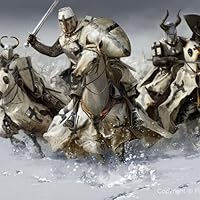
Quelques années après la conquête de Jérusalem par les chrétiens, en 1118, des chevaliers francs décident de consacrer leur vie à la défense des pèlerins en Terre sainte. Moines-chevaliers en Orient, les Templiers vont participer activement à la croisade. Moines-agriculteurs en Occident, ils cultivent la terre. Architectes, ils fondent dans toute l'Europe des commanderies. Banquiers, ils sont les financiers des grands et ce rôle va précipiter leur chute. Le 13 octobre 1307, Philippe le Bel, jaloux de leur autorité, les fait tous arrêter. À l'issue d'un long procès, ils seront jugés, condamnés et brûlés. Régine Pernoud retrace l'histoire de ces hommes exceptionnels, dont le plus grand peché fut sans doute d'orgueil.
Régine Pernoud (17 June 1909 in Château-Chinon, Nièvre - 22 April 1998 in Paris) was a historian and medievalist. She received an award from the Académie française. She is known for writing extensively about Joan of Arc.
I find there are some historical events that I hold a grudge over. The fall of Constantinople, I'll probably never forgive the Turks for that (though, for some weird reason, I don't have the same animosity towards Venice for the Fourth Crusade). Or the expulsion of the Moors and Jews from Spain, though I'm more lenient there since Spain has invited Sephardi Jews to have Spanish citizenship (or so says wikipedia at least, so says Wikipedia ).
Anyhow, the arrest of the Templars is one of those (France, this is why I'm suspicious of everything you do. Well, this, the Revolution, Napoleon and the Dreyfus affair.) And then the Templars got hijacked by every half wit who wanted to claim they had 'secret knowledge' for the next 700 years.
Anyway, I'm slightly drunk so suffice to say that I enjoyed this book for taking a step back and talking about the actual facts of the Templars' foundation, organization and arrest.
Though I'm still a little confused about why Phillip IV decided that the Templars had to go. I'm sure Phil would say it was because they were Mahomedan, pseudo-Cathar sodomites but I would say that he's so full of crap that it's coming out of his mouth so, yeah. From this book I think that Phillip IV basically decided that the Templars were really rich and wouldn't it be cool if they were guilty of heresy and someone burned them at the stake so the king could confiscate all their wealth. And oh wait, I'm the king, why don't I just fabricate some charges and anyone who claims they confessed only to escape torture we can just burn them alive as 'hardened sinners'. Wait, wouldn't the pope complain about the arrest and suppression of a crusading order? What? The pope is a French puppet in Avignon? Well that simplifies things!
This is another history book (in French) that I brought back from France. I struggled a bit more with this one, but finished it and added to my weak vocabulary, so basically a success, and a fun book. The French title is actually, Les Templiers: Chevaliers du Christ
Releitura antiga. Livrinho de divulgação, sério e sem pretensões, ao nível dos pequenos manuais da velha colecção "que sais-je?". Bom para quem quer informação básica sobre o tema, sem grandes aprofundamentos académicos.
Being on a history binge lately as I’ve had trouble finding good fiction to read, I’ve been reading up on some of my favorite topics from Discovery Channel and History Channel Documentaries. The biggest draw for me is the Knights Templar. The biggest drawback… it’s very hard to find good books on the Templars that don’t devolve into rambling discourses on how Dan Brown was right about everything.
And then I found this book… by accident… at my local library. It’s an English translation of a French text but both the text itself and the translation are very well written. If I hadn’t discovered later that it was a translation, I wouldn’t have known it was at all.
The Templars: Knights of Christ is a very detailed, very well sourced introductory text and basic history of the Order of the Temple, later known as the Knights Templar. Régine Pernoud takes us from the very beginnings of the order completely through to the suppression. Everything is explained meticulously, from the founding to the organization of the order to its Rule to their downfall. The author even takes the time to explain the differences between the Latin Rule and the French Rule of the Order and how that could have influenced the later situations which led to the arrests and suppression. Any quotations are sourced, both inline and in notes in the back of the text, plus the author uses many of the original source documents. This book is the best introduction to the Templars I have read so far and will be the book I use as a basis of comparison for any later histories I read. I can not recommend it more highly.
En levant soigneusement le rideau sur cette réalité, à peine transportée dans le raisonnement actuel, ce livre de Régine Pernoud nous en décrit quelques détails concrets. La vie militaire et la vie religieuse, deux occupations pas aussi incompatibles que ça. C'est dans une institution de défense que l'on traque le "démon" ou le spectre en toute laïcité, en toute légalité, et c'est dans l'activité templière qu'on flaire sciemment l'odeur de soufre.
I actually read the English version of the book, not the french, but since Facebook's visual bookshelf app is gay and didn't have it, i listed this one instead.
The Templars are conspiracy theorists’ favorite whipping boys (and that’s not to say that all conspiracy theories are wrong; many, in fact, are quite true). Accordingly, good literature on the Templars is hard to find—most being written by border-line illiterates who know that a sensational story sells a lot of books. Regine Pernoud, on the other hand, is a rigorous French Medieval historian. Even when disagreeing with her conclusions, one knows beforehand that she is sane, balanced, and level-headed and can be trusted.
Pernoud seeks to defend the Templars from 1) the original charges of sodomy and devil-worship and 2) the importance they played in Europe.
Who were the Templars? They were a monastic order of military knights who protected pilgrims in the Holy Land. As military fighters, as their Muslim opponents testify, they were some of the finest in world history. Being monks, they held to almost fanatical discipline, and knowing they would never be ransomed, they almost always fought to the death. They also became Europe’s first bankers.
The Fall of the Templars: Pernoud goes into great detail covering the arrest and trials of the Templar Order. While admitting that the Templars did have a few unsavory traitors (human nature being ubiquitous and what-not), the trial was a joke. All of the “evidence” was obtained by torture, and many of those who confessed later recanted. Philip the Fair needed the Templars destroyed to further his totalitarian designs over Europe.
More about the Trial: It’s easy for us to criticize the medievals on this point. But in many ways, the farce of the Templar trial is no worse (and in many cases, a lot better) than the legal travesty known as the International Criminal Court at the Hague. Medieval justice, as brutal and myopic as it was, is far more human than the ICC.
Good succinct overview of the history of the Order of the Temple in a slightly dated style (owing at least partly to being a translation from French). Gives attention to the Templars' origins, career in the Holy Land, logistics and bases of support in Europe, institutional finances and role in early banking, and, of course, their unjust destruction by Philip the Fair, an act of plunder which ultimately did him no good. Pernoud also has some wonderfully trenchant remarks about the esoteric and mystical hoodoo that surrounds the Templars in the modern era.
Recommended as a introductory guide to the Templars specifically or the role of the military orders more generally.
Regine Pernoud has done a extraordinary job in research on putting this short yet straight to the point book on The Knights Templars,the Real Original ones not Heretic Masons/Wanna-bee's/"FreeMason" AntiCatholic/AntiGod Dribble and not Dan Brown-type of made up intrigue and Historical Revisionism.Plain and simple The King Wanted What the Knights had that's what History shows.They tortured these Servants of Christ who always fought valiantly against the Real Infidels and protected Jerusalem,and by the way even erected a Mosque for Moslems to worship at,far from Being blood-thirsty,the first Bankers/Banking system.They were Not Heretics as history has indeed shown,they lived normal lives except for Doing Battle and being protectors of the one True Faith,I highly recommend this book to any Catholic who wants to know what really happen to these brave Knights of Christ,other Good Books: H.W.Crocker's Triumph,and "How the Catholic Church Built Western Civilization by Thomas Woods and the book God's Battalions.
Her şeyden önce bu konuya giriş niteliğinde, komplo teorilerinden ari bir kitap ve tarihi bir okuma olarak fena değil ama üzerimize yağmur gibi yağan sayısız yer ve kişi isimlerini biliyor olsak zaten bu kitapla işimiz olmazdı. Bizim gibi konunun acemilerine masal gibi kesintisiz anlatılacak bir şey lazım ve kilit isimler hariç diğer yer ve kişi adları zaten kısa olan bu kitaba girmemeli idi. Bir çok yerde kuru bilgileri MG42 gibi kafanıza sıkıyor ve bu sayede de sıkıyor. Çeviri zayıf ve özensiz. Örneğin Hospitalier şövalyelerine bazen Hospitalier, sık sık hastabakıcı, arada sırada hastane tarikatı deniyor. Ayrıca İlk baskısı 2005'de yapılmış olan bir kitap bu kadar dizgi hatasına sahip olması pek hoş değil.
O lucrare scurtă care abordează un subiect puternic mistificat pe parcursul istoriei, dezlipind straturile fantastice pentru a povesti pe înțelesul tuturor formarea ordinului Templului, modul în care era organizată ierarhia Templierilor și tragicul sfârșit al “Ordinului Cavalerilor Sărmani ai lui Hristos” printr-o arestare masivă și o acuzare nefondată a membrilor ordinului de cele mai oribile crime împotriva propriilor valori. 4/5
I know templars have become way too “pop culture” in the latest decades, but I share that appeal with many. This book is useful for going deeper than general knowledge, for trying to understand who they were, historically, socially and symbolically. A good read, it’s deep enough to teach everybody something about the subject, yet not too vast to turn it into an academic work that few of us have time to invest in.
Libretto molto stringato ma davvero completo che descrive le caratteristiche dell'Ordine del Tempio, dalla nascita, all'organizzazione, alle loro opere architettoniche fino alla tragica fine. Soprattutto è un'opera scritta da una medievalista accreditata, ed è pertanto priva di tutte le sciocchezze che sono state raccontate sul conto dei Templari nel corso dei secoli.
A concise and fair history of the templars. The author is not a dull historian who just gives dates and numbers but relates some of the phenomenal episodes of the templars as well. Although there are not many stories of individual knights and battles the book gives a very good overview of the daily life of a knight and how the order worked.
I have loved the Templars ever since reading Crusader King by Susan Peek in the fourth grade. This book was informative and straightforward, trying not to approach the topic with the usual fanciful theories. It was quite dry which partly could have been due to the translation.
Interesting introduction to the history of the Templars. So many conspiracy theories and mysteries surrounding this order. Crazy to think how the lies of a power-hungry king led to their downfall.
Quelques années après la conquête de Jérusalem par les chrétiens, en 1118, des chevaliers francs décident de consacrer leur vie à la défense des pèlerins en Terre sainte.
Moines-chevaliers en Orient, les Templiers vont participer activement à la croisade. Moines-agriculteurs en Occident, ils cultivent la terre.
Architectes, ils fondent dans toute l'Europe des commanderies.
Banquiers, ils sont les financiers des grands et ce rôle va précipiter leur chute.
Le 13 octobre 1307, Philippe le Bel, jaloux de leur autorité, les fait tous arrêter.
À l'issue d'un long procès, ils seront jugés, condamnés et brûlés.
Régine Pernoud retrace l'histoire de ces hommes exceptionnels, dont le plus grand péché fut sans doute d'orgueil.
Yazarın anlatım tarzı, ilköğretim okul kitabından daha sevimsiz bir hale sokmuş kitabı. Böylesine ilgi çekici bir konudan böyle tatsız bir okuma deneyimi çıkmamalıydı. Yanlı bakış açısından bahsetmiyorum bile. Ayrıca, baştan sona bu baskıyı editörün tekrar gözden geçirmesi gerektiğini düşünüyorum.
Short history one of the most famous order of knights. The inner rules, the history of Jerusalem battles and the sad story of unjust trial. Definitely worth reading as long as you want to clarify the facts about Templars and ged rid of the legends.