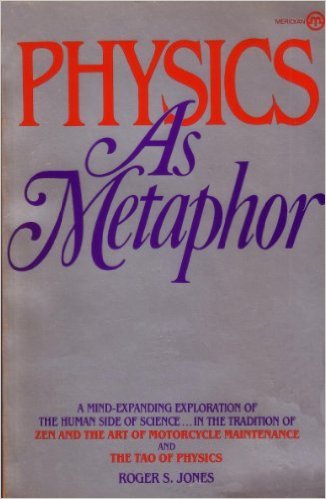
Accessible to the layman like me and yet wonderful thesis of how all scientific law and fundamentals such as time, measurement etc are themselves just metaphors. Whatever the maths proves, science still needs to turn it into language and it is here that metaphor is resorted to and thus also here where it all begins to break down because of language's imprecision. Einstein bemoaned that he couldn't explains some of his more abstruse theories because the language to explain it didn't yet exist. It still doesn't once you get into M-theory and string theory and multi-dimensionality.
“I define metaphor as an evocation of the inner connection making things: It is an act of consciousness that borders on the very creation of things, blurring the distinctions between them, even between them and their names.” 4
“The heart of our modern idolatry is quantification — the world reduced to quantities and the relationships between them, the belief that the quantitative description of things is paramount and even complete itself. Physical science persuades is to disregard, devalue, and even deny what we cannot measure, to act as though such things as love, life, optimism, wonder, and beauty do not matter much in an objective description of reality. I do not dispute the wealth of knowledge science adds to our wonder and experience. […] But I rebel at the dominance is quantitate description in our scientized lives which sustains our idol of objectivity and keeps us from initiate participation in the world.” 14
“Since there is no way to separate our knowledge is the world from our consciousness of it, changed in either world or mind must be understood as changes in both. World and mind are seemingly different, perhaps complimentary, aspects of the same thing.” 68
“The quantitativeness of physics does not guarantee an objective physical world and there is no meaningful boundary — indeed no real difference — between subjective and objective approaches to things. In all of this, I have conceived of consciousness as evolving. Reality, a projection of consciousness, must also evolve and is a timely expression of the state of the human mind and spirit. As we explored space, time, matter, and number, we saw that their purely quantitative aspect, as used in physics, is inseparable from our subjective intuitions of them. But as we saw as well that these cardinal metaphors deal with our deepest questions and fears about existence. They express our elemental needs for extension, distinction, identity, stability, endurance, variation, movement, and meaning. We know we shall not last forever, but we church at the assurance of a canonical three score and ten years of life (or, at the latest prediction from mortality tables). We fool ourselves and hang on to enough sanity to remain functioning animals through the magic of number and extension. But the world beyond our metaphors and illusions is unitary and chaotic. It is a world filled with terror of death.” 171
“We feel ourselves to be symbolic, ethereal, timeless beings, and yet we know we are creatures of flesh and matter, subject to decay and death. We struggle heroically against this cruel paradox, creating symbolic systems in society, science, religion, the home, and the mind to reinforce ourselves and give us meaning. These vital lies provide a screen against despair and the awesome horror of a meaningless life and death, but they also prevent us from facing truth squarely. Our life struggles are secondhand and illusory.” 175
“Life without illusions is not possible, not even meaningful. What matters is to become more conscious of our myths and metaphors, to recognize that they are the only reality we have, and to learn how we participate in creating them.” 183
The book is subpar. Maybe because I have read many of the books Jones cites or the background I have in math and physics, I found the book rather superficial, especially over the front half. The Cosmic Egg and Alan Watts' works among others do a much better job highlighting the subjective nature of science. If anything the book serves as a decent bibliography.
The basic premise of the book is very simple, and completely messes up our modern notion of "Science."
Simply put: The notion that space and time and dimensions and matter exist outside of our consciousness, and that we have an ability to put numbers on discrete objects, will inevitably lead to logical paradox.
Individual objects are only 'individual' because we have decided to define them in a way that ignores the fact that we can never completely define a nice, crisp edge between one object and another. Or between any object and the air that surrounds it. At the atomic level, the object is evaporating into the air, and the air is penetrating the 'solid' object. While remembering that an 'atom' is a mental construct, and that nobody has ever seen one. (Yes, I know there are graphic representations, but they are all heavily processed to conform to our expectations)
Of course at the everyday macro level all of that makes no difference. But if we truly want to understand what the world around us is made of, we eventually discover that the 'world around us' does not exist in any fixed way without the parcipitation of our minds. Spooky, eh?
The ancients and primitives had no problem with that, only we secular, rational moderns.
A quote: pp214-215 "We congratulate ourselves that the truth of today is so much more remarkable than the tales of the ancients. What we have may be more imaginative, but it is certainly no more true. We are pagans all."