
 Cecily’s
Comments
(group member since Dec 06, 2009)
Cecily’s
Comments
(group member since Dec 06, 2009)
Cecily’s
comments
from the Language & Grammar group.
Showing 1-20 of 175
 Ken wrote: "Yes, the "he or she" is awkward, as is the "s/he." Thus, the ascension of "their."... Though the new GOP trifecta (Prez/House/Senate) may introduce legislation to change that."
Legislation - to change what (the language those in the US use?!), and HOW?
Ellipses is the opposite of "relatively quickly", surely? It implies pause, or hesitation. Why would you omit all but the final question mark?
I'm not sure there is a way to indicate rapidity with standard punctuation, so why not do it with words, saying the person "rattled off questions" or some such phrase.
Which is why I said "likely" rather than "definitely". (Pickier!)
Also, if we're being picky, a Brit would be more likely to refer to a lorry or a van than a truck.
It doesn't sound British to me (a lifelong Brit).
Sharon wrote: "When I ordered salad in England, perhaps with a sandwich, I got a few bits of lettuce meant to go on the sandwich, I presume. It wasn't enough for anything else and it was extra cost. Imagine what a salad bar -- unlimited -- looks like to a Brit."We have salads, and salad bars here, even unlimited ones, and I can't remember a time when we didn't. Not in every eatery of course, but they're not a novelty. LOL.
If you order a sandwich in a pub or café, it will often come with a "salad garnish", but no one thinks that's the same as an actual salad!
Doug wrote: "I believe England is the main holdout for theatre which has a long established "truh" ending sound."We may spell it so it looks like a "truh" ending, but most accents in England are non-rhotic, so there's no audible "r" in it.
Sharon wrote: "I enjoy the differences in language between our two countries. Some of your words for things are charmingly different from ours. I enjoyed browsing grocery stores when we visited England."The first time I visited the US, I was amazed how many items on restaurant menus were unintelligible to us. It was a few years ago. For instance, we'd never heard of subs, let alone many other things (I forget what).
It's always refreshing to see people pointing out the differences between AmE (American English), BrE (British English) and any others, rather than asserting that only one form is right, oblivious to geography. As a Brit, I always write "theatre" and thought those in the US always wrote "theater"; I didn't know you sometimes use the other spelling.
Regarding "dialog" and "dialogue", much of the impetus comes from IT, along with "program" and "programme". In both cases, the shorter version is the norm in the software world, even in the UK, but the longer form is still the norm in other formal contexts (though I'm expect that may change.)
It's the same rule: the apostrophe goes after the noun, whatever it is. The oddity with "deer" is that the plural is the same as the singular, with no final s. Thus:
The deer's red color.
Those deer's red color.
The reader needs other clues to know whether the first refers to one deer or more.
Yes, that is correct, for the reasons you cite. (The trick is to forget what the last letter is, and just the apostrophe after the noun, whether it be singular or plural.)
Doug wrote: "None of them can be plural (toward-s)..."A word that ends in S is not necessarily a plural. All these words are prepositions, not nouns. In British English, it's common to use the -s form, but they're still just prepositions: "He ran towards his mother."
Doug wrote: "Visual (usually a verb)..."Usually a verb?!
I visual, you visual, he/she visuals?
Surely "visual" is an adjective or a noun, and the verb form is "visualise" or "visualize"?
Newengland wrote: "Hmn. We may need a primer on the difference between "British" and "English." Is the former all the isles of GB and the latter England alone?"In simplified terms, "yes".
The nation is The United Kingdom of Great Britain and Northern Ireland. So Great Britain is England, Scotland and Wales. But the Channel Islands and Isle of Man complicate matters.
If you prefer visuals:
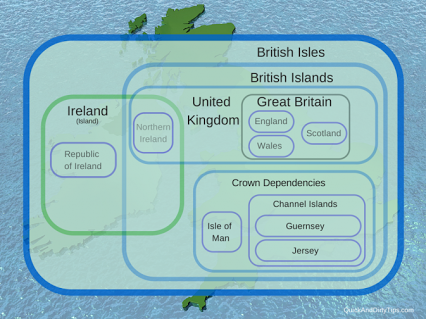 Ha! Yes, I'm oh-so-British. Or given that yesterday was St George's day, maybe I should say oh-so-English.
The example I like is by A P Herbert:
Ha! Yes, I'm oh-so-British. Or given that yesterday was St George's day, maybe I should say oh-so-English.
The example I like is by A P Herbert:“If you see a man staggering along the road you may infer that he is drunk, without saying a word; but if you say ‘Had one too many?’ you do not infer, but imply, that he is drunk.”
Related: people sometimes confuse corporal punishment (beating etc) with capital punishment (execution)!
Newengland wrote: "Comment: Weird how the Brits split their spelling between legalese and vernacular."In general, we don't. There is specialist vocabulary, as with any profession, but I think this is the only word where we use different spellings in different domains.
Stephen, Ruth is right about its/it's. When it's a contraction, it has an apostrophe, and when it's a pronoun, it doesn't.In general though, there is no real reason. Read Jane Austen with the original typography and you'll see pronouns with apostrophes, such as her's and many other differences with modern usage, such as to-day.
Grammar is as much about fashion as it is about perceived rules and logic.
Ruth wrote: "I find it's usually more useful to read any Introduction after I've finished reading the book, rather than before."It's the same with <>writing an introduction.
;)
