
 Dan’s
Comments
(group member since Mar 15, 2019)
Dan’s
Comments
(group member since Mar 15, 2019)
Dan’s
comments
from the Weird Fiction group.
Showing 1-20 of 1,611
 I have begun my read of this 376-page collection. The 16 stories are all short stories by Matt Cardin (unless otherwise noted):
An Abhorrence to All Flesh (1999) novelette
Notes of a Mad Copyist (1999)
The Basement Theater (2000)
If It Had Eyes (2002)
Judas of the Infinite (2002) novelette
Teeth (1998) novelette
The Stars Shine Without Me (2002)
Desert Places (2006) novelette
Blackbrain Dwarf (2010)
Nightmares, Imported and Domestic (2006) novelette with Mark McLaughlin
The Devil and One Lump (2010)
The God of Foulness (2002) novella
Chimeras & Grotesqueries (2010)
Prometheus Possessed (2012)
The New Pauline Corpus (2010)
A Cherished Place at the Center of His Plans (2019) novelette with Mark McLaughlin
An Abhorrence to All Flesh (1999) novelette ★★★1/2
I was concerned that in my earlier description of this collection I may have overbilled its religious nature and unnecessarily turned some people off reading it. I am glad now to see that is not the case. This story is an example of a sub-genre I would (and will) call cosmic christian horror. This is my first reading in this sub-genre, one I didn't even know existed until this meeting with Matt Cardin's work.
This is a great story to start with, which I suspect is probably a rewriting of Cardin's first story written in this genre. ISFDB notes the following about this collection, the third of Cardin's three so far: Includes the contents of the earlier collections "Divinations of the Deep" (2002) and "Dark Awakenings" (2010). According to the publisher, "several of the tales have been substantially revised from their original appearances."
Cardin's take on all this in his notes before the first story sees the Void from which the world was created as preexisting even God since God created the world from it. In all seriousness, the logic doesn't necessarily fit. Why can't God have come before the Void? But okay, it's a neat starting premise, nevertheless. Cardin derives his source of cosmic horror from the unknowability of the Void.
The story started in a fun way. The protagonist, Todd Whitman, is invited to a party by his old college buddy, Darby Cole. A staple of Darby's parties is that theological debates will ensue, therefore Todd prepares by doing some reading beforehand. But this party is different. It's small, just a handful of guests, and no elaborate debates get going, just an introduction to the other guests. One couple from among the guests is a member of an odd church called the Temple of Jehovah. They say they are a reformation of the church as it was originally intended to be. A debate ensues on what that actually means and what the role of creating flesh plays in all of it. Creating flesh can be corrupted to create horror, the kind of cosmic horror the story inevitably gets to.
I found the story and party conversation interesting enough. It was not particularly suspenseful or revelatory. Still, I am curious to see where Cardin goes from this starting basis in the subsequent stories in this collection.
With and Without Buttons (1938) by Mary Butts ★Ending an anthology with this story is not the way to leave a reader with a lasting good impression. This story was nominated in 2014 for a retro Hugo award, but fell below the cutoff number of votes needed for it to be considered. I can see why it might have been nominated. Mary Butts was primarily a poet and makes good word choices always, including in this story. However, like a poet, many of the things written about here have self-referential meaning that can't be sussed out by an objective reader coming into the story cold a century later a continent's culture away, at least not by this reader.
Two women who might have supernatural powers want to play a practical joke on a man they don't particularly like for reasons never made clear to this reader. Frankly, I don't know what the prank was or if it succeeded. I'm not even sure if by the end of the story that was any longer the point. Bored with the nonsensical meandering, I skimmed the last half and regret having given the story even that much effort.
Mary Butts wrote one novel and two in-genre short stories during her lifetime, nothing more. This might have been her weakest. Dated 1932 in papers of Mary Butts at Yale University, as "typescript carbon, corrected", it was posthumously published in Last Stories (Brendin Publishing Company, 1938). In short, she was unable to get the story published during her lifetime, probably due to its flaws. It makes me wonder what the editor of our present anthology could have possibly seen in it. Did she just like the mildly pretty word choices?
Nicolai Alexander wrote: "That's a lovely stamp! Did it cost 175 dollars? :O"No. You are probably not seriously in the market, but just in case, I will share that I found mine on eBay (search Liberia mermaid stamp) for under $10, including tax and shipping.
I ended up, to my surprise, mostly enjoying this story collection. Here is my modest review of the work: https://www.goodreads.com/review/show...
A blurb:"To Rouse Leviathan by Matt Cardin is a collection of short fiction that delves into the shadowy side of religious and spiritual experience. The stories are inspired by H.P. Lovecraft, Thomas Ligotti, and other masters of cosmic horror, exploring the existential terror we feel in a cosmos that may be hostile to our species. The collection includes a novella co-written with Mark McLaughlin and has been revised from its original appearances. Cardin's work has been praised for its theological and occult ideas grounded in real-world practices, and it has been nominated for the World Fantasy Award and long-listed for the Bram Stoker Award. The book is available in Kindle Edition and is highly recommended for those who enjoy interrogating the shadow of faith."
Because religion is more a part of this month's group read than it has been for any other so far, I felt it important to warn people of that fact up front here and in the masthead. I get it -- many people are either bored or offended (or both) by subjects that touch on the religious. If that's you, see you next month! As a churchgoing Christian, the fact this collection asks theological questions bothers me personally not in the least. On the other hand, I never look for religion directly in my fiction reading. Having browsed the Christian Fiction section of my local library let's just say the YA section looks downright edgy in comparison to the insipidity I saw. As if there were anything insipid about gnashing of teeth, lakes of fire, casting out demons, or the central act of suffering that establishes the new covenant. Matt Cardin's work looks anything but tame. So that makes me 100% in, even if I didn't nominate or vote for it. I just purchased the book via Kindle for six entire dollars. Let's begin our reading today.
Couching at the Door (1932) by Dorothy Katleen Broster ★★★An unremarkable story of a poet being haunted by a boa, or piece of fluff from it, due to certain indiscretions (unspecified) the author participated in when on a recent trip to Austria, or somewhere. The poet tries to get rid of the malevolent piece of fluff by diverting it upon some lowly illustrator. That works, but then doesn't work. The story is well enough written and is easily understood. But advance the field of literature the story does not.
One of my favorite hobbies is stamp collecting. I mention this because I came across (and just purchased) a stamp featuring mermaids where I thought the art stunning. Given the first short story in this collection, I can't resist sharing it with you all: 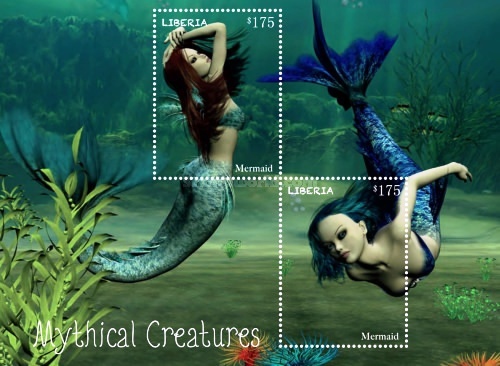 I have read the next two stories, "Far-Off Things" and "Cousin X" and like them, 3.5 and 4 stars respectively.
 The first one is a short story about a young man's love of a girl, only he keeps it to himself, never expresses it to her. I get it. I've been there. She is out of his league, or he does not know how to approach her in a way he believes she would find appealing. So rather than creep her out, risk pretty certain rejection of one form or another, he admires her from a safe distance, does whatever he can to help her, and would really miss her if she were not around anymore. I've been this guy. So I really get involved with the plot emotionally. I give the story just 3.5 stars despite loving the premise. "Far-Off Things", the title, is what the girl meant to the protagonist relationally, but it's also where the author keeps the reader. The story needs more development to reach a conclusion with an adequate point.
I really liked "Cousin X" for personal reasons as well. I know exactly how the cousin feels and why he feels that way. Crispin's characterizations are spot-on for the cousin--how does Crispin know?--except for the boy's need to figure out personally and directly how things mechanically work. That part doesn't ring true to me. Since the boy lives almost entirely in his mind, it's enough for him to be able to theoretically conceptualize how things work. But then if I remove that key plot element, we wouldn't have the same psychological horror story, would we?
This story had me on the edge of my seat throughout as I read it. It's a hard story to stomach though because there are elements of animal cruelty and suicide motifs involved. Crispin's use of these at least is not gratuitous, and is a logical, perhaps even necessary, extension of the premises the story raises. But if you're going to go there, go somewhere so painful to any normally sensitive reader, there needs to be strong justification for doing so. The point the story makes has to be worth the discomfort it causes. I tend to think Crispin failed to meet this bar. If he does, the point he wants to make eludes me.
Therefore, despite liking the story myself, and finding the content extremely interesting and identifiable with, I can't (and won't) recommend the story to a soul.
Nicolai Alexander wrote: "Or perhaps an even better place to start, in general, would be Michael Cisco's Weird Fiction: A Genre Study? It's expensive, though."I have had my eye on that as well as other books in the series for the non-fiction book we previously read. All are in that $100-150 range. I'm interested. Michael Cisco is perhaps the leading theoretical writer of New Weird. But maybe not quite $100 interested.
The Book (1930) by Margaret Irwin ★★★★I read this story in its original form from the 1930 issue of The London Mercury in which it was first published. The story does not have much action, but is interesting, nevertheless. A man takes books down to read from a home library, but notices gaps in the second shelf. These gaps are caused by a mysterious and malevolent entity that gains sway over the protagonist's mind that persuades him to at first harm people, and then escalated to getting him to kill a dog and then ordering him to kill his daughter.
I liked the suspense the story generated. Its only limitations were the relatively shallow characterizations and its lack of ultimate explanations. It's not enough for a presence to be trying to persuade the protagonist, we need to know why as well.
The Twelve Apostles (1929) by Eleanor Scott ★★★Unfortunately, I could only locate about 70% of this text. I am missing about eight pages near the beginning and perhaps the very end if it went on past "... Trayls of Slyme compassing him aboute as it were in a Nett'." Based on what I could read, this is a story of an American who while on vacation wanted to rent an English house only if it had a ghost. He found one and was soon contending with it. There was a treasure hunt involved, quotations from the Bible serving as clues, a horror unearthed, yadi yadi ya. I don't consider this a particularly interesting ghost story, but those with greater patience than me for slow moving text, and more appreciation of the plot device of slightly off biblical quotes as clues to the finding of a treasure could like this more than me.
The Haunted Saucepan (1922) by Margery Lawrence ★★★1/2I read this a few months ago and did a quick reread just now when I found the story in the public domain. My impression then as now is that this is a rather pedestrian ghost story not really weird fiction. Frankly, the title gives the entire plot away. And that's not a strength. There needs to be more to the plot than the fact a saucepan is haunted because of its previous owner's actions, which is now causing predictable problems for its present owner. It's not a great story, but not a waste of time to read either.
I hope I can find the last four in the public domain as well so that I can "finish" this book.
I meant to get back to it when I finished Angela Carter, but I think I accidentally put it in the Good Will pile earlier this week and so have now given it away.
As a group read we have read The Challenge from Beyond by H.P. Lovecraft, Robert E. Howard, C.L. Moore, and Frank Belknap Long. It's the work we started the group with! I rated Howard's contribution as the second best, I think. Reading Howard is a bit of a quandary for me. As a frequent contributor to Weird Tales he is always classified as a Weird writer. Yet his stuff seems to belong more in other genres (like fantasy) to me. Still, I am happy to let the nomination stand. I wouldn't mind giving that Weird Horror mag another go either. Maybe former group read #4's being sub-par was an anomaly.
I nominate Lords of Night by Thom Brannan. Thom is a member of our group, has been since its founding really. The group read one of his books the first year and it went over well. I'd like to revisit this author with the work he regards as his magnum opus (so far), his first published fiction. It's only recently been made available again on Kindle and in print. I have his original 2012 book that I'll be myself reading soon (win or lose the poll). Hopefully it's not too different from the more recent version.
Please nominate up to two works of weird fiction you think the group will most enjoy reading and discussing to kick off 2026. Nominate by December 15 please. That's when I hope to start the poll.
If we go the Joshi route, instead of the two books you mention I recommend we start with The Weird Tale: Arthur Machen, Lord Dunsany, Algernon Blackwood, M.R. James, Ambrose Bierce, H.P. LovecraftThe Weird Tale: Arthur Machen/Lord Dunsany/Algernon Blackwood/M. R. James/Ambrose Bierce/H. P. Lovecraft by S.T. Joshi. It is available as a Kindle for $3.99. AI has this to say on the subject: "S.T. Joshi's most notable and acclaimed non-fiction book about the weird genre is widely considered to be The Weird Tale.
First published in 1990, this work is considered a foundational text in the critical study of supernatural and weird literature. In it, Joshi provides a thorough study of the art, craft, philosophy, and aesthetics of the genre through detailed examinations of what he considers its founding fathers:
Ambrose Bierce
Arthur Machen
Lord Dunsany
Algernon Blackwood
M.R. James
H.P. Lovecraft
Joshi has since expanded on these ideas with follow-up studies, including The Modern Weird Tale (2001) and The Evolution of the Weird Tale (2004), which cover later and more contemporary writers. However, the original The Weird Tale remains his most frequently cited and influential single volume on the classic period of the genre."
Therefore, this Joshi work will be my second nomination.
