
Classics and the Western Canon discussion
Virgil - Aeneid
>
Aeneid Book 5
date newest »
newest »
 This chapter continued the excitement that I felt for the book, as I quite liked the description of the games and the associated drama. One thing that surprised me was the description of the display of horsemanship, which reminded me of a medieval bohort (a sort of play tournament and display of knightly prowess). I didn't realize there was such an ancient precedent for medieval sports, though I'm sure that the writers of many medieval romances had Virgil as a model, so perhaps his influence was transmitted through them.
On the other hand, when travel to the underworld was mentioned, I wrote the note "who HASN'T traveled to the underworld?" It seems a commonplace.
 I have to say in some ways I found this chapter to be quite amusing in some of the behavior of some of the constants, in which they proved to be rather poor losers. Particularly during one of the races when one of the contests complained that his loosing was do to the ill luck of his tripping and falling and so it wasn't fair that he lost, and then others started to complain that there own loosing was equally unfair or due to bad luck so Aeneas has to give them all prizes to appease them.
 I thought it was quite amusing and fitting how they had addressed him "Fathers Aeneas considering they themselves acted so much as if they were children in their belly aching about not winning, and needed to be consoled.
The whole notion of just giving out prizes to everyone regardless as to weather or not they actually win, simply to make them fill better about themselves or to appease them seems like such a modern idea (trying to make sports less and less competitive for children) that I was surprised to see Aeneas using a similar tactic here.
 Silver wrote: "I have to say in some ways I found this chapter to be quite amusing in some of the behavior of some of the constants, in which they proved to be rather poor losers. Particularly during one of the r..."
The same kind of squabbling and complaining goes on during the chariot race in Iliad 23. Eumelus is considered the best charioteer but finishes last because Athena smashes the chariot's yoke. He winds up dragging the chariot himself over the finish line. Achilles gives him the second place award anyway. This angers Antilochus, the true second place winner -- Achilles has just given away his prize. I think this is meant to raise questions about fairness in general, particularly in light of the unfairness of Agamemnon.
Similarly, there are questions about fairness here as well. Sergestes wrecks his ship and comes limping in last, but Aeneas gives him the prize that he has promised him -- a Cretan slave girl.
The similarities and allusions to the Iliad are impossible to ignore, but Vergil could not have meant to simply reproduce what Homer had already written. By drawing our attention to the games that Achilles holds, I think Vergil is asking us to look at the differences between Achilles and Aeneas. What are they?
Thomas wrote: "Silver wrote: "I have to say in some ways I found this chapter to be quite amusing in some of the behavior of some of the constants, in which they proved to be rather poor losers. Particularly duri..."I forgot about that scene in the Iliad. Interseting thought about the comparisson between Achilles and Aeneas.
At the beginning of the race, Vergil even uses a chariot analogy. A nod to the master, I suppose.
Does anyone have any thoughts on the women burning the ships? It seems that women are very easily manipulated in the Aeneid. The women here are driven to madness just as Dido was, and the result in both cases is fire. It seems especially demeaning when the child Ascanius berates them in an almost petulant way and throws down his helmet.
Thomas wrote: "Does anyone have any thoughts on the women burning the ships? It seems that women are very easily manipulated in the Aeneid. The women here are driven to madness just as Dido was, and the result in..."Perhaps it is in part a reflection of the Roman's general view upon women. While patriarchal societies were the order of the day, it seems that the Roman's did tend to have particularly lowly views upon women in general. It is an interesting contrast to Homer and particularly The Odyssey which portrayed very strong females characters. Penelope, though helpless in her position was clever, and held out against the suitors, and then there is Calypso and Crice (though not human.) While the Greeks were patriarchal as well in their literature and mythology it seems they still show more empathy and perhaps in some degrees admiration for women.
Thus far within this story we have not really seen very strong, or favorable women, or women of much consequence. While Dido might be seen as sympathetic, she is also seen as given wholly to her emotions and breaks her vow to the gods, and acts in a way which can be seen as irrational.
It may also be another way of showing how much men are at the mercy of the gods, and how much they are pawns of the gods, and the ways in which their lives and choices are manipulated by the gods.
There also seems to be a lot of points in this story that reflect back to or parallel in some ways the Trojan War, and the way in which the women lament their woe of being tired of traveling and wanting to find a place to settle down at last, reminds me of the Iliad and when Agamemnon tries to convince the men to sail back home again. The Trojan women being led into agreeing to burn the ships because they have already been pushed past their point of endurance and are simply ready for there to be end of it, and wanting a "home" of their own, no longer able to face more hardship ahead.
Patrice wrote: "I'm not sure about this idea but I thought I'd throw it out there. This idea of piety and fate, seems to me that if this is a foundational epic, meant to present heroes and ideals, what Virgil (an..."On the other hand, Rome experienced far more stability than Greece did. Athens hardly went a year without warring on someone, but Augustus introduced a period of relative peace that lasted around 200 years. If given the choice, which society would you prefer to live in -- a creative democracy at constant war, or a conservative but peaceful dictatorship? (That's a broad oversimplification, by the way... but it's not an easy choice!)
Aeneas does seem at this point to be guided almost exclusively by fate, but this isn't easy for him. His piety is a burden. His fate is a burden. But he perseveres for the sake of future generations, and the hope that Troy may be reborn as a safe home for a reborn race of Trojans. His destiny seems to be much more far-sighted, and probably more difficult, than that of Homer's heroes.
Patrice wrote: "Do you suppose that fire=furor (passion)? Women are passionate? And destructive? Oooof! ;-(Virgil does mention the Bacchae, the maenads, the harpies, etc. "
Yes, I think that's it exactly. It would be interesting to hear about the feminist perspective on this. It isn't that women are simply weak and men are simply strong -- that's obviously not true when we have Dido, a woman who rules, and Aeneas, a man who begins his journey by wishing he had died at Troy. But women are susceptible to the "Dionysian" element in a way that men aren't, and this seems to be true of almost all the women we've seen so far. (Creusa is the only exception I can think of.)
Patrice wrote: "It reminds me a bit of the Freudian thing, the "hysteria". Whatever happened to all of those hysterical women? Does Dido really rule well? The walls of Carthage just sit there while she is wit..."
She appears to be a fine leader until she becomes sick in love. That's when everything starts to fall apart.
But now I wonder if there is anything that makes men immune to Cupid's poison... Aeneas seems quite happy with Dido, and is even "laying out the towers and building houses." He hasn't been stung by Cupid's arrow, but he is content to stay and build a life there, at least until Mercury arrives with his terrifying order from Jove. It makes me wonder if Juno had the power to afflict Aeneas with passion if she might not have been able to swing things her way... Venus laughs at Juno's "marriage" arrangement -- she knows that marriage is no match for passion.
Patrice wrote: "So fire can be hearth and home. It can be an omen of greatness. It can be destruction. It can be different things, depending on how it is handled. "Since you alluded to Annie Hall earlier, I'll quote from the end of Stardust Memories, where the cinephiles are filing out of the theater:
"Fan #1: What do you think the Rolls Royce represented?
Fan #2: I think that represented his car. "
No, I think you're right -- it depends on the context. (I just couldn't resist the Woody Allen reference. I'm a big fan too, at least of the older movies.) But the flames that lick Iulus' head are sort of an anomaly. Usually fire is associated with passion of some sort.
Thomas wrote: "On the other hand, Rome experienced far more stability than Greece did. Athens hardly went a year without warring on someone, but Augustus introduced a period of relative peace that lasted around 200 years. If given the choice, which society would you prefer to live in -- a creative democracy at constant war, or a conservative but peaceful dictatorship? (That's a broad oversimplification, by the way... but it's not an easy choice!)
.
Yes. And there had been wars and civil wars for so much of Vergil's life. Wouldn't most of the people have wanted a world at peace? I keep thinking back to that quote in Book 1:
"so hard and huge
a task it was to found the Roman people" (Fitz 1: 48).
I keep thinking that Vergil has Aeneas here as an example to the Roman people, saying in effect: Aeneas had to lose his wife...his father... the woman of his heart... EVERYTHING... for you, the Roman people... and admonishing them: and if Aeneas gave all for you, you, too, must be able to give what is necessary for Rome. In importance, Rome comes before individuals.
.
Yes. And there had been wars and civil wars for so much of Vergil's life. Wouldn't most of the people have wanted a world at peace? I keep thinking back to that quote in Book 1:
"so hard and huge
a task it was to found the Roman people" (Fitz 1: 48).
I keep thinking that Vergil has Aeneas here as an example to the Roman people, saying in effect: Aeneas had to lose his wife...his father... the woman of his heart... EVERYTHING... for you, the Roman people... and admonishing them: and if Aeneas gave all for you, you, too, must be able to give what is necessary for Rome. In importance, Rome comes before individuals.
Just a mishmash of thoughts on Book 5 as I try to catch up. I'm too late to interact. Browse/Don't Browse.
From the Fitzgerald translation. No spoilers...but it will be long. (view spoiler)
From the Fitzgerald translation. No spoilers...but it will be long. (view spoiler)
 @9Silver wrote: "...It may also be another way of showing how much men are at the mercy of the gods, and how much they are pawns of the gods, and the ways in which their lives and choices are manipulated by the gods...."
Also, Thomas @14.
I find it very amusing that women are subject to their "passions" and emotions, whereas men are the pawns of the gods!
And then we remember the anger of Achilles.
The impact of how we language reality?
Back in Book Five today, among the games. Hopefully the last day here for this reading. The word noticed was "Nereid" -- Line 268 in Fagles. There is wonderful collection of images here (or simply Google images - Nereid): https://www.google.com/search?num=10&...For an image of a Nereid, open (view spoiler)
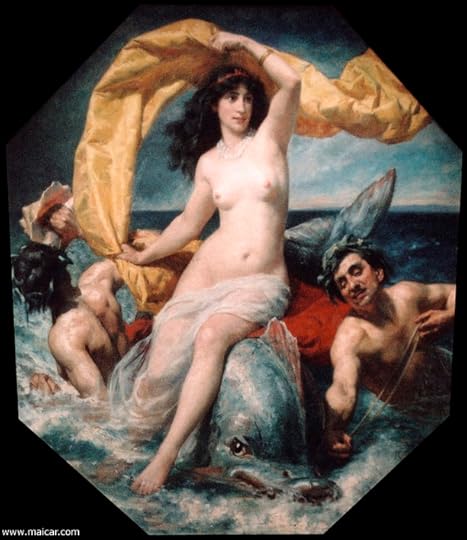
Nereid. Painting at Frederiksborg, Denmark. (Artist n/a.) My first thought was whether the man in the scene might be the overboard helmsman Menoetes of Gyas's huge ship Chimaera, but I think not! :-)
http://www.maicar.com/GML/NEREIDS.html
For a lovely sculpture in a somewhat surprising place, try here: http://bpnola-photographs.smugmug.com...
"Puerto Vallarta, Mexico, 'Triton and the Nereid' by Carlos Espino, 1990: Mexico City sculptor Carlos Espino’s focus on the human form and classical mythology can be seen in this piece, which depicts Triton (son and herald of Poseidon, the Greek god of the sea) reaching out to a Nereid (a Greek sea nymph)."
I noticed that Cloanthus, who "sails the bright blue Scylla" (haven't found an image that I consider to match) was praying to the Nereids (there are supposedly fifty of them), Panopea (may be the Nereid who bore a son of Hercules), and Father Portunus to attain his rather amazing victory among the racing ships. (Lines 267-272) None of those were creatures or people from ordinary acquaintance with mythology, at least for me. This site, with text from Dryden's translations, has a number of pictures, including one of Cloanthus receiving his laurel wreath recognition for his swift and able sailing. The site also reminds me of another use of the name of his ship, Scylla, for a sea monster ("between Scylla and Charybdis").
http://hoocher.com/Publius_Vergilius_...
This bit of etymology on Portunus probably completes my exploration of this passage of The Aeneid for this reading, at least of the funeral game of ship sailing:
"In Roman mythology, Portunes (alternatively spelled Portumnes or Portunus) was a god of keys, doors and livestock. He protected the warehouses where grain was stored. Probably because of folk associations between porta 'gate, door' and portus 'harbor', the 'gateway' to the sea, Portunus later became conflated with Palaemon and evolved into a god primarily of ports and harbors. In the Latin adjective importunus his name was applied to untimely waves and weather and contrary winds, and the Latin echoes in English opportune and its old-fashioned antonym importune, meaning 'well-timed' and 'badly-timed'. Hence Portunus is behind both an opportunity and importunate or badly-timed solicitations (OED)."
http://en.wikipedia.org/wiki/Portunes
I hope this doesn't seem like a passage that belongs in research to too many readers. Once in awhile, this is more like how I read a passage that I get curious about than it is background, as I think of "research". Obviously, can't do that as often as I'd sometimes like, but once in awhile, I find it fun. (The levels of allusions in these classics amaze me again and again -- "opportune" winds, god of harbor or port, i.e., destination.)
LOVED the story behine "opportunity" and "importune."
Thanks Lily.
Thanks Lily.


It has been a year since Anchises died, and Aeneas commemorates his death with funeral games. Much of this is very familiar from the games Achilles arranges for Patroklos in Iliad 23, but here special respect is paid to ancestral relations and fatherhood in general. At one point, young Ascanius rides out with his friends and with the next generation he puts on a display of horsemanship. Nothing like this happens in Achilles' games.
But again the gods intervene. This time Juno sends Iris to plant the notion in the Trojan women that they should burn the ships "that caused so much sorrow." (Is there a symbolic relation between women and fire in the Aeneid?) Aeneas prays to Jove, who responds with a storm that puts out the fires.
Aeneas is taking the advice of Nautes, a seer of sorts, when the ghost of Anchises appears. He approves of Nautes' advice, but tells Aeneas that before he founds his city in Italy he must pay a visit to the underworld. (Sounds familiar, doesn't it?) The Trojans repair their ships and set out. Venus arranges safe passage for the ships from Neptune, but Neptune requires a sacrifice of one man, "a single man for many."