
Pinoy Reads Pinoy Books discussion

This topic is about
Manila Noir
ABSBYNGPGBBSNGAKLT
>
Manila Noir edited by Jessica Hagedorn (Noiranians Unite!)
date newest »
newest »
 First things, first...
What is noir?
Noir (pronounced: nwär) is a genre of crime fiction featuring hard-boiled cynical characters and bleak sleazy settings.
Have you ever read any work from this category? How was it? Did you like it?
 Sasali ako dito kasi pinipilit ako ni Jzhun.
Kwesi 章英狮 wrote: "Sasali ako dito kasi pinipilit ako ni Jzhun."
Sasali ako dito kasi pinipilit ako ni Jzhun.
Kwesi 章英狮 wrote: "Sasali ako dito kasi pinipilit ako ni Jzhun."All right! Kwesi's on board!
 Yayks, simula na ng diskusyon ng NWAR!
 "hard-boiled cynical characters and bleak sleazy settings". Ang asteeg naman ng depinisyon na yan.
May mga nabasa na akong nwar at napanood na pelikula Subukan nyo si Kurosawa Kiyoshi ng Japan (walang relasyon kay Kurosawa Akira). Sa fiction, Georges Simenon.
As background to the book, narito ang isang panayam kay Jessica H. mula sa blog na Bookmarked! Jessica Hagedorn interview, part 1: http://sumthinblue.com/jessica-hagedo...
Jessica Hagedorn interview, part 2: http://sumthinblue.com/manila-noir-pa...
 Hi Jzhun! Thanks for having me here. Stieg Larsson's Millenium trilogy (the girl with the dragon tattoo) is noir. In the university, I watched my first film noir, Bound, starring Gina Gershon and Jennifer Tilly. Then there's LA Confidential. I like this genre because the darkness of the story adds to the mystery.
Rise wrote: "As background to the book, narito ang isang panayam kay Jessica H. mula sa blog na Bookmarked!"
Hi Jzhun! Thanks for having me here. Stieg Larsson's Millenium trilogy (the girl with the dragon tattoo) is noir. In the university, I watched my first film noir, Bound, starring Gina Gershon and Jennifer Tilly. Then there's LA Confidential. I like this genre because the darkness of the story adds to the mystery.
Rise wrote: "As background to the book, narito ang isang panayam kay Jessica H. mula sa blog na Bookmarked!"Thanks for that, Rise! I also read a similar interview with Jessica Hagedorn from the Philippine Daily Inquirer.
Sheila wrote: "Hi Jzhun! Thanks for having me here."Hi Sheila! It's great having you here! :)
Like Sheila, I also first encountered noir when I read The Girl with the Dragon Tattoo, but I considered it crime fiction then (which reminds me, I have to read the second the third book soon!).Going by the definition provided above, I guess I can pretty much say that The Valley of Fear and other stories from The Case Book Of Sherlock Holmes can also be categorized under noir as well. Well, I admit I'm a big Sherlock Holmes fan, and I'm quite jarred with the exponential shift Doyle did with his latter books where the crimes committed became more violent, the themes darker, a far cry from the Victorian sensibilities readers have come to associate with Holmes and Watson from the earlier novels and short stories.
Introduction: Femme FataleDiscussion Questions:
1. Jessica Hagedorn said thus from her introduction: "I like to think of Manila as a woman of mystery, the ultimate femme fatale. Sexy, complicated, and tainted and tainted by a dark and painful past, she's not to be trusted." In your own point of view, how do see Manila? If any, what's your own personification for "the distinguished and ever loyal city"?
2. Do you think Hagedorn did a terrific job with her no nonsense introduction in setting forth and getting the readers (foreigners in mind) acquainted with the milieu of the stories in this anthology?
Intro: Femme FataleI think Hagedorn wrote a 'competent' intro to the book. I think it's enough to make foreign readers curious about it. But she said nothing new really. Anyone familiar with Philippine history already knew what she outlined there.
It's hard to capture Manila in a single image. A sexy and complicated femme fatale may do but is simplistic. (view spoiler)
 Buhay na Buhay ka Rise! tinuhog mo na!
 isama mo na rin yung lahat ng kurapsiyon sa gobyerno!
sa lahat ng anyo!
Mahabang pila at mahabang pila!
natuhog mo pa yung mala-colonial mentality na iyon, pero given na siguro yun dahil simula pa man hindi na maaalis ang pagkakaroon natin ng ganyang pag-iisip, bahagi na ng buhay ng mga Pilipino ang malakolonyal na na pag-iisip, nag-ugat na at patuloy na itong yayabong sa kamalayan man at di kamalayan ng mga Pilipino.
Juan wrote: "bahagi na ng buhay ng mga Pilipino ang malakolonyal na na pag-iisip, nag-ugat na at patuloy na itong yayabong sa kamalayan man at di kamalayan ng mga Pilipino."Tama. Kakalungkot lang na laging niro-romanticize ang kolonyal na kaisipain. Di na tayo naka-move-on....
Rise wrote: "Seriously, a femme fatale may be a colonial mentality-inspired representation of the metropolis as a whole. Or it's just a convenient metaphor for a book about noir, dahil pa-mysterious effect."While I love Hagedorn's intro for the book (her mellifluous voice is still ringing in my ears when she read a page or two from it when I attended the book's launching last month), I agree with you that it's a "convenient" metaphorical image to better represent noir this side of the orient.
Hey, narito rin pala si kaibigang, Emir!Ayos lang, 'yan! Ang layunin naman talaga ng pisi na ito ay upang ipahayag at ibahagi ang iba't iba nating interpretasyon sa mga kuwento at sa aklat sa kabuuan.
Opinions are highly appreciated.
May punto ka, Emir, lalo na sa alindog ng Manila sa mga bagong salta na tigib ng pag-asa. Pero ang historikal na depinisyon ni Hagedorn ang nais kong bigyang pansin: "She's been betrayed time and again, invaded, plundered, raped, and pillaged, colonized ..." Siguro maiging balikan ang representasyon na ito sa dulo ng antolohiya para makita kung naayon ba sa mga napiling kuwento ang imahe na ito.Kagaya ng sinabi ko, may konteksto na hindi maganda na maaring ikabit sa femme fatale kung kaya dalawa ang talim ng imaheng ito.
nakakainggit lang kayo..anyway.
may mga bagay talaga na maaaring mambabasa lang ang makasipat ng ibang sinasabi o nilalaman ng isang akda,
at katulad nito, maaaring may kamalayan ang may akda sa kanyang mga ginamit na salita at ang kahulugan nito.
Pero bakit kailangan maging ganun ang pagkagamit? at ano naman ang sagot natin diyan?
at sa huli, lahat naman tayo taga-kunsumo?
pero hindi rin naman siguro kalabisan ang magbigay ng interpretasyon na may batayan naman di ba?
ay nakakainggit na talaga kayo!
Emir Never wrote: "Naisip ko lang, bakit nga ba 'inang bayan' o motherland o mother country ang tawag sa bayang sinilangan? Bakit babae?"Siguro dahil isa tayong lipunang matriyarkal.
Sa simbolismo ng Manila, naalala ko yung panimulang salita ni Ave Perez Jacob sa Sa Mga Kuko ng Liwanag ni Edgardo M. Reyes na hinalintulad naman ang siyudad sa isang tunay na lalaki, barakong-barako. Sa BAKA NG INA MO! naman ng UngazPress ay mga batang hamog ang piniling simbolo ("Ang panulat namin ay tulad sa mga batang laman ng kalsada...").Juan, pwede kang sumali any time*.
Emir Never wrote: "Naisip ko lang, bakit nga ba 'inang bayan' o motherland o mother country ang tawag sa bayang sinilangan? Bakit babae?"Siguro ay dahil dito tayo'y isinilang? tulad ng pagsilang ng ating ina sa atin kaya nagamit ang salitang motherland?
sa tula naman ni Federico Licsi Espino na Manila, Ermitanyong Talangka (Hermit crab) naman ang imaheng binigyang kulay bilang pigura ng Maynila at bilang Pilipino na din.
Hinanap ko yung tula ni Espino onlayn. http://www.scribd.com/doc/54305611/Ma...Bulaklak ng Maynila ni Domingo Landicho. Di ko nabasa pero napanood ko yung pelikula starring Elizabeth Oropesa at Christopher de Leon. Negatibo ang depiksyon ng siyudad dito dahil nakatuon sa buhay iskwater.
Speaking of Mabangis na Lungsod, nasa wishlist ko: Sa Kagubatan ng Lungsod ni Edgardo M. Reyes at Sa Kagubatan ng Isang Lungsod ni Abdon M. Balde Jr. Sa Manila Zoo yata kinumpara. hehe.
Aviaryby Lysley Tenorio
Greenbelt, Mall
(view spoiler)
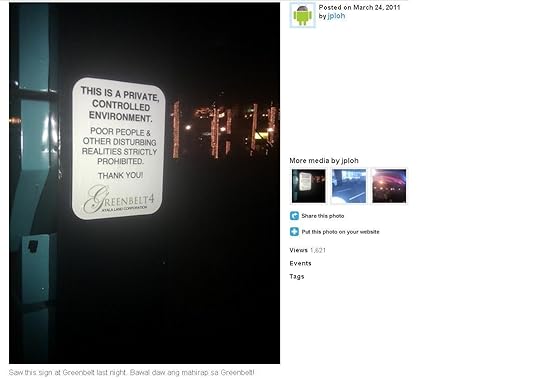
Discussion Questions:
1. The main theme of the story is discrimination of the poor, particularly, the double standard in our society. Is it reason enough or does it justify the unnamed narrator and his chorts' anger in serving the people that ill treated them their comeuppance?
2. To whom do you think is the unnamed narrator and his cohorts' anger targeted at: at the management of Greenbelt? Or is the filthy rich, white people in general?
3. What with all the troubles they caused (or might have caused), did they, the street children, managed to get their message across?
4. Apart from what's been alluded to in the story, that the area that Greenbelt Mall was once an aviary, why do you think did the author titled it as such?
5. Is it just me or can we derive a Marxist reading from this story wherein the proletariat (represented by the poor teenagers) rebels at the capitalist (represented by the white, rich people that the children encountered at the mall)? Pero joke lang ang tanong na 'to. Nagpapaka-hardocre lang ako. Haha!
What first bothered me is that the English, the tone of the story is too smooth, too polished to come from angsty teenagers. But that's just me.Me, too. This is a weak story to introduce a collection. The language feels inauthentic. The choice of words is incompatible to the status of a gang of poor kids. Smooth and polished prose, like you said. Perhaps the decision to use a first person plural point of view ("We") is to blame. The writer simply could not channel the poor. The hoax premise was quite good, but the manner of telling a sanitized tale destroyed any illusion of "realism" of a "neo-noir". If it was meant to be ironic, I didn't get it. Take this passage:
"A samurai raises his sword over two lovers slurping thick, wormy noodles from a steaming white bowl. We half wish it was real, that the samurai could come to life and lop off the heads of these diners. But the samurai is just a character in a movie projected on the wall of a restaurant called johnandyoko, a name as strange as the food they serve—slivers of raw fish that look like tongues, piled high on top of each other, and surrounded with leaves and dots of orange and magenta sauce, on dinner plates so large they're mostly empty."
Seriously—"slivers"? And "magenta"? Will this group of kids describe something as "magenta"?
Spell "f*s**ia"?
Pwedeng "magenta" na lang?
(Will reply to the questions later)
Rise wrote: "What first bothered me is that the English, the tone of the story is too smooth, too polished to come from angsty teenagers. But that's just me.Me, too. This is a weak story to introduce a collec..."
Hi Rise! Can I ask who you are quoting (What first bothered me...)? Because I have the same opinion about the language. But then, there are stories like
Atonement whose narrator is a 13-year old girl and who uses mature language (this is before she started writing her novel of amends about her sister and her boyfriend).
Sheila, I'm quoting Jzhun at message 30 (inside the spoiler tag).
Di ko nabasa ang Atonement, napanood ko lang. Dahil siguro novel-writing at creative license ang tema ng istorya. At ang karakter naman ng batang babae ay upper class(?) at maaring na-expose sa mga mature novels. Dito kasi sa "Aviary" mga batang kalye ang nagsasalita kaya malabo na gumamit sila ng mga sopistikadong paglalarawan ng mga nakikita nila. (Maliban na lang kung nagbabalik-tanaw ang isa sa kanila na yumaman bigla. Pero nasa present tense ang istorya.)
Thanks for pointing that out, Rise. You are right, Briony was justified to have an adult voice. Sa Aviary, hindi mo alam kung saan nanggaling ang sophistication ng mga bata, lalo na kung local TV lang ang exposure nila (it has to be one media or another, and I doubt they read books). So just like what I said in my review of Atonement, we have to suspend our disbelief in the main characters' observation of the outside world that is Greenbelt and its upperclass shoppers. The story needs a description of this controlled environment where the poor and other disturbing realities are prohibited. An omniscient narrator would have made the story more plausible, but the writer must have her limitations.
Emir, thanks for reading my review. It feels strange to be reading that after a very long time. Did I really write that one? Yes I did: )
 Hey guys, I own a copy of the book too. Hope you don't mind if I join the discussion.. :)
Aviary was definitely weak as the opening story for the book. Upon reading some of the comments above, ngayon ko lang din napansin na medyo unrealistic ang sophistication nung kid who was supposed to be poor. I wasn't really able to notice it the first time na binasa ko yung story. For me the story is not that bad, it just pales in comparison to the other stories in the book.
Jc wrote: "Hey guys, I own a copy of the book too. Hope you don't mind if I join the discussion.. :)"Of course, everyone is welcome to join in the discussion, Jc. :)
Emir Never wrote: "Here, if Rise will rise and raise his left fist, I'll join him."*pumps fist up in the air*
I found the story promising at first. I didn't even know there's a hoax like that 2 years ago. It's very unlikely for the management of a mall to put up a sign like that. But it's plausible. (Imagine a mall manager being a victim of a theft perpetrated by a palaboy in serious need of money--perhaps putting up the sign was his way of venting his anger against the likes of the thief.) So yes, unlikely but still plausible.
The kids felt wronged by the sign and it's understandable that they would rebel against the mall management and the rich clientele who frequent the mall. It's a silly thing to take seriously and be offended by. But they're just kids, and their feelings were really hurt. So, still plausible.
Were they justified in doing what they did? Maybe. The rich have to be taught a lesson. And yet the kids' actions wouldn't change their being dirt poor. Their actions, like the putting up of the offending sign, are illogical and silly too.
Putting dead birds on handbags, what would that accomplish? It may scare people away from going to the mall. It may generate bad publicity against Greenbelt.
But it's ultimately a shallow act, a cheap trick. As if it was done just to tie up the image of the aviary to their action. We are meant to see the kids like the displaced birds in the former aviary.
We can't say for sure if they successfully delivered their message. It's an open-ended story. Maybe for all their trouble, the fake bomb will be altogether ignored by chapel-goers. Maybe the dead birds in the bags will just elicit some eye-rolling disgust from the rich customers. The terrorist act is too timid to make lasting damage.
It's a plausible story, but silly. And not executed that well.
Welcome, Jc. Feel free to join us.
Hi guys! Seems everyone was busy: )I'm having trouble reading The Unintended. It's full of adjectives ; )
Sheila, yan yata ang pinakapaborito kong kuwento sa Noir. Hindi dahil sa mga pang-uri kundi dahil sa estilong naiiba. At saka paborito ko ang Ali Mall, dahil tambayan ko dati.
Talaga? Sige, I'll give it one more chance, because I did like the mention of the clown: )
Na-appreciate ko sa istorya ang dugtong-dugtong na galamay ng mga ideya. Ang The Unintended ay maaaring reference sa "the Intended" na fiancee ni Kurtz sa Heart of Darkness, nobela tungkol sa kolonyalismo sa Congo ni Joseph Conrad. Ang Apocalypse Now na pelikulang tungkol sa Vietnam War pero dito sa Pilipinas syinut ay dinirehe ni Francis Ford Coppola. Ito ay halaw sa nobela ni Conrad. Ang anak ni Coppola na si Sofia Coppola ay nagdirek naman ng pelikulang Lost in Translation, starring Scarlett Johansson. Umiinog ang istorya sa mga uri ng translation/adaptation. Ang karakter na tranlator na si Magsalin at si Estrella Espejo ay hango sa nobela ni Gina A., The Revolution According to Raymundo Mata (sinimulan kong basahin, medyo magulo rin pero nakakatawa).
Rise, thanks for the background. I've watched Sofia's Lost in Translation, but I have yet to watch Apocalypse Now. As a reader who wants to learn how to write, I'm very keen, well, at least I try to be, about writing styles, because they affect the telling of the story. So my initial reaction can't be helped. Ms. Gina's style is something I have to get used to.
So I'm done reading The Unintended. And to be honest, I'm lost. Or maybe I'm just dumb about symbols. I get the layers of texts----the Channel shades, the plywood tunnel, the mystery novel to be written, but as parts that make up a short story, I don't know what they all mean. I don't know the message (if there's any). Until the end, I was still half expecting the depressed clown doing something criminal. I've read Vonnegut and Nabokov, who are considered post-modern writers, so maybe I just need to re-read this story to get a better appreciation (though I never felt the need to re-read Vonnegut or Nabokov---their storytelling never confused me). But I did appreciate the history lesson on the Balangiga massacre. That's one text that was worth mentioning.
I didn't fully understand it myself. I just like the ideas, the creative/confusing way Gina tells it. There may not be a fully-fleshed out story as she tells in her blog that it's just an excerpt of a novel, also called The Unintended. But it may be safe to assume that that whole novel will be just as convoluted, going by this sample and the 'playful' Raymundo Mata novel. Here's an essay of hers that is related to her theme. It may clarify her position or further complicate it. http://lareviewofbooks.org/essay/borg...
Thanks Rise. You're right. That essay just complicated things for me: ) I'm just not that sophisticated a reader. But I love ideas and I like them better when they're inside a story and their presence is not an accident like that plywood tunnel (they are put there because the mall for some reason or another, just can't afford to erect a permanent hallway even after being there for a decade). I accept that mystery of the mall. In fact, it adds beauty.
 May ganito pala! Dapat sumali ako bilang epal naman ako palagi. LOL.

Pinoy Reads Pinoy Books
Books mentioned in this topic
Atonement (other topics)The Girl With the Dragon Tattoo (other topics)
The Valley of Fear (other topics)
The Case-Book Of Sherlock Holmes (other topics)
Manila Noir (other topics)
Authors mentioned in this topic
Jessica Hagedorn (other topics)Lysley Tenorio (other topics)
Rosario Cruz-Lucero (other topics)
Lourd Ernest H. de Veyra (other topics)
Sabina Murray (other topics)
More...

Coming this week and starting by August 5, we will be doing a read-along of Manila Noir edited by Jessica Hagedorn, moderated by yours truly.
Here's the slated schedule of reading for this book:
Part I: Us Against Them- for Aug. 5-10
Aviary by Lysley Tenorio
A Human Right by Rosario Cruz Lucero
Satan Has Already Bought U by Lourd Ernest H. de Veyra
Broken Glass by Sabina Murray
After Midnight by Angelo R. Lacuesta
Part II: Black Pearl of the Orient- Aug.12-17
Trese: Thirteen Stations by Budjette Tan & Kajo Baldisimo
Comforter of the Afflicted by F.H. Batacan
The Professor's Wife by Jose Y. Dalisay Jr.
Cariño Brutal by R. Zamora Linmark
The Unintended by Gina Apostol
Part III: They Live by Night- Aug.19-24
Old Money by Jessica Hagedorn
Desire by Marianne Villanueva
Darling, You Can Count on Me by Eric Gamalinda
Norma from Norman by Jonas Vitman
As suggested, the discussion for the read-along will be flexible, at most once or twice a week based on the online availability of the readers / participants. Being your dear moderator, I'll be posting questions from time to time within the week of the indicated particular section of stories we are discussing—just to whet your "noir-istic" appetites.
Readers for this read-along are:
1. Jzhun
2. Rise
3. Billy
4. Sheila
5. Phoebee
6. Kwesi
PRPB members and crime fiction lovers are all welcome to join!