
The History Book Club discussion

This topic is about
An Army at Dawn
THE SECOND WORLD WAR
>
WE ARE OPEN - 2. AN ARMY AT DAWN ~ September 16th ~ September 22nd ~ PART ONE - 1. PASSAGE - Gathering the Ships and Rendezvous at Cherchel and On The Knees of the Gods and A Man Must Believe in his Luck - (33 - 68) No-Spoilers

message 2:
by
Bentley, Group Founder, Leader, Chief
(last edited Sep 17, 2013 09:41PM)
(new)
-
rated it 5 stars
 Mod
Mod
Part One
Gathering the Ships
After sailing from Hampton Roads, Virginia, more than 33,000 American soldiers and 100 ships were to be involved in the operation. The British were not to be involved in the initial operation due to British/French animosity. There was quite a bit of discussion concerning the choices for exact landing points, with some proposed locations being scrapped due to proximity to Axis airports. The final decision was to plan on three sites in Morocco and six beaches in the Algiers/Oran region. These sites were spread over 900 miles of coastline.
Patton had come of age during World War I. He was considered a pioneer of mechanized armor and spoke with much bravado concerning the honor of war. He had a five-word war manifesto: "violent attacks everywhere with everything." His Torch troops were comprised of units assembled quickly to make up three divisions. He addressed troop commanders on October 23 in Norfolk, speaking of urgency and threatening against showing signs of weakness.
At Hampton Roads, ships making up Task Force 34 were being loaded with thousands of tons of supplies. The thousands of soldiers coming together all at once created confusion, and the influx of worried troops waiting to embark in Norfolk stressed the city to its limits. Eventually 28 transport ships were loaded and the fleet set sail early in the morning on October 24.
Rendezvous at Cherchel
Only two days earlier, a small group of British and Americans dressed in civilian clothes had set ashore at Cherchel, just up the coast from Algiers. The British submarine HMS Seraph waited just off shore. Major General Mark W. Clark, the Deputy Torch Commander, led the mission at the behest of Eisenhower. A Vichy French Commander named General Charles Mast had made contact earlier about letting the Allies get safely to shore. Less than a dozen men came ashore and entered a villa at the planned rendezvous point. General Mast arrived at 6am and the generals spoke at length about Vichy troop morale in North Africa. Mast maintained that the region could easily commit 300,000 troops to the Allied cause, if given enough weapons. Clark gave Mast vague information about Torch, although he did not reveal how imminent the invasion actually was. Mast showed the Americans military target maps, and said to expect the French Army and Air Force to back the Allies, but not the Navy. Clark returned safely to the Seraph, and reported to London what he had learned.
On the Knees of the Gods
Vessels from Britain were heading for Algeria as Hewitt's forces sailed for Morocco.
The ships were staggered to arrive and "shoot" the narrow Strait of Gibraltar in a
specific order that required precise seamanship. Many deception plans had been made and broadcast to throw Axis planners - specifically submarines (U-Boats) - off track.
The loading ordeal at British ports turned out to be even more chaotic than at
Hampton Roads, and many supplies were lost or stolen. Most troops leaving Britain
were fresh recruits with no fighting experience. Many badly needed tanks were left
behind when they wouldn't fit in the landing vessels. This armored division was
known as "Old Ironsides," and was also full of green recruits. Another infantry
division, the 34th, was rushed into service stripped of many of its experienced offers and with the new troops having received no maneuver training. The group sailed for Algeria completely untested in most aspects of combat. In spite of these shortcomings, the fleet turned toward the Strait of Gibraltar on November 5 and then sailed on into the Mediterranean. Soon they would split, with half of the vessels bound for Algiers and the other half toward Oran.
The island of Gibraltar was basically a rock than jutted out of the narrow strait
between the Atlantic and Mediterranean Sea. Just 3 miles wide by 1 mile long, it
housed a very congested airport where fourteen squadrons of fighter planes had been
secretly assembled and now were ready to fly in Torch. Eisenhower met with British
officers and found the office he would share with Clark in the bowels of Fortress
Gibraltar. He communicated with London and Washington using an ocean cable to
maintain radio silence. As the British convoy passed quietly through the Strait, he
received no word of Hewitt's convoy to the west
A Man Must Believe In His Luck
French General Henri Giraud arrived at Gibraltar on November 7 and met with Eisenhower and Clark to discuss his own plan for the invasion of North Africa. He had incorrectly assumed that he would
become the Supreme Allied Commander. This was not the case, though Giraud was
promised a lesser position in the North African command.
Axis planes soon became aware of the fleet in the western Mediterranean, but Hitler
assumed incorrectly that they were headed for Tripoli or Benghazi, which were much
farther to the east than the actual landing sites. He massed his submarines and aircraft
in the Sicilian Straits, only later realizing that his troops were too far east to meet the
Allies. There were still some casualties, though. On November 7, the USS Thomas
Stone was hit with a torpedo off the Spanish coast. Nine men were killed and the ship
disabled. Other news was good. Hewitt had slipped by a German submarine wolf pack, and
Axis powers had been taken by surprise. The battle of El Alamein had also swung in
favor of the British; Rommel was retreating in Egypt.
Operation Torch was worked out at very high levels of command without much thought being given to the details. The fact that it turned out as well as it did must be attributed in large part to luck.. If the Germans had sent submarines and planes farther west and discovered the convoy while out to sea, the invasion could have ended much differently. The Strait of Gibraltar could easily have been an ambush point. While the author makes the point that individual actions determined many outcomes in the campaign, he also shows that a great many events simply came down to dumb luck.
message 3:
by
Bentley, Group Founder, Leader, Chief
(last edited Sep 17, 2013 09:46PM)
(new)
-
rated it 5 stars
Mod
"The dawn was bright and blowing. Angels perched unseen on the shrouds and crosstrees. Young men, fated to survive and become old men dying abed half a century hence, would forever remember this hour, when an army at dawn made for the open sea in a cause none could yet comprehend. Ashore, as the great fleet glided past, dreams of them stepped, like men alive, into the rooms where there loved ones lay sleeping."
What did you think of this passage? (page 41 - Gathering the Ships)
message 4:
by
Bentley, Group Founder, Leader, Chief
(last edited Sep 17, 2013 09:48PM)
(new)
-
rated it 5 stars
Mod
Please open up discussion of this week's reading. Remember if a person is mentioned in the chapter, you do not have to cite them even if they have written a book but if you are citing anybody else you do. If you are mentioning any book at all - you must do the full citation - the only book exempt is An Army At Dawn and Rick Atkinson.
 One of the focal points was crucial fact that Eisenhower needed to be the point person and Allied commanding general on the ground during the war in North Africa. General Giraud was out of his element and thus Eisenhower pushed him aside by saying “Old gentleman, I hope you know that from now on your ass is out in the snow.” (pg.66)
On another continent, if General Joseph Stilwell had similar authorization to take ultimate command in China and push General Chiang Kai-Shek aside, success would have been more attainable.
 Dwight D. Eisenhower
message 6:
by
Bentley, Group Founder, Leader, Chief
(last edited Sep 19, 2013 07:04AM)
(new)
-
rated it 5 stars
Mod
Note: I am assuming that Ike was the one in charge and understood what was being conveyed in the translation.
Dwight D. Eisenhower
 Good point guys. You know, it could have been the pressure that got to Ike in that moment and said those words. Not very diplomatic, but he is also learning the ropes, so to speak.
 You do have to say Giraud is a piece of work. You appreciate the work Ike has to face.
Dwight D. Eisenhower
message 8:
by
Bentley, Group Founder, Leader, Chief
(last edited Sep 18, 2013 06:42AM)
(new)
-
rated it 5 stars
Mod
Dwight D. Eisenhower
I agree, Bentley, he could have been more diplomatic, the language was too course. It is interesting that he talked with Giraud for hours and the language in those talks could have been more diplomatic and Giraud was not responding to diplomacy.
Dwight D. Eisenhower
message 10:
by
Bentley, Group Founder, Leader, Chief
(last edited Sep 18, 2013 07:00AM)
(new)
-
rated it 5 stars
Mod
Dwight D. Eisenhower
message 11:
by
Bentley, Group Founder, Leader, Chief
(last edited Sep 18, 2013 07:08AM)
(new)
-
rated it 5 stars
Mod
message 12:
by
Bentley, Group Founder, Leader, Chief
(last edited Sep 18, 2013 09:51AM)
(new)
-
rated it 5 stars
Mod
According to Atkinson - "An officer with a twisted mind and a classical education had borrowed the motto for Hampton Roads Port of Embarkation from the Aeneid":
(page 35)
"Forsan et haec olim miminissee invabit" translated to - "Someday, perhaps, the memory of even these things will be pleasant." Someday, perhaps, but not soon (Atkinson).
What did you make of the disorderliness and chaos of this preparation and the fact that normally all cargo was supposed to combat loaded which seemed pretty far fetched for the way things were going?
 by
by
 Virgil
 http://en.wikipedia.org/wiki/Combat_l...
This seems fairly typical to me for a first attempt to do something this large that has probably only been a theory before. It is not an efficient way to load a ship so if you have a deadline (which they did) it puts a lot of pressure on the loaders. If you don't know where or when material is going to be in the rail yard. it becomes much harder. The armies last amphibious assault was probably the invasion of Cuba 45 years ago. That loading operation didn't go very good either and I'm sure any lessons learned had been forgotten in the interval. In his novel "Bright Star" Harold Coyle has a scene with the Navy and Army struggling with combat loading a ship in modern times.
 by Harold Coyle no photo
message 14:
by
Bentley, Group Founder, Leader, Chief
(last edited Sep 18, 2013 10:59AM)
(new)
-
rated it 5 stars
Mod
Thank you for the link and the add. Just a note - this book is about an incident in the future and is a novel.
It must have been one crazy show. As they get the material and load the boats up, they must have faced a lot of issues as they went along, too many to fathom. I kept picturing the men and the author does a good job depicting life crammed on these boats. The disease, lack of good food, the heat, and the bunks where the man on the top bunk has about 6 inches before he hit the ceiling!
It was an eye-opener for me. Can you also imagine the anxiety about waiting on the boat until you see action?
message 16:
by
Bentley, Group Founder, Leader, Chief
(last edited Sep 18, 2013 11:27AM)
(new)
-
rated it 5 stars
Mod
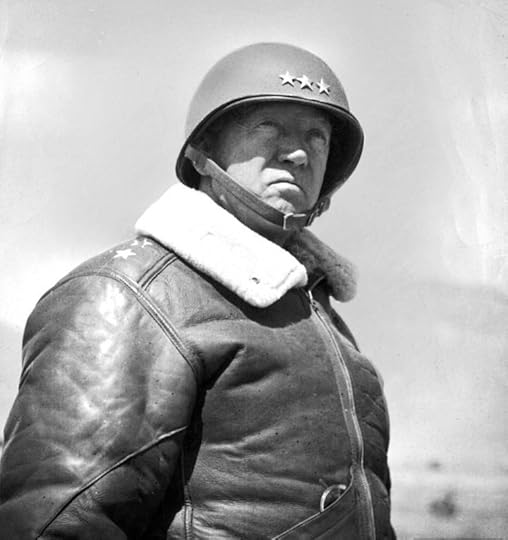
This was a very interesting reflection of the life in war and what you might face and also a great insider view into Patton's view of himself and the effort. - page 35 - Gathering the Ships
"On this disorderly Thursday, Patton flew to Norfolk from Washington in a C-47 transport plane with his tin suitcase and an entourage of eight staff officers. In his slashing, runic handwriting he had written his will and a long treatise to his wife, Bea, on how to care for their horses in his absence. He also wrote several farewell letters. "To his brother-in-law: "My proverbial luck will have to be working all out. All my life I have wanted to lead a lot of men in a desperate battle; I am going to do it." To a family friend, he noted that by the time he read his letter, "I will either be dead or not. If I am, please put on a good Irish wake." Now striding from ship to ship along the wharves, Patton inspected the cargo with the possessive eye of a man who intended to use every last bullet, bomb, and basketball shoe. When he asked a young quartermaster captain how the loading was proceeding, the officer replied, "I don't know, but my trucks are getting on all right." Patton took a moment to scribble in his diary: "That is the answer. If everybody does his part, these seemingly impossible tasks get done. When I think of the greatness of my job and realize that I am what I am, I am amazed, but on reflection, who is as good as I am? I know of no one."
=======
What did you think of the above when reading it about Patton, the man, the husband, the soldier, brother-in-law, the friend, the leader?
Mod
I kept picturing the men and the a..."
It must have been dreadful and especially for some of the more inexperienced recruits.
Good question, Bentley, on Patton. For me, he is hard to grasp, not served in the armed services. He wears many hats, though. He seems to be gentle and caring with his family, but rough and rigid when it comes to his command. If I was one of his soldiers, I'm beginning to see the appeal: he wants to use everything to win victories, the more you win, the quicker the war ends. Just some random thoughts.
 Mod
Mod
Mod
Mod
message 21:
by
Bentley, Group Founder, Leader, Chief
(last edited Sep 18, 2013 12:48PM)
(new)
-
rated it 5 stars
Mod
Thanks for the thoughts Bryan - I thought I saw different facets of his personality - at home it was obvious that he ran the show giving detailed directions about horses which were probably the last thing on his wife's mind - to his brother-in-law (link to his wife) - he was more serious - to a friend - he kept it light and used a bit of dark humor and for himself he thought about his confidence in himself and I guess an internal pep talk that nobody better than himself could have faced these odds and how much he valued his position.
It is odd but I think you are right - he was a man of many faces. And maybe he was what was needed for the men to believe in themselves and their abilities. They had a leader who did.
Bryan wrote: "I agree, Bentley, he [Eisenhower] could have been more diplomatic, the language was too course. It is interesting that he talked with Giraud for hours and the language in those talks could have been more diplomatic and Giraud was not responding to diplomacy."Once again the rub of WWI might have carried over to WWII. Eisenhower might have recalled that during WWI French Prime Minister Georges Clemenceau suggested in a letter to French General Ferdinand Foch that U.S. General John J. Pershing should possibly be removed of command of the AEF. (smile) The full letter was printed in the "The Memoirs of Marshal Foch" copyright 1931 for all to see.
Around this same time of October 1918 both the U.S. 36th Division and the heralded 2nd Division commanded by USMC General John A. Lejeune, were placed under the control of French General Henri Gouraud for the monumental battle of Blanc Mont. Throughout the politics the AEF claimed a major victory.
 by Ferdinand Foch (no photo)
Dwight D. Eisenhower
Mod
by Ferdinand Foch (no photo)
Dwight D. Eisenhower
Mod
One thing I came across which should be on interest to those folks interested in Patton is an interview with his son and daughter - some very very interesting details about the man which I think all of you will find incredibly interesting - I know I did.
Reflections of a Fighting Father
by Jeffrey St. John
The following article is a summary of a two-and-a-half-hour exclusive interview with Major-General George S. Patton (Ret) and Mrs. Ruth Ellen Totten, the son and daughter of Major General George S. Patton Jr. (1885-1945). The interview was conducted in South Hamilton, Massachusetts, where both General Patton and Mrs. Totten make their home.
General Patton, 63, graduated West Point Military Academy in 1946. His first combat assignment was in Korea as a tank commander and during the Vietnam conflict he served three tours of duty, between 1961 and 1969, for a total of 33 months. His decorations include the Distinguished Service Cross with Oak Leaf Cluster, two Silver Stars, the Distinguished Service Medal, and the Purple Heart. Promoted to Brigadier General in 1970, he later attained the rank of Major-General in 1973. In 1975 General Patton made military history by assuming command of the Second Armored Division that had been his father's first divisional command. It was the first time in US. military history that a son took command of a unit previously commanded by his father. He retired in 1980 after 34 years of active service as a U.S. Army commissioned officer. In retirement, General Patton divides his time between farming and extensive public speaking dates. He is the father of five children, two girls and three boys.
Mrs. Ruth Ellen Totten, 70, is the family historian and has supervised the collection and editing of the family papers. She is currently at work on a biography of their mother, Mrs. George S. Patton, Jr., who was a published novelist. In 1940 she married James W. Totten, a career army officer, who rose to the rank of Major-General. She is the mother of three children. One of them, Colonel Michael W. Totten, is the Military Attache to the U.S. Embassy in Damascus, Syria.
-------------------------------
Here is the link to the interview itself:
http://www.pattonhq.com/textfiles/ref...
Mark wrote: "One of the focal points was crucial fact that Eisenhower needed to be the point person and Allied commanding general on the ground during the war in North Africa. General Giraud was out of his elem..."In the book this remark is attributed to Clark. From what little I know about Clark, this sounds like him and not the diplomatic Ike. It also isn't clear to me that Giraud understood the remark.
What I find hard to believe is that Clark was allowed to make his North African trip. With all the knowledge he had of the invasion that was very foolish of Ike to let him go. If the Germans had gotten him and found out about the enigma secret the war could have been very much prolonged.
 Mark wrote: "One of the focal points was crucial fact that Eisenhower needed to be the point person and Allied commanding general on the ground during the war in North Africa. General Giraud was out of his elem..."
These were Clark's words. It's not clear from the text whether or not he was translating verbatim for Ike.
DonnaR wrote: "Mark wrote: "One of the focal points was crucial fact that Eisenhower needed to be the point person and Allied commanding general on the ground during the war in North Africa. General Giraud was ou..."Oops, sorry, I see that Mark has already made that point.
Very interesting interview on Patton, Bentley, thanks for finding this. He does seem to be a gentle father and studied hard to prepare for battle.
Mod
message 29:
by
Bentley, Group Founder, Leader, Chief
(last edited Sep 19, 2013 07:05AM)
(new)
-
rated it 5 stars
Mod
Why Clark was allowed on the invasion is clear - Ike needed him and wanted him there and he was trusted by Ike - maybe as a sounding board. FDR could not afford to give up Marshall and that is why Ike was where he was. And I do not mean to compare Clark to Marshall in terms of skillsets, or personal qualities or characteristics, etc - because I think Marshall could stand above them all in terms of trust, integrity, style and smarts.
And I also think/suspect that Clark wanted to go and probably implored Ike regarding his wishes. Whether that was a wise choice remains a point of discussion although at the time Ike considered him indispensable - although he seemed to waver at times regarding that too. At least in personal musings.
@DonnaR - true
message 30:
by
Bentley, Group Founder, Leader, Chief
(last edited Sep 19, 2013 05:16PM)
(new)
-
rated it 5 stars
Mod
This is his entire obituary - any comments on this:
Patton's Career A Brilliant One
By THE NEW YORK TIMES
December 22, 1945
Gen. George Smith Patton Jr. was one of the most brilliant soldiers in American history. Audacious, unorthodox and inspiring, he led his troops to great victories in North Africa, Sicily and on the Western Front. Nazi generals admitted that of all American field commanders he was the one they most feared. To Americans he was a worthy successor of such hardbitten cavalrymen as Philip Sheridan, J. E. B. Stuart and Nathan Bedford Forrest.
His great soldierly qualities were matched by one of the most colorful personalities of his period. About him countless legends clustered--some true, some untrue, but all testifying to the firm hold he had upon the imaginations of his men. He went into action with two pearl- handled revolvers in holsters on his hips. He was the master of an unprintable brand of eloquence, yet at times he coined phrases that will live in the American Army's traditions.
"We shall attack and attack until we are exhausted, and then we shall attack again," he told his troops before the initial landings in North Africa, thereby summarizing the military creed that won victory after victory along the long road that led from Casablanca to the heart of Germany.
At El Guettar in March of 1943 he won the first major American victory over Nazi arms. In July of that year he leaped from a landing barge and waded ashore to the beachhead at Gela, Sicily, thus beginning a campaign that, as he himself observed, out-blitzed the inventors of Blitzkreig. In just thirty-eight days the American Seventh Army, under his leadership, and the British Eighth Army, under Gen. Sir Bernard Montgomery, conquered all of Sicily.
But it was as the leader of his beloved Third Army on the Western Front that General Patton staked out his strongest claims to military greatness. In ten months his armor and infantry roared through six countries--France, Belgium, Luxembourg, Germany, Czechoslovakia and Austria. It crossed the Seine, the Loire, the Moselle, the Saar, the Rhine, the Danube and a score of lesser rivers; captured more than 750,000 Nazis, and killed or disabled 500,000 others.
There were times, in those great days when the tank spearheads of the Third were racing across France with almost unbelievable speed and again when they were cutting the dying Nazi armies to pieces in the final spring of the war, that not even Supreme Headquarters itself knew where his vanguards were. Driven by his iron will, his advanced units had to be supplied with gasoline and maps dropped by air.
About such a leader it was inevitable that heroic myths grew up. One eager war correspondent wrote that he jumped onto the Normandy beachhead waving a $1,000 bill and offering to bet it that he would beat Marshal Montgomery to Berlin. When the tale caught up with him, he pithily remarked that he had never seen a bill of that denomination.
One of his men brought back the story that he swam the icy, 150-foot Sauer River in January, 1945, under machine gun and artillery fire, to inspire the men of the Third to follow him. That, too, General Patton denied, but the extent to which the story was believed was eloquent testimony to General Patton's habit of being where the fighting was fiercest.
Called "Old Blood and Guts"
His best-known nickname--"Old Blood and Guts"--was one that he detested, but his men loved. "His guts and my blood," his wounded veterans used to say when they were flown back here for hospitalization. His explosive wrath and lurid vocabulary became legendary wherever American soldiers fought.
General Patton had a softer side to his nature, too. He composed two volumes of poetry, which he stipulated were not to be published until after his death. He was an intensely religious man, who liked to sing in church and who knew the Episcopal Order of Morning Prayer by heart.
He seemed fated to be the center of controversy. Again and again, when his fame and popularity were at their height, some rash statement or ill-considered deed precipitated a storm about his head. The most celebrated of these incidents, of course, was the slapping of a soldier whom he took to be a malingerer but who was actually suffering from battle fatigue in a hospital during the Sicilian campaign.
This episode resulted in widespread demands for his removal from the command of American soldiers, in Congress and in the press, and caused the Senate to delay his confirmation to the permanent rank of major general for almost a year. General Eisenhower sharply rebuked him, but insisted that his military qualifications, loyalty and tenacity made him invaluable in the field.
The turmoil over this incident had hardly died away when he caused another stir by a speech at the opening of a club for American soldiers in London. The original version of his remarks there quoted him as saying that the British and American peoples were destined to rule the world, but after this had evoked an outburst of criticism Army press relations officers insisted that he had actually said, "we British, American and, of course, the Russian people" were destined to rule.
He raised another brief teapot tempest when he came home in June, 1945, and told a Sunday school class that its members would be the officers and nurses of the next war. But this was nothing compared to the furore he caused by an interview he granted American correspondents after his return to Germany. Discussing conditions in Bavaria, where the military government was under his command, he asserted that too much fuss was being made over denazification and compared the Nazi party to the losers in an election between Democrats and Republicans back home.
General Eisenhower promptly called him on the carpet for these remarks. General Patton promised that he would be loyal to General Eisenhower's orders and to the Potsdam agreements prescribing the complete and ruthless elimination of all elements of Nazism from German life, but ten days later, on Oct. 2, 1945, he was removed from the command of his beloved Third Army.
Although reports were current that he might retire, General Patton took his transfer in soldierly silence. He assumed command of the American Fifteenth Army, a paper organization devoted to a study of the tactical lessons to be learned from the war just completed, and told friends that this was in line with what had been his favorite mental occupation since he was 7 years old: the study of war.
Although he customarily signed himself George Smith Patton Jr., General Patton was actually the third in line of his family to bear that name. The original George Smith Patton, his grandfather, was a graduate of Virginia Military Institute, and became a colonel in the Confederate Army. He was killed in action at the battle of Cedar Creek.
Expert Horseman From Childhood
General Patton's father went through V.M.I., then studied law, and moved west. He married a daughter of Benjamin Wilson, who was the first Mayor of Los Angeles, and for whom Mount Wilson was named. The future general was born on the family ranch at San Gabriel, Calif., on Nov. 11, 1885, and from childhood was an expert horseman.
At the age of 18 he came east and entered V.M.I., but after a year there he entered West Point with the class of 1909. There is a legend at the academy that he boasted at his entrance that he would be cadet captain, the highest post in the cadet corps, and that he would also be the first member of his class to become a general. Actually, he was cadet adjutant, the second highest post, and was the second member of the class to become a general.
He was a poor student--throughout his life he remained remarkably deficient in spelling--but an outstanding athlete at the Point. He excelled as a sprinter on the track team, and was also an expert fencer, swimmer, rider and shot. He continued his interest in sports and athletics after his graduation as a second lieutenant of cavalry.
In 1912 he represented the United States at the Olympic Games in Stockholm, Sweden, competing in the modern pentathlon, a contest which up to that time had been almost monopolized by Swedish Army officers. He finished fifth among more than thirty contestant, immediately after four Swedes. Of the five events, swimming, riding, fencing, running and shooting, he made his poorest showing in the pistol marksmanship competition, but he subsequently practiced until he overcame this weakness.
Early in his Army career he established himself as a hell-for-leather cavalry man. His first post was at Fort Sheridan, Ill., but in December, 1911, he was transferred to Fort Myer, Va., where he was detailed to design a new cavalry saber. In 1913 he went to France to study French saber methods, and on his return was made Master of the Sword at the Mounted Service School, Fort Riley, Kan.
He accompanied Gen. John J. Pershing as his aide on the punitive expedition into Mexico after the bandit, Pancho Villa, in 1916, and the next year he went to France with the general as a member of his staff. He attended the French Tank School and then saw action at the battle of Cambrai, where the British first used tanks on a large scale.
The new weapon was one to gladden the heart of a cavalryman, and from that time on his service was closely connected with tanks. He was assigned to organize and direct the American Tank Center at Langres. For his service in that capacity he was subsequently awarded the Distinguished Service Medal. But he was not satisfied with a training command, and sought action.
He took command of the 304th Brigade of the Tank Corps and distinguished himself by his leadership of it in the St. Mihiel offensive in September, 1918. Later that autumn, during the Meuse-Argonne offensive, he was severely wounded in the left leg while charging a pillbox, after 40 percent of the tanks in his command had been disabled.
His life was saved by Pvt. Joseph T. Angelo of Camden, N.J., who dragged him to safety in a shell hole.
After the first World War he served with tank units and then with the cavalry at various posts in the United States. He was graduated from the Cavalry School, the Command and General Staff School and the Army War College. While on duty in the office of the Chief of Cavalry in Washington, he was detailed as aide to the Prince of Wales on one of his visits to this country. He told the Prince that a game called "craps" was very popular in this country, and taught him to play it.
A Colonel in 1940
When this country began to rearm in the summer of 1940 Patton was a colonel. He was sent to Fort Benning, Ga., for duty as commander of a brigade of the Second Armored Division, then being formed. In April, 1941, he became its commanding officer and made the division famous as a tough and rough-and-ready outfit. Promoted to corps commander, he organized the Desert Training Center in California.
When the North African invasion was planned, General Patton was placed in command of the American forces scheduled to land on the Atlantic coast of Morocco. One of the closest of the many narrow escapes for which he was noted came when a landing boat into which he was about to step was sunk. But he got ashore and after a brief but fierce fight took his objectives.
During the Tunisian campaign that followed, General Patton became celebrated for the strictness of his discipline. He punished men who failed to wear their helmets, even in back areas.
message 31:
by
Bentley, Group Founder, Leader, Chief
(last edited Sep 19, 2013 05:14PM)
(new)
-
rated it 5 stars
Mod
After the American reverse at Kasserine Pass in February, General Patton took command of the Second United States Corps, which forced the Nazis back into a narrow corridor between the mountains and the sea, up which the British Eighth Army under General Montgomery pursued them. He won the battle of El Guettar in march, but not long thereafter disappeared from the public eye. On April 16 Gen. Omar Bradley succeeded him in command of the Second Corps.
The reason for the shift was not made known at the time and there were rumors that General Patton had fallen into disfavor. Actually, General Eisenhower had withdrawn him from action in order to prepare the American Seventh Army for the invasion of Sicily in July. The invasion was brilliantly successful, and General Patton's troops cut clear across the island to Palermo; then fought their way along the north coast to Messina.
This magnificent feat of arms was marred, however, by the slapping episode, which did not become generally known to the public until the following November. General Patton, who drove himself as hard as he drove his men, visited a hospital not far from the front lines at a time when he had been under prolonged strain and was in an overwrought condition.
There he encountered two men who showed no signs of visible wounds, but who had been diagnosed by medical authorities as suffering from battle neurosis. Losing his temper, General Patton called them "yellow bellies" and other unprintable epithets, and struck one of them so that his helmet liner flew off and rolled on the ground.
General Eisenhower made an investigation and sharply castigated General Patton, although he did not formally reprimand him. General Patton made personal apologies to all those present at the time of the episode, and later sent public apologies to each division of the Seventh Army.
General Patton did not appear during the campaign on the Italian mainland that followed, and some observers thought he had been relegated to a secondary role because of the storm of criticism that his action had caused in this country. Actually, however, General Eisenhower had picked him for a key role in the invasion of Western Europe, and he was then in England preparing for it.
Whereabouts a Mystery
For almost two months after D-Day, June 6, 1944, General Patton's whereabouts remained a mystery. The fact that he was in England, at the head of an army, was well known, and the inability of the Nazi intelligence to locate him forced their High Command to retain the German Fifteenth Army in the Pas de Calais area, far from the Normandy beachhead, lest he head a landing there.
Instead, the Third Army landed on the beachhead in great secrecy, and deployed behind the First Army. When the First Army broke the German lines between St. Lo and the sea on July 25, the Third Army poured through the breach to exploit it. The opportunity was ideal for a dashing, driving leader of General Patton's talents. His spearheads roared clear across the base of the Breton Peninsula, then turned east toward Parish.
While the Nineteenth Tactical Air Command of the Ninth Air Force protected the right flank along the Loire Valley, General Patton's armor and motorized infantry forced the line of the Seine and smashed clear across France after the badly disorganized Nazis. The pursuit went all the way to the Moselle, with planes dropping supplies to the leading units, before lack of gasoline finally halted the chase and gave the Nazis a chance to make a stand.
In the bitter autumn that followed, General Patton's men made slow but steady headway against the entrenched Nazis. For almost two months--from Oct. 3 to Nov. 22--they carried on a sanguinary attack against Metz, which in 1,500 years of history had never before been taken by assault. They had to fight their way in, fort by fort and street by street, but they eventually took the city.
Early in December the Third Army began an attack on the Saar Basin, but the unexpected success of von Rundstedt's offensive against the First Army's lines to the north forced a swift change. General Patton was ordered to go to the rescue of the crumbling American positions on the south side of the "bulge." He broke off his attack and redeployed his forces with astonishing speed.
Within three days the Third Army had begun to pound at the southern flank of the Nazi wedge. Some of its divisions had traveled 150 miles in open trucks in freezing weather, but they were still full of fight. By Dec. 28 they had fought their way to the relief of Bastogne, and the worst of the danger was over. For another month they hammered away at the bulge, until it was no more.
In February the Third Army broke through the Siegfried Line between Pruem and Echternach and then crossed the Moselle into the triangle bounded by that river, the Rhine and the Saar. Working in perfect cooperation with Lieut. Gen. Alexander M. Patch's American Seventh Army, the Third cut to pieces the Nazi forces in the Saar-Palatinate region. On March 17 it seized Coblenz.
The Third seemed headed for Leipzig when it was diverted to the south toward the so-called Alpine redoubt, where, it had been rumored, the Nazis planned their last stand. On April 18 the Third crossed the border of Czechoslovakia and nine days later it passed the Austrian frontier. Its advance units were in the vicinity of Linz when the cease-firing order came.
On May 26, 1910, General Patton married Miss Beatrice Ayer of Boston. They had two daughters and a son.
In a characteristically brilliant operation, General Patton led the Third Army across the Rhine north of Ludwigshafen on March 22. Attacking without air or artillery preparation at 10:30 P. M., the Third took the Nazis completely by surprise and landed on the east bank without the loss of a single man.
Mod
message 33:
by
Bentley, Group Founder, Leader, Chief
(last edited Sep 19, 2013 07:38PM)
(new)
-
rated it 5 stars
Mod
Rendezvous at Cherchel - what did you think of Clark's mishap getting into the boat from the submarine with a dozen or so men which would become one of the most celebrated clandestine operations of the war? (page 43 and 44)
What would have happened if the Vichy forces had captured Clark and surrendered him to the Gestapo - as he was privy to Ultra?
Was Ike so naive, not that intelligent, so brash to not have weighed the consequences or was it something else? Would a seasoned Allied commander in chief - let us say if Marshall had that role - have risked Ultra by including Clark in this operation? I have to wonder if Marshall knew that Clark was the designated hitter or that Ike had considered Clark indispensable to him? What did you make of Clark having himself baptized as an Episcopalian because that was the creed most expedient for aspiring generals? And why would Marshall have listened to Clark about who should be the new war plans chief? Ike thought he owed Clark one.
Why do you think that Ike and Clark - both so very different from each other - were favorites of Churchill? (page 44)
Mod
I think Clark's capture would be very dangerous. I have no idea how effective the Gestapo was to get people to talk, but I would suspect they would try beatings and torture.It was a huge risk to let Clark go on this mission since he was such high ranking. But to get the job done, to meet with a French general, I suppose you had to send another general. Anyone else of a lower rank would be insulting to Giraud, I think.
 Bentley wrote: "Bryan wrote: "Good question, Bentley, on Patton. For me, he is hard to grasp, not served in the armed services. He wears many hats, though. He seems to be gentle and caring with his family, but ..."
Bentley wrote: "Jerome - it may be both"
Yet don't we all possess many faces or wear many masks? I am not sure that is unique to Patton, just that his faces or masks were off the chart compared to the rest of us...
Mod
It was a huge risk to..."
You make an excellent point and Patricrk alluded it to earlier. I have to wonder at Ike's reasoning or whoever approved his being on the mission given those circumstances - let us face it - there were a lot things that placed not only Ultra in danger if Clark was caught but Clark's background could have made it even more dangerous for him personally as well if in fact he had been captured by the Germans.
I agree about Giraud and his standing.
Bentley wrote: "Obituary continued: - Patton (New York Times)After the American reverse at Kasserine Pass in February, General Patton took command of the Second United States Corps, which forced the Nazis back i..."
I have always wondered if there was a conspiracy or something dark and sinister about his death. However, Band Of Brothers by Ambrose pointed out that as the war was winding down, accidents, carelessness, restlessness, drunkenness and other circumstances accounted for significant casualties, not just enemy bullets and bombs. I have come to think in recent years his life was cut short by an accident, as hard as it may sound. There is no denying however, the potential lightening rod he would have been in the uneasy beginnings of the Cold War.
 Band of Brothers

message 39:
by
Bentley, Group Founder, Leader, Chief
(last edited Sep 20, 2013 11:29AM)
(new)
-
rated it 5 stars
Mod
Indeed Tom that is also true. Yet Patton was exceptional - there was no doubt about that and aren't there always a few warts when that is the case - I have never found very exceptional or extraordinary folks in any capacity that easy to deal with. That is why they are extraordinary many times because they see, feel, hear, understand, intuitively and most important intellectually understand and have knowledge that many folks just don't possess naturally. He was off the chart in many instances but FDR and Marshall thought he was one of the men for the job.
Are you a fan or a critic of Patton or are you both - he was a complex man - and he was a most polarizing individual (smile) - thanks for your comment on this.
What are the things you like the best about Patton or felt made him indispensable at that time and what are other things that bothered you about the man and made your feel that he was "off the chart as compared to the rest of us". We would be very interested to hear more of your views about him.
Mod
After the American reverse at Kasserine Pass in February, General Patton took command of the Second United States Corps, which forced ..."
Yes, you are absolutely correct - the others in the vehicle got off with minor scrapes and he tragically did not - odd the conspiracy theories that arise when someone unexpectantly dies that way tragically after so many close calls in war.
Thank you Tom for your great attempt with the citation - you almost had it. You just had to go in under the author tab once more and click on the radio button for link under the author tab - bookcover, author's photo and author's link.
by
Stephen E. Ambrose
Oh without a doubt I am a fan. Patton was an extension of some of the best leaders in American military history. Not without his hubris, he does strike me as having more of the 19th Century mentality of courage, honor, and duty. Where Ike was constantly aware of diplomatic fallout concerning decisions, policies, etc, Patton was completely focused on defeating the enemy and as such, completely intolerant of anything he perceived as an obstacle. Intolerance to me, was his greatest weakness yet in his position he was many times rewarded for it, sought after because of it and he achieved results. During the Civil War, Lincoln said the following about Grant's issues with drinking "I wish some of you would tell me the brand of whiskey that Grant drinks. I would like to send a barrel of it to my other generals." I could almost hear FDR saying something similar about Patton and his lack of tolerance. Negative aspects of character are often overlooked in perilous times. Joslyn Pine
I have to agree with Tom. Even though he is hard to figure out (like most people), this general could fight and fight well. I think he was at times hard to control which must have been very frustrating for Ike, but he kept him in battle for a reason.
Bentley wrote: "Tom wrote: "Bentley wrote: "Bryan wrote: "Good question, Bentley, on Patton. For me, he is hard to grasp, not served in the armed services. He wears many hats, though. He seems to be gentle and ..."
Joslyn Pine
I have to agree with Tom. Even though he is hard to figure out (like most people), this general could fight and fight well. I think he was at times hard to control which must have been very frustrating for Ike, but he kept him in battle for a reason.
Bentley wrote: "Tom wrote: "Bentley wrote: "Bryan wrote: "Good question, Bentley, on Patton. For me, he is hard to grasp, not served in the armed services. He wears many hats, though. He seems to be gentle and ..."Bentley wrote: "Tom wrote: "Bentley wrote: "Obituary continued: - Patton (New York Times)
I will get the hang of citations, thanks for your patience Bentley, and glad you are feeling better!
After the American reverse at Kasserine Pass in February, General Patton took command of the Second United States Corps, w..."
Tom wrote: "Oh without a doubt I am a fan. Patton was an extension of some of the best leaders in American military history. Not without his hubris, he does strike me as having more of the 19th Century menta..."
message 44:
by
Bentley, Group Founder, Leader, Chief
(last edited Sep 20, 2013 11:48AM)
(new)
-
rated it 5 stars
Mod
That is OK Tom we are here to help as we can and we only expect you to keep plugging (smile)
Joslyn Pine (no photo)
Mod
Thanks Tom - I do feel better.
While we are still talking about Patton, I wonder if anyone thinks he was in the same mold as Curtis LeMay of the Air Force? LeMay's role in the use of atomic weapons during the war, and his readiness to use them post war might give us an idea of what Patton might have been capable of had he lived...Still Patton seemed more conventional where as LeMay embraced the new technology...just thinking out loud here but would love to hear some thoughts along this line.
Tom wrote: "While we are still talking about Patton, I wonder if anyone thinks he was in the same mold as Curtis LeMay of the Air Force?..."Good question Tom...As for Patton his obituary in the New York Times mentioned “He was not a man of peace”. (pg. 36)
message 48:
by
Bentley, Group Founder, Leader, Chief
(last edited Sep 20, 2013 07:37PM)
(new)
-
rated it 5 stars
Mod
I think I tend to agree with you that he was more conventional.
message 49:
by
Bentley, Group Founder, Leader, Chief
(last edited Sep 20, 2013 09:05PM)
(new)
-
rated it 5 stars
Mod
Gen. George Patton made big impact on young WWII U.S. Army officer
Posted: March 24th, 2013 | Author: Denise Goolsby

U.S. Army veteran Andy Allen was an 18-year-old sophomore at Syracuse University — enrolled in the school of journalism — when the Japanese bombed Pearl Harbor on Dec. 7, 1941.
“I semi-volunteered in June of 1942,” he said, laughing.
He spent 13 weeks in the armored officer training program at Fort Knox, near Louisville, Ky., where he received his commission as a 2nd lieutenant.
“They were going to put me in the tanks,” he said. “I was shipped to Camp Polk in Louisiana and assigned to the 7th Armored Division.”
After participating in maneuvers in Louisiana, “They thought we were going to be fighting in North Africa so they shipped us out to the California desert to train to fight Mr. Rommel (Erwin Rommel, known as ‘The Desert Fox,’ was a German field marshal).
“Ten miles east of Palen, out by the Coxcomb and Chocolate Mountains — past Desert Center. It was hot. It was really brutal. We spent three months out there. The day we left the desert it was 118 degrees!”
Allen was sent to England with the division’s advance party in March 1944.
The 7th Armored Division arrived in May — prior to D-Day (June 6, 1944) — and was stationed in the Kandahar Barracks near Portsmouth on the Southern coast of England.
By the time the division hit Omaha and Utah beaches in Normandy, France in mid-August, the battle had already moved inland.
The division was assigned to Gen. George Patton’s Third Army.
“The fighting started during the St. Lo breakthrough,” he said. “Then we drove across France.
“Gen. Patton divided troops into a series of combat teams that moved towards Paris. We were one of the spearhead divisions. There was no one in front of us except bad guys.”
By this time, 1st Lieutenant Allen was 2nd platoon leader, B Company, 48th Armored Infantry Battalion.
“Once we broke through St. Lo, there were no major German defenses. But they set up ambushes along the road.”
The Germans hid and the woods and shot at the convoys, especially when the the column crested a hill.
“They shot at you usually with an 88 (88 mm tank gun). You’re chance of getting killed was pretty good.”
“Our standard operating procedure was get off the road, set up machine guns, fire back, and try to get by with as few casualties as possible.”
Allen met Patton before the troops made it to Paris.
“One time, we were taking a little more fire than normal. I am scared. We’d taken some casualties. I’m off the road in a ditch.”
While Allen stressed about his next move, “Down the road comes a guy standing up in a Jeep.”
He said Patton cussed and yelled and demanded to know who was in charge.
No one answered, so Allen thought he’d better speak up, because he was out of options.
“I’m hiding behind a blade of grass,” Allen said, laughing.
“I said, ‘Sir, Lieutenant Allen here. I’m in command.’ ”
“Patton said, ‘Lieutenant, the entire Allied advance is being held up because you’re not doing your job!’ ”
“I’m more scared of Patton than the Germans. He was an absolutely fearless leader. Generals are not supposed to be up there (at the front lines) getting killed. Privates, lieutenants and captains are supposed to get killed.”
When the commander of 2nd Platoon, Company B was killed in battle, Allen took over as company commander.
“There was a fairly large contingent of Germans … we were pinned down there. They were getting closer. We got into throwing hand grenades at each other.”
There was an eight-second delay before a grenade blew up after the pin was pulled, so the men were taught to count “one-thousand-one, one-thousand-two ..,” before throwing it at a target. If thrown too soon, there was a chance the enemy could pick it up and throw it back.
“We were on the outskirts of town,” he said. “They were hiding behind walls and shooting at you. I was up with the lead platoon. The Germans threw some hand grenades at us.”
One of the guys he was with picked up a German grenade and threw it back.
“The one that got me went 10 yards when it exploded.” A piece of shrapnel hit Allen in the leg, tore through his pants and into his skin.
He was taken back to an aid station where a medic put some sulfonamide (antibacterial medicine) on the wound, covered it with a bandage and “Gave me a handful of aspirin and said: ‘That should take care of it,’ ” Allen said, laughing at the memory.
“We suffered a lot of superficial wounds, but we just pushed on,” he added.
The shrapnel earned Allen his first Purple Heart.
 - Andy Allen at 90
http://blogs.mydesert.com/author/deni...
Yes, more scared of the General than the Germans...seems to be a typical reaction to a Patton encounter...great stuff in that article. Thanks for sharing it.

The History Book Club
Books mentioned in this topic
Wit and Wisdom of the American Presidents: A Book of Quotations (other topics)Wit and Wisdom of the American Presidents: A Book of Quotations (other topics)
Band of Brothers: E Company, 506th Regiment, 101st Airborne from Normandy to Hitler's Eagle's Nest (other topics)
Band of Brothers: E Company, 506th Regiment, 101st Airborne from Normandy to Hitler's Eagle's Nest (other topics)
The Memoirs of Marshal Foch (other topics)
More...
Authors mentioned in this topic
Joslyn Pine (other topics)Joslyn Pine (other topics)
Stephen E. Ambrose (other topics)
Stephen E. Ambrose (other topics)
Dwight David Eisenhower (other topics)
More...

For the weeks of September 16th - September 22nd, we are reading Part One - 1. Passage - Gathering the Ships and Rendezvous at Cherchel and On the Knees of the Gods and A Man Must Believe in His Luck of the book - An Army At Dawn..
The second week's reading assignment is:
Week Two - September 16th - September 22nd
Part One - 1. Passage - Gathering the Ships and Rendezvous at Cherchel and On the Knees of the Gods and A Man Must Believe In His Luck - pages 33 - 68:
We will open up a thread for each week's reading. Please make sure to post in the particular thread dedicated to those specific chapters and page numbers to avoid spoilers. We will also open up supplemental threads as we did for other spotlighted books.
This book was kicked off on September 9th.
We look forward to your participation. Amazon, Barnes and Noble and other noted on line booksellers do have copies of the book and shipment can be expedited. The book can also be obtained easily at your local library, local bookstore or on your Kindle. Make sure to pre-order now if you haven't already. This weekly thread will be opened up on September 16th
There is no rush and we are thrilled to have you join us. It is never too late to get started and/or to post.
Bentley will be leading this discussion and back-up will be Assisting Moderators Christopher and Jerome.
Welcome,
~Bentley
TO ALWAYS SEE ALL WEEKS' THREADS SELECT VIEW ALL
REMEMBER NO SPOILERS ON THE WEEKLY NON SPOILER THREADS - ON EACH WEEKLY NON SPOILER THREAD - WE ONLY DISCUSS THE PAGES ASSIGNED OR THE PAGES WHICH WERE COVERED IN PREVIOUS WEEKS. IF YOU GO AHEAD OR WANT TO ENGAGE IN MORE EXPANSIVE DISCUSSION - POST THOSE COMMENTS IN ONE OF THE SPOILER THREADS. THESE CHAPTERS HAVE A LOT OF INFORMATION SO WHEN IN DOUBT CHECK WITH THE CHAPTER OVERVIEW AND SUMMARY TO RECALL WHETHER YOUR COMMENTS ARE ASSIGNMENT SPECIFIC. EXAMPLES OF SPOILER THREADS ARE THE GLOSSARY, THE BIBLIOGRAPHY, THE INTRODUCTION AND THE BOOK AS A WHOLE THREADS.
Notes:
It is always a tremendous help when you quote specifically from the book itself and reference the chapter and page numbers when responding. The text itself helps folks know what you are referencing and makes things clear.
Citations:
If an author or book is mentioned other than the book and author being discussed, citations must be included according to our guidelines. Also, when citing other sources, please provide credit where credit is due and/or the link. There is no need to re-cite the author and the book we are discussing however and we have made a special consideration for these books - if the person discussed is in the chapters of the weekly assigned reading - then you do not have to cite him - if he or she is not - you do. And you always have to cite outside books and sources - full citation - other than An Army at Dawn .
If you need help - here is a thread called the Mechanics of the Board which will show you how:
http://www.goodreads.com/topic/show/2...
Introduction Thread:
http://www.goodreads.com/topic/show/1...
Table of Contents and Syllabus
http://www.goodreads.com/topic/show/1...
Glossary
Remember there is a glossary thread where ancillary information is placed by the moderator. This is also a thread where additional information can be placed by the group members regarding the subject matter being discussed.
Glossary - Part One - http://www.goodreads.com/topic/show/8...
Glossary - Part Two - http://www.goodreads.com/topic/show/1...
Glossary - Part Three - http://www.goodreads.com/topic/show/1...
Bibliography
There is a Bibliography where books cited in the text are posted with proper citations and reviews. We also post the books that the author used in his research or in his notes. Please also feel free to add to the Bibliography thread any related books, etc with proper citations. No self promotion, please.
http://www.goodreads.com/topic/show/1...
Book as a Whole and Final Thoughts - SPOILER THREAD
http://www.goodreads.com/topic/show/1...