
Classics and the Western Canon discussion

This topic is about
Anton Chekhov
Chekhov Short Stories
>
Happiness
date newest »
newest »
 Perhaps when there is nothing but stretches of fields and time when tending the sheep, that to have that fairy tale, that myth, that essence of hope in a legend of fortune, that such provides something to dream of with a scintilla of happiness of the possible.
 I love so many things about this story--it's my favorite so far. Like "In the Dark," it happens close to dawn, and there's something magical about these characters and animals awake while everyone else sleeps. The younger shepherd refers to "the fantastic, fairy-tale character of human happiness." I found it interesting that, somewhat counter-intuitively (for me, anyway), he seemed to be more practical than the old shepherd, who is spinning superstitious tales and wants to find the treasure. It's as if he's less inclined to believe that happiness is attainable. The "happiness" seems to have more to do with hope and the thrill of possibility than with any reality, since the old shepherd has no intention of actually finding the treasure.
I agree, Kathy...think the "happiness" is in the hope and as you wrote, the thrill of possibility....whether truly attainable or not..but keeps a person going, Having something to look forward to is important .....and perhaps the fear of hope being dashed keeps the old shepard from truly seeking it out.
I love so many things about this story--it's my favorite so far. Like "In the Dark," it happens close to dawn, and there's something magical about these characters and animals awake while everyone else sleeps. The younger shepherd refers to "the fantastic, fairy-tale character of human happiness." I found it interesting that, somewhat counter-intuitively (for me, anyway), he seemed to be more practical than the old shepherd, who is spinning superstitious tales and wants to find the treasure. It's as if he's less inclined to believe that happiness is attainable. The "happiness" seems to have more to do with hope and the thrill of possibility than with any reality, since the old shepherd has no intention of actually finding the treasure.
I agree, Kathy...think the "happiness" is in the hope and as you wrote, the thrill of possibility....whether truly attainable or not..but keeps a person going, Having something to look forward to is important .....and perhaps the fear of hope being dashed keeps the old shepard from truly seeking it out.
 For those who likes trivia:
In the original story, there is a note under the title:
Dedicated to Y. P. Polonsky
https://en.wikipedia.org/wiki/Yakov_P...
 Bigollo wrote: "For those who likes trivia:
In the original story, there is a note under the title:
Dedicated to Y. P. Polonsky
https://en.wikipedia.org/wiki/Yakov_P..."
Thanks, Bigollo... I especially like this detail about Polonsky:
Nocturnal scenes especially appealed to him; in fact, one of his best known poems is called Georgian Night.
 I have heard several times now that Chekhov went to great pains to eschew any unnecessary elements in his writing.
Does anyone have any idea why the 2 interruptions by the shaggy dog were necessary or why the dog was cursed at and told to lie down on both occasions?
I can only think the dog was spoiling the relative peace and quiet (happiniess?) of the night.
David wrote: Does anyone have any idea why the 2 interruptions by the shaggy dog were necessary or why the dog was cursed at and told to lie down on both occasions?".This doesn't answer your question, which is a good one, but apparently Chekhov was quite fond of dogs:
"It must be said that Anton Chekhov loved all animals very much with the exception of cats, for whom he felt an invincible disgust. He loved dogs specially. His dead "Kashtanka," his "Bromide," and "Quinine," which he had in Melikhovo, he remembered and spoke of, as one remembers one's dead friends. "Fine race, dogs!" --he would say at times with a good-natured smile."
From Reminiscences of Anton Chekhov
http://www.eldritchpress.org/ac/kupri...
("Kashtanka" is also the name of his most famous dog story, about a dog who runs away to join the circus. There is at least one edition illustrated for children.)
"Every evening Quinine would come up to Anton, put her front paws on his knees and look into his eyes pathetically and devotedly. He would change his expression and say in a broken old man's voice: 'Quinine! You poor old thing! You ought to go to hospital, you'd feel better there.' He spent a whole thirty minutes talking to the dog and made everyone in the house helpless with laughter. Then came Brom's turn. He too would put his front paws on Anton's knee and the fun would start again."
http://dachshundlove.blogspot.com/201...
Thomas wrote: " The title of this story is sometimes translated "Fortune." Are the characters talking more about fortune than happiness, or is it the same thing?"The Russian word for “Happiness” is “Schast’ye”. And that’s how the story is titled in the original.
One would wish everything was that easy in languages, ideally, a one-to-one correspondence between words.
I browsed the original text looking for the word Schast’ye. I counted at least 13 occurrences, all in the second half of the story.
Then I went to the English version and checked those 13 spots.
They were translated as
Fortune – 6 times
Luck – 2 times
Happiness – 2 times
Treasure – 3 times
You can imagine how many times the word Schast’ye one has to pronounce (if only mentally) reading the book in Russian.
And every time, according to the context, the word takes a different shade in meaning; at times, a mere pun.
For me, all the ‘Schastyes’ almost spread out into a continuous background field of ‘happiness’, once and again disturbed into waves of different shapes. Sometimes a myth, sometimes poetry, sometimes hope, a hunter drive, or a dream. Sometimes something very concrete, buried in the ground, (yet only maybe).
Bigollo wrote: "And every time, according to the context, the word takes a different shade in meaning; at times, a mere pun.For me, all the ‘Schastyes’ almost spread out into a continuous background field of ‘happiness’, once and again disturbed into waves of different shapes."
That's really interesting. It reinforces the idea that happiness is not easily grasped or defined, just like the treasure in the story. I've been thinking that maybe the title refers to that particular moment in time, that dawn on the steppe, the conversation and the twilight. The experience as a whole.
In one sense happiness is forever out of their grasp, like the treasure; in another sense it's happening right at that moment, but they don't know it.
 I didn’t get this story at all. It struck me as having a haunting, surreal quality about it—a sort of in-between, liminal atmosphere.
 It takes place at an in-between time (the end of one day and the dawn of another); it gravitates between the mundane and the bizarre (stories of buried treasure, “whistling melons,” talking hares, etc.); the shaggy dog who circles around the horse three times. (Why three times? Why does he dash suddenly from behind the overseer with an angry aged growl? Does he sense something about the overseer we don’t?) The number 3 brought to mind Coleridg’e’s Kubla Khan, a number with magical properties: protecting the visionary experience of the poet or maybe shielding us from his ravings:
And all should cry, Beware! Beware!
His flashing eyes, his floating hair!
Weave a circle round him thrice,
And close your eyes with holy dread
For he on honey-dew hath fed,
And drunk the milk of Paradise.
Rather than having anything to do with “happiness,” I thought the story had more to do with thresholds, the thin line between things: night and day; what’s real/what’s illusion; what’s said/what’s left unsaid; what’s buried/what’s revealed; what’s magical/ what’s prosaic.
Questions are left hanging in mid-air, unanswered, (what did your brother Ilya do with the soldier?) An old man who “knows” the location of the treasure but it’s just beyond his reach. And what to do with it if he finds it?
Echoes of T. S. Eliot’s The Hollow Men:
Between the idea
And the reality
Between the motion
And the act
Falls the shadow
Add to that an enigmatic overseer—a chance encounter that leaves one with more questions than answers. He talked of buried treasure, but I got the impression he knew more than he revealed. And then there was this as the overseer looked out on the horizon:
The boundless steppe had a sullen and death-like look; there was a feeling of endless time and utter indifference to man in their immobility and silence; another thousand years would pass, myriads of men would die, while they would still stand as they had stood, with no regret for the dead nor interest in the living, and no soul would ever know why they stood there, and what secret of the steppes was hidden under them.
A nature teasing us with the possibility of “buried treasure” but in the end man is left standing on the threshold unable to attain it. Meanwhile, it is a nature completely indifferent to man’s plight: The indifference to man . . . no regret for the dead nor interest in the living . . .
And, finally:
The old shepherd and Sanka stood with their crooks on opposite sides of the flock, stood without stirring, like fakirs at their prayers, absorbed in thought. They did not heed each other; each of them was living in his own life. The sheep were pondering, too.
The old and the young on opposite ends of life, coming together, talking to each other but not communicating, each sequestered in his own thoughts, his own life. The isolation, the absence of community.
Again, T.S. Eliot’s The Hollow Men:
Our dried voices, when
We whisper together
As wind in dry grass
Or rats’ feet over broken glass
In our dry cellar
Forgive my ramblings. As I said, I just didn’t get this story.
Tamara wrote: "Forgive my ramblings. As I said, I just didn’t get this story."It looks like you got more out of it than you are professing! :) I especially like your comments on the young and the old and think the comparison is a critical one when he says:
"Yes, so one dies without knowing what happiness is like . . ." he said emphatically, lifting his left leg into the stirrup. "A younger man may live to see it, but it is time for us to lay aside all thought of it."I do not know if this was the intention but the title gave me a hopeful feeling in the beginning of the story but as I read on I became disenchanted by the realization that there would be no revelation of a singular and happy event so I gave up looking for one. However, after a few days and reading what others had posted about the story I began to feel like the shepherds reflecting on their lives by rereading the story trying to discover other meaning from the various descriptions, actions, and speeches. I have to admit, It made me happy to work on the story like a puzzle in this way.
 As David suggests, Tamara, you seem to have grasped this story more than you think. On reading your comment and your ending twinned with your beginning, it almost seems like irony on your part. I thought "Well, if this is someone who doesn't get this story what hope is there for the rest of us?!" Btw, Tamara, this is meant as a compliment. You write beautifully and with great discernment.
For my part, I was holding on in anticipation for a stunning or shocking or twisted or even a happy ending. Not so. I give Chekhov that: he is beautifully unpredictable!
The atmosphere was, as you noted Tamara, almost other-worldly. In his description of the sheep on the steppes and the shepherds amidst the wonderful scenery (come to think of it perhaps I invented the beautiful scenery as that's how it made me feel!) I couldn't help but think of Hardy. I imagined Chekhov sitting ensconced with a Hardy book one day and ruminating thereon. "Russia has sheep, plains and shepherds too. I can do that!"
Thanks so much, Bigollo, for your insights into the Russian language. It helps so much to be aware of the nuances in translation. :)
Thanks so much for the Chekhov/dachshund link, Thomas. I sent the quotation about medicine and literature to my older daughter with the exception that she substitute acting for literature. She is totally over the moon and says it's her motto for life! I love the story about Chekhov and his dogs. There are so many echoes with our dogs - so funny!
Thomas wrote: " I've been thinking that maybe the title refers to that particular moment in time, that dawn on the steppe, the conversation and the twilight. The experience as a whole."I think that particular moment WAS a happy event; and the paragraph about the dawn is quite poetic, and maybe the culmination of the whole story.
What is it about “…all burst into gay colours, taking the sunlight for their own smile.”?
Doesn’t it sound like a bit of a shy irony?
David wrote: " It looks like you got more out of it than you are professing! :) Hilary wrote: "As David suggests, Tamara, you seem to have grasped this story more than you think. On reading your comment and your ending twinned with your beginning, it almost seems like irony on your part. I t..."
Hilary and David,
You've both been very gracious. Thank you for the compliment.
 Tamara wrote: "Rather than having anything to do with 'happiness,' I thought the story had more to do with thresholds...Questions are left hanging in mid-air, unanswered,"
Allow me to say, Tamara, that I enjoyed more your review than the story itself :D Happiness, as this story suggests, is a state of possibilities, hopes, communication between things and people, questions unanswered, free speculation, gazes into the distant future, tales of moments past, acceptance of the indifference of the world; a state from which we can view, at the same time, "against the grey background of the dawn, already beginning to cover the eastern part of the [boundless] sky...villages, manor-houses, the settlements of the Germans and of the Molokani...the town and the railway-station. Only from there could one see that there was something else in the world besides the silent steppe and the ancient barrows, that there was another life that had nothing to do with buried treasure and the thoughts of sheep." Happiness is a dreamy state. It has nothing to do with the busy day in which the young and the old go on with their individual lives; at least as this story suggests.
Iván wrote: "Tamara wrote: "Rather than having anything to do with 'happiness,' I thought the story had more to do with thresholds...Questions are left hanging in mid-air, unanswered,"Allow me to say, Tamara, that I enjoyed more your review than the story itself..."
Thank you for your kind words, Ivan.
I enjoyed what you had to say about the story as suggesting happiness as a state of possibilities, a "dreamy" state. And as is the case with a dream, we cannot fully grasp it. Maybe that's what Chekhov was aiming for in the story.
You're most welcome, Tamara.I love what you have said, Iván. It is beautifully poetic.
Bigollo, I love your phrase 'shy irony'. I'm not quite sure what it means but I love how it sounds and the feeling it conjures up ...
Hilary wrote: "Bigollo, I love your phrase 'shy irony'. I'm not quite sure what it means but I love how it sounds and the feeling it conjures up ... "Actually, I don't know what it means either :).
I was struggling to express in words the feeling that mysterious Chekhov's line conjures up... This Chekhovian prose is so hard to re-tell, especially to put into some logical form, at the same time the evoked feelings are so strong and recognizable. So after some struggle this 'shy irony' came out (irony expressed by flowers?).. i almost deleted it right before leaving the web.. :)
Oh I love that you're not sure, Bigollo. That makes it even better!
A perfect phrase, "shy irony," I agree!At one point in the story, I got the sense that the overseer and the other nobles might have told these stories about hidden treasure to keep the peasants hoping for something that will never happen. The overseer has a "majestically condescending expression," and later, it is said that he "had thought it over long ago, and knew much more than was known to the old shepherd."
On the other hand, coming back to the dog, I wondered if there wasn't really some magic afoot. Right after telling the story about how Yefim's spirit once possessed a cow, the shepherd tells the dog to lie down, which made it seem as if maybe the dog was possessed! Knowing now that Chekhov talked so earnestly to his dogs, that seems an even more probable reading!
 The story has a contemplative quality about it. These men are in a wide, immense steppe. Dawn is slowly breaking and they have spent the night under the big expanse of sky taking in the immeasurably bigger expanse of the Milky Way. In the darkness, the only light comes from the stars above drawing the focus heavenward. What is immediately around them, the sheep they tend, the dog, the overseer and his horse, are barely perceptible and give an illusion of intimacy, of all there is. But as the dawn advances the vast sky gets mirrored by the vast steppe. There are towns in the distance, and as the focus widens the place of the shepherds becomes very isolated.
 A place like this can make a person feel really small. The stillness, the endless expanse can be oppressive and desolate to those not used to it. But these men are at home here. The shepherds are, as they have always been, men of few means. And even though they talk with the overseer of treasure, other places and people and even the devil, they don’t long for them; they are happy where they are.
 While ’Oysters’ is completely transparent, ’Happiness’ is somewhat murky. But while I admire the first, I’m captivated by the suggestive power of the latter. It has the feeling of a painting*: ’Daybreak on the steppe’. Ultimately, I think, the meaning of literature is not necessarily more explicit that that of painting (or the observation of nature).
 That being said, we start out with a clear idea: happiness is everywhere, only we cannot see it (or only those can see who have no use for it). And yet, we never stop searching. But is this the opinion of all present? Are they all thinking of the same 'thing'? Is this about means or ends (one might 'do' something with treasure, but what can one 'do' with happiness)?
The story seems to suggest that happiness is more about longing than about possession**. Longing to know what could be 'on the other side'. I think Tamara’s suggestion, that this is about thresholds, moves in the same direction. And one threshold seems to be particularly important here: the difference between man and animal.
It is suggested that this is indeed a threshold, not a wall. The peasants are, with all respect, rather inarticulate, while we end with an image of 'pondering' sheep. So while longing may be our essence, it is not what makes us different from animals - longing may be part of all life forms, and even of non-living nature. There is a strong sense of pantheism in this story.
* Indeed, reading Chekhov stories often feels like strolling through a museum, contemplating one painting after another
** In one of our later stories we will see that the (apparent) realization of happiness can even be a bit degrading.
Chekhov mentioning Saur Grave makes it possible to locate the story in eastern Ukraine, in the Donbass region. Saur Grave Hill was the scene of heavy fighting in WW2, remembered with a monument that was in its turn destroyed in the fighting of 2014. The region is now controlled by Russian separatists. Not far from here a Malaysian airliner was shot down, claiming 298 uninvolved victims.
But all that, of course, has no relevance to our story.
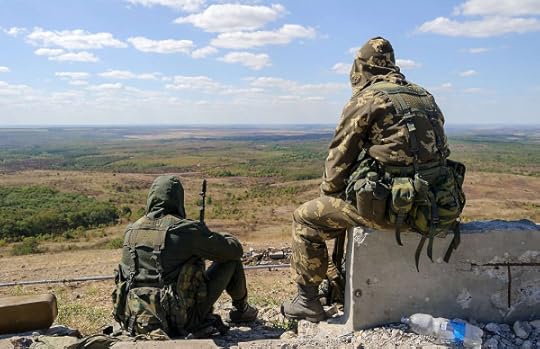 Wendel wrote: "The story seems to suggest that happiness is more about longing than about possession**. Longing to know what could be 'on the other side'. ..."
I really like what you said here. The story conveys a sense of longing or yearning for something that is just beyond reach. Even the setting with its vast landscape, the town in the distance, the Milky Way, etc. etc. we can see it but we can't possess it.
Maybe that's why I was having such a hard time with this story: I was trying to "pin" it down, to "grasp" it. And maybe Chekhov's whole point was to show us that "it" i.e. happiness cannot be pinned down/possessed. It will always be something on the horizon. Something just beyond our reach. Something nebulous that can never be pinned down.
Patrice wrote: ".. no meaning, no happiness, no God..."There is indeed no place for God - or any other idea in need of uppercase - in Chekhov's work.
Maybe that excludes 'Meaning', though I'm far from certain about that. I cannot however, agree that there is no happiness here - Chekhov rather seems to understand happiness as something no one can possess. But then again, I'm quite sure you would not claim to possess God?
Actually, these stories can be a source of happiness - maybe because they seem to be so truthful (undercast)? I at least found that when unduly worried, Chekhov often helped to put things in perspective again.
Patrice wrote: "Most of all i return to nihlism. no meaning, no happiness, no God in this universe. just imaginary superstition and false hope."Patrice, thanks for a great post. I have been pondering Chekhov's inclusion of the ability to see the settlements and your shared thoughts prompted a eureka moment for me and provided the perspective I needed to connect some dots. What about this passage?
. . .in the distance, Saur's Grave with its peaked top. If one clambered up on that tomb one could see the plain from it, level and boundless as the sky, one could see villages, manor-houses, the settlements of the Germans and of the Molokani, and a long-sighted Kalmuck could even see the town and the railway-station. Only from there could one see that there was something else in the world besides the silent steppe and the ancient barrows, that there was another life that had nothing to do with buried treasure and the thoughts of sheep.Interestingly enough one has to look beyond a grave and climb upon a tomb to see it. Could he be alluding to a happy afterlife here that those with certain long-sighted perspectives are able to realize?
 Sue wrote: "that essence of hope in a legend of fortune, that such provides something to dream of with a scintilla of happiness of the possible. "
Nice observation.
Bigollo wrote: "Thomas wrote: " The title of this story is sometimes translated "Fortune." Are the characters talking more about fortune than happiness, or is it the same thing?"The Russian word for “Happiness” ..."
Bigollo, thanks for this bit of information. Would you suggest reading the story and substituting "happiness" for the words "luck" or "treasure"? See, for me, the more serious discussion of happiness felt strangely tacked on at the end. Perhaps it would not have been so if I had been reading and thinking of happiness all along. For me, the title of "Happiness" jarred with the story until the end. Or maybe I should just go read it again. lol
Patrice wrote: "i love the painting of the scene. the young shepherd staring up at the stars, the old shepherd staring down at the ground and leaves."Symbolic of the endless possibilities stretching before the young man and the fact that the old man is close to 6 feet underground?
Wendel wrote: "Chekhov mentioning Saur Grave makes it possible to locate the story in eastern Ukraine, in the Donbass region. Saur Grave Hill was the scene of heavy fighting in WW2, remembered with a monument t..."
Neat to see the place, Wendel.
Several people have mentioned the sheep passages and connections with animals. For me, the sheep jumped out immediately. Sheep are easily led around. They were asleep, but still thinking. I'm feel a bit like Tamara: he mentions these sheep so many times but I'm not really sure what exactly I'm supposed to "get" from them. They seem to be much more than atmospheric additions.
Genni wrote: "Would you suggest reading the story and substituting "happiness" for the words "luck" or "treasure"? See, for me, the more serious discussion of happiness felt strangely tacked on at the end. Perhaps it would not have been so if I had been reading and thinking of happiness all along. For me, the title of "Happiness" jarred with the story until the end. Or maybe I should just go read it again. lol "I wouldn’t recommend substituting blindly. For one thing, the word, say, ‘treasure’ does not have as its prototype ‘schastye’ in the Russian text in ALL the instances. There is a regular Russian equivalent for ‘treasure’; and I remember seeing the word a couple of times in the story.
But, having said that, I think rereading the story and trying to substitute fortune, luck, and treasure for happiness where possible could be a fun experiment:).


The title of this story is sometimes translated "Fortune." Are the characters talking more about fortune than happiness, or is it the same thing?
The old man seems fairly obsessed with the treasure buried in the steppe. Why can he not answer what he would do with it if he found it?
"Happiness" is story 121 on the Eldritch Press site: http://www.eldritchpress.org/ac/jr/12...