
The Readers Review: Literature from 1714 to 1910 discussion

This topic is about
Eugénie Grandet
Honoré de Balzac Collection
>
Eugenie Grandet - Discussion - Week 1
date newest »
newest »

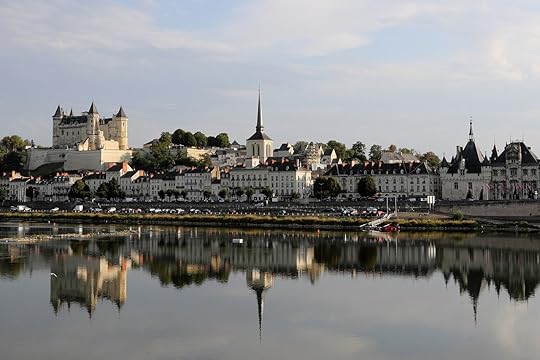
Saumur - a pleasant, still sleepy, small town, not far from Balzac’s native (more lively) Tours. And a stone throw from the abbey of Fontevraud, where Richard the Lionheart is buried together with his parents, Henry II and Eleanor of Aquitaine. Like Eugenie, Coco Chanel was born in Saumur - in the local poorhouse to be precise, the town probably didn’t mean much to her.
Balzac locates the Grandet house somewhere on the short but steep walk from the church of St. Pierre to the castle. En route you may restore yourself with some local white wine - they are fine indeed. But that's enough city promotion, back to the book.
Balzac is considered to be an early realist - Wikipedia mentions his unfiltered representation of society, and praises the multi-faceted characters; even his lesser characters are complex, morally ambiguous and fully human. However, the people we meet here aren’t particularly nuanced. It would be difficult to name one single redeeming trait of père Grandet, while the ladies Grandet are nothing much but innocent.
The most complex figure yet is Nanon. Of course the others, especially the younger generation, Eugenie and Charles, may develop later in the book. And anyway, why couldn’t we have good story without complex characters? Also, like everything, realism must be relative. Balzac at least places his novel in the utterly unromantic environment of the provincial bourgeoisie.
Though I’m not sure why we consider the middle classes to be so especially commonplace. Or why the French seem to be even more critical. It’s not like there are no misers in, say, Dickens, but Grandet’s narrow mindedness and meanness is more than a personal trait. He rather represents his class (he is only smarter than most), and 'the condition of' French provincial life in general.
Bashing the bourgeoisie is a trademark of many French authors, both from the left (Zola) and and right (Céline). But why? Are the middle classes indeed morally lagging, or does this critical attitude reflect the revolutionary tradition?
 Mod
Mod
It could be that the lower classes are considered "authentic", while the bourgeois are "posers", always trying to impress others, and of course not accepted by high society, even when they are rich.
Thank you for the picture, Wendel, it looks much more attractive than Balzac makes it appear.
Robin wrote: " ...it looks much more attractive than Balzac makes it appear. ..."Cities and towns must have looked different then. Houses and streets were not well kept, and even if not filthy they were grey. The first page of Old Goriot describes Paris: "… that illustrious valley of endlessly crumbling stucco and black, mud-clogged gutters …". People must have been quite different too, in appearance.
(I just finished EG and picked up Goriot for a bit of 'Parisian life')
 I wonder why Grandet’s guests visit him at all. They don’t seem to respect him, the hall is not comfortable and he seems unlikeable. I am thinking of the things Mrs. Grassin confides to Charles.
 The setting is so depressing to begin with. I am looking forward to some lively drama involving Eugenie and Charles.
Mod
 I agree! I think Grandet rather enjoys being the curmudgeon and having everyone dance to attention.
 I've read most of the reading for this week.Things are pretty busy, so I'm just going to post about what I've noticed so far. I don't have time to go in-depth with these interesting bits. Mr. Grandet is a penny pinching scrooge. He is so controlling over everything, the food the candles and so on. He is not considerate of his poor wife. She helped to make him wealthy by marriage, it's sad the way he doesn't spend money on her. spending money on someone shows how much you value them and how much you would like to make them happy at your own cost. I don't think He has much feelings for his wife, he just loves the money. I've met people that take saving money to the extreme. There are people that look poor, but are rich and there are people that look rich. but are poor. I'm wondering if this is going to be a riches to rags story.
 Another interesting thing mentioned is the the dozen, which is similar to a dowry.
It's also interesting in the was he calls his servant "poor Nanon." The description of Nanon is striking too. She is described as a Hercules. Mr. Grandet even makes her sleep in the closet.
Overall, I really like this book so far, looking foreword to this group read.
 So far I find the reading of this book thouroughly entertaining. The author spends much space in describing the environment, then he comes to the outer characteristics of the persons but their characters are only revealed later, slovly and gradually. I wonder why - some authors start by depicting the characters early or immefiately in their work. I wonder if he wants to say that their personality traits are formed by this environment to a very great extent. The women of the family are (surprisingly?) ignorant and uncritical towards the husband/father. How can they be kept apart from society to such an extent that they don't even realise how rich they are? Another thing is that so far there is absolutely no sisterhood between the two Grandet women and the women from the neighbouring families. The latter could at least have shown the Grandet women how badly they are treated in their home.
 Mod
All the characters are fixated on money. When Charles shows up, he gives them a breath of fresh air as someone who has so much money to not care to count it but only to enjoy it. Maybe that's a sign of "nobility" that the bourgeois doesn't comprehend, yet nobility doesn't necessarily mean good character. So far, beauty (both the invisible and the visible) does not seem to be present the way Balzac portray these characters (except for Charles).
Mod
All the characters are fixated on money. When Charles shows up, he gives them a breath of fresh air as someone who has so much money to not care to count it but only to enjoy it. Maybe that's a sign of "nobility" that the bourgeois doesn't comprehend, yet nobility doesn't necessarily mean good character. So far, beauty (both the invisible and the visible) does not seem to be present the way Balzac portray these characters (except for Charles).
 Linda wrote: "All the characters are fixated on money. When Charles shows up, he gives them a breath of fresh air as someone who has so much money to not care to count it but only to enjoy it. Maybe that's a sig..."
There is a lot of that in French literature. I was struck when reading Maupassant's Bel-Ami by how often actual prices are given.
 Rosemarie wrote: "Balzac begins most of his novels with detailed descriptions of the setting. Perhaps because we get to know people that way in actual life. We generally notice the surroundings first and then get to..."
Hhmmm that is true isn't, good observation.
I just started on this, so far good :)
Mod
But it turns out Charles doesn't really have money, as his father has lost it.
As far as the emphasis on money, those of us who read the first few novels of Zola found he talked a lot about it, both for the bourgeoisie and the nouveau riche.
 As for money, maybe it's the time not the country. There have been comments in the Trollope Project discussions about how money amounts are talked about precisely - we often seem to know people's income amounts, the amount owed, the dowry amount, etc.. I don't remember too many 20th century novels talking about the exact salaries of characters.
I like the way Balzac sets the scene, though I would have appreciated shorter paragraphs. As for characters, I wonder if anyone, besides Nanon, will be that likeable. I find them humorous, though. So far.
 There has been a change in attitudes towards discussing money in the UK where it is nowadays considered vulgar to do so. The rise of the middle classes during the Industrial Revolution led to a culture of being proud of your wealth and displaying it so this is what we observe in Trollope. This changed during the Napoleonic wars when there was fear of Revolution and its hatred of the rich.
 In France after the Revolution displays of wealth were despised as being linked to the deposed aristocracy and the excesses of Louis XIV so frugality and living simply, like a peasant, became something to be admired. We have also seen that reflected in Russian novels where aristocrats try to live like their peasants, in imitation of the French.
 But Balzac is all about the kind of person who got rich because of the revolution.
Goriot the cooper buying up vineyards at knock down prices, etc.
eta: I meant Grandet the cooper, of course..
Brian wrote: "As for money, maybe it's the time not the country. There have been comments in the Trollope Project discussions about how money amounts are talked about precisely - we often seem to know people's i..."The result being that today, financial matters are considered far more private than sexual and emotional matters.
Money (and class difference) is of prime importance in other Balzac novels too (Old Man Goriot). Money was indeed changing society - even, or especially, in the provinces. Hardheaded men (sometimes women) of business buying up the spoils of the revolution may have had a greater impact on France's future than Robespierre's chopping off heads or Napoleon's imperialism. It reminds me of what we have seen in Central Europe since 1989: unscrupulous, half educated, entrepreneurs nicking state property and eventually dominating politics as well.
Though the bold way in which Balzac describes old Grandet's tricks may also be seen as a display of his 'intrepid' realism (like the description of sexual matters in a later generation). And I have no doubt that there is a biographic element: Balzac was often involved in financial schemes himself, though in his case usually resulting in a loss.
A Penguin edition blurb states:"The theme of Balzac's Comedie Humaine is primarily that of the struggle to amass money and achieve power. This is seldom more evident than in Eugenie Grandet ..."
To me, the only power Grandet wants to achieve is the power to amass money.
I too liked the way the scene at the start of set up, a good description of the village, surroundings and the people.The detail description of money matters and amassing money by Grandet kind of threw me off the book.
But reflecting on the current world markets and the highs and lows of the current living standards in most places, it made me read on, and discovered that the struggles, at times, were similar then and now.
It was also sad to read how the women in the house were kept 'in the dark' (literally) and they seem to take it all i their stride.
What struck me there was not that its anything new, for the time depicted, but how Balzac seems rather a feminist.
This hooked me in, and I'm keen to see where he takes the female characters.


How does Balzac set the mood?
What kind of relationships exist within the Grandet family and with their neighbors, the Cruchots & the Grassins?
How does Balzac show the smugness of the small-town bourgeoisie? (something we've seen in Zola, Dickens and other writers as well)
Into this predictable milieu comes the Parisian cousin. (Shades of Return of the Native!) How do you think his arrival and the news in the letter will affect the family?