
Classics and the Western Canon discussion

This topic is about
Don Quixote
Don Quixote - Revisited
>
Chapters XXVIII - XXXII
date newest »
newest »
 It was getting a little crowed in the deep woods. Good place to meet new people, though.
Wow, what a change in personality when Sancho starts thinking about all the money he can make selling Ethiopians as slaves.
It was getting a little crowed in the deep woods. Good place to meet new people, though.
Wow, what a change in personality when Sancho starts thinking about all the money he can make selling Ethiopians as slaves."No flies on me! Who says I don’t have the wit or ability to arrange things and sell thirty or ten thousand vassals in the wink of an eye? By God, I’ll sell them all, large or small, it’s all the same to me, and no matter how black they are, I’ll turn them white and yellow. Bring them on, then, I’m no fool!”
Looks like a pretty damning criticism of the slave trade and slave traders to me -- greed, avarice, and the dark side of man all bundled up in one little common man, Sancho Panza, the everyman, who otherwise seems nonthreatening.
"I'm No Fool."
I take "large and small" to mean adult and child.
 It seems to me that the joke through these sections is how caught up everyone else becomes in meeting Don Quixote on his own terms in order to manipulate him in his own game. The priest seems to be enjoying himself the most in conducting the charade.
I am still undecided on the wisdom of humoring such persons but it is certainly comical in the story.
It strikes me that by humoring such a person by entertaining his delusion, you can manipulate him. Isn't that what the priest and barber were trying to do? And if the priest and barber can do it, so can someone with darker, more selfish motives too. Perhaps that's another reason not to humor them. But maybe only manipulation works.
One could also look at it as DQ, albeit unwittingly, has manipulated the priest and the barber into playing his game by their decision to humor DQ as a way to manipulate him. So who is manipulating whom?
{grin} An infinitely leafed clover: DQ is manipulating, *no he's not, yes he is* -- repeat between the asterisks until . . . ???
I found this passage near the beginning of Chapter 30 an interesting one relating to the literal rigidity to which DQ holds himself to his chivalric romance principles.“Imbecile,” said Don Quixote, “it is not the responsibility or concern of a knight errant to determine if the afflicted, the fettered, and the oppressed whom he meets along the road are in that condition and suffering that anguish because of misdeeds or kind acts. His only obligation is to help them because they are in need, turning his eyes to their suffering and not their wickedness. And I encountered a rosary, a string of disheartened, unfortunate people, and I did for them what my religion¹ asks of me;. . .Is Cervantes making a comment on religion here, or just absurdity of substitutes for religion? Is he also commenting on strict literal interpretations instead of figurative ones?
¹ In this context, religion signifies the order of chivalry.
[Grossman Translation]
 David wrote: "One could also look at it as DQ, albeit unwittingly, has manipulated the priest and the barber into playing his game by their decision to humor DQ as a way to manipulate him. So who is manipulating..."
It is interesting that there is no attempt to bring DQ back to reality. There seems to be a tacit assumption that this is not possible, but even if it were, would it be at all interesting or entertaining?
In Chapter 32 the priest is arguing with the innkeeper about the foolishness of chivalry novels as opposed to books of real history. They go back and forth, with the innkeeper finally gathering up his books to save them from the priest. But then the priest says he is interested in one particular novel -- The Novel of the Man who was Recklessly Curious. "The title of this novel certainly doesn't seem bad, and I think would like to read all of it." In the midst of trying to cure DQ's obsession with a fantasy world, the priest is himself pulled into one. Not only is he the author of a fiction, designed to trap DQ, but now he is drawn to a novel, like a moth to the flame.
(And though this may be reading between the lines, I don't think it's coincidental that this man is a priest.)
 Xan Shadowflutter wrote: "... I take "large and small" to mean adult and child. "
Xan, in my version it actually says "small with large" (chico con grande) and a footnote clarifies that it means that Sancho intends to sell them all in only one sale, as a block...
 Thomas wrote: "It is interesting that there is no attempt to bring DQ back to reality. There seems to be a tacit assumption that this is not possible, but even if it were, would it be at all interesting or entertaining? "
I think you're absolutely right, Thomas. There is no longer any more reason for these folks to try to bring Don Quixote to his senses. It seemed like the first set of chapters the main thrust was to see what might be done to bring him to reason, yet, after multiple attempts, they've given up all hope. As a result, we're left to play along with it and just hope that he doesn't hurt anybody.
Some folks there's just no convincing.
David wrote: "I found this passage near the beginning of Chapter 30 an interesting one relating to the literal rigidity to which DQ holds himself to his chivalric romance principles.“Imbecile,” said Don Quixote,..."Next passage:
And as he said this, he thrust his feet firmly into the stirrups and set his simple morion helmet firmly on his head, because the barber’s basin, which to his mind was the helmet of Mambrino, hung from the forebow of his saddle, waiting for the damage it had received at the hands of the galley slaves to be repaired.
Something of the petulant child in the entire passage. The child doubling down when told he is wrong, offering an all too simplistic explanation for his bad behavior.
And the child turns the golden rule and Christian teachings on their head, I think. He wishes to redress injustices, but misdeeds and kind acts are all the same to him, so he bludgeons and skewers guards who have done no wrong while freeing criminals to continue their crimes.
David wrote: "Is Cervantes making a comment on religion here, or just absurdity of substitutes for religion? Is he also commenting on strict literal interpretations instead of figurative ones? ."It's hard to ignore "rosary of .... people" here, and the explicit reference to religion. It's a specific kind of religious faith though. It takes its inspiration from literature, but it's not literal in itself -- we see how DQ is able to wiggle out of the contradictions and paradoxes that come from literalism, like a good lawyer or theologican would.
I think more generally it's a comment on zealotry. Honor is the most important quality of soul for DQ, but his standards for honor seem to be out of whack, or out of sync with his community and his time.
Totally unecessary extracurricular question for the absurdly ambitious:
Aristotle says in the NIchomachean Ethics that the "great-souled" person is primarily concerned with honor. It seems to me that this is DQ's primary virtue as well, or the one he holds to be preeminent.
Take a look at Aristotle's Ethics, Book 4 Chapt. 3 (which we read here a while back) and ask yourself if DQ would qualify as being "great-souled." I think he does, but there are problems.
Chapter 31DQ and SP are discussing the letter EQ gave SP to give to Dulcinea. DQ asks SP if she put it in her head. My footnote says this is a sign of respect. All I could think of was Carnac The Magnificent. Showing my age.
 David wrote: "Is Cervantes making a comment on religion here, or just absurdity of substitutes for religion? Is he also commenting on strict literal interpretations instead of figurative ones? "
I consider this entire volume a great critique of religion and, yes, I think that chivalry is identical with religion in the context of this book. There is at very least a considerable amount of scholarly writing to support this.
Considering the constraints of writing during this period, I think that Cervantes goes to great lengths to say what he means cloaked in something which doesn't criticize directly.
In fact, there is a great deal of discussion as to whether Cervantes himself was a converso but even if he was, one would be hard pressed to argue that this impacts his criticism of the Catholic Church.
The great argument, hardly unique to DQ, is how a higher love for another exposes itself in the world and how those in the world relate to that love. We may try to move our best thoughts to purity and love, but it sometimes, at very least, seems to resolve into something less. As a friend said to me, it is an easy thing to love God, but it is much harder to do it on His own terms.
One of the reasons I enjoy these stories on the side is because I believe that, far from them being relief of any kind, we are exposed to more of what Cervantes would have us understand.
 When confronted with the consequences of his freeing the prisoners, DQ replies that his only responsibility is to alleviate human suffering wherever he sees it. He is under no obligation to learn the cause of their punishment or to determine whether they deserve it. He isn’t plagued with moral dilemmas, doesn’t equivocate, and dismisses context. He lives in a world where everything is clear cut. When confronted with a situation, he automatically behaves according to his book of rules. No questions asked. No shades of grey. This attitude absolves him of taking responsibility for his choices and/or behavior.
 There must be something very comforting in abdicating your ethical and moral decisions to an outside entity in this way—whether it is to a book of rules or to some other external entity. It is also extremely dangerous and very scary.
I agree with what has already been suggested--Cervantes is pointing out the dangers of an unquestioning adherence to religion.
A couple of things I really enjoyed in this section is the name Pandafilando of the Gloomy Glance. What a delightful name! And Sancho’s description of Dulcinea as exuding “a mannish kind of odor” had me in stitches.
The innkeeper seems to be as obsessed with books of chivalry as DQ. But unlike DQ, he has a foothold in reality—in his time and place.“. . . I won’t be crazy enough to become a knight errant; I see very well that these days are different from the old days, when they say those famous knights wandered through the world.”
Are we to take from this that believing in fantasies is not harmful as long as we keep our feet grounded in reality—as long as we are not out of joint with our time and place?
And to take this one step further. If Cervantes is using chivalry to critique religion, is he suggesting that acting on one's religious beliefs must be grounded in one's time and place? In other words, application of principles--religious or otherwise--must take into consideration current context.
Tamara wrote: "Are we to take from this that believing in fantasies is not harmful as long as we keep our feet grounded in reality—as long as we are not out of joint with our time and place?". . .In other words, application of principles--religious or otherwise--must take into consideration current context.For me the questions Cervantes suggests are on a spectrum of possibilities..
1. The chivalric romances are fictions.
2. The chivalric romances are deemed to be true, but impractical, obsolete, or too hard to live by in the current times, but good to read during idle time, as the inkeeper suggests.
3. The chivalric romances are deemed to be true and taken as dogma to live by, in all times, as DQ is attempting and suffering from, almost gladly, and causing others to suffer.
Of course these same questions apply to religion as well.
1. Is religion a fiction?
2. I religion true, but impractical, obsolete, or too hard to live by in these times. Are religious texts good to read during idle times, as long as it is tempered by reason and not taken too seriously or dogmatically, and discerning the beneficial from the harmful.
3. Should religious texts be taken literally and as dogma at all times, despite the suffering it causes to one's self and others?
Furthermore, respecting the religious aspects.
1. Does Sancho's character correspond to a clergy that profits from the dogmatic belief's of others? Does Sancho encourage DQ more than he discourages him from his quests?
2. Des DQ letting the prisoners go due to his quixotic dogma reflect the battle for ultimate authority between church and state? I thought of this one while watching Becket this weekend.
David wrote: "For me the questions Cervantes suggests are on a spectrum of possibilities..1. The chivalric romances are fictions.
2. The chivalric romances are deemed to be true, but impractical, obsolete, or too hard to..."
A helpful post/summation of the range of possibilities.
Thank you, David.
 David wrote: "I found this passage near the beginning of Chapter 30 an interesting one relating to the literal rigidity to which DQ holds himself to his chivalric romance principles.“Imbecile,” said Don Quixote,..."
There have been great comments on this! I'd like to look at it from another direction, there is a kernel of truth in what DQ is saying.
He is separating the human person and his suffering from his (mis)deeds. This is very Catholic, i.e., the person in his personhood has innate dignity. Our actions are a separate matter from personhood and come from the exercise of our free will. What DQ is pointing out is regardless as to the causes of suffering, suffering it is. He shows charity and gives dignity to each of these prisoners by acknowledging their humanity. The "human rosary" is a fabulous visual how mankind is shackled to our sufferings/sins. At the same time it points to salvation.
Of course in true fashion DQ falters at the same time by ignoring that one has to atone for one's misdeeds. These prisoners committed crimes and they need to serve their sentence.
Kerstin wrote: "He is separating the human person and his suffering from his (mis)deeds. This is very Catholic, i.e., the person in his personhood has innate dignity. "Ah, I see. Thanks, Kerstin.
Kerstin wrote: "There have been great comments on this! I'd like to look at it from another direction, there is a kernel of truth in what DQ is saying...I'm a little confused by your post, Kerstin, and would appreciate a clarification.
On the one hand, I think you're saying it's good to separate the human person from his suffering and misdeeds because by doing so, you're acknowledging his innate dignity. But on the other hand, I think you're saying that a person has to be held accountable for his misdeeds.
If you hold a person accountable for his misdeeds, does that mean you're denying his dignity?
I'm sorry. I guess I'm just not understanding.
Tamara wrote: "When confronted with the consequences of his freeing the prisoners, DQ replies that his only responsibility is to alleviate human suffering wherever he sees it. He is under no obligation to learn t..."Great point, Tamara. I think I would even take it one step further to say that MC is pointing out the dangers, not just of blind adherence to religion, but blind adherence to any ideology.
Tamara wrote: "I'm a little confused by your post, Kerstin, and would appreciate a clarification.If you hold a person accountable for his misdeeds, does that mean you're denying his dignity?
I'm sorry. I guess I'm just not understanding. "
Sorry Tamara, I hope this is less confusing...
Holding someone accountable does not deny their dignity, unless the person is deliberately mistreated.
The innate dignity of every person is separate from behavior, yet both are manifested in each person. In other words, being human is our essence, behavior is an individual choice.
Got it! Thanks, Kerstin.
Kyle wrote: "Great point, Tamara. I think I would even take it one step further to say that MC is pointing out the dangers, not just of blind adherence to religion, but blind adherence to any ideology. "It seems unlikely that Cervantes really had a deeply heartfelt animus against novels of chivalry. It seem more likely that DQ's fanatical adherence is a wild card or stand-in for something else. Some people are fanatically devoted to role playing games, or Star Trek, or Princess Diana. For these folks their obsession is a "religion." I don't think that Cervantes is satirizing religion per se, but perhaps some forms of it that are absurdly incompatible with the everyday world.
Thomas wrote: "Some people are fanatically devoted to role playing games, or Star Trek, or Princess Diana. For these folks their obsession is a "religion."If it isn't out there somewhere already, I can easily imagine a modern retelling of this story around an Obi-Wan Quixote pursuing the life of a Jedi-Knight-errant. There is in fact a Jedi religion/church:
We are a Jedi church and international ministry of the religion Jediism and the Jedi way of life. Jedi at this site are not the same as those portrayed within the Star Wars franchise. Star Wars Jedi are fictional characters that exist within a literary and cinematic universe. We are a recognized International Ministry and Public Charity; a tax exempt (donations are US income tax deductible) 501(c)3 non-profit organization founded in 2005.I have to note the admission that the fundamental basis for the religion is fictional is more honest than most. And of course there is more than one:
https://www.templeofthejediorder.org/
https://www.jedichurch.org/
I cannot find any at the moment, but I do recall several real news items in the past relaying the quixotic misadventures of those aspiring to be Jedi Knights with consequences ranging from amusing to tragic. There may even be a few more profound stories out there, but they don't seem to make the news.
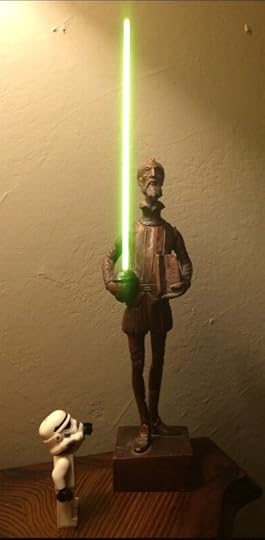
 Religions based on fiction, or other elements of popular culture, have been under study for a number of years. An Australian scholar, Carole Cusack, has posted on-line a number of articles on the subject, along with other material. See, for example, the writings of Carole Cusack, at https://sydney.academia.edu/CaroleCusack
 (A free sign-in with Academia site is required for basic services. Very annoyingly, it now has a pop-over promoting the more powerful paid version which appears whenever you download an article, although not when you check the preview, if one is offered.)
Cusack's page includes a bunch of books, the downloads for which (I think -- I haven't tried every one) are just to front-matter and/or advertising announcements. The articles and papers follow: most are fairly short. The titles are usually self-explanatory, and at least some of them are available for complete downloads.
Of particular interest are "Six Entries for the Dictionary of Contemporary Esotericism: Church of All Worlds; Oberon Zell-Ravenheart; Morning Glory Zell-Ravenheart; Grey School of Wizardry; Fourth Way; Gurdjieff Foundation" at
https://www.academia.edu/31098869/Six...
and "Science Fiction as Scripture: Robert A. Heinlein’s Stranger in a Strange Land and the Church of All Worlds" at
https://www.academia.edu/738499/Scien...
By the way, I find it doubtful that Cervantes was deliberately portraying Don Quixote's obsession with fictional chivalry as an allegory of, or analogue to, religion, and especially Catholicism. If he did, it was so subtle as to elude the rather rigorous censorship in Spain. And none of his Protestant readers outside of Spain seem to have detected anything critical of the Roman Catholic Church, either.
Which doesn't mean that the comparison isn't valid -- Cervantes may have done it unconsciously, or simply stumbled on a formula that, from our perspective, can be interpreted in that manner without stretching things excessively.
Ian wrote: "By the way, I find it doubtful that Cervantes was deliberately portraying Don Quixote's obsession with fictional chivalry as an allegory of, or analogue to, religion, and especially Catholicism..."Perhaps he's not satirizing Catholicism and/or religion, per se, as Thomas suggested @29. Instead, perhaps he is satirizing the individuals who confuse the literal with the spiritual aspects of a religion and/or ideology.
I'm coming back to the human rosary one more time. I think Cervantes had a soft spot in his heart for the convicts who did time in the galleys. He was part of the sea Battle of Lepanto, 7 October 1571, where against overwhelming odds the Holy League defeated the Ottomans. Because the threat was so dire, Pope Pius V called for all the faithful to pray the rosary. To this day on October 7 the Battle of Lepanto is marked in the liturgical calendar, and October is dedicated to the rosary.
With this scene Cervantes may have memorialized the contribution of all the forgotten convicts who slaved away in the bellies of the galleys.
Tamara wrote: " I don't think that Cervantes is satirizing religion per se, but perhaps some forms of it that are absurdly incompatible with the everyday world. *I think we should back up from the microscopic view we have in this reading and see the world-view, if you will, in terms of the historically great powers that were Catholic Spain and its bitter rival, the Moors.
While I am sure that everyone knows the history of Spain during its Golden Age, there were a few issues which seem prominent to me. First, with the discovery of the New World, far from restoring Spain for all its war efforts, this encouraged a new mindset in the hidalgos that they might find some shortcut to riches. Their attitude was clearly to debase anyone who believed in hard work and great effort to achieve influence and power. These people wished to live an easy life of rentiers with investment in government censos
These censos were the greatest plague and perdition of Spain, wrote González de Cellorigo, perhaps the most acute of the arbitristas [essentially government economic and social analysts] of 1600. “It seems,” he concluded, “as if we had wanted to turn these kingdoms into a republic of enchanted men, living outside the natural order.”
When we look at Sancho counting the money from his slaves, we see an image of a greater social issue. When we speak of the love of God in the Spanish Catholic Church, we also have to understand that this same love was sanctioning the mistreatment and enslavement and even death of thousands of native Americans. All of this is signified in the mention of the picaresque work, Lazarillo de Tormes where the hidalgo would rather starve than raise his hand to work, expecting the boy to scrounge for them both.
This issue is taken to a much greater psychological analysis in Don Quixote, perhaps anticipating some of Freud, but certainly portraying the characters living in a republic of enchanted men
Although this is probably tangential and a bit tedious, Phillip II in 1567 had outlawed Muslim dress and Arabic texts. Whatever text is left over found in Don Quixote, must have been a rare one indeed....and highly illegal. Most of the Moors semi-converted by force and became moriscos or new Christians.
Phillips III's expulsion edict in 1609 expelled moriscos and Moors alike with varying degrees of success according to different the region. However the expulsion of Muslims was quite efficient in Aragon and, as a direct result, this resulted in a marked loss of technology and wealth, resulting in a marked shift in power from Castile to Barcelona where the Muslims existed in greater number.
Rhonda wrote: "Tamara wrote: " I don't think that Cervantes is satirizing religion per se, but perhaps some forms of it that are absurdly incompatible with the everyday world. *I think we should back up from th..."
Just as an FYI, Rhonda. You attributed the above words to me. They are actually Thomas' words (see #29).
It's no big deal. I just wanted to correct the record.
I've been participating in another Goodreads discussion, on Wayne C. Booth's "Rhetoric of Fiction" (first edition 1961, second 1983), and came across a sentence in Chapter Seven, "The Use of Reliable Commentary" (p. 183): "Is Don Quixote a Christian saint or a lovable old fool?"Booth provides a footnote to a then-recent article on the subject: "For an excellent defense of Cevantes' own explicit judgments, see Oscar Mandel, "The Function of the Norm in Don Quixote," Modern Philology, LV Feb., 1958, 154-163."
I've taken a look at the article, which, fortunately, can be read free on-line at a digital library, JSTOR (see https://about.jstor.org/ -- downloading requires a rather steep payment), which requires a free registration, and has some other restrictions. You will be asked to register or log in, and offered a subscription service, which you can skip.
 Xan Shadowflutter wrote: "Wow, what a change in personality when Sancho starts thinking about all the money he can make selling Ethiopians as slaves.
"No flies on me! Who says I don’t have the wit or ability to arrange thi..."
I don't know what intention it has but I am a bit disapointed by Sancho.
Tamara wrote: "When confronted with the consequences of his freeing the prisoners, DQ replies that his only responsibility is to alleviate human suffering wherever he sees it. He is under no obligation to learn t..."It seems with Adolf Eichmann defending his actions as "I was just obeying orders". This thinking removes your own responsability of your misdeeds.
Some of you were debating the disappearing and reappearing of the Sancho's donkey, but my edition keep it disappeared. It only appears when they encounter Ginés again and he flees.
Rhonda wrote: "When we speak of the love of God in the Spanish Catholic Church, we also have to understand that this same love was sanctioning the mistreatment and enslavement and even death of thousands of native Americans."Yes and no. There were brave priests on Cuba, for instance, who preached against and reported the mistreatment and enslavement of indigenous people in the New World. The earliest offical Papal denunciation of slavery I know of is Sublimus Dei dated 29 May 1537, roughly 80 before the publication of Don Quixote. It isn't the only such document. Sublimus Dei is fairly short and the most important part,
"We define and declare by these Our letters, or by any translation thereof signed by any notary public and sealed with the seal of any ecclesiastical dignitary, to which the same credit shall be given as to the originals, that, notwithstanding whatever may have been or may be said to the contrary, the said Indians and all other people who may later be discovered by Christians, are by no means to be deprived of their liberty or the possession of their property, even though they be outside the faith of Jesus Christ; and that they may and should, freely and legitimately, enjoy their liberty and the possession of their property; nor should they be in any way enslaved;..."
http://www.newadvent.org/library/docs...
One of the things that complicated the matter due to political wrangling (see China today), is that the kings of Spain instituted their bishops and not the Holy See. They were able to put in their sycophants, so compliance was largely ignored. But all was not lost. In due time the Church in Spain (and/or Portugal?) developed guidelines on the humane treatment of indigenous people which was the basis of today's International Law and Human Rights understanding. The book How the Catholic Church Built Western Civilization has an entire chapter on the origins of International Law.
Tamara wrote: "Rhonda wrote: "Tamara wrote: " I don't think that Cervantes is satirizing religion per se, but perhaps some forms of it that are absurdly incompatible with the everyday world. "Sorry for the misquote. I hate when others do it to me, unless, of course, someone said something very astute. ;)
Kerstin wrote: "Rhonda wrote: "When we speak of the love of God in the Spanish Catholic Church, we also have to understand that this same love was sanctioning the mistreatment and enslavement and even death of tho..."While clearly I have oversimplified my statement in the interests of brevity, I did not wish to denounce the entire Catholic Church nor would I denounce a significant religious body of Jesus Christ for the sins of the few. Certainly there were some very good people trying to do good things and I apologize if I indicated anything different.
My greater point is the confusion and rationalization with having pillaging and looting the New World, the Spanish social system was thrown into deep disarray which was well-documented by the arbitristas.
While I would hesitate to raise the Inquisition, it is also quite clear that the proverbial violent violations of those who appeared to be non-believers, was highly exaggerated and yet remains "fact" for many people studying this period today. There is, of course, no doubt that Spain did its best to ensure that everyone left in the country was Catholic, expelling many, even when it was not in its best interest to do so. The effects were significant in Cervantes' time.
As a side note, it appears that Cervantes himself applied to go to the New World but was rejected, apparently twice. Scholars have cited this as part of the evidence for him having been a converso.
All I know is that some of those ladies are so cruel that their knights call them tigers and lions and a thousand other indecent things. And sweet Jesus, I don’t know what kind of people can be so heartless and unfeeling that they don’t look at an honorable man, and let him die or lose his mind. I don’t know the reason for so much stiffness: if they’re so virtuous, let them marry, which is just what their knights want.That is the innkeeper's daughter speaking. A barber, a priest, an innkeeper, his wife, and his daughter sit around a table discussing stories of chivalry. The men are all caught in the fantasy and the romance. The women . . . ?
The innkeeper's wife notes her husband's irresponsible behavior when he reads them. And the innkeeper's daughter notices the cruelty in the fighting and especially in these ladies of virtue who keep their knights waiting. The innkeeper's daughter seems to be calling these so called virtuous women teases or worse.
Edit: Compare these virtuous women with Marcela. Doesn't Marcela look like the more honest and virtuous one.


Dorotea's story dovetails with Cardenio's, creating dramatic tension of a more conventional sort. It is at least a respite from the slapstick. Do the stories within the stories blend well with the overarching plot so far, or do they strike you as distractions? What, if any, is the relation between the framed tales and the journey of DQ and Sancho?
Chapter 31 shows DQ on the horns of a dilemma -- he must choose between his newly discovered destiny, to defeat the dread giant Pandafilando and restore Princess Micomicona to her rightful place, or to remain loyal to Dulcinea. He rationalizes a way to do both, saying that whatever he does redounds to Dulcinea's greater glory and fame.
Shortly thereafter, Andres, the boy DQ saved from being whipped by his master, reappears and tells DQ that his master not only did not pay him, as DQ commanded, but beat him even more. DQ had sworn that he would find the master and make him pay if he didn't follow through. But his promise to Princess Micomicona conflicts with his prior promise. What ever is a knight to do?
In the next chapter, just as the barber and the priest are about to go on another book burning spree in the inn, the priest finds some papers he finds interesting. He likes the first few lines and asks the innkeeper permission to copy it if he likes it. Cardenio likes the first part, and Dorotea is game... so it looks like we're getting another novel.