
Book Nook Cafe discussion
Group Read
>
Tender is the Night- October 1, 2014

 Discussion Questions
*** Discussion Questions may contain SPOILERS !
1. How would you describe the characters of Dick and Nicole Driver? What is the nature of their marriage? Do they love one another? Talk about how and why their marriage changes during the course of the novel?
2. Talk about Nicole's psychological state? Why did Dick marry her? As his patient, their relationship most likely would be viewed today as a violation of the the American Psychiatric Association's (APA) code of ethics. Why would marrying a patient concern the APA? How does Nicole's mental illness affect their marriage?
3. What do you make of Rosemary Hoyt? Is she a "provocateur" with regards to the Drivers' marriage? Would you describe her as innocent, aggressive, duplicitous...or as a young, naive American out of her depth? Why is Dick Driver attracted to her? What, if anything, does she offer him? What does it say about Rosemary that she is also attracted to Brady right after professing her love for Dick?
4. Rosemary encounters two parties on the beach at the beginning of the book. What is the distinction she makes between the two—and what do two circles represent? What is your opinion of the two groups?
5. The book is concerned with the differences between Americans and Europeans. How does that difference present itself? Would you say that Dick is more European or more American?
6. The narrator refers to French Mediterranean Coast as a region in a state of flux. How so?
7. The book's narrator identifies with Rosemary in the first part of the novel. Thus we see the characters through her perspective. Starting in Book 2, however, the narrator is allied with Dick Driver...as we follow him into his decline. Why would Fitzgerald have used two perspectives?
8. Hollywood is, of course, the capital of acting. How does "acting" become a theme throughout the novel? Who besides Rosemary acts? What does Hollywood as "the city of thin partitions" mean? How might that descriptive phrase apply to the main characters?
9. How does McKisco change after the duel...and what inspires the change? Talk about the juxtaposition of his rise with Driver's fall.
10. What is the significance of the scene in the restaurant, where the Drivers, Norths and Rosemary measure the "repose" of American diners? How does "repose" reflect on Americans' ability to maintain elegance and dignity? Are those qualities important?
11. In what ways can Dick be considered a father figure for women? Would you say he has a need to fulfill that role?
12. Does Nicole ruin Dick's potential to become a great psychiatrist? In other words, did she ruin his career...or is he the cause of his own downfall?
13. By the end of the novel, Nicole seems to have achieved a healthy mental state. Is Dick responsible for her cure?
14. Who loves whom in this book? Do Dick and Nicole love one another? Does Dick love Rosemary? Does Nicole love Tommy Barban?
15. Critics and scholars see Tender Is the Night as partially autobiographical, tracing F. Scott's and Zelda's marriage. Do a little research and discuss how the book parallels the Fitzgeralds' own lives.
16. Does Dick's disappearance in America resolve any problems raised in the novel? Why would Fitzgerald have ended his story in this way? Do you find the ending satisfying...or would you have preferred a different one?
~~ Questions by LitLovers.
Zelda and F. Scott Fitzgerald, circa 1921.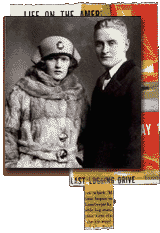
Author Bio
• Birth—September 24, 1896
• Where—St. Paul, Minnesota, USA
• Died—December 21, 1940
• Where—Hollywood, California
• Education—Princeton University
F. Scott Fitzgerald was named for his famous relative, Francis Scott Key, though he was always referred to as "Scott." Minnesota born and Princeton educated, Fitzgerald published his first novel, This Side of Paradise, in 1920 to critical and popular acclaim.
That same year, He married Zelda Sayre, the queen of Montgomery, Alabama youth society, and the two lived a boisterous, decadent life in New York City. (See LitCourse 5 with Fitzgerald's story "Babylon Revisited" for an idea of their life.) To better afford their extravagant lifestyle, the couple moved to France, where Fitzgerald befriended Hemingway and Gertrude Stein, becoming part of the legendary group of expatriate writers and artists, which Stein labeled the "Lost Generation." In Paris he wrote his finest novel, The Great Gatsby (1925).
Zelda was eventually hospitalized in 1930 for the first of many breakdowns, and Fitzgerald moved to Hollywood (William Faulkner was there, too), where his heavy drinking ended his screen writing career. In 1934 he published Tender Is the Night. He died there of a heart attack six years later at the age of 44.
~~ Lit Lovers
Epigraph"Already with thee! tender is the night.
… But here there is no light,
Save what from heaven is with the breezes blown
Through verdurous glooms and winding mossy ways."
~~ Ode to a Nightingale
Here is the full poem
John Keats. 1795–1821
624. Ode to a Nightingale
MY heart aches, and a drowsy numbness pains
My sense, as though of hemlock I had drunk,
Or emptied some dull opiate to the drains
One minute past, and Lethe-wards had sunk:
'Tis not through envy of thy happy lot, 5
But being too happy in thine happiness,
That thou, light-wingèd Dryad of the trees,
In some melodious plot
Of beechen green, and shadows numberless,
Singest of summer in full-throated ease. 10
O for a draught of vintage! that hath been
Cool'd a long age in the deep-delvèd earth,
Tasting of Flora and the country-green,
Dance, and Provençal song, and sunburnt mirth!
O for a beaker full of the warm South! 15
Full of the true, the blushful Hippocrene,
With beaded bubbles winking at the brim,
And purple-stainèd mouth;
That I might drink, and leave the world unseen,
And with thee fade away into the forest dim: 20
Fade far away, dissolve, and quite forget
What thou among the leaves hast never known,
The weariness, the fever, and the fret
Here, where men sit and hear each other groan;
Where palsy shakes a few, sad, last grey hairs, 25
Where youth grows pale, and spectre-thin, and dies;
Where but to think is to be full of sorrow
And leaden-eyed despairs;
Where beauty cannot keep her lustrous eyes,
Or new Love pine at them beyond to-morrow. 30
Away! away! for I will fly to thee,
Not charioted by Bacchus and his pards,
But on the viewless wings of Poesy,
Though the dull brain perplexes and retards:
Already with thee! tender is the night, 35
And haply the Queen-Moon is on her throne,
Cluster'd around by all her starry Fays
But here there is no light,
Save what from heaven is with the breezes blown
Through verdurous glooms and winding mossy ways. 40
I cannot see what flowers are at my feet,
Nor what soft incense hangs upon the boughs,
But, in embalmèd darkness, guess each sweet
Wherewith the seasonable month endows
The grass, the thicket, and the fruit-tree wild; 45
White hawthorn, and the pastoral eglantine;
Fast-fading violets cover'd up in leaves;
And mid-May's eldest child,
The coming musk-rose, full of dewy wine,
The murmurous haunt of flies on summer eves. 50
Darkling I listen; and, for many a time
I have been half in love with easeful Death,
Call'd him soft names in many a musèd rhyme,
To take into the air my quiet breath;
Now more than ever seems it rich to die, 55
To cease upon the midnight with no pain,
While thou art pouring forth thy soul abroad
In such an ecstasy!
Still wouldst thou sing, and I have ears in vain—
To thy high requiem become a sod. 60
Thou wast not born for death, immortal Bird!
No hungry generations tread thee down;
The voice I hear this passing night was heard
In ancient days by emperor and clown:
Perhaps the self-same song that found a path 65
Through the sad heart of Ruth, when, sick for home,
She stood in tears amid the alien corn;
The same that ofttimes hath
Charm'd magic casements, opening on the foam
Of perilous seas, in faery lands forlorn. 70
Forlorn! the very word is like a bell
To toll me back from thee to my sole self!
Adieu! the fancy cannot cheat so well
As she is famed to do, deceiving elf.
Adieu! adieu! thy plaintive anthem fades 75
Past the near meadows, over the still stream,
Up the hill-side; and now 'tis buried deep
In the next valley-glades:
Was it a vision, or a waking dream?
Fled is that music:—do I wake or sleep? 80
http://www.bartleby.com/101/624.html
Birthday !
"His was a great sin who first invented consciousness. Let us lose it for a few hours."
- F. Scott Fitzgerald born on September 24, 1896
This week in history -- on September 24, 1896 -- F. Scott Fitzgerald was born to a wealthy family in St. Paul, Minnesota. The literary impulses of the young Fitzgerald -- who'd go on to become the messiah of Jazz Age melodramas -- arose with great urgency. By age thirteen, he 'published' his first work in the school newspaper. By the time he signed up for WWI, he dashed off a novel -- The Romantic Egoist -- in mere weeks, afraid he'd die before achieving literary success. Chastened by a rejection letter from Charles Scribner's Sons, Fitzgerald edited his work after the war and renamed it This Side of Paradise. Published in 1919, it became an instant success.
Despite the extravagance we've come to associate with Fitzgerald novels, his own ambitions were id-driven, sourced from some primeval urge to write rather than accumulate wealth. The Great Gatsby, after all, was not the green beacon of great literature it's regarded as today. After draining the money that came from his first novel's success, F. Scott and the unstable Zelda -- then a combustible couple -- found themselves in dire financial straights. Their troubles were often deepened by their own lavish, boozy lifestyles, and the Fitzgeralds frequently relied on loans from agents and editors to stay afloat.
With troubles mounting -- alcoholism became an unwelcome guest in the Fitzgerald household, schizophrenia was prying at Zelda's grasp of reality -- Fitzgerald soon wrote what many critics deem his most thinly-veiled autobiographical novel: Tender is the Night. For a glimpse into Fitzgerald's life through his own eyes, start there. For more on the overarching worldview of the great American writer -- in his fiction and his letters -- start with the nine quotes below. And finally, if you're wondering where the spirit of F. Scott Fitzgerald resides today, let his "Lost Generation" pal Ernest Hemingway color your imagination with a candid assumption of a Fitzgeraldian heaven: "A beautiful vacuum filled with wealthy monogamists, all powerful and members of the best families all drinking themselves to death."
1. "The idea that to make a man work you've got to hold gold in front of his eyes is a growth, not an axiom. We’ve done that for so long that we've forgotten there’s any other way." ("Amory Blaine" in This Side of Paradise, 1920, Bk. 2, Ch. 5)
2. "The victor belongs to the spoils." (The Beautiful and Damned, 1922)
3. "All good writing is swimming under water and holding your breath." (Undated letter to his daughter "Scottie," Frances Scott Fitzgerald in Letters)
4. "The test of a first-rate intelligence is the ability to hold two opposed ideas in the mind at the same time, and still retain the ability to function." (The Crack-Up, 1936)
5. "His was a great sin who first invented consciousness. Let us lose it for a few hours." (From "A Diamond As Big as The Ritz" in Short Stories)
6. "Genius goes around the world in its youth incessantly apologizing for having large feet. What wonder that later in life it should be inclined to raise those feet too swiftly to fools and bores." (The Crack-Up, 1936)
7. "All life is just a progression toward, and then a recession from, one phrase— 'I love you.'" (From "The Offshore Pirate" in Short Stories)
8. "It is in the thirties that we want friends. In the forties we know they won't save us any more than love did." (Notebooks)
9. "So we beat on, boats against the current, borne back ceaselessly into the past." (The Great Gatsby, 1925)
http://www.biographile.com/9-f-scott-...
* page # for hardcover editionI've started and read the first 3 chapters.
His descriptions are so vivid; I feel like I am on he French Riviera !
I love the way he writes- Frequently I find myself re-reading lines just for the enjoyment of it.
simple things like -
Chapter 2 page 16
"Obviously he had created his wife' world, and allowed her few liberties in it."
Glad to have you aboard, Lesley !
Carol wrote: "I started tonight!"Excellent !
 I'll probably join in next week. I'm not quite in the mood for this one right now - not sure what I will read next - but will definitely get to this one soon!
Looking forward to the discussion.
We read & discuss the book all month long. I'm also a slow reader, so next week is fine. :)
 So far I'm at chapter 15.
 Seventeen-year-old Rosemary and her mother, Elsie Speers, are enjoying their time at a beachfront hotel on the French Riviera. Rosemary just finished a new film entitled Daddy's Girl and Rosemary's goal is to find a lover, which appears to be Dick Diver, a very strange individual. The Diver's (Dick and wife Nicole) host a party; with Nicole realizing that Rosemary wants Dick as a lover. Something shocking is in the Diver's bathroom, Tommy Barbarn (soldier) might know and stays close to Violet. Later there is a gun duel at 4am, both men shoot and miss. Dick and Rosemary were viewing memorials and found a young girl, carrying a wreath. She was a red-haired from Knoxville, Tennesse whom they met on the train in the morning. She was trying to find her brothers grave. Dick advised her to lay the wreath on any grave. She asked, "Is this what I ought to do?" And Dick replied, "I think that's what he'd have wanted you to do." She rode back with them.
Carol, the first part of the book is told from Rosemary's point of view. You are way ahead of me, but do you have an opinion on her? To me, she seems a bit fickle. She is young of course. I smiled when she met Dick for a minute and then went back to her mother and said she was in love.
IMO I'm not sure about Rosemary Hoyt's character. First she has been spoiled by her mother, and has been successful in the film industry. Since she is an actress, maybe things she says are not always true. I also thought that when she attempted to seduce Dick Divers, 34 yrs. old, she told him that she loved both him and his wife, Nicole. She chooses Dick Diver to be her "father" figure. (She is young enough to be his daughter.) She is a complex character -- "We never really pierce Rosemary’s veil. We don’t know how much is acting, how much is sincere, how much is the excited imagination of a young woman." I wouldn't trust her.
I finished Book One!!Rosemary announces her 18th birthday one day late and Dick (his position as a psychiatrist) insists on a party the next night to celebrate. He is focused on Nicole and her feelings. Rosemary enjoys her first glass of champagne and trying to get Dick into bed.
Abe North, musician, has a misunderstanding with black men in a bar in Paris. One is shot in Rosemary's suite, and Dick calls another Doctor to help him remove the body (keep Dick's reputation clean.) The body is in the hall, reported to the hotel manager by another colleague of Dicks. Where is Nicole? They find her on the bathroom floor, swaying and oddly talking. Rosemary remembers that Violet McKisco saw something weird in the toilet 2 weeks ago.
I'm listening to an audio version of the book (so much easier!) The best thing about it is that it is an old audio format, published with The Scribner Library, 1933 - which is exactly the same publisher and year -1933! of my book. odd . . .
Carol wrote: I wouldn't trust her."I'll keep that in mind as I read. Thanks.
Carol wrote: "I finished Book One!!..."
Wow ! That's fast. I'll try to get a few chapters in tonight
Background on Tender is the Night in the book
 Reader's Companion to F. Scott Fitzgerald's Tender is the Night by Matthew J. Bruccoli
On May 1, 1925, three weeks after publication of The Great Gatsby, F. Scott Fitzgerald wrote to Scribners editor Maxwell Perkins: "The happiest thought I have is of my new novel--it is something really NEW in form, idea, structure--the model for the age that Joyce and Stien are searching for, that Conrad didn't find."
By the late April 1926 Fitzgerald informed Harold Ober, his agent: "The novel is about one fourth done and will be delivered for possible serialization about January 1st. It will be about 75,000 words long, divided into 12 chapters, concerning this absolutely confidential such a case as that girl who shot her mother on the Pacific coast last year."
The novel was to be about Francis Melarky, an American in his twenties who murders his domineering mother while they are traveling in Europe. The matricide version occupied Fitzgerald, with many interruptions, from 1925 to 1930. There were five drafts--three in third person, and two with a narrator--but no draft progressed beyond four chapters. Francis Melarky and his mother arrive on the Rivera; he is taken up by attractive American expatriates Seth and Dinah Piper (Roeback) and the alcoholic Abe Grant (Herkimer); Francis, a movie technician, visits a Riviera movie studio, and he acts as a second in a duel; then, Melarky, the Grants, and the Pipers go to Paris. There is a flashback opening chapter in which Melarky is beaten by the police in ROme. Many of these incidents are recognizable in Tender is the Night.
The character of Frank Melarky was loosely based on Theodore Chanler, a young expatriate American composer--who was not involved in a violent crime. The Pipers are recognizable as Sara and Gerald Murphy, the Fitzgerald's close friends at Cap d'Antibes and later. Abe Grant is a portrait of Ring Lardner. The Pipers and Grant were developed into the Divers and Abe North in the published novel.
Trans-Atlantic travel and the effects of Europe on Americans were the subjects of Fitzgerald short stories during the time he was working on the novel. As George Anderson demonstrates, themes, descriptions, and phrases were transplanted from the novel drafts to stories or from stories to the novel. In June 1929 Fitzgerald reported to Perkins: "I am working night and day on novel from a new angle that I think will solve previous difficulties." This "new angle" was a plot utilizing movie director Lew Kelly and his wife Nicole, who are going to Europe for an extended vacation. Fitzgerald wrote two manuscripts chapters set on shipboard. Also aboard the ship is a young address named Rosemary who hopes to impress Kelly. No transcript survives for the Kelly chapters, which indicate that Fitzgerald abandoned the angle. There is evidence that Fitzgerald returned to the Melarky material early in 1930, assembling 127 typescript pages from the previous drafts.
Zelda Fitzgerald's collapse and hospitalization in Switzerland, commencing in April 1930, interrupted work on the novel; and it provided Fitzgerald with material about which he felt strongly, superseeding the unfelt Melarky plot. A signal to Fitzgerald's new concerns is provided by "One Trip Abroad," a story written in August 1930, while Zelda was at Les Rives de Prangins clinic on Lake Geneva, Switzerland. This story was published in The Saturday Evening Post in October is a forecast of Tender. An attractive young American couple, Nicole and Nelson Kelly, go to France intending to study music and painting; but they are caught up in dissipation and become patients in a Swiss clinic. . . .
Psychiatry in France in the Time of Zelda Fitzgerald
http://uramericansinparis.files.wordp...
Prangins Mental Hospital, Switzerland where Zelda Fitzgerald was treated.
Regarding the details of Nicole Diver's illness (Tender is the Night) was based on Zelda Fitzgerald's illness. The incest factor in Nicole's collapse was apparently invention. But for Zelda, it was much more than a factual background for Tender: it provided the emotional focus of the novel. Diver's response to Nicole's illness from Fitzgerald's feelings about his wife's collapse and relapses.In the published novel the major departments from the "sketch" have to do with the nature of Nicole's insanity and Diver's political ideas. She does not manifest a homicidal mania in Tender, nor does she commit a murder that Diver conceals. Diver is not a communist in the novel; he is apolitical. Nothing in the surviving drafts that Fitzgerald tried to develop these ideas.
The criticism has been made that Dick Diver is not a convincing figure as a psychiatrist. It is true that he is not surround with medical details, but Tender is not about psychiatry. Fitzgerald indicates that the paucity of medical details was deliberate: "Only suggest from the most remote facts. Not like doctor's stories."
Fitzgerald's memo on the three-part structure establishes that the point-of-view shifts in the novel were planned from the inception of work.
Book 1 shows the Divers through Rosemary's adoring eyes. It is brilliant surface, with hints of the corruption beneath the facade Diver maintains. "From outside mostly" provides the rationale for the introductory flashback. Although Fitzgerald reconsidered the flashback structure after the book was published, the plans and drafts show that he did not alter the structural plan during the writing of Tender.
In Book 2 the reader is taken behind the barricade of charm to learn Nicole's case history as Diver did. And Book 3 provides Diver's attempts to work out his destiny--to break the bond with Niocle, to cure her, and to save himself.
Tender is not just the result of work Fitzgerald began in 1932, but is the product of a cumulative process, salvaging the seemingly wasted work on the Melarky drafts. The dominant theme--the deterioration of a personality under the distractions and dissipations of expatriate life in its most attractive form--endured throughout the process of composition.
I have yet to find anything regarding sexual abuse on a young Zelda. http://upload.wikimedia.org/wikipedia...
The biggest crisis in their marriage and its tenuous balance of power came in 1932, when Zelda wrote an autobiographical novel, Save Me the Waltz, drawing on the same material with which he was struggling in Tender is the Night. Scott was outraged that Zelda should presume to poach on his territory. He wrote in fury to his publisher Max Perkins, to whom she had sent the manuscript, telling him not to publish.

Zelda, "Scottie", and Scott
Finished reading Book Two! The second book is from Dick Diver’s perspective. Dick graduated from Yale (Rhodes Scholar), left in 1917 for Zurich, received his degree in Psychology, and as an American was sent to the War in France with a neurological unit. Dick is a colleague with Franz Gergorvius, aka Dr. Gregory.
Dick also met a new inpatient, Nicole Warren, before he left for France. Nicole’s father had admitted her to the clinic due to her fear of men after his wife died. Nicole liked Dick and wrote numerous letters while he was stationed in France. Her writing made more sense over time. Dick has been instrumental in her improvement.
Mr. Warren discussed Nicole issues and then actually told the truth, that he spent a great deal of time with Nicole, and that they were very close. “We were just like lovers – and then all at once we were lovers.” (page 129 pp.) Her father was sent home. Interesting that she was called a “daddy’s girl.”
Dick and Nicole have a great relationship through the mail. The letters helped Nicole regain her health, and Dick was sort of a father figure. Nicole calls him as her captain, not as a doctor, and loves his military uniform.
Nicole changes Dick’s life. When they kiss, Dick finds proof of his own existence in her eyes. Dick’s existence, as doctors suspected, becomes reduced to taking care of Nicole. She becomes his existence, she is his case.
Nicole’s sister, Baby, doesn’t approve of their marriage (because Dick isn’t as good as Englishmen (American royalty doesn’t do it.) Dick’s book is successful, published shortly after the marriage. Nicole has bouts of depression, while Dick realizes that his dreams of great scholarship is gone.
Nicole is somewhat out of control -- a note from a former patient accusing Dick of seducing her daughter -- Nicole assumes the worst. Dick takes the family to a fair where Nicole flees and becomes hysterical. On their drive back to the clinic, Nicole grabs the wheel and runs the car off the road, almost killing them all and laughing the whole time.
Dick takes a leave of absence, goes to Berlin, meets Tommy Barban who helped the Russian Prince Chillicheff escape from hiding in Russia. Tommy tells Dick that Abe North was beaten to death in New York. Dick is shocked. Dick heads to Innbruck, to have an affair with a woman that falls through. He goes to his room to discover a telegram about the death of his father; this is his last tie with America has been severed. Dick buries his father’s remains and Dick’s next flight takes him to Rome. He checks into the hotel and bumps into Rosemary – his affection for this young girl has drawn him in, and after lunch the next day, they make love.
Dick runs into Baby in the lobby and urges Dick to see the clinic and move Nicole to England. Dick keeps a relationship with Rosemary, but finds his questions annoying to Rosemary about her love affairs. They argue and Rosemary leaves in anger. Dick goes out to drink, and falls into a bad situation where he is beaten by a mob of Italians (his attitude.) Dick slaps the driver and is beaten by a mob of Italians. He is taken to jail, and offers money. Find Baby Warren-- she, in the middle of the night, does her best (with pleas and wealth) to release him. When Dick is finally released, he is badly hurt, and has lost statue in the eyes of his sister-in-law.
I appreciate you sharing the companion notes. You are way ahead of me. I wasn't able to get in any reading today. I had a ballet barre class at 4PM and then I stayed and did the elliptical afterward for an hour. I didn't get home until 7:30.
 Alias, only just yesterday I requested that book from the library! Funny!
I have almost finished Book 1, but have to admit I'm not really connecting to any of it yet. I think I'm struggling with the idleness of the characters etc (like the decadence in The Great Gatsby) though I really should be able to accept this as "of the time"!
Alias Reader wrote: "Carol, does this book make you want to read
Alias, only just yesterday I requested that book from the library! Funny!
I have almost finished Book 1, but have to admit I'm not really connecting to any of it yet. I think I'm struggling with the idleness of the characters etc (like the decadence in The Great Gatsby) though I really should be able to accept this as "of the time"!
Alias Reader wrote: "Carol, does this book make you want to read  Z: A Novel of Zelda Fitzgerald by Therese Anne Fowler"
I read it in 2013, this is my review -- https://www.goodreads.com/book/show/1...
Next month, I will add Save Me the Waltz by Zelda Fitzgerald 225 pp. and possibly Zelda by Nancy Milford (2001) 464 pp. - Milford has a lot of positive reviews.
I finished both books; reviews also. Tender Is the Night by F. Scott Fitzgerald
Review: https://www.goodreads.com/book/show/4...
Reader's Companion to F. Scott Fitzgerald's Tender is the Night by Matthew J. BruccoliReview: https://www.goodreads.com/book/show/4...
Wow, you are a fast reader. I hope you will come back and discuss the book when the rest of us finish.
I will start it tomorrow - looking forward to it.
Carol, I have also added Save Me the Waltz by Zelda Fitzgerald to my to read list.
Not sure how much I am liking this one so far (about 20% in). I know this is the point Fitzgerald likes to make but I have always had issues with his empty and unlikeable characters. I am getting the same ennui with this book so far.
However, I do like the writing - he built up a picture of these people as viewed by Rosemary as very glossy and perfect, emphasised by the luxury and beauty of the surroundings. And now he has just started to show how things are actually fractured under the veneer and is chipping away at the perfect surface to show these glamorous people are quite troubled underneath (i.e. Rosemary realises Abe North is never without a drink in his hand, or seeking one out). This is very skilful and he is an excellent wordsmith, I just feel a bit like I've seen it all before...
However, I do like the writing - he built up a picture of these people as viewed by Rosemary as very glossy and perfect, emphasised by the luxury and beauty of the surroundings. And now he has just started to show how things are actually fractured under the veneer and is chipping away at the perfect surface to show these glamorous people are quite troubled underneath (i.e. Rosemary realises Abe North is never without a drink in his hand, or seeking one out). This is very skilful and he is an excellent wordsmith, I just feel a bit like I've seen it all before...
Susan from MD wrote: "I will start it tomorrow - looking forward to it."Great !
Soph wrote: "Not sure how much I am liking this one so far (about 20% in). I know this is the point Fitzgerald likes to make but I have always had issues with his empty and unlikeable characters. I am getting t..."I am with you, Soph. I think I prefer other Fitzgerald books more. Most notably The Beautiful and Damned
I am only up to chapter 8 in part 1.
I am not connecting with the group. It did help that I got a character list online and wrote down a few words about each person to keep them straight.
Rosemary is so extreme in her emotions. I understand she is young. However, she is IN LOVE with married Dick Diver one second, not the next and now is again.
Then I just read her description of Mrs. Nicole Diver (chapter 7). Rosemary saw her suddenly in a new way and found her one of the most beautiful people she had ever known. Her face, the face of a saint, a Viking Madonna..."
Then when she blurted out to Diver (Chapter 6) "I fell in love with you the first time I saw you." Diver was nice and pretended not to hear.
For some reason I don't find her child like youthful innocence endearing. Maybe 24 year olds act very differently today.
I do see the sides taking place. The old world Europeans on one side and the Americans on the other.
I am now reading the part about the party/dinner that Diver has set up. A party that he says he wants to be "bad".
This sort of put me off as I think he just wants to make fun of the uncouth Americans. Hey, I gotta stick up for my people! LOL.
Anyway, that is where I am now at the party.
I'm currently in Book 2, and things have picked up. Here there is background and history of Dick and Nicole, which helps! They travels through some interesting places, though the characters don't seem to take or appreciate these amazing locations. They are certainly a shallow lot!!I can't understand Rosemary's actions at all, and those her mother. Is Rosemary's mother pushing her daughter anywhere and with anyone to get wealth and attention?
Lesley wrote: "I'm currently in Book 2, and things have picked up. .."Good to hear. Thanks !
Lesley wrote: They travels through some interesting places, though the characters don't seem to take or appreciate these amazing locations. They are certainly a shallow lot!!"
---------------
Sounds the same as the folk in The Great Gatsby folk.
 I too found myself comparing the characters to the Great Gatsby. In fact I found myself thinking of Mia Farrow in the film version of Gatsby that she was in.
Of the time, yes but ... everyone didn't act that way then or now. Also thinking of the phrase "The rich are different from you and me."
I just left the party. Hope to read more in the next few days.
Lesley wrote: "I can't understand Rosemary's actions at all, and those her mother. Is Rosemary's mother pushing her daughter anywhere and with anyone to get wealth and attention?
"
I also found myself thinking about Rosemary's mother. Rosemary says she is a genius and a brilliant person to look after her career etc, so at first it sounded like she was supporting her daughter's need to perform. Then it transpired that she had her hallmarked for stardom for a long time and it was the mother's plans put into action.
I went from thinking she was a decent woman who wanted her daughter to go out into the world and cut the apron strings a bit, now I am suspicious of her motives. She seems to be pushing Rosemary into a lot of things she is wary of. I don't know whether this is healthy or if she has a tiger-mother, Svengali type effect on her daughter. Certainly so far Rosemary has just followed her instructions and not questioned anything.
I also have to question the mother being happy about her daughter 'falling in love' with an older, married man. She seemed to encourage it, or was at least indifferent! Not great parenting considering the complicated world Rosemary is in.
"
I also found myself thinking about Rosemary's mother. Rosemary says she is a genius and a brilliant person to look after her career etc, so at first it sounded like she was supporting her daughter's need to perform. Then it transpired that she had her hallmarked for stardom for a long time and it was the mother's plans put into action.
I went from thinking she was a decent woman who wanted her daughter to go out into the world and cut the apron strings a bit, now I am suspicious of her motives. She seems to be pushing Rosemary into a lot of things she is wary of. I don't know whether this is healthy or if she has a tiger-mother, Svengali type effect on her daughter. Certainly so far Rosemary has just followed her instructions and not questioned anything.
I also have to question the mother being happy about her daughter 'falling in love' with an older, married man. She seemed to encourage it, or was at least indifferent! Not great parenting considering the complicated world Rosemary is in.
Alias Reader wrote: "I am with you, Soph. I think I prefer other Fitzgerald books more. Most notably The Beautiful and Damned"
Yes I quite liked TBAD when I read it in uni. I certainly liked it better than Gatsby and at the moment this book. The characters are getting on my nerves, so pretentious. And even though I think Fitzgerald sort of wants us to think these people are not so great, I also feel a reverence for this life coming through his writing. He sort of DOES want the reader to admire Dick Diver and his ilk a little bit. But I just can't, I don't think they are cool or clever. I am a realist LOL
Nicole's character does interest me a bit. I wonder whether she is smarter and less enraptured by Dick than she is letting on. I am hoping some depth is added to somebody SOON. ANYBODY! :)
Yes I quite liked TBAD when I read it in uni. I certainly liked it better than Gatsby and at the moment this book. The characters are getting on my nerves, so pretentious. And even though I think Fitzgerald sort of wants us to think these people are not so great, I also feel a reverence for this life coming through his writing. He sort of DOES want the reader to admire Dick Diver and his ilk a little bit. But I just can't, I don't think they are cool or clever. I am a realist LOL
Nicole's character does interest me a bit. I wonder whether she is smarter and less enraptured by Dick than she is letting on. I am hoping some depth is added to somebody SOON. ANYBODY! :)
Soph wrote: I also found myself thinking about Rosemary's mother. Rosemary says she is a genius and a brilliant person to look after her career etc, so at first it sounded like she was supporting her daughter's need to perform. Then it transpired that she had her hallmarked for stardom for a long time and it was the mother's plans put into action...."--------------
Chapter 9
I agree Soph. When I came across this line I marked it as I thought it was odd not only for the times but just odd advice in general.
And as you note, encouraging her to go after an older married man with kids. What morals is that? Not to mention that people are going to be hurt no matter what the outcome.
Mother regarding Rosmary
"You were brought up to work- not especially to marry Now you've found your first to crack and it's a good nut- go ahead and put whatever happens down to experience. Wound yourself or him0whatever happens it can't spoil you because economically you're a boy not a girl."
End of Chapter 7Mrs. McKisco ends the chapter all aflutter saying she saw something in the house.
End of Chapter 8
We are reminded as this chapter ends again of about Mrs. McKico.
"Again she wondered what Mr. McKisco had seen in the bathroom."
Chapter 10 The Duel !Well this was certainly an odd thing to do. And people were just going to see it for fun. Fun? Two people shooting at each other?
Also Rosemary's mom thinks it's a grand idea to go and watch. WTH ??
I'm not getting the mindset of these people.
End of chapter 9I just wanted to note the reference to the nightingale.
"Plagued by the nightingale, Abe suggested, and repeated, probably played by the nightingale."
We first read about the nightingale in the epigraph.
Alias Reader wrote: "We first read about the nightingale in the epigraph."I have to admit that this is my favorite poem by Keats. Fitzgerald also had a lifelong and deep response to Keats: “for awhile after you quit Keats, all other poetry seems to be only whistling or humming.” The “Ode to a Nightingale” was especially important to him; he found it unbearably beautiful, confessed he read it always with tears in his eyes (--F. Scott Fitzgerald, The Crack-up (New York, 1956), 298.)
It seems strange that the relationship between the novel and Keats’s “Ode to a Nightingale,” which supplied Fitzgerald with both title and epigraph, should have received no more than passing attention from the critics.
The epigraph reads:
Already with thee! tender is the night . . . .
But here there is no light,
Save what from heaven is with the breezes blown
Through verdurous glooms and winding mossy ways.
There are parallels more significant than those of color and mood. There is "a calculated pattern of allusion beneath the literal surface of the novel which deepens the psychoanalytic rationale and adds context to the cultural analysis the book offers. Also the “Ode” appears to provide us with a sort of thematic overlay which clarifies unsuspected symbolic structures, essential to the understanding of the book.
What about the contrast between night and day?
The night is tender, and the day's sunshine is harsh and painful, even maddening. The sun troubles the Divers and their group. They seek shelter under their umbrellas which “filter” its rays. At the beach, the sea yields up its colors to the “brutal sunshine.” Rosemary retreats from the “hot light” on the sand. Dick promises her a hat to protect her from the sun and to “save her reason.” Or the scene where Dick is driving Nicole and children, tragically Nicole lapses into "madness" at the Agiri Fair, “a high sun with a face traced on it beat fierce on the straw hats of the children. Days of sun and fear.
Regarding the symbolism of darkness/night is more complicated and more intricately woven into the story. The night is the time of enchantment, masking the ugliness of reality that the day exposes. The night, as in the “Ode.” is the time of beauty and the time of illusion. Dick and his friends prefer the night: “All of them began to laugh spontaneously because they knew it was still last night while the people in the streets had the delusion that it was bright hot morning.”
-William E. Doherty. Tender Is The Night and the “Ode to a Nightingale”
http://fitzgerald.narod.ru/critics-en...

Fitzgerald and Zelda
Regarding Zelda, I believe that she would have been truly loved and and a successful woman if she wasn't born in 1900. Yes, she loved being a mom, enjoying her drinks and dancing, ballet, and more. Zelda was also original and imaginative: "I'm so full of confetti I could give birth to paper dolls," she declared at a ball.
Unfortunately when this creative female wrote, over a six-week period while being treated at Johns Hopkins Hospital in Baltimore, a novel entitled Save Me the Waltz, it was over-the-top for her self-centered spouse, Fitzgerald, a creative man, but he couldn't share his spot with, supposedly, the woman he loved.
Zelda wanted a divorce, but without any money of her own, and without the means of earning any, she had no power in the relationship. In 1930, their marriage was broken, and Zelda spent her life in hospitals, and clinics. Scott was a control freak who wanted to arrange and order every detail of her life, as he would also for their daughter, but he also did his best to find her the most advanced care.
She suffered with the diagnosis of schizophrenia (although it didn't meet the criteria.) Zelda was forced to give up her dancing, painting and writing, and to submit to versions of the rest cure (electric shock therapy) that made her worse. She was left with nothing and developed symptoms of suicidal depression.

Zelda and Scottie
I finished the book yesterday, and whilst I didn't really enjoy it that much, I have become interested in the Fitzgeralds. I'm looking forward to getting hold of a copy of Save the last Waltz. I just looked up Scottie on Wiki (sorry, I can't do links). She was a writer and pollie and died in her 60s. I found it timely to be reading about a character struggling with mental illness, as it is mental awareness week here in Aus., with some interesting and tragic of course, stories in the media. It's all about raising awareness and encouraging people to get help.
On one documentary last night, a patient suffering chronic depression was given shock therapy. I was surprised it is still used, but only in the most severe cases where all other therapies and drugs are of little use. The doco continues tonight.
Carol wrote: What about the contrast between night and day? The night is tender, and the day's sunshine is harsh and painful, even maddening..."
----------
Thanks for posting that analysis, Carol !
It also set up the sides.
Divers group is described as "tanned". They aer old world Europe.
The McKisko group is often described as "pale". They are American.
I just read the duel section (chapter 11 -the penultimate paragraph) "Abe paid the doctor while McKisco suddenly turned into the bushes and was sick there Then paler than before he strutted on with Abe toward the car through the now rosy morning."
Carol wrote: "Fitzgerald and Zelda
Regarding Zelda, I believe that she would have been truly loved and and a successful woman if she wasn't born in 1900. Yes, she loved being a mom, enjoying her drinks and dan..."
-----------
Interesting. I may have to read a book on Zelda.
Carol, how do you get the photos to post? It seems I can only get jpeg files to post and it's not always easy to find them.
Lesley wrote: On one documentary last night, a patient suffering chronic depression was given shock therapy. I was surprised it is still used, but only in the most severe cases where all other therapies and drugs are of little use. The doco continues tonight. ."
---------
Lesley, to put a link in a post you just have to copy the web address and past it into your post.
That sound like a fascination documentary.
I believe I've read the shock therapy went out of vogue but is now back to some degree. Though I don't know much about it.
Here is the wiki on it.
http://en.wikipedia.org/wiki/Electroc...

Book Nook Cafe
Books mentioned in this topic
The Green Hat (other topics)Gifted Hands: The Ben Carson Story (other topics)
Gifted Hands: The Ben Carson Story (other topics)
The Great Gatsby (other topics)
The Beautiful and the Damned Volume 1 (other topics)
More...
Authors mentioned in this topic
Michael Arlen (other topics)Ben Carson (other topics)
F. Scott Fitzgerald (other topics)
Matthew J. Bruccoli (other topics)
Zelda Fitzgerald (other topics)
More...

All are welcome and encouraged to join in. :)
Book:
Author:
When: The discussion will begin on October 1, 2014. You do not have to have the book read on that date. You just have to start reading by that date. We discuss the book as we read it.
Where? The discussion will be held in this thread.
Spoiler Etiquette: I believe the book has 3 parts.
Please put the Part # and chapter at the top of your post and the words SPOILER if giving away a major plot element.
Book Details:
F. Scott Fitzgerald, 1934
Scribner
320 pp.
ISBN-13: 9780684801544
Available for Nook & Kindle for under $2.
Synopsis:
In Tender Is The Night, Fitzgerald deliberately set out to write the most ambitious and far-reaching novel of his career, experimenting radically with narrative conventions of chronology and point of view and drawing on early breakthroughs in psychiatry to enrich his account of the makeup and breakdown of character and culture.
* In 1998, the Modern Library ranked Tender Is the Night 28th on its list of the 100 best English-language novels of the 20th century.
Movie:
Tender Is the Night (1962)
Director: Henry King
Stars: Jennifer Jones, Jason Robards, Joan Fontaine
Movie trailer:
https://www.youtube.com/watch?v=QOdEe...
The song Tender is the Night was a hit for Tony Bennett
TONY BENNETT - TENDER IS THE NIGHT 1962
https://www.youtube.com/watch?v=DtRFb...