
Reading the 20th Century discussion

This topic is about
Up the Junction
Moderator's Choice
>
Up the Junction by Nell Dunn (February 2020)

 Mod
Mod
The London of Nell Dunn and Up The Junction
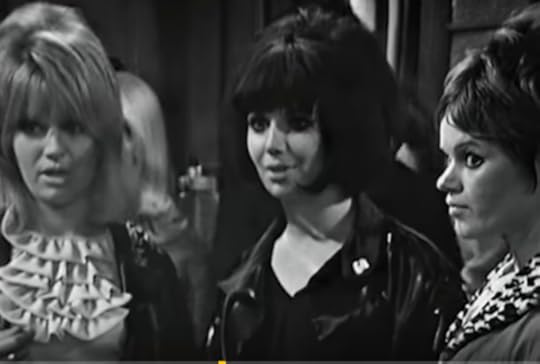
Her stories of a long lost, early 1960s Battersea broke new ground and generated TV and movie adaptations
Nell Dunn was a “posh bird” from Chelsea, a knight’s daughter and the maternal granddaughter of the man who broke the bank at Monte Carlo. In 1959, she moved south of the river to what was then run down, working-class Battersea and wrote a series of short stories about her new life there. They were published in 1963 under the title Up The Junction.
Up The Junction won both plaudits and disapproval for its spare but vivid social realism. Dunn was accused by some of slumming, but New Statesman, which published one of the stories before the book came out, defended her, saying she was “reworking a national literary tradition, the love affair between the classes”.
Ken Loach was an admirer. He and Dunn adapted the book for a BBC Wednesday Play, which Loach directed. Sylvie was played by Carol White, who became famous the following year as the protagonist of Cathy Come Home, the epochal TV drama about homelessness, also directed by Loach, and written by Dunn’s then spouse, Jeremy Sandford. In 1967, White starred in another Loach-directed adaption of a Dunn book, Poor Cow, this time turned into a feature film.
Click here for the rest of the article
Mod
The Wednesday Plays: Up The Junction
Three years later, in 1968, a film version came out, starring Suzy Kendall as Dunn, along with Maureen Lipman (Sylvie), Adrienne Posta (Rube) and Dennis Waterman.
Up the Junction - Trailer
Mod
It's an interesting period piece: a collection of dialogue-driven short snapshots of a group of young working class Londoners in the Battersea area.
It must have been quite shocking and ground breaking when it was first published.
I won't say any more for now.
Who has read it?
Or is reading it, or plans to?
I'm really looking forward to finding out what the rest of you think about this slice of London literature and social history.
 Mod
Mod
 I read this many years ago, but don't remember it very well. I have reserved a library copy, so will be able to refresh my faulty memory, but I remember it as being set in an ordinary working-class area, not a slum.
Mod
I read this many years ago, but don't remember it very well. I have reserved a library copy, so will be able to refresh my faulty memory, but I remember it as being set in an ordinary working-class area, not a slum.
Mod
 I recently finished it and my review is:
This is an odd little book, a series of short stories with some of the stories connected by characters. At first I was a little disoriented by not really having a feel for the characters but I soon adjusted by just thinking I was in a coffeeshop overhearing a discussion in the booth behind me. It wasn't as important to identify or know much about the person speaking; I just listened to the rhythm, tone and details of what was being said. As I did with the Don Camillo stories, I limited my reading to just a few stories at a time and found that I really looked forward to my daily taste of the junction talk. Not for all tastes, though. I also think that 130 pages was long enough. I rate it 3.7 stars rounded up to 4 stars for the different, yet interesting, reading experience it provided.
For me, the book brought back memories I had while an Anglophile in my tween years in the 1960s. There was a Brit movie I saw at that time, called The Boys, starring Richard Todd, about young London lads on trial for murder that came out in 1962, that I kept picturing when I was reading. That made me enjoy the book more.
Mod
Like you, I didn't try to keep track of who was who....
It wasn't as important to identify or know much about the person speaking; I just listened to the rhythm, tone and details of what was being said.
I saw each incident as a snapshot or vignette of life in that community at that time.
 Mod
Mod
 Will start it today.
Mod
Will start it today.
Mod
Looking into tower blocks in London, I was interested to learn the first 3 were built in Bow in 1951, probably to help replace housing lost through bombing. London was certainly changing at that time and communities faced re-housing and separation.
She certainly has an ear for dialogue. Brian's 'overhearing a discussion in a coffee shop' analogy is a good one.Some of the stories had been first published in the New Statesman, according to the preface, and were then collected into this book.
I've read the first two 'chapters'. In way the a photograph is a snapshot of a moment in time, which is full of detail, I find these little chapters a snapshot of moment of someone's experience.
So far not so London centric, I see these moments replicated across the country.
I'll keep in reading, I'm interested in how the working class is portrayed in London in Nell's stories, as she appear to identify as working class.
The others living in the area do point out that her family have money from time to time, but she doesn't seem to have much herself and she is working in the sweet factory along with the women who grew up there.
Mod
Mod
There seem to have been some slum areas - I've just read the first three stories, and in one of them there was a mention of a bulldozer knocking down slums. Maybe a tower block would be going up there?
There are mentions of dismantled prefabs and an empty terrace as well, and it is certainly referred to as slum clearance, but later opinion seems to be that all this clearance was somewhat over-enthusiastic and that a programme of putting bathrooms in existing properties would have been a better option.
Mod
https://www.coam.org.uk/
 We had prefabs in our road in East London. My mum was always quite jealous of them at first, as they had bathrooms and indoor toilets. Ours was a two up , two down with no bathroom and an outside toilet. In fact the more I think about it our road was unique, there was a maternity hospital at one end, and a cemetery at the other. A pub in the middle, and a sweet factory. Almost as if every thing was provided.
Jill wrote: "... there was a maternity hospital at one end, and a cemetery at the other..."
We had prefabs in our road in East London. My mum was always quite jealous of them at first, as they had bathrooms and indoor toilets. Ours was a two up , two down with no bathroom and an outside toilet. In fact the more I think about it our road was unique, there was a maternity hospital at one end, and a cemetery at the other. A pub in the middle, and a sweet factory. Almost as if every thing was provided.
Jill wrote: "... there was a maternity hospital at one end, and a cemetery at the other..."So walking down your street was, in the words of Mark Knoepler, the proverbial Walk of Life
Mod
Mod
Mod
The contraceptive pill and abortions both being available on the NHS; widespread acceptance of one parent families; and lack of stigma about modern divorce have surely made a huge difference Susan? Or were you thinking about some other aspect of unplanned pregnancy out of wedlock?
Mod
Mod
Yes, there are interesting parallels between the two books, and they work really well together as a pairing. I'll add another comment about AKOL over on that thread.
Mod
Right. Got you. I am sure you're quite right too. It must happen all the time. I guess the difference is that the consequences are nowhere near as dire as they once were.
In addition to having to get married, young women were sometimes sent away to have their babies which were then forcibly taken from them. It really was a terrible thing back in those more traditional times.
Mod
My mother had a relative who was sent to an asylum because she was pregnant out of wedlock. The feeling being that she was mad to have let it happen. Apparently she was there for the whole of her life. No one knew what happened to the baby. This was Victorian times.
I think my great-grandfather's second wife may have been an illegitimate baby who was taken away from her mother, or possibly abandoned by her. She was raised by nuns in an orphanage in Ireland and had no birth certificate (which was a problem when they wanted to marry).
Mod
Mod
Mod
I agree too. We hear what people are saying, but that can only give hints of what those people think and feel. There are some events later in the book which must have been more upsetting than they appear.
 I agree too. Most of the events are very mundane and repetitive, and the more interesting ones are never developed so we have to put our own interpretation on what happened. It was a quick read but not very satisfying.
Mod
I agree too. Most of the events are very mundane and repetitive, and the more interesting ones are never developed so we have to put our own interpretation on what happened. It was a quick read but not very satisfying.
Mod
Has anyone watched the TV play or the feature film? I think it would be interesting to see how they compare.
Mod
I've watched about 15 minutes of the TV play
The YouTube link is above
I thought it was a really convincing and clever evocation of the book
Mod
The Wednesday Plays: Up The Junction
As I say, based on what I've seen it's excellent. Really good. Director Ken Loach did quite a bit of location filming which really adds to its impact, that and the incredibly naturalistic performances of the actors
Three years later, in 1968, a film version came out, starring Suzy Kendall as Dunn, along with Maureen Lipman (Sylvie), Adrienne Posta (Rube) and Dennis Waterman.
Up the Junction - Trailer
Mod
Mod
Mod
Mod
Mod
Nell Dunn seems to have been better known as a playwright and scriptwriter. I have not watched the film, but I can see why. These are scenes from Battersea life, so we get the conversations and the visual descriptions, but I agree with Judy that it does lack depth.
I have finished the book and....Having read it, I found it could been written in any town or city in the UK not just London. The style is easy to read but, a style most writers could easily replicate and to be honest we all could write in that style about our life experiences. Maybe we should and read back to ourselves years later?
The subject matter must therefore of greater importance. It is a selection of experiences of three working class young women. I was disappointed as it could have been so much more, but it centred on their quest for quick temporary happiness rather than hopes and aspirations beyond the narrow local lives they seem to be trapped in. Because of which there is a danger that the reader may believe this is a real and true overall depiction of the working class.....it isn't. They are a selection experiences and snapshots in time of three women, you may ask why it was those experiences were more worthy of note than other experiences, what was the author intention?
One thing it did do, is make me think of my late teenage years etc and if the 60's were any different to the 80's. To me in the 80’s there were greater opportunities and social mobility was possible and generally accepted and encouraged, although I’m unsure of the situation was in the 60’s.
All that said, I did enjoy it and enjoyed more as I progressed through the book.
Mod
(Freeview channel 81)
Mod
Thanks from me as well.

Reading the 20th Century
Books mentioned in this topic
Poor Cow (other topics)Up the Junction (other topics)
Up the Junction (other topics)

Nell Dunn's scenes of London life, as it was lived in the early Sixties in the industrial slums of Battersea, have few parallels in contemporary writing. The exuberant, uninhibited, disparate world she found in the tired old streets and under the railway arches is recaptured in these closely linked sketches; and the result is pure alchemy. In the space of 120 perfect pages, we witness clip-joint hustles, petty thieving, candid sexual encounters, casual birth and casual death. She has a superb gift for capturing colloquial speech and the characters observed in these pages convey that caustic, ironic, and compassionate feeling for life, in which a turn of phrase frequently contains startling flashes of poetry. Battersea, that teeming wasteland of brick south of the Thames, has found its poet in Nell Dunn and Up the Junction is her touchingly truthful and timeless testimonial to it.
This discussion will open on or around 1 February 2020
Here's to another enjoyable RTTC discussion
Up the Junction by Nell Dunn