
Reading the 20th Century discussion

This topic is about
Blindness
Group reads
>
Blindness by Jose Saramago (October 2020)

 Mod
Mod
Like Roman Clodia, I am looking forward to this discussion having read, and thoroughly enjoyed, Blindness a few years back
Mod
I'm interesting to discover how the rest of you get on with the writing style.
I'll just add one more thing for now, and that is that I enjoyed this so much that I went on to read the sequel - Seeing.

 Mod
Mod
I probably won't have time to make a start till Friday so will be back then.
Mod
I eagerly await your reaction
Roman Clodia wrote: "I probably won't have time to make a start till Friday so will be back then."
We can be patient Roman Clodia
 Hello, I am looking forward to this. I shall begin this afternoon. I am reading it in Portuguese.
I have read three other Saramagos before: A Caverna, A Jangada de Pedra, and O Evangelho Segundo Jesus Cristo
Mod
Great to have a seasoned Saramagoist here, Kalli - this is my first, but I already have my eye on Seeing, The Elephant's Journey and Baltasar & Blimunda.
Mod
'If you can see, look.
If you can look, observe.'
I wonder what we make of this? Seeing is passive, looking is active, and observing adds a layer of analytical perception perhaps?
 Roman Clodia wrote: "I came home early from work as I have a sore throat (and this is not a good time to be coughing on the tube!) - but the good news is that I can make a start on this."
I hope all is well with you RC.
Roman Clodia wrote: "The epigraph: 'If you can see, look.
If you can look, observe.'
I wonder what we make of this? Seeing is passive, looking is active, and observing adds a layer of analytical perception perhaps?"
And of course we have the title of the book, Blindness, which denotes a physical condition but also a lack of awareness and almost willful ignorance.
This condition of blindness, curiously, is one of perpetual white light rather than total darkness.
At the beginning of the second chapter, second paragraph, there was a discussion of "moral conscience" that has always existed...and "is not an invention of the philosophers of the Quarternary". (I had to search Quarternary.)I was struck with the beauty, and perhaps the significance, of "we ended up putting our conscience in the colour of blood and in the salt of tears, and, as if that were not enough, we made our eyes into a kind of mirror turned inwards, with the result that they often show without reserve what we are verbally trying to deny".
Profound in a book where we anticipate a plague of blindness.
Mod
Oh yes, I had the virus back in March/April so this is just a normal winter bug, thanks.
 I hope to reread this book some time in the next few weeks. I have read a number of Saramago books and this was my favourite.
Mod
I hope to reread this book some time in the next few weeks. I have read a number of Saramago books and this was my favourite.
Mod
Snap! I also had to look up quarternary, and underlined the same statement.
I'm still pondering what the connection might be between eyes as a 'mirror turned inwards' and the white blindness. I think I'm stating the obvious but I like that there isn't a neat and simplistic allegory at work here.
Mod
I love the way the prose has a jittery, anxious feel to it, as voices merge over each other and we're aware of a cacophony of words that are messy and chaotic - it's like the prose feels the same confusion of emotions that the characters do, and it's certainly transmitting that sense of edginess to me.
Mod
Looking forward to your thoughts, Hugh - I already think this is eminently rereadable.
There are little jewels scattered...when the ophthalmologist realizes he has the disease of blindness two tears slip from his eyes and down his temples. He is sure they are white.
The third chapter, on the 4th page in my book, the ophthalmologist is thinking about his patient (the first blind man). The doctor forgets, for a moment, that he too is blind. Human selflessness is identified. Nothing new. Homer’s words (albeit different) are recalled. Thinking of Odysseus, I think of him as a rather selfish hero. There’s Penelope’s story.
Ce Ce wrote: "And of course we have the title of the book, Blindness, which denotes a physical condition but also a lack of awareness and almost willful ignorance. ..."Yes, and the original title is "Essay on Blindness"
Roman Clodia wrote: "I came home early from work as I have a sore throat (and this is not a good time to be coughing on the tube!) - but the good news is that I can make a start on this. Great to have a seasoned Sara..."
Yes, I also have in my list 'Seeing' and 'An Elephant Journey'.. and his book on Lisbon...
Depressing, given the current pandemic, quarantine is still the first linear defense (after hundreds of year since the plague). It could “as easily mean forty days as forty weeks, or forty months or forty years...”. Had I read those words a year ago they would not have resonated as ominously.
Mod
Roman Clodia wrote: "Yes, some of this feels eerily familiar which I wasn't expecting. I'm also reminded of Camus' La Peste where the ophthalmologist is trying to convince the authorities of what is happe..."I have not read The Plague by Camus, but I hadn't really considered the challenge of convincing officials. Highlighted in this case by an unlikely transmisson of blindness. Well, I would have seen it unlikely a year ago...it's much easier to believe at this point.
Roman Clodia wrote: "Nigeyb wrote: "... no quotation marks for dialogue, and many long sentences which frequently have a "stream of consciousness" quality"I love the way the prose has a jittery, anxious feel to it, a..."
I am really enjoying Saramago's writing, so idiosyncratic and so recognisable. And it is not just the almost absence of punctuation, but of how everything flows and the seamless introduction, here and there, of authorial comments.
I also enjoy the humour. Often when he uses any terms related to 'seeing' - and the irony that these terms create.
Mod
Up to p.56:
Some of the imagery is very striking: the line of the blind walking through the hospital hands on the shoulder of the person in front. And the creepy car thief sexually assaulting the girl in the dark glasses.
The doctor's wife is interesting in terms of her role while her husband ostensibly has the authority within the group.
Roman Clodia wrote: "The thing is, now that we're all pandemic experts, some of the tropes of dystopia no longer hang together - the speed with which the government acts to herd people together in quarantine, for examp..."Well, this is an excellent opportunity for a government to gain further control of the people. Some were not too slow on this.
RC - you were right about posting images. your drawing attention of the image of the blind forming a line... brought to my mind this wonderful painting by Bruegel:
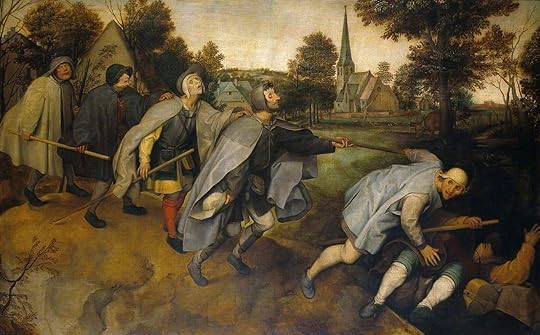 As for the role of the doctor's wife.. I thought that not only does she become very useful to her husband and the other (unknowing) blind, but also for Saramago. Without her it would be much more difficult to deal with the group.
Mod
As for the role of the doctor's wife.. I thought that not only does she become very useful to her husband and the other (unknowing) blind, but also for Saramago. Without her it would be much more difficult to deal with the group.
Mod
Is it about self-delusion and 'seeing' what looks resplendent (the world, the self) but that vision is itself a form of blindness?
Mod
Ps. Your Breugel image doesn't show Kalli...
Roman Clodia wrote: "Does anyone have any thoughts about why the blindness is white and described as a 'resplendent whiteness' and 'luminous, resplendent'? Is it about self-delusion and 'seeing' what looks resplenden..."
Nothing specific comes to my mind as yet, but I have read about 60 pages only. Your suggestions are interesting.
Corrected the image.
The painting is in Capodimonte, Naples.
Mod
There's a kind of timelessness about this story that seems to make it parallel to various other stories: I remember reading a novel whose title I've forgotten set in Switzerland just after WW1 where blinded soldiers from a nursing home are taken out to walk, and they also are a line like this.
Mod
This is getting compulsive now as the power hierarchies and inequalities of society are reasserting themselves amongst the blind.
Mod
Mod
I am in the middle of Chapter 7, page 103.The punctuation and run on sentences are evolving as is the horror of confinement and quarantine.
A few days ago memories, just 6 months old, of a cruise ship (Grand Princess) filled with passengers floating off the coast of California. They were disallowed port entry due to Covid-19 cases onboard. When they were finally allowed to disembark they were greeted by protesters unhappy with their presence. The passengers were boarded on buses and whisked off to yet another quarantine on a military base.
Last night, as I was reading, vivid memories viscerally flooded of the early days of AIDS. We lived in San Francisco in the 1980’s. Before the long sad dirge of funeral after funeral was the singeing fear of the unknown. Ostracism on steroids.
This was triggered by the fearful delivery of food and the panicked shooting of the blind. Somewhere I read a few days ago that we humans are capable of untold generosity when we generally feel safe and secure...introduce the element of primal fear and we become vicious. I don’t think we can exclude ourselves, as humans, from that appalling reaction.
Mod
I've just finished after racing through the second half - 5 stars, for sure!
I won't say more yet as others are still reading...
I loved the prose style and felt that as well as being propulsive it also erodes the barriers between individual voices so that what we end up with is a kind of chorus of all humanity.
I finished chapter 8. Once violence sets in, with the senseless killing it stops being a joke even if Saramago's humour with the way he intercepts his comments so seamlessly continues to be there. I find myself underlining those sections.
Ce Ce wrote: "I am in the middle of Chapter 7, page 103.The punctuation and run on sentences are evolving as is the horror of confinement and quarantine.
A few days ago memories, just 6 months old, of a crui..."
I am finding parallels with the current situation and how politicians are using the Covid pandemic for their own sheer political objectives. Disgusting. I even think a certain degree of euthanasia practices have been carried out - a politician who had claimed that olde people should not be allowed to vote asked to be the primary responsible of the Residences for old people, where most deaths have taken place.
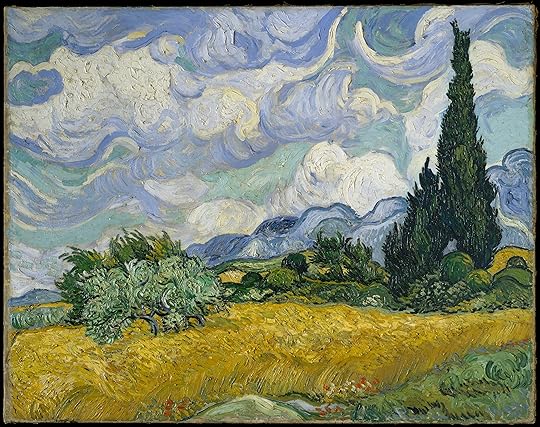
At the end of chapter 8 there are more opportunities for posting paintings.... RC was right...The blind who became so in a museum mentions several paintings.. Some are easier to identify than others... some descriptions recall more than one painting.
the wheat fields with the cypresses and the crows and the sun made o several pieces... I first thought of Bruegel again..
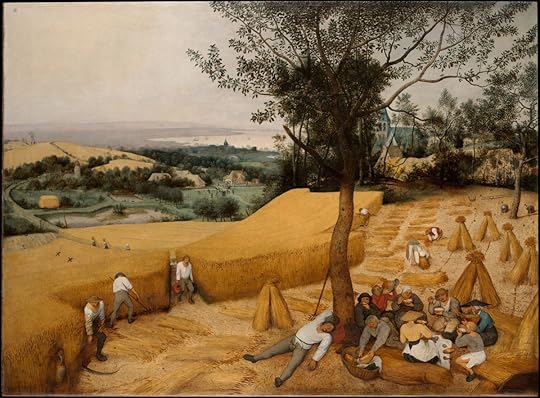
But then thought of Van Gogh...
.. then the dog which is half sinking and that "can only be by a Spaniard".. is clearly Goya's...
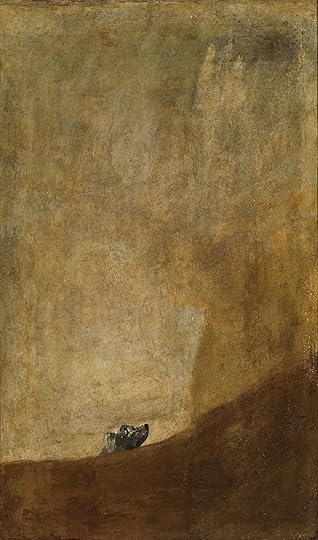
-- nobody before him painted a dog in this way, and after him no one else has dared... (my translation)
.. then one with a cart carrying hayn crossing a river.. with a house at the left.. this is the famous Constable - The Haywain..
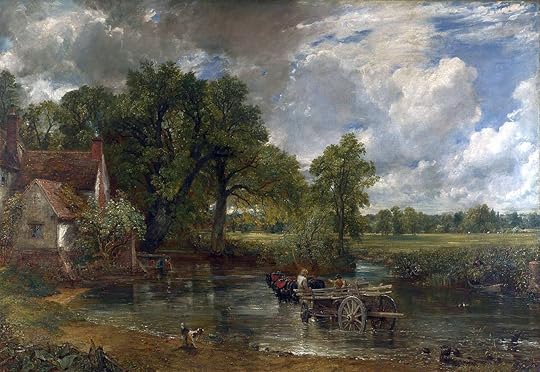
then a woman with a child and men eating.. there are so many possible samples that they are sort of discarded except when those men eating number 13 - but again no further indication is given...
Then the naked (nude) woman with blond hair on top of a floating shell... that's Botticelli...
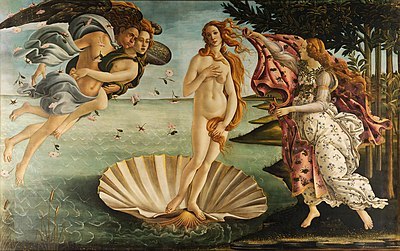
Then there is a battle and a scared horse - again here many possibilities but Stubbs and Géricault would be candidates.
The character of the ophthalmologist's wife is very appealing.. almost like a religious figure.And the young woman with the dark glasses (what word is used in the English translation? - the Portuguese is rapariga dos óculos escuros.. the use of the epithet every time she is mentioned reminded me of the conventions in oral literature such a Homer and his Dawn of the rosy cheeks...
Roman Clodia wrote: "I loved the prose style and felt that as well as being propulsive it also erodes the barriers between individual voices so that what we end up with is a kind of chorus of all humanity. .."I agree.. but this is always his style... for me it is very effective in dissolving who is talking - the characters or the narrator... may be that is what you mean about the chorus for all humanity.
Mod
Oh I Ioved that section - and it made me very pleased that you're reading with us, Kalli! Is the 13 men eating, Leonardo's The Last Supper?
I didn't know Goya's dog painting, but I'm glad to have an image for what happens later...
I like the idea of Breugel being evoked in the text because I associate him with detailed crowd scenes, which feels appropriate for this book.
Roman Clodia wrote: "Kalliope wrote: "At the end of chapter 8 there are more opportunities for posting paintings.... "Oh I Ioved that section - and it made me very pleased that you're reading with us, Kalli! Is the 1..."
Yes, the 13 would be a Last Supper - Leonardo's is the most famous, but he does not give any indication of which particular one it would be.
And you are right about Bruegel with all his people running around does match the atmosphere of this novel.
Kalli, thank you for the paintings. I came back in to view them on my tablet. I can't see them on my iPhone. When I read that section last night I was certain you would recognize the paintings.
Mod
And the young woman with the dark glasses (what word is used in the English translation? - the Portu..."
The English is 'the girl in the dark glasses' - I thought it was Saramago's wicked sense of humour and irony that identifies characters by connections to their eyes: the boy with the squint, the man with the eye patch.
The role of religion is an interesting issue that we can pick up when everyone's finished.
And yes, I found it striking that it's the ophthalmologist who has the authority within the group but his wife who really is the heroine and who has to make some hard decisions.
Roman Clodia wrote: "The role of religion is an interesting issue that we can pick up when everyone's finished..."Yes, that will be an interesting topic to discuss. He was an avowed atheist. My first Saramago was the Gospel according to Jesus. I may reread it.
Another interesting element is the pervasive use of popular sayings, which together with the use of epithets also makes me think of the oral tradition..
I was intending to reread the book, but I am struggling to find my copy!
Mod
Oh, I missed those popular sayings - did they translate, I wonder?
I hadn't thought of the descriptors as epic epithets but good catch! And, of course, blindness means that literacy can't work (apart from the long-term blind person who can write using Braille).
Mod
So familiar! And not a problem since Kindle, of course :)

Reading the 20th Century
Books mentioned in this topic
Seeing (other topics)Seeing (other topics)
Seeing (other topics)
Seeing (other topics)
O Evangelho Segundo Jesus Cristo (other topics)
More...
Authors mentioned in this topic
José Saramago (other topics)José Saramago (other topics)
Manuel Vázquez Montalbán (other topics)
Samuel Beckett (other topics)
José Saramago (other topics)
More...

José Saramago is one of the most important international writers of the last hundred years. Born in Portugal in 1922, he was in his sixties when he came to prominence as a writer with the publication of Baltasar & Blimunda. A huge body of work followed, translated into more than forty languages, and in 1998 he was awarded the Nobel Prize in Literature. Saramago died in June 2010.
Blindness was first published in 1995: A city is hit by an epidemic of "white blindness" that spares no one. Authorities confine the blind to an empty mental hospital, but there the criminal element holds everyone captive, stealing food rations, and assaulting women. There is one eyewitness to this nightmare who guides her charges—among them a boy with no mother, a girl with dark glasses, a dog of tears—through the barren streets, and their procession becomes as uncanny as the surroundings are harrowing. As Blindness reclaims the age-old story of a plague, it evokes the vivid and trembling horrors of the twentieth century, leaving readers with a powerful vision of the human spirit that's bound both by weakness and exhilarating strength.
I'm very excited about reading this - see you in October!