
The Old Curiosity Club discussion

This topic is about
David Copperfield
David Copperfield
>
DC, Chp. 44-46

 Mod
Mod
"She was one of those people who can bear a great deal of pleasure, and she never flinched in her perseverance in the cause."
Although Dr. Strong encourages Annie to get out more, the selfish Mrs. Markleham widens the gap between the couple as she would between any couple that had to live with her by driving at least one of them if not both, insane. Mr. Dick becomes disturbed over this because both Dr. Strong and Annie are his friends. He comes to David one night and asks whether David thinks he is simple-minded. David says that he does in fact think so, and Mr. Dick is pleased. Mr. Dick expresses his concern over the problems between the Doctor and his wife. He asks David what the tension between Doctor and Mrs. Strong is, so David explains the Strongs’ marital problems. Mr. Dick has the idea that he should reconcile the couple because the more intelligent people they know are too polite to attempt to do so. When he asks if the Doctor is angry with her, and David replies, "No. Devoted to her." Mr. Dick shouts "Then I've got it, boy!"
A few weeks after this David and his aunt, on a night that Dora wishes to stay home, visit Dr. Strong and Annie. The Doctor is busy in his study with some visitors and they decide to wait for him. After a few minutes Mrs. Markleham comes into the room very excited because she has just overheard the Doctor making his will in which he leaves everything to Annie.Shortly after this the Doctor's visitors leave and they all go into the study, where David notices Mr. Dick standing in the shadows. Annie comes into the room "pale and trembling." Mr. Dick supports her on his arm and lays the other hand upon the Doctor's arm. Annie kneels in front of her husband and begs him "to break this long silence." Dr. Strong will only say that it is not her fault and there is no change in his love for her. Annie begs those in the room that if someone can tell her what has happened to cause the change between her and her husband please tell her. It is left up to David to explain the things Uriah Heep had told her husband. Annie admits that before she married the Doctor she had liked Jack Maldon "very much" and that they had been "little lovers once" and she might have come to persuade herself that she really loved him and might have married him and "been most wretched." She then assures her husband that she has never wronged him or wavered from the fidelity she owes him.
"'Oh, hold me to your heart, my husband! Never cast me out! Do not think or speak of disparity between us, for there is none, except in all my many imperfections. Every succeeding year I have known this better, as I have esteemed you more and more. Oh, take me to your heart, my husband, for my love was founded on a rock, and it endures!'
In the silence that ensued, my aunt walked gravely up to Mr. Dick, without at all hurrying herself, and gave him a hug and a sounding kiss. And it was very fortunate, with a view to his credit, that she did so; for I am confident that I detected him at that moment in the act of making preparations to stand on one leg, as an appropriate expression of delight.
'You are a very remarkable man, Dick!' said my aunt, with an air of unqualified approbation; 'and never pretend to be anything else, for I know better!'
With that, my aunt pulled him by the sleeve, and nodded to me; and we three stole quietly out of the room, and came away."
I must say that I like Dr. Strong and I like Annie Strong but I'm not sure why they are married, what kind of marriage is it I mean. She seems to think of him as a father. She calls him a father, guide, patient teacher and friend. He says he thought of her as a daughter, as the daughter of his old friend, that he wanted to be her refuge and her teacher. I don't think I'd like it if my husband told me he thought of me as a daughter. It would be especially creepy if we shared the same bed if he felt that way, luckily he's never told me that although he is 18 years older than I am. I wonder how much older the doctor is, I can't remember if they say. It just doesn't seem to me like they should be married if they both feel the way they say they do. Do they even sleep together? When Annie is talking to the doctor she makes the comment:
"There can be no disparity in marriage like unsuitability of mind and purpose."
David thinks of that on the way home. I wonder if we will find out why.
Mod
"'To wish her dead,' said I, 'may be the kindest wish that one of her own sex could bestow upon her. I am glad that time has softened you so much, Miss Dartle.'"
Poor Emily. She is deserted by Steerforth and wished dead by both Miss Dartle and David. Miss Dartle calls Littimer into the room to give a report. Littimer explains that he and Mr. James traveled all over Europe with Em'ly and that she was admired wherever they went, that her merits attracted much notice and for awhile Steerforth was quite content. He says that Em'ly, however, was often depressed, and that she and Steerforth frequently quarreled until finally Steerforth left her.
"'At last, when there had been, upon the whole, a good many words and reproaches, Mr. James he set off one morning, from the neighbourhood of Naples, where we had a villa (the young woman being very partial to the sea), and, under pretence of coming back in a day or so, left it in charge with me to break it out, that, for the general happiness of all concerned, he was'—here an interruption of the short cough—'gone."
Littimer goes on to say that Steerforth had behaved extremely honourable; for he proposed that Em'ly should marry a very respectable person - Littimer himself - "who was fully prepared to overlook the past, and who was, at least, as good as anybody the young woman could have aspired to in a regular way: her connexions being very common.' "
Again I say, poor Emily. I suppose marrying Littimer may have saved her reputation, I'm not sure, but I wouldn't have married a man who felt that way about me either. I'm now for the dying too. Littimer goes on to say that Em'ly was so upset that he had to watch her constantly so that she wouldn't kill herself or anyone else.
"A more outrageous person I never did see. Her conduct was surprisingly bad. She had no more gratitude, no more feeling, no more patience, no more reason in her, than a stock or a stone. If I hadn't been upon my guard, I am convinced she would have had my blood.'
'I think the better of her for it,' said I, indignantly."
I wonder if David wasn't already married and Em'ly found her way home, would he have married her. I doubt it. He then says that Em'ly escaped from him and has not been seen since. Once again Miss Dartle expresses the hope that Em'ly may be dead.
"'She is dead, perhaps,' said Miss Dartle, with a smile, as if she could have spurned the body of the ruined girl.
'She may have drowned herself, miss,' returned Mr. Littimer, catching at an excuse for addressing himself to somebody. 'It's very possible. Or, she may have had assistance from the boatmen, and the boatmen's wives and children. Being given to low company, she was very much in the habit of talking to them on the beach, Miss Dartle, and sitting by their boats. I have known her do it, when Mr. James has been away, whole days. Mr. James was far from pleased to find out, once, that she had told the children she was a boatman's daughter, and that in her own country, long ago, she had roamed about the beach, like them.'"
The next evening, David goes to Hungerford Market in London to find Mr. Peggotty. David finds him in his room that he keeps neat and orderly (unlike David's house, maybe he should visit more often) and is always kept ready for Em'ly to be brought there. David informs Mr. Peggotty of what he has learned from Littimer, and they agree that the best chance of finding Em'ly would be through Martha Endell, Em'ly's friend, who has been living in London. Before they go out however, Mr. Peggotty does this:
"He assented, and prepared to accompany me. Without appearing to observe what he was doing, I saw how carefully he adjusted the little room, put a candle ready and the means of lighting it, arranged the bed, and finally took out of a drawer one of her dresses (I remember to have seen her wear it), neatly folded with some other garments, and a bonnet, which he placed upon a chair. He made no allusion to these clothes, neither did I. There they had been waiting for her, many and many a night, no doubt."
Mr. Peggotty certainly never gives up, I wonder now how long it has been since he first started looking for her, I've lost track of time. By coincidence, they see Martha not far from Blackfriars Bridge, and follow her to get to a quieter place where they will be less likely to be observed. Eventually they reach an appropriate place to talk and the chapter ends.
"At length she turned into a dull, dark street, where the noise and crowd were lost; and I said, 'We may speak to her now'; and, mending our pace, we went after her."
I'm off for the illustrations.
Yes, David went into his marriage headfirst, and made some very unwise decisions there. Dora might have been a very sweet girl in her way (although I still don't like her for abusing and hitting Jip so much), but she is unfit to lead any kind of household. While she cannot even talk to her servant, she would be worse off without one - no way she could do things like cleaning the house or cooking herself. I do wonder if something is the matter with her. She really does not seem to be all there. Which made me wonder, while we all know that people with mental illnesses and such were locked up under abonimable conditions, would they even recognise things like learning disabilities? I mean, Dora shows clear signs of dyscalculia at best, but from the pages she comes across as if she has such a low iq that she could not function without being sheltered - and if nowadays she would have been in a care facility of sorts because of that. I am just completely baffled that Dickens wrote her into the story like that, without qualms about implying that 'he' (it is a fictionalised autobiography of sorts after all) would have married a girl who really mentally was a child. Em'ly at least knew what she was doing, I feel the same cannot be said about Dora - so I find the chapters with her in it way more depressing.
 Kim wrote: "It sounded to me like David enjoyed the courtship of he and Dora more than the actual marriage."
You think so? I found this section very easy to identify with. I have been married 12 years that I have enjoyed very much, but there are moments when I'm still kind of surprised to find I am actually living with this person. Similarly, at moments I'm still kind of surprised to realize I am an adult, which is a change that happened many more than 12 years ago. Things sneak up on you.
Kim wrote: "What is she doing all day? She can't spend the day playing with Jip, I know dogs and dogs sleep alot, and she doesn't seems like she would be much of a reader, so what does she do? ."Putting her hair in those curl-papers must take up some time. Especially because she probably finds curling her hair to be an intellectual challenge.
I really love the Aunt Betsey parts of this chapter, and they help me understand why she didn't discourage David when he was courting Dora.
 Mod
Mod
Wow, these weeks certainly do go by fast, which is usually a good thing until we get to Christmas and I want them to slow down, here I am putting up the village on the kitchen ca..."
It is tempting to be overly harsh with Dora. She did not have a mother in her life. She has Miss Murdstone. Her father may have been a successful professional but apparently lacked any significant role in being a guiding father. Dora’s life was that of a hothouse flower. If we think of Jip we have the perfectly pampered dog. Is Dora not like Jip on two legs? Dora is what she is.
I think it is David who made the tragic error of allowing the relationship between himself and Dora to flourish. We know that David prior to Dora has had an interest in many females, both around his age and older. It seems that he is attracted to all females of all shapes, sizes, ages and even mental stability. I think he even has a flash of emotional curiosity and interest in Rosa. Yikes!
Why so many attempted excursions into the human heart? Is it because he lost his mother so soon? That might work but Peggotty was always there for him. I think it might simply be that he wanted to be loved by someone. That’s understandable. David’s maturity might have well been arrested by his fruitless search for love, and thus when the first person came along that seemed to be interested in him came along he thought his emotional needs were met.
Mod
After the insights into the marriage of David and Dora in the previous marriage we come to this chapter. Here, another marriage is presented and one that, on the surface, is perhaps also questionable. Annie is much younger than her husband. Dickens signals this fact with both his description of the pair and the choice of pet names they have for one another.
The difference is that there is clearly a communication and connection of mutual caring and concern that exists between the Strong’s. The observation of Annie that “there can be no disparity in marriage like unsuitability of mind and purpose” that Kim has provided from the novel might well be the key comment about marriage for all the couples in this novel.
To this point in the novel we have many couples ranging from Little Em’ly and Steerforth, through David’s mother’s second marriage, Traddles and Sophy to, of course, David and Dora. The relationships that are based on honest, common and shared open minds and purposes of the couple seem to be solid and flourishing. Those relationships which are based on cross purposes and mismatched minds seem doomed to failure.
The fact that Dickens has structured the chapters in such a manner that the Dora and David marriage and the Annie and Dr Strong appear one after the other suggests and even urges us to compare and contrast the relationships.
I think Annie’s comments about the need for suitability and purpose in a marriage may also be a guideline for what may be coming in the future chapters.
Mod
The three chapters this week fall nicely into a trio of marriage possibilities. David and Dora appear to be headed for a marriage that will not have a common purpose or a shared pattern of growth. Annie and Doctor Strong have a stable and caring relationship. Here, we have the question of what is actually happening between Steerforth and Em’ly. Are they married? Are they happy? There is only vitriol from the Steerforth house.
This chapter also reintroduces the character of Martha, a fallen woman, an emblem of what may well happen to a woman who does not find either harmony or even ambivalence within a marriage. She is a commodity, neither the lover or the beloved of another.
How will Dickens fit Martha into the matrix of love and marriage?
Mod
Have her marry Mr. Dick. Or Murstone, but she's too good for him.
Mod
Mod
Mod
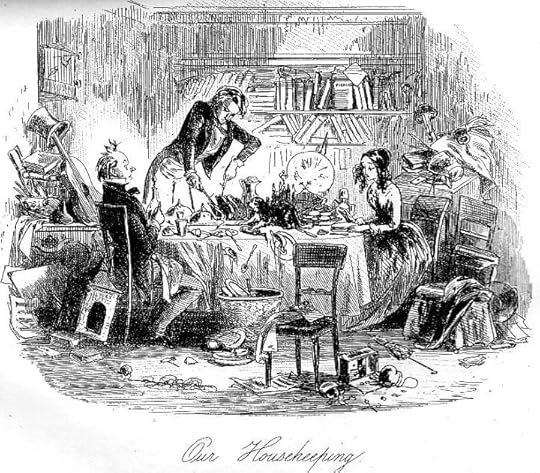
Our Housekeeping
Chapter 44
Phiz
Commentary:
For the first illustration in the fifteenth monthly number, which was issued in July 1850 and comprises chapters 44 through 46, Phiz demonstrates the unfortunate but comical consequences of David's marrying a "child-wife" with fewer domestic skills and less common sense. Once again, the observer and mediator is the good-hearted young attorney and newspaper writer Tommy Traddles (right), who observes his old school chum wrestling with a joint as the incorrigible Jip scampers across the dining table. According to J. A. Hammerton (1910), the moment that Phiz has realized is the following: "One of our first feats in the housekeeping way was a little dinner to Traddles".
In fact, Phiz has chosen one of the most entertaining — and for David utterly embarrassing — moments in the dinner as the host, failing in his attempt to carve a boiled leg of mutton, is about to abandon it and serve oysters instead:
There was another thing I could have wished; namely, that Jip had never been encouraged to walk about the table-cloth during dinner. I began to think there was something disorderly in his being there at all, even if he had not been in the habit of putting his foot in the salt or the melted-butter. On this occasion he seemed to think he was introduced expressly to keep Traddles at bay; and he barked at my old friend, and made short runs at his plate with such undaunted pertinacity, that he may be said to have engrossed the conversation.
However, as I knew how tender-hearted my dear Dora was, and how sensitive she would be to any slight upon her favourite, I hinted no objection. For similar reasons I made no allusion to the skirmishing plates upon the floor; or to the disreputable appearance of the castors, which were all at sixes and sevens, and looked drunk; or to the further blockade of Traddles by wandering vegetable dishes and jugs. I could not help wondering in my own mind, as I contemplated the boiled leg of mutton before me, previous to carving it, how it came to pass that our joints of meat were of such extraordinary shapes—and whether our butcher contracted for all the deformed sheep that came into the world; but I kept my reflections to myself.
The picture, like the others in Phiz's narrative-pictorial sequence which depict Tommy traddles, emphasizes his unruly hair and chubby face. As is usual with Traddles, Phiz shows him in a social situation, as in "Traddles makes a figure in parliament and I report him" and "Traddles and I, in conference with the Misses Spenlow", reacting with good humour to other characters in an interior setting. Once again, the scene occurs in David's residence, but we are no longer in his bachelor rooms in Buckingham Street, which have been the backdrop for "We are disturbed in our cookery", "My Aunt astonishes me", and "Mr. Wickfield and his partner wait upon my Aunt". Rather, in this view of David's residence we see neither a window nor the door (nor, for that matter, any sort of domestic order); the young couple are entombed, or perhaps caged in a confined space, the constriction reinforced by the impinging clutter; visual continuity with David's former residence is provided by the books (rear centre), now terribly jumbled, and the birdcage (left), whose occupants serve as a visual metaphor for the newly-weds established by Dickens himself early in the forty-fourth chapter: "I doubt whether two young birds could have known less about keeping house", reflects David, reverting to the early days of their occupancy of the little cottage outside London that he had leased shortly before their marriage. Things in the dining-room are utterly chaotic, with the guest wedged into a corner next to Dora's guitar, David's hat, and Jip's pagoda:
The musical emblem becomes a guitar (the actual instrument played by Dora) in "Our Housekeeping" (ch. 44), rather unceremoniously used as a hatrack, and positioned beneath a caged pair of lovebirds who are now apparently quarreling, in contrast to those in an earlier plate. [Steig 122]
Another curious mistake is apparent in the interesting plate entitled "Our Housekeeping;" here David is seen struggling with a loin of mutton, whereas in the text the joint is distinctly described as a boiled leg of mutton. [Kitton 104]
Modern readers not accustomed to the Victorian tradition of the Sunday joint do not even register the discrepancy. Jan Rabb Cohen notes the prominence that Phiz has accorded to the jar labelled "PICKLES" which Phiz has prominently "displayed among the scattered books on the drawing-room shelf, [to] reveal the plight of their marriage".
Although David and Dora can afford a cottage, albeit a small one, in a quiet suburban neighbourhood an easy walk from "Town" and Dr. Strong's, Dickens at David's age had rented two different sets of rooms at Furnival's Inn, London, from the period before his marriage to Catherine Hogarth until 1838, when the couple and their first child moved to Doughty Street, Holborn:
in December 1834 he moved with his younger brother, Frederick, into chambers at Furnival's Inn, He rented what was then known as a "three pair back" at what was then the not inconsiderable rent of £35 a year — three modest rooms, a cellar and a lumber room [Americans should read "storage area or attic"] in a not very prepossessing congeries of buildings which had been expressly built as chambers. It was a "good" address but somewhat gloomy. . . . [Ackroyd 161]
Apart from summer vacations in a cottage at the Kentish village of Chalk and another a Petersham, Charles and Catherine remained at their slightly more commodious and more expensive quarters at Furnival's to which Charles had shifted just before their wedding on 2 April 1836, made possible by his signing with Chapman and Hall to write what would become The Pickwick Papers. Catherine's younger sister visited frequently, and became resident after the birth of the Dickenses' first child on 6 January 1838. By the time of Mary's sudden death, aged seventeen, on 7 May 1838, she and her brother-in-law and her sister were living at 48 Doughty Street, now the Dickens Museum, to which the Dickens had moved shortly after he began writing Oliver Twist, on 18 March 1837, a twelve-roomed house of four floors that dwarfs the little cottage in which David and Dora begin their married life. Thus, although the Dickenses' happy days early in their marriage may well be reflected in David Copperfield's "first marriage" chapters, there is nothing about the little Copperfield cottage that has much basis in the author's own residences in the early years of his relationship with Catherine Hogarth — and certainly neither a younger sister nor children intrude on the domestic infelicities of David and Dora.
The situation in "Our Housekeeping" is anarchic as David, in an early Victorian swallow-tail coat, cuts the meat, Traddles (ignoring Jip) tries to engage Dora in conversation, and Dora seems utterly unaware of either her husband or his guest. Cutlery falls off the table as Jip advances; clothing (largely feminine) is strewn about the room, and chairs are askew, as if the house is suffering an earth-quake. Sheet music, a parasol lying on the floor in the foreground, the spaniel on the dining-table, and a woman's work box tumbled open — reminiscent of the spilled sewing box in "Changes at home" and thereby connecting David's mother and Dora — all point towards Dora as the source of the chaos. Despite what may appear to be random disorder, Phiz, as Kitton has noted, subjected the sketch of the illustration to editing, taking out "the frame of a mirror or picture . . .[that he had] introduced on the wall behind David". Accordingly, we should assume that every detail that Phiz has included serves a purpose in creating the overall impression of "most admired disorder."
 Mod
Mod
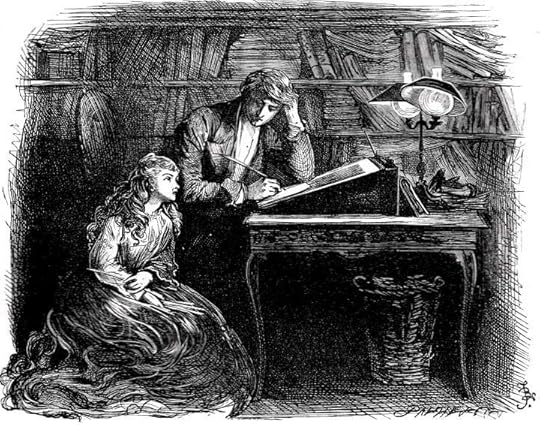
Holding the pens.
Chapter 44
Fred Barnard
1872 Household Edition
Text Illustrated:
Because, you clever boy, you'll not forget me then, while you are full of silent fancies. Will you mind it, if I say something very, very silly? — more than usual?" inquired Dora, peeping over my shoulder into my face.
"What wonderful thing is that?" said I.
"Please let me hold the pens?" said Dora. "I want to have something to do with all those many hours when you are so industrious. May I hold the pens?".
Commentary:
Rereading the chapters which figure as the context for Barnard's "Holding the pens," one finds himself — or, if a feminist, him- or herself — less charmed by Dickens's vision of domestic bliss, even if the scene blurs the distinctions between the domestic world of women and the professional world of men. By the time that the reader encounters this scene early in the Copperfields' marriage, David as head of the household has established that Dora shows no capacity whatsoever for domestic management: she simply cannot cook or even execute a recipe (no mere oversight that she serves Traddles oysters in the shell, but has not thought to provide oyster-knives); she cannot manage the servants or tradespeople and their bills (under her superintendence, "Everybody [they] had anything to do with seemed to cheat [them]"); she cannot perform the simple arithmetic of the household accounts; and her notion of "housekeeping" centres around Jip's Chinese pagoda and little else! She may be an attractive and adoring pen-holder, but she only volunteers to be such because she feels utterly useless while her young husband, now a budding novelist, spends so many hours writing, and presumably this nocturnal activity (reflective of Dickens's own activity as a young writer) has heretofore excluded her almost entirely not merely from David's conversation, but even from his thoughts. Her request to be of assistance, then, amounts to the child's plea, "See me! See me!"
Blissfully happy as he reports himself as having been at that time, David nevertheless recalls that he sometimes would invent something meaningful for Dora to do: "I occasionally made a pretence of wanting a page or two of manuscript copied. Then Dora was in her glory" Sometimes David in retrospect wishes Dora had had the intellectual equipment to be his "counsellor" instead of a pen-holder and copying machine. An objective, emotionally detached reader sees these obvious deficiencies in David's marriage, even though years later in reflection David apparently does not, encountering the illustration proleptically, seventeen pages in advance of the text it realizes. Thus, the tender moment exemplifies youthful idyll of David Copperfield's marriage to Dora Spenlow. Hablot Knight Browne's illustration Our Housekeeping (July 1850) in contrast implies that the marriage was an amusing housekeeping disaster in which the unfortunate Dora was the source of the domestic chaos.
Mod
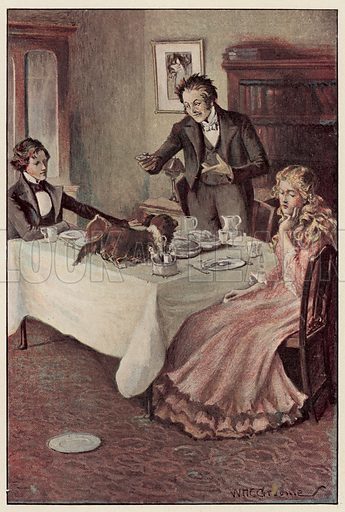
"He barked at my old friend."
Chapter 44
William Henry Charles Groome
Text Illustrated:
One of our first feats in the housekeeping way was a little dinner to Traddles. I met him in town, and asked him to walk out with me that afternoon. He readily consenting, I wrote to Dora, saying I would bring him home. It was pleasant weather, and on the road we made my domestic happiness the theme of conversation. Traddles was very full of it; and said, that, picturing himself with such a home, and Sophy waiting and preparing for him, he could think of nothing wanting to complete his bliss.
I could not have wished for a prettier little wife at the opposite end of the table, but I certainly could have wished, when we sat down, for a little more room. I did not know how it was, but though there were only two of us, we were at once always cramped for room, and yet had always room enough to lose everything in. I suspect it may have been because nothing had a place of its own, except Jip’s pagoda, which invariably blocked up the main thoroughfare. On the present occasion, Traddles was so hemmed in by the pagoda and the guitar-case, and Dora’s flower-painting, and my writing-table, that I had serious doubts of the possibility of his using his knife and fork; but he protested, with his own good-humour, ‘Oceans of room, Copperfield! I assure you, Oceans!’
There was another thing I could have wished, namely, that Jip had never been encouraged to walk about the tablecloth during dinner. I began to think there was something disorderly in his being there at all, even if he had not been in the habit of putting his foot in the salt or the melted butter. On this occasion he seemed to think he was introduced expressly to keep Traddles at bay; and he barked at my old friend, and made short runs at his plate, with such undaunted pertinacity, that he may be said to have engrossed the conversation.
Mod
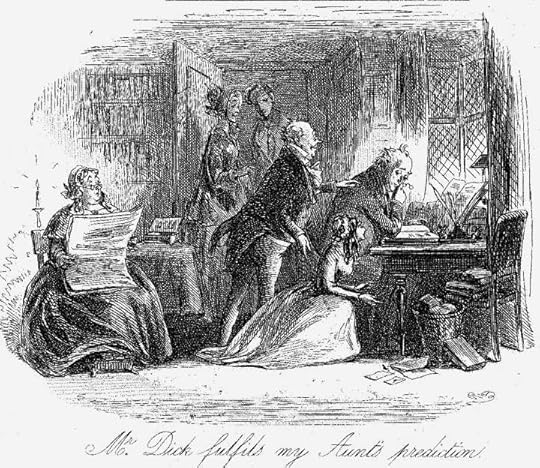
Mr. Dick fulfills my Aunt's prediction
Chapter 45
Phiz
Commentary:
For the second illustration in the fifteenth monthly number, which was issued in July 1850 and comprises chapters 44 through 46, Phiz has chosen to realize the dramatic moment at which the foolish, good-natured Mr. Dick attempts to effect an emotional reconciliation between the Strongs, who have been torn asunder by unvoiced suspicions as to young Mrs. Strong's infidelity with his childhood sweetheart, the wastrel Jack Maldon, the moment depicted is the following:
I was conscious of Mr. Dick’s standing in the shadow of the room, shutting up his knife, when we accompanied her to the Study; and of my aunt’s rubbing her nose violently, by the way, as a mild vent for her intolerance of our military friend; but who got first into the Study, or how Mrs. Markleham settled herself in a moment in her easy-chair, or how my aunt and I came to be left together near the door (unless her eyes were quicker than mine, and she held me back), I have forgotten, if I ever knew. But this I know,—that we saw the Doctor before he saw us, sitting at his table, among the folio volumes in which he delighted, resting his head calmly on his hand. That, in the same moment, we saw Mrs. Strong glide in, pale and trembling. That Mr. Dick supported her on his arm. That he laid his other hand upon the Doctor’s arm, causing him to look up with an abstracted air. That, as the Doctor moved his head, his wife dropped down on one knee at his feet, and, with her hands imploringly lifted, fixed upon his face the memorable look I had never forgotten. That at this sight Mrs. Markleham dropped the newspaper, and stared more like a figure-head intended for a ship to be called The Astonishment, than anything else I can think of.
The gentleness of Doctor Strong's manner and surprise, the dignity that mingled with the supplicating attitude of his wife, the amiable concern of Mr. Dick, and the earnestness with which my aunt said to herself, "That man mad!" (triumphantly expressive of the misery from which she had saved him) - I see and hear, rather than remember, as I write about it.
‘Doctor!’ said Mr. Dick. ‘What is it that’s amiss? Look here!’
‘Annie!’ cried the Doctor. ‘Not at my feet, my dear!’
‘Yes!’ she said. ‘I beg and pray that no one will leave the room! Oh, my husband and father, break this long silence. Let us both know what it is that has come between us!’
Mrs. Markleham, by this time recovering the power of speech, and seeming to swell with family pride and motherly indignation, here exclaimed, ‘Annie, get up immediately, and don’t disgrace everybody belonging to you by humbling yourself like that, unless you wish to see me go out of my mind on the spot!’
‘Mama!’ returned Annie. ‘Waste no words on me, for my appeal is to my husband, and even you are nothing here.’
This highly staged, serio-comic tableau vivant is a reification of Victorian sentimentality, that luxuriating in tender-hearted, maudlin feelings that is so alien to twentieth-century and present-day readers. Phiz would have the reader take seriously the melodramatic pose of Annie Strong, kneeling in earnest supplication and humility before her donnish, somewhat emotionally detached philologist-spouse. As in the text, Dr. Strong seems to pause in his research; however, he does seem particularly surprised either at his wife's beseeching posture or Mr. Dick's benign interruption. Although the books on his shelves (left) bespeak good order and domestic discipline contrasting the chaotic shelves in David and Dora's cottage in the other July 1850 illustration, "Our Housekeeping", nevertheless the artist comments on the impracticality of Dr. Strong's dictionary project through the numerous reference tomes and loose papers that clutter the area immediately around his desk (right). In the shadowy central space in front of the doorway to Dr. Strong's study stand the acute observers of the scene, David and Aunt Betsey, fully engaged in the domestic drama unfolding before them.
In contrast to the serious subject of marital reconciliation at the right, to the left is "our military friend" and "old soldier" Mrs. Markleham, Annie Strong's obtuse, meddling, and snobbish mother, who has consistently served as the butt of Dickens's satire as she acts as a blight upon her daughter's marriage. Despite her importance in the text ever since David's arrival in Canterbury years before, this is her first appearance in Phiz's narrative- pictorial sequence. Corpulent and complacent, she curiously looks up from her newspaper but has not yet resumed her customary pomposity and implored her daughter to rise rather than abase herself before her husband. She is lit by the scene's only obvious source of illumination, the candle to the extreme left, but she remains emotionally and intellectually in the dark as to the significance of the scene playing out in the right-hand register of the plate. Around the noble head of Dr. Strong another light plays, but this would seem to be non-literal, the light of self-knowledge into which the amiable, simple- minded Mr. Dick and his adoring wife are about to bring him. Mr. Dick gently, tentatively rouses Dr. Strong with his upstage hand and he gestures downward with his right to bring Annie to her husband's attention, so that he seems to be saying, "Doctor! . . . What is it that's amiss? Look here!"
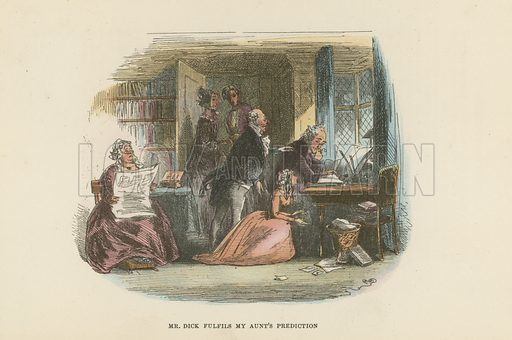
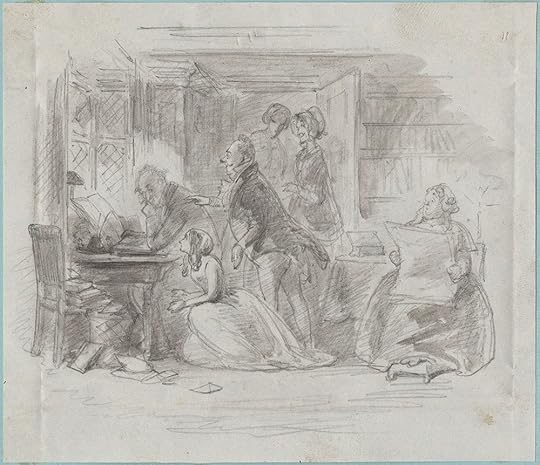 Mod
Mod
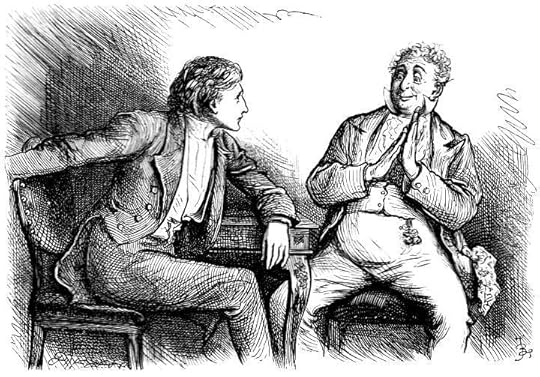
"Then, I have got it, boy!" said Mr. Dick.
Chapter 45
Fred Barnard
Text Illustrated:
‘Now you are a scholar, Trotwood,’ said Mr. Dick. ‘You are a fine scholar. You know what a learned man, what a great man, the Doctor is. You know what honour he has always done me. Not proud in his wisdom. Humble, humble—condescending even to poor Dick, who is simple and knows nothing. I have sent his name up, on a scrap of paper, to the kite, along the string, when it has been in the sky, among the larks. The kite has been glad to receive it, sir, and the sky has been brighter with it.’
I delighted him by saying, most heartily, that the Doctor was deserving of our best respect and highest esteem.
‘And his beautiful wife is a star,’ said Mr. Dick. ‘A shining star. I have seen her shine, sir. But,’ bringing his chair nearer, and laying one hand upon my knee—‘clouds, sir—clouds.’
I answered the solicitude which his face expressed, by conveying the same expression into my own, and shaking my head.
‘What clouds?’ said Mr. Dick.
He looked so wistfully into my face, and was so anxious to understand, that I took great pains to answer him slowly and distinctly, as I might have entered on an explanation to a child.
‘There is some unfortunate division between them,’ I replied. ‘Some unhappy cause of separation. A secret. It may be inseparable from the discrepancy in their years. It may have grown up out of almost nothing.’
Mr. Dick, who had told off every sentence with a thoughtful nod, paused when I had done, and sat considering, with his eyes upon my face, and his hand upon my knee.
‘Doctor not angry with her, Trotwood?’ he said, after some time.
‘No. Devoted to her.’
‘Then, I have got it, boy!’ said Mr. Dick.
The sudden exultation with which he slapped me on the knee, and leaned back in his chair, with his eyebrows lifted up as high as he could possibly lift them, made me think him farther out of his wits than ever. He became as suddenly grave again, and leaning forward as before, said—first respectfully taking out his pocket-handkerchief, as if it really did represent my aunt:
‘Most wonderful woman in the world, Trotwood. Why has she done nothing to set things right?’
‘Too delicate and difficult a subject for such interference,’ I replied.
‘Fine scholar,’ said Mr. Dick, touching me with his finger. ‘Why has HE done nothing?’
‘For the same reason,’ I returned.
‘Then, I have got it, boy!’ said Mr. Dick. And he stood up before me, more exultingly than before, nodding his head, and striking himself repeatedly upon the breast, until one might have supposed that he had nearly nodded and struck all the breath out of his body.
‘A poor fellow with a craze, sir,’ said Mr. Dick, ‘a simpleton, a weak-minded person—present company, you know!’ striking himself again, ‘may do what wonderful people may not do. I’ll bring them together, boy. I’ll try. They’ll not blame me. They’ll not object to me. They’ll not mind what I do, if it’s wrong. I’m only Mr. Dick. And who minds Dick? Dick’s nobody! Whoo!’ He blew a slight, contemptuous breath, as if he blew himself away.
It was fortunate he had proceeded so far with his mystery, for we heard the coach stop at the little garden gate, which brought my aunt and Dora home.
‘Not a word, boy!’ he pursued in a whisper; ‘leave all the blame with Dick—simple Dick—mad Dick. I have been thinking, sir, for some time, that I was getting it, and now I have got it. After what you have said to me, I am sure I have got it. All right!’ Not another word did Mr. Dick utter on the subject; but he made a very telegraph of himself for the next half-hour (to the great disturbance of my aunt’s mind), to enjoin inviolable secrecy on me.
Mod
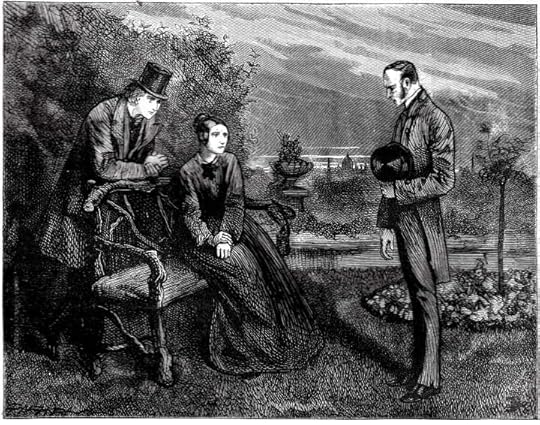
Mr. Lattimer tells his story.
Chapter 46
Fred Barnard
1872 Household Edition
Text Illustration:
She rose with an ill-favoured smile, and taking a few steps towards a wall of holly that was near at hand, dividing the lawn from a kitchen-garden, said, in a louder voice, ‘Come here!’—as if she were calling to some unclean beast.
‘You will restrain any demonstrative championship or vengeance in this place, of course, Mr. Copperfield?’ said she, looking over her shoulder at me with the same expression.
I inclined my head, without knowing what she meant; and she said, ‘Come here!’ again; and returned, followed by the respectable Mr. Littimer, who, with undiminished respectability, made me a bow, and took up his position behind her. The air of wicked grace: of triumph, in which, strange to say, there was yet something feminine and alluring: with which she reclined upon the seat between us, and looked at me, was worthy of a cruel Princess in a Legend.
‘Now,’ said she, imperiously, without glancing at him, and touching the old wound as it throbbed: perhaps, in this instance, with pleasure rather than pain. ‘Tell Mr. Copperfield about the flight.’
 Don't you find it odd that so little attention is given in this book to David's main occupation, and one he becomes famous for : writing? What does he write? Novels like Dickens? Are they funny, sad, sentimental, pot-boilers, romantic, poetic, epic, dramatic, fantastic, horrific, philosophical, pornographic (probably not the latter)? It seems strange that someone like Dickens who, let's face it, is a literary genius, would write a semi-autobiographical novel about a writer and say next to nothing about what or how this writer writes. He seems much more interested in telling us what and how he eats. Any thoughts on why this might be?
Peter wrote: "It seems that he is attracted to all females of all shapes, sizes, ages and even mental stability. I think he even has a flash of emotional curiosity and interest in Rosa. Yikes!"
Don't you find it odd that so little attention is given in this book to David's main occupation, and one he becomes famous for : writing? What does he write? Novels like Dickens? Are they funny, sad, sentimental, pot-boilers, romantic, poetic, epic, dramatic, fantastic, horrific, philosophical, pornographic (probably not the latter)? It seems strange that someone like Dickens who, let's face it, is a literary genius, would write a semi-autobiographical novel about a writer and say next to nothing about what or how this writer writes. He seems much more interested in telling us what and how he eats. Any thoughts on why this might be?
Peter wrote: "It seems that he is attracted to all females of all shapes, sizes, ages and even mental stability. I think he even has a flash of emotional curiosity and interest in Rosa. Yikes!"Not just the females--as people have noted, he was kind of in love with Steerforth, too.
I put it down less to his deprivation--though that definitely existed, even with Peggotty in the picture--than his imagination. He's a dramatic guy. He feels everything intensely.
Ulysse wrote: Don't you find it odd that so little attention is given in this book to David's main occupation, and one he becomes famous for : writing?
I agree that's very odd. We get more on his stenography than his writing.
I wonder if it's because this book is more autobiographical as a character study of Dickens/David (so dramatic! so in love with the world!) than as a professional study.
I enjoyed Mr. Dick a great deal in this one, and love how he exposes the ways social decorum can get in the way of doing the right thing. While I am glad things have worked out between them, as a reader I am a tiny bit disappointed in how the Strong story worked out. I wanted to see Annie developing from a young woman with limited judgment, easily infatuated (the feminine version of David) to someone a little older and wiser and more capable of loving her generous, self-sacrificing husband. Instead we get Annie as permanently and constantly worshipping her man. Oh, well. I'm just going to keep my own version of the story stowed away in my head.
Mod
Original drawing"
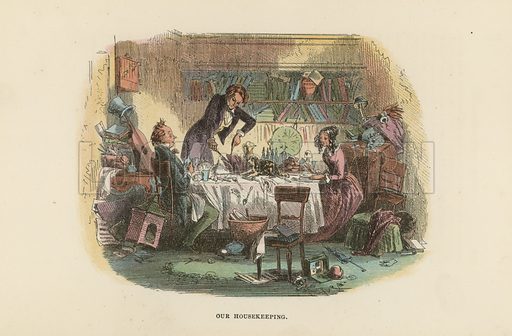
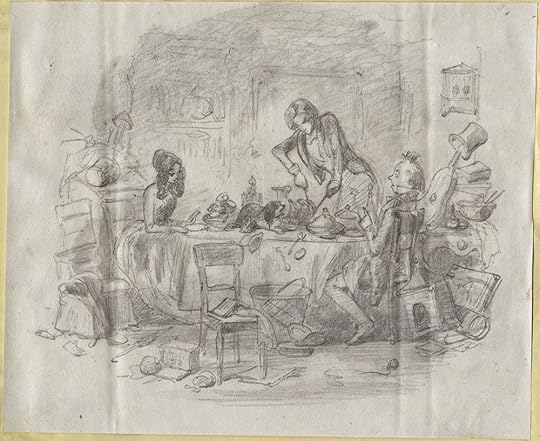
Ah, Kim. You have given us everything. The book’s illustration, it’s original drawing, and a colourized version of the illustration. Thank you. There is so much of interest here. The commentary is thorough so I will just add one observation. At the front centre of the illustration we have an empty chair which is facing the viewer. On the chair is an opened book and what appears to be some form of material or clothe. One leg of the chair holds down some loose papers.
Interesting to speculate on this most prominent detail that is, at the same time, lost amid the confusion in the rest of the picture. An empty chair. An opened book. Phiz, what are you thinking?
Mod
Original sketch"
In this illustration which appeared in the same monthly number as “Our Housekeeping” we find an interesting contrast. In “Our Housekeeping” we have the chaos which is David and Dora’s home and activity. We know that Dora’s contribution to their household is to occasionally hold David’s pencils. What she does not do is stop Jip from walking on the dining room table when they entertain.
In this illustration we again have portrayed a husband who is a writer and his wife. Much else, however, is similar to David and Dora. In the illustration “Mr Dick fulfills my Aunt's prediction” we find a husband and a wife who, while they have differences, are much more harmonious. True, from a 21C perspective the male-female roles are antiquated. Nevertheless, Doctor Strong and Annie are meant for one another. Dickens makes it clear that David and Dora are not.
I found the placement of these chapters within the same monthly number with their corresponding illustrations to be very interesting and effective. I also found the placement of the empty chair in this illustration to be telling. Here, the chair is found in the centre right of the illustration. It is facing inwards towards the Doctor and Annie. Thus, suggestively it is part of them and their environment. In “Our Housekeeping” the placement of the chair excludes itself from the domestic scene, suggesting an alienation of the characters.
 Very interesting. Does anyone think Dickens is making a statement on his own marriage?
Mod
Very interesting. Does anyone think Dickens is making a statement on his own marriage?
Mod
Hi Bobbie
I think that Dickens must have been reflecting on his own marriage to some degree. So much of this novel is tinged with his own life it would be strange if his opinions on marriage did not seep into the novel.
We are still several years from Dickens’s own marital breakdown but by the time of this novel he had many children and Catherine was not up to his energy and pace of life. I think Dickens might well have begun to become restless.
Mod
I read once that one of the reasons for the breakdown of the marriage is that Dickens blamed his wife for having so many children, giving him so many people he had to support. I would think it was just as much his fault as hers.
Mod
I've wondered, he based Dora on his first love, he based Flora from Little Dorrit on the same person. Did he base any character on his wife?
Mod
Kim wrote: "I also think sitting on the floor handing someone a new pen whenever he needs it sounds like one of the most boring things I've ever heard of."I would find it hard to work with someone sitting next to me waiting to hand me a pen.
Of course I don't have to sharpen or ink my pens so maybe I would feel differently if I did.
 Mod
Mod
I've wondered, he based Dora on his first love, he based Flora from Little Dorrit on the same..."
I think that Dora might be a blend of Maria Beadnell and Dickens's wife. He describes Dora as enchanted but also as dim, and this latter judgment might reflect the growing estrangement between the mercurial Dickens and his less sanguine wife. Perhaps he did not feel really understood by Catherine, and the recurring words of Mrs. Strong, that a good marriage should be based on a common outlook towards life, might resonate in Dickens's feelings of not quite being able to share his own thoughts with his own wife?
I like Peter's comparison of Dora to a hothouse flower, because this makes it easier to understand Dora's character - although I also think that Jantine's diagnosis has a lot for itself. The constant talking of the "child-wife" is cringeworthy, and herein I agree with Kim. Kim, did you hear that? I am actually agreeing with you on a point ;-)
Mod
Mod
Never could I have another person cleaning my house. I would have to clean the house first so the person coming to clean wouldn't see how dirty my house was.
Mod
Really? Are you sure you are feeling okay? Are you sure you are virus free? Are you sure I am right? If you agree with me I can't see how I could be.
Mod
My dearest Love,
I received your welcome letter on arriving here last night, and am rejoiced to hear that the dear children are so much better. I hope that in your next, or your next but one, I shall learn that they are quite well. A thousand kisses to them. I wish I could convey them myself.
To years later, trying to get her put into a mental institution.
Mod
My dearest Love,
I received your welcome letter on arriving here last night, and am rejoiced to hear that the dear children are so ..."
Alas. Too often I think it is best not to know anything personal about those I look up to in my life.
Kim wrote: "https://onoto.com/product/the-copperf..."
Kim, you are mean for my stationery/fountain pens-loving head 😅 I'm way too broke for that pen!
Kim, you are mean for my stationery/fountain pens-loving head 😅 I'm way too broke for that pen!
Mod
Mod
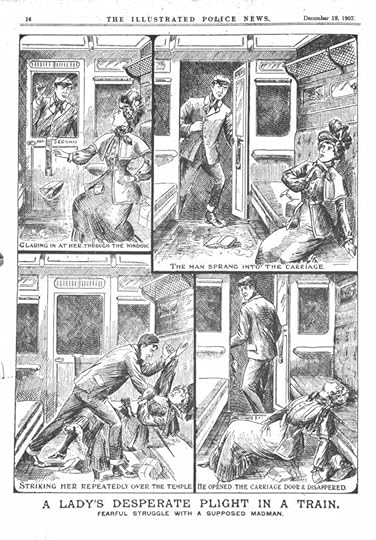
The Victorian Belief That a Train Ride Could Cause Instant Insanity, "Railway madmen" were thought to be activated by the sounds and motion of train travel.
Mod
 Mod
Mod
At least, this way your house would be clean, and you'd still have to pay the cleaning lady for that.
Mod
 Mod
Mod
Really? Are you sure ..."
You ARE right there, Kim. Creepy, isn't it?


Wow, these weeks certainly do go by fast, which is usually a good thing until we get to Christmas and I want them to slow down, here I am putting up the village on the kitchen cabinets, I can hardly believe it. Well, obviously I'm not putting it up at this moment, I needed a little break, all the climbing up and down the ladder was making me a little lightheaded. Anyway, the weeks usually go fast and once again it is my turn at this week's installment. Chapter 44 is titled "Our Housekeeping" and I find myself at first being extremely annoyed with Dora but by the end of the chapter I have softened toward her. I didn't think the first paragraphs of the chapter sounded promising for the marriage:
"It was a strange condition of things, the honeymoon being over, and the bridesmaids gone home, when I found myself sitting down in my own small house with Dora; quite thrown out of employment, as I may say, in respect of the delicious old occupation of making love.
It seemed such an extraordinary thing to have Dora always there. It was so unaccountable not to be obliged to go out to see her, not to have any occasion to be tormenting myself about her, not to have to write to her, not to be scheming and devising opportunities of being alone with her. Sometimes of an evening, when I looked up from my writing, and saw her seated opposite, I would lean back in my chair, and think how queer it was that there we were, alone together as a matter of course—nobody's business any more—all the romance of our engagement put away upon a shelf, to rust—no one to please but one another—one another to please, for life."
It sounded to me like David enjoyed the courtship of he and Dora more than the actual marriage. I have a picture in my head of David returning home each day and now that he sees Dora every evening and Dora isn't the most brillant person I've ever met, before long they have nothing to talk about and sit there just looking at each other. That's the picture in my head anyway. It seems as if the glamour of the wedding has worn off and the housekeeping has begun and is going the way we should have expected. David says no one could have known less about housekeeping than he and Dora did. They hire a servant to keep house for them. They have a very difficult time with Mary Anne, David says he thinks she is Mrs. Crupp's daughter in disguise. When David tells Dora to talk to her about the preparation of meals, which are usually late, underdone or not served at all, Dora's only recourse is to cry and to tell David she could never do that because she is a "a little goose and a poor little thing" and drives me crazy. David asks his aunt to advise and counsel Dora, but she refuses and tells David that he must have patience with "Little Blossom". She tells him:
"You have chosen freely for yourself'; a cloud passed over her face for a moment, I thought; 'and you have chosen a very pretty and a very affectionate creature. It will be your duty, and it will be your pleasure too—of course I know that; I am not delivering a lecture—to estimate her (as you chose her) by the qualities she has, and not by the qualities she may not have. The latter you must develop in her, if you can. And if you cannot, child,' here my aunt rubbed her nose, 'you must just accustom yourself to do without 'em. But remember, my dear, your future is between you two. No one can assist you; you are to work it out for yourselves. This is marriage, Trot; and Heaven bless you both, in it, for a pair of babes in the wood as you are!'"
Hmm, his aunt says it will be a pleasure to advise and counsel Dora, I can't imagine that. After this they go through what David calls the "Ordeal of Servants" , when Mary Anne leaves and servant after servant goes through their house, a "long line of Incapables". This all has me wondering why they need a servant at all. There are only two people in the house, Dora is home all day, what could be so hard to keep this house in order and put meals on the tables between the two of them? What is she doing all day? She can't spend the day playing with Jip, I know dogs and dogs sleep alot, and she doesn't seems like she would be much of a reader, so what does she do? When David and Dora go shopping, the merchants cheat them, just the appearance of them is a sign for the merchants to get out the damaged goods. Reading that makes me think that in this case Aunt Betsey could go along with them and show the both of them the bst way to do their shopping. One night Traddles comes to dinner, but the house is so cluttered that David wonders if there is enough room for Traddles to use his knife and fork. Jip walks on the table, "putting his foot in the salt or the melted butter." I have had dogs my entire life and adore them much more than I enjoy people usually, but I wouldn't let them walk around on the table, especially when there is food on it. The mutton is barely cooked, and the oysters that Dora bought cannot be opened. I have never attempted to serve anyone oysters, but don't you throw them in a pot of boiling water and they open on their own?
And why are they always cramped for room? Even if neither one of them can hold a broom or a mop they could at least put things away, organize the house in some way. They both drive me crazy and calling her child-wife makes me want to scream. I begin to warm to Dora though when she sits and tries to "be good" by taking care of the account book although that seems like one of the things she would be least likely to be able to do, cleaning should be much more in her line of thought, and I'm not sure why David doesn't do it himself. I still wish she would simply put things away, but at least she is trying to do something. And I think she is sweet when she asks him if she can hold his pens.
"Will you mind it, if I say something very, very silly?—-more than usual?' inquired Dora, peeping over my shoulder into my face.
'What wonderful thing is that?' said I.
'Please let me hold the pens,' said Dora. 'I want to have something to do with all those many hours when you are so industrious. May I hold the pens?'
The remembrance of her pretty joy when I said yes, brings tears into my eyes. The next time I sat down to write, and regularly afterwards, she sat in her old place, with a spare bundle of pens at her side.”
I wonder how many pens you need to write a book? I have no idea.