
The Old Curiosity Club discussion

This topic is about
David Copperfield
David Copperfield
>
DC, Chp. 51-53

 Mod
Mod
To cut a long story – as Mr. Micawber is telling it – short, Mr. Micawber exposes Uriah Heep as the scoundrel he really is, and – what is more – he also makes it clear that he has written evidence of his accusations, such as signatures Uriah has forged in the process of embezzling money and of incriminating Mr. Wickfield. Mr. Micawber could not forego the pleasure of reading out a kind of memorandum, which he relishes very much. Uriah Heep, seeing that he has been cornered and that there is hardly any way of escaping justice, finally drops the mask of humility – to his mother’s great alarm – and threatens those present by hinting that he has some of them under the harrow and that he will have his revenge on them before long. In this context, David, once again, reveals his sheer detest for Uriah:
”Though I had long known that his servility was false, and all his pretences knavish and hollow, I had had no adequate conception of the extent of his hypocrisy, until I now saw him with his mask off. The suddenness with which he dropped it, when he perceived that it was useless to him; the malice, insolence, and hatred, he revealed; the leer with which he exulted, even at this moment, in the evil he had done—all this time being desperate too, and at his wits' end for the means of getting the better of us—though perfectly consistent with the experience I had of him, at first took even me by surprise, who had known him so long, and disliked him so heartily.”
Uriah’s penchant to do evil for the sake of doing evil, and not only to enrich himself, seems dominant here. In the face of Uriah’s wickedness, David thinks of what Agnes had to go through and says,
“I was shocked by the mere thought of her having lived, an hour, within sight of such a man.
Here, however, he should, as we say in German, touch his own nose because he has known of Agnes’s precarious situation and even seen Uriah boast of his power over the Wickfields for such a long time without really doing anything about it.
I liked the following passage, though, because it shows that even the Heeps are human beings with human feelings:
“'But I love you, Ury,' cried Mrs. Heep. And I have no doubt she did; or that he loved her, however strange it may appear; though, to be sure, they were a congenial couple. 'And I can't bear to hear you provoking the gentlemen, and endangering of yourself more. I told the gentleman at first, when he told me upstairs it was come to light, that I would answer for your being umble, and making amends. Oh, see how umble I am, gentlemen, and don't mind him!'”
Then there is this:
”Her son sat her down in his chair; and, standing sulkily by her, holding her arm with his hand, but not rudely, […]”
Why it should be strange, though, that a mother should love her own son, I cannot see.
Finally it becomes clear that Uriah Heep will have to make amends for all he has done – e.g. by restoring what he has stolen and embezzled to his victims, amongst others to Aunt Betsey. Aunt Betsey also suggests to Mr. Micawber joining the Peggottys and going to Australia, an idea Micawber immediately regards as one he has entertained for quite a long time. I also noticed that Master Micawber is a rather sullen and soured young man – probably Micawber’s carelessness in financial things is a source of mirth only to the reader and not so much to his children?
Two other quotations I found remarkable are:
“[…] I felt devoutly thankful for the miseries of my younger days which had brought me to the knowledge of Mr. Micawber.”
Does this mean that Dickens finally wants to stress his having a point in having introduced Micawber into the story? We were all wondering to what purpose this rambling character kept reappearing.
Then there is the following description hinting again at the motif of time going by:
”Early in the morning, I sauntered through the dear old tranquil streets, and again mingled with the shadows of the venerable gateways and churches. The rooks were sailing about the cathedral towers; and the towers themselves, overlooking many a long unaltered mile of the rich country and its pleasant streams, were cutting the bright morning air, as if there were no such thing as change on earth. Yet the bells, when they sounded, told me sorrowfully of change in everything; told me of their own age, and my pretty Dora's youth; and of the many, never old, who had lived and loved and died, while the reverberations of the bells had hummed through the rusty armour of the Black Prince hanging up within, and, motes upon the deep of Time, had lost themselves in air, as circles do in water.
I looked at the old house from the corner of the street, but did not go nearer to it, lest, being observed, I might unwittingly do any harm to the design I had come to aid. The early sun was striking edgewise on its gables and lattice-windows, touching them with gold; and some beams of its old peace seemed to touch my heart.
I strolled into the country for an hour or so, and then returned by the main street, which in the interval had shaken off its last night's sleep. Among those who were stirring in the shops, I saw my ancient enemy the butcher, now advanced to top-boots and a baby, and in business for himself. He was nursing the baby, and appeared to be a benignant member of society.”
This lengthy excursion does not seem important in itself, although it is beautiful, but it helps conjure up the mood of melancholy that must hang over somebody who is looking back at his life.
Mod
I found it very moving, however, to see Dora so changed and matured in the face of death. Her old misgivings of being really loved by David seem to come back with a vengeance, and then there is this passage in which she suddenly sees it all:
” 'I was very happy, very. But, as years went on, my dear boy would have wearied of his child-wife. She would have been less and less a companion for him. He would have been more and more sensible of what was wanting in his home. She wouldn't have improved. It is better as it is.'
'Oh, Dora, dearest, dearest, do not speak to me so. Every word seems a reproach!’”
Although Dora replies that she does not mean her words to be a reproach, I could not help thinking that David is reproaching himself here because her words voice his very thoughts, and that he is somehow feeling guilty of her death. This also becomes clear in a later passage:
”I sit down by the fire, thinking with a blind remorse of all those secret feelings I have nourished since my marriage. I think of every little trifle between me and Dora, and feel the truth, that trifles make the sum of life. Ever rising from the sea of my remembrance, is the image of the dear child as I knew her first, graced by my young love, and by her own, with every fascination wherein such love is rich. Would it, indeed, have been better if we had loved each other as a boy and a girl, and forgotten it? Undisciplined heart, reply!“
Then there is another question that remains yet open: What might Dora have said to Agnes when her friend visited her on her deathbed?
 Tristram wrote: "What might Dora have said to Agnes when her friend visited her on her deathbed?"
Dora wonders as soon as she meets Agnes why David didn't marry Agnes instead of her. She knows what's up. I assume she's giving her blessing.
What she says to David--it's better off that she dies and doesn't become a (greater) disappointment to him--is immensely heartbreaking, and it kind of doesn't make me like David all that much. Though really it's not David's fault either. People make mistakes when they get married all the time; in fact when I think about it, David is as much a disappointment to Dora as the other way around. Both David and Dora did their best to live up to the promises they'd made, and I don't see how we can ask more of them. So sad. Thank goodness for divorce.
 Mod
Mod
Dora wonders as soon as she meets Agnes why David didn't marry Agnes instead of her. She knows wha..."
Julie
Yes. Well said.
I found David and Dora’s youthful marriage to be one that was based on innocence and naivety. So much hope and rainbows and unicorns. The moment when David comments that “trifles make the sum of life” is the place where I see his maturity.
Looking back into the novel there are other characters who have been fooled by early love. There is Em’ly and Aunt Betsey. Perhaps to that list we can add the three young women who married Murdstone.
No doubt in the last chapters of this book Dickens will unveil marriages yet to come. We shall see whose relations will stand the test and the trifles of time.
 I was so happy to finally see Uriah Heep get his just rewards. I did remember something of this confrontation but I did not remember that Mr. Micawber had anything to do with it until last weeks chapters. It certainly gives us reason to look at Mr. Micawber in a better light.
As for Dora's talk with Agnes, I think it would be easy to assume that Dora in her new maturity may have asked Agnes to take care of David.
I think so too. Dora would either give her blessing to pursue David to Agnes in person, or even ask her to take care of him. In the end she was wiser than she herself might even have realised. How many of her problems with 'not being child-like' would have been merely insecurity, and having too often heard 'don't break your pretty little head over it, pet' I wonder?
And I too am so happy that HEEP is finally being taken care of! Oh that nasty little turd ... and I even was a bit proud of Micawber. Although I also had to chuckle about aunt Betsey setting them up for migration very connivingly. Give them a fresh start they didn't even think about before, and get rid of the endless asking for help in the process. Although it would mean that Mr. Peggotty and Em'ly and Mrs. Gummidge would have to put up with them on the same ship for ages, which feels a bit mean.
Oh and what I wanted to mention, apart from the story. No matter how her character was written, Mrs. Gummidge always felt a bit silly to me, and I couldn't remember why. Then while reading chapter 51 I remembered at once. When I was very little, one of the few television stations that broadcasted for children during the day was (to us) foreign: the CBBC. So I did spend quite some of my tv-watching moments with British television. Which would not have been a lot in the end, because I loved to draw and play outdoors and all, but one thing I definitely did not want to miss was indeed Worzel Gummidge.
image: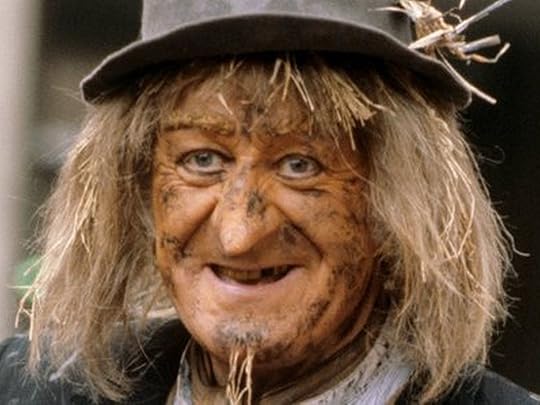
And I too am so happy that HEEP is finally being taken care of! Oh that nasty little turd ... and I even was a bit proud of Micawber. Although I also had to chuckle about aunt Betsey setting them up for migration very connivingly. Give them a fresh start they didn't even think about before, and get rid of the endless asking for help in the process. Although it would mean that Mr. Peggotty and Em'ly and Mrs. Gummidge would have to put up with them on the same ship for ages, which feels a bit mean.
Oh and what I wanted to mention, apart from the story. No matter how her character was written, Mrs. Gummidge always felt a bit silly to me, and I couldn't remember why. Then while reading chapter 51 I remembered at once. When I was very little, one of the few television stations that broadcasted for children during the day was (to us) foreign: the CBBC. So I did spend quite some of my tv-watching moments with British television. Which would not have been a lot in the end, because I loved to draw and play outdoors and all, but one thing I definitely did not want to miss was indeed Worzel Gummidge.
image:
Mod
Dora wonders as soon as she meets Agnes why David didn't marry Agnes instead of her. She knows wha..."
It is rather convenient for David that he implies that Dora might have asked Agnes to take care of him, isn't it, because that way, it seems that he is actually honouring Dora's last wish when he is doing what he himself wishes. And yes, Dora's saying that David would have been happier if he had married Agnes right from the start is very heart-breaking and adds a lot of depth to a character one would not have expected to show it so much.
Mod
This is indeed a bit mean on Aunt Betsey's part, although I am sure she does not quite realize the implications of her suggestion. Tying the Micawbers on Mr. Peggotty's back is a neat way to get rid of them and of rendering them a service by having them associate with some responsible and well-meaning people - but, as we say in German, this is surely a bear's service to Mr. Peggotty, i.e. a service that will eventually cause more harm and inconvenience than good.
Mod
In the chapters where we see David and Dora in their marriage it just dawned on me that this particular relationship/marriage has similarities to that of Clara Copperfield and the loathsome Mr Murdstone. In their marriage we see how how Murdstone breaks David’s mother by his constant domination. We are told that Murdstone does this to two other innocent and somewhat docile young women.
I don’t think it is too much of a stretch to see that David slips into this role with Dora in some minor ways. He too tries to bring Dora around to his way of thinking and his way of conceiving the world. David, unlike Murdstone and his sister, is an innocent himself, but to me there lingers a bit of domination in his approach to his marriage with Dora.
Am I off base here?
I did not realise, but I think you are right here. And I think David noticed this too, from the way he writes - which probably is why he does what he can to let it go and let Dora be his child-wife, but sometimes he doesn't manage (enough). And it is very easy to slip into roles you have experienced, that you know. It's something you can see all the time with people who come from abusive households, or households with otherwise unhealthy role models - people want to do better, but do not know how.
I definitely see the parallels between David's pretty and hapless little mother and Dora, and this goes a long way to explaining why he fell in love with her. But I don't see him as domineering Dora. To me, it seems the opposite: he would like Dora to take on a little initiative and autonomy in the housekeeping department, so he doesn't have to himself. Housekeeping is her job. Whereas Murdstone doesn't really want Clara Copperfield to handle anything on her own. He has a sister who is already programmed to carry out his agenda, and he'd rather Miss Murdstone handle things, David being the most noteworthy of those things, and Clara just stay out of it and be ornamental.
(I am pretty sure Aunt Betsey also sees the parallels between Clara and Dora Copperfield, and regrets opposing her brother marrying the first, so refuses to oppose her nephew marrying the second. Some people do learn from their mistakes.)
Julie wrote: "I definitely see the parallels between David's pretty and hapless little mother and Dora, and this goes a long way to explaining why he fell in love with her. But I don't see him as domineering Dor..."Julie, I agree with your observations about Clara and Dora. Although they are similar, I don't see any similarity between how David and Mr. Murdstone treated their wives. I think you are spot on. I also agree with your second observation regarding Aunt Betsy's treatment of the two young women.
Mod
The only difference here is that David grudgingly comes to the conclusion that Dora's mind is already formed and that unless he stopped trying to form it, he would break her. He doesn't want to break her, though, which makes him different from Murdstone, who actually takes pleasure in breaking people.
I see a point in both too. And now my mind starts to work through this discussion ... what if he wanted to form her mind, because of his experience with Murdstone? What if he recognised she was like his mother, and was afraid that if she (they both) fell for servants who took advantage of them, what would happen to her if he fell away and she met a Murdstone-like man? In that way I can totally imagine him wanting her to be more independent where it comes to keeping track of household expenditures and such, so that in such a case she would be less likely to lose it all like his mother did ...
Mod
Thinking back, I do not understand why David could not step in and get their servant or housekeeper to do her job. It seems that a man could get better results in that and not just let a servant not do their job. Surely he could have found a better servant somewhere. Poor Dora.
 Mod
Mod
He reminded me of Rob the Grinder.
Mod
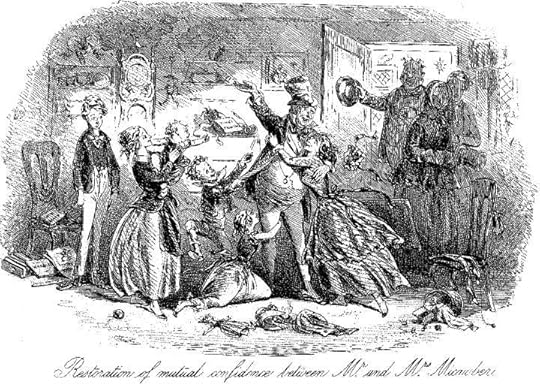
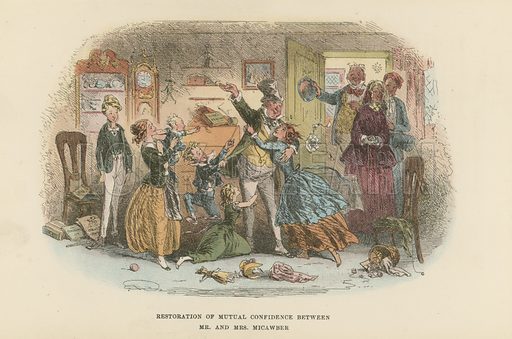
Restoration of mutual confidence between Mr. and Mrs. Micawber
Chapter 52
Phiz
Commentary:
The first illustration for the seventeenth monthly number, issued in September 1850, strikes a mood of triumph in contrast to the domestic melodrama and sentimentality of August's complementary illustrations for chapters 47 through 50. For this first September illustration, Phiz focuses not on the highly charged scene of Micawber's and Traddles' dramatic revelations of Uriah Heep's financial chicanery at Heep and Wickfield, Canterbury, but rather on the happy consequences of Micawber's having cleared his conscience at having become the odious Heep's reluctant accomplice. According to J. A. Hammerton (1910), the illustration of the happy "Restoration" of the Mr. Micawber to his family may be specifically associated with the following passage:
Mr. Dick, my aunt, and I , went home with Mr. Micawber. . . . . His house was not far off; and as the street-door opened into the sitting- room, and he bolted in with a precipitation quite his own, we found ourselves at once in the bosom of the family. Mr. Micawber exclaiming, "Emma! my life!" rushed into Mrs. Micawber's arms. Mrs. Micawber shrieked, and folded Mr. Micawber in her embrace.
In fact, Phiz has synthesized far more text than that in this ebullient celebration of the Micawbers' domestic felicity which is the chief comic strain of the novel. On the broad stage of the full-page plate Phiz has captured the poses, juxtapositions, and emotions of ten characters in an almost Baroque tableau reminiscent of the Cratchit family's celebration in A Christmas Carol (1843), both families having as their common point of origin that of John and Elizabeth Dickens:
Miss Micawber, nursing the unconscious stranger of Mrs. Micawber's last letter to me, was sensibly affected. The stranger leaped. The twins testified their joy by several inconvenient but innocent demonstrations. Master Micawber, whose disposition appeared to have been soured by early disappointment, and whose aspect had become morose, yielded to his better feelings, and blubbered.
Phiz has disposed the figures as the text suggests, with Mr. Dick doffing his hat in the doorway, and Aunt Betsey and David to his immediate left (at the extreme right of the scene, the shading placing them very much in the background), leaving the viewer to focus on the joyful reunion of Emma and Wilkins Micawber (centre), the latter a gigantic figure just having come from the conquest and abasement of the devilish Heep. Indeed, Phiz has deliberately had Micawber keep his hat on, though indoors, to increase his height and dwarf everyone else in the scene. The effect is especially telling for the form and figure of Mrs. Micawber in her second appearance in the narrative-pictorial sequence, for she seems far less matronly and more girlish here than in "Mr. Micawber delivers some valedictory remarks", and both shorter and thinner than her adolescent daughter, who has grown into a young woman of much the same mould since her last appearance. So kinetic is the moment recorded that Phiz shows Mrs. Micawber's hat in mid-air, and one of the twins (also considerably grown) in mid-leap. To the right, Mrs. Micawber rushes into her husband's embrace, knocking over her workbox near the chair on which she has been sitting. The strong horizontal lines in her dress emphasize her rapid movement from right to centre. The action, however, grows less frantic as we move toward the left-hand register with teenaged Miss Micawber holding up her infant brother and the pillar-like Master Micawber end-stopping the action, not "blubbering" as Dickens states, but aloof and uncertain as to how to respond to his father's latest emotional outpouring of optimism as he jubilantly welcomes the prospect of "misery, . . . homelessness, . . . hunger, rags, tempest, and beggary".
Looking somewhat sheepish and uncertain how to respond to his quixotic parent, Wilkins Micawber, Jr., stands beside sheet music ("Warble" is clearly printed on the cover) and a flute lying discarded on the floor at his feet. The significance of the music and instrument quickly become apparent when Micawber mentions that he had hoped to arrange for his oldest son to join the Canterbury Boys' Choir (reminiscent of Dickens's sister, Fan, having musical inclinations, and having attended the London School of Music prior to marrying Henry Burnett). Meantime, as was the case with young Charles Dickens in Chatham, the father tells Copperfield that his boy "has contracted a habit of singing in public-houses, rather than in sacred edifices". Thus, the instrument in the illustration prepares the reader for the subsequent revelation that Micawber's son is destined to be a performative musician, in which character he will gain distinction in the community of Port Middlebay as both singer and dancer, noted by the local newspaper as being "Among the votaries of Terpsichore, who disported themselves until Sol gave warning for departure" ( the flowery language replete with classical allusions suggesting that this reportage is by Wilkins Micawber, Senior) at a public dinner held in honour the recently installed District Magistrate. The flute, apparently a trivial detail in the illustration, becomes first a signifier of the youth's talent and then a foreshadowing of his being acclaimed an artist in his adopted country. One must therefore assume that Dickens took Phiz into his confidence about his plans for the social and material success that the Micawbers would enjoy abroad. However, the flute also constitutes an extension of the text because Dickens nowhere mentions young Master Micawber's interest or proficiency in instrumental music. Phiz may have decided that using an object to signify his vocal talent would have been difficult, and opted for a more obvious signifier of musical ability. In short, in this illustration Phiz shows more than Dickens tells.
The picture's sense of motion and renewal prepares the reader for the debt-ridden Micawbers' scheme to make a fresh start by emigrating to Australia, proposed and financed by Betsey Trotwood through her recently recovered fortune. The notion of emigration had been much on Dickens's mind since his founding together with philanthropist Angela Burdett-Coutts of Urania Cottage, a refuge and training centre for reformed prostitutes. The wind of optimism that blows through this illustration will sweep the Micawbers across the seas to the other land of opportunity, Australia, which is the destination of Mr. Moddle in Martin Chuzzlewit (1843) and later of Magwitch in Great Expectations (1861). When writing David Copperfield, Dickens was an enthusiastic supporter of the Family Colonisation Loan Society, which a Mrs. Caroline Chisholm (afterwards whom he lampooned as Mrs. Jellyby in Bleak House) established specifically to help English fam ilies such as the Micawbers to emigrate to the farthest corners of the Empire, but especially to Australia. In the initial (March 1850) number of Household Words, about six months before writing this seventeenth instalment of the novel, Dickens published letters from such "assisted emigrants" to advertise the benefits of this scheme, the editors of these letters being Dickens and Mrs. Chisholm. In his working notes, Dickens had written for this sequence of chapters "Clear the way for Emigration." Perhaps Dickens's interest in emigration led him to propose that this scene rather than that of Heep's denunciation be the subject of the first of the two illustrations for September 1850, whereas, for example, in illustrating these chapters Fred Barnard in the Household Edition chose the other, far more dramatic moment for realisation in chapter 52's "Approach me again, you — you — you heep of infamy," gasped Mr. Micawber, "and if your head is human, I'll break it. Come on, come on!"
In this initial plate for chapters 51 through 53, Phiz comments upon the comic scene that results from Heep's receiving his comeuppance by inserting telling background details that do not detract from the focal point of the scene, the reunion in confidence of the Micawbers. The principal of these non-textual elements include an apparently smiling clock (a fine piece of pathetic fallacy), a child's hanging puppet (which may suggest either Micawber's former dependence on Heep, or Heep's having been taken up by the officers of the law), and a New Testament print (immediately behind Micawber's hat) of the return and forgiveness of the Prodigal Son. Although Michael Steig in Dickens and Phiz does not comment upon this illustration, it offers a number of parallels with other interior scenes which he has taken pains to analyse, including "Mr. Peggotty's dream comes true" and "Our Housekeeping"". Again, the chairs, right and left, serve as bookends to the scene, and Phiz employs embedded book titles, pictures, and objects to offer comments upon his narrative material. As Steig notes of the mask motif seen in "Mr. Peggotty's dream comes true":
That the mask may signify the return to one's true self is suggested by its presence in the first illustration for the next monthly part, "Restoration of mutual confidence between Mr. and Mrs. Micawber" (ch. 52), where it clearly signifies Micawber dropping his role as Uriah's toady, exposing the villain and returning to his own natural expansiveness.
 Mod
Mod
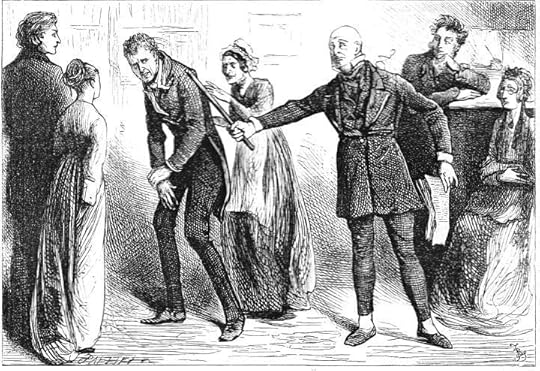
"Approach me again, you - you heep of infamy."
Chapter 52
Fred Barnard
1872 Household Edition
Text Illustrated:
Mr. Micawber, whose impetuosity I had restrained thus far with the greatest difficulty, and who had repeatedly interposed with the first syllable of SCOUN-drel! without getting to the second, now burst forward, drew the ruler from his breast (apparently as a defensive weapon), and produced from his pocket a foolscap document, folded in the form of a large letter. Opening this packet, with his old flourish, and glancing at the contents, as if he cherished an artistic admiration of their style of composition, he began to read as follows:
‘“Dear Miss Trotwood and gentlemen—“’
‘Bless and save the man!’ exclaimed my aunt in a low voice. ‘He’d write letters by the ream, if it was a capital offence!’
Mr. Micawber, without hearing her, went on.
‘“In appearing before you to denounce probably the most consummate Villain that has ever existed,”’ Mr. Micawber, without looking off the letter, pointed the ruler, like a ghostly truncheon, at Uriah Heep, ‘“I ask no consideration for myself. The victim, from my cradle, of pecuniary liabilities to which I have been unable to respond, I have ever been the sport and toy of debasing circumstances. Ignominy, Want, Despair, and Madness, have, collectively or separately, been the attendants of my career.”’
The relish with which Mr. Micawber described himself as a prey to these dismal calamities, was only to be equalled by the emphasis with which he read his letter; and the kind of homage he rendered to it with a roll of his head, when he thought he had hit a sentence very hard indeed.
‘“In an accumulation of Ignominy, Want, Despair, and Madness, I entered the office—or, as our lively neighbour the Gaul would term it, the Bureau—of the Firm, nominally conducted under the appellation of Wickfield and—HEEP, but in reality, wielded by—HEEP alone. HEEP, and only HEEP, is the mainspring of that machine. HEEP, and only HEEP, is the Forger and the Cheat.”’
Uriah, more blue than white at these words, made a dart at the letter, as if to tear it in pieces. Mr. Micawber, with a perfect miracle of dexterity or luck, caught his advancing knuckles with the ruler, and disabled his right hand. It dropped at the wrist, as if it were broken. The blow sounded as if it had fallen on wood.
‘The Devil take you!’ said Uriah, writhing in a new way with pain. ‘I’ll be even with you.’
‘Approach me again, you—you—you HEEP of infamy,’ gasped Mr. Micawber, ‘and if your head is human, I’ll break it. Come on, come on!’
I think I never saw anything more ridiculous—I was sensible of it, even at the time—than Mr. Micawber making broad-sword guards with the ruler, and crying, ‘Come on!’ while Traddles and I pushed him back into a corner, from which, as often as we got him into it, he persisted in emerging again.
Mod
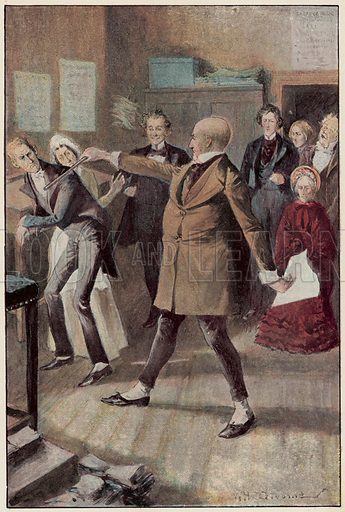
"You - you Heep of infamy."
Chapter 52
William Henry Charles Groome
Mod
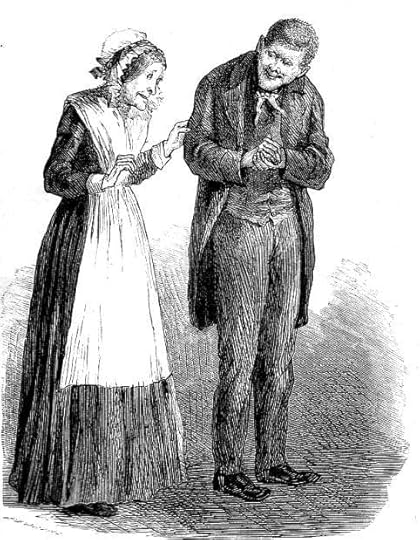
Uriah Heep and His Mother
Chapter 52
Sol Eytinge Jr.
1867 Diamond Edition
Commentary:
The fifteenth illustration — "Uriah Heep and His Mother" — captures the moment in Chapter 52, "I Assist at an Explosion," when the Heeps are receiving their comeuppance at the hands of Wilkins Micawber, whose indictment:
had a powerful effect in alarming the mother; who cried out in much agitation: —
"Ury, Ury! Be umble, and make terms, my dear!"
"Mother!" he retorted, "will you keep quiet? You're in a fright and don't know what you say or mean. Umble!" he repeated, looking at me with a snarl; "I've umbled some of 'em for a pretty long time back, umble as I was!"
The text gives the reader very little sense of Uriah's mother, other than that she has inculcated the doctrine "Be umble" into Uriah's speech, if not his consciousness. Compared to Phiz's lean, long-headed Uriah, Eytinge has given us a better fed, less angular villain, although the pointed chin and wringing of the hands are still very much in evidence.
Mod
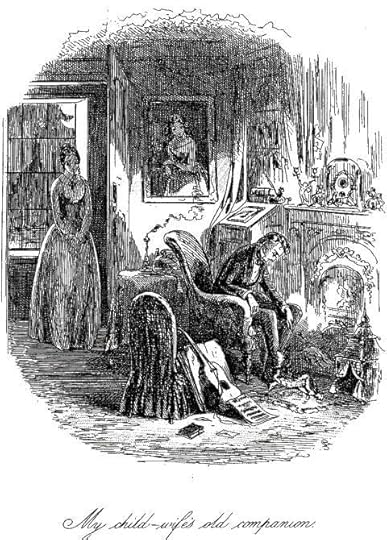
My child wife's old companion
Chapter 53
Phiz
Commentary:
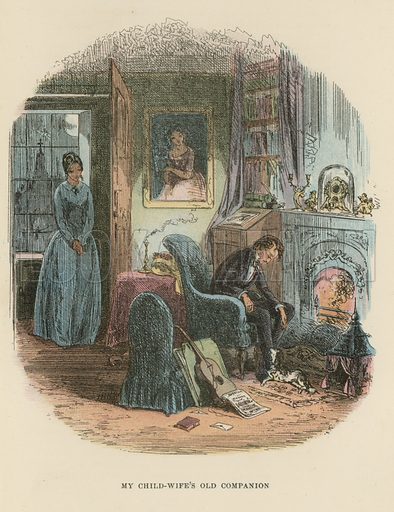
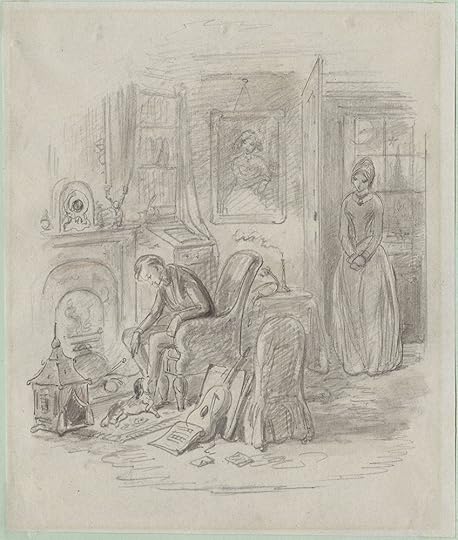
In the second illustration in the seventeenth monthly number, which was issued in September 1850 and comprises chapters 51 through 53, Phiz again utilizes the guitar as a symbol of the musical Dora, a signifier which he employed previously in "Our Housekeeping", but here the effect is sentimental rather than satirical as the instrument's broken strings foreshadow the impending death of its owner and that of her pet and alter ego, Jip the spaniel, still alive at David's feet in this The text illustrated is this:
Agnes is downstairs, when I go into the parlour; and I give her the message. She disappears, leaving me alone with Jip.
His Chinese house is by the fire; and he lies within it, on his bed of flannel, querulously trying to sleep. The bright moon is high and clear. As I look out on the night, my tears fall fast, and my undisciplined heart is chastened heavily—heavily.
I sit down by the fire, thinking with a blind remorse of all those secret feelings I have nourished since my marriage. I think of every little trifle between me and Dora, and feel the truth, that trifles make the sum of life. Ever rising from the sea of my remembrance, is the image of the dear child as I knew her first, graced by my young love, and by her own, with every fascination wherein such love is rich. Would it, indeed, have been better if we had loved each other as a boy and a girl, and forgotten it? Undisciplined heart, reply!
How the time wears, I know not; until I am recalled by my child-wife’s old companion. More restless than he was, he crawls out of his house, and looks at me, and wanders to the door, and whines to go upstairs.
‘Not tonight, Jip! Not tonight!’
He comes very slowly back to me, licks my hand, and lifts his dim eyes to my face.
‘Oh, Jip! It may be, never again!’
He lies down at my feet, stretches himself out as if to sleep, and with a plaintive cry, is dead.
‘Oh, Agnes! Look, look, here!’ —That face, so full of pity, and of grief, that rain of tears, that awful mute appeal to me, that solemn hand upraised towards Heaven!
‘Agnes?’
It is over. Darkness comes before my eyes; and, for a time, all things are blotted out of my remembrance.
As in the text, Phiz stationed David in his easy-chair by the fire, his posture suggestive of reflection, if not "blind remorse." However, in the passage illustrated David is apparently alone, for Agnes has received Dora's message and has gone upstairs. Although Phiz's young women all too often resemble one another, here Phiz utilizes the physical similarities between Dora, presiding over the scene from the painting above David, and Agnes, standing in the doorway with a church spire behind her. Behind her, "The bright moon is high and clear", but Phiz has caused a cloud to move across it, and has positioned it immediately above Agnes's head. Since Dickens does not mention the Thames lying beyond the window of David and Dora's cottage at Highgate, we must assume that the boat and its occupant are a symbolic rendering of David on "the sea of . . . remembrance."
As both Steig and Cohen note, details within the theatrical set reflect David's relationship with Dora and her youthful death, especially the sheet music by the broken-stringed guitar (the words "REQUIEM" and "MOZART" easily deciphered) and the candle that smokes as it gutters out, in keeping with the impending death of Jip and, as Agnes's posture and presence at the doorway imply, the announcement that Dora of the curls has just expired upstairs. Jip's exotic doghouse, a bit of chonoissierie of the type favoured by the Prince Regent at his Brighton Pavillion in the era of the visionary poets Keats, Shelley, and Coleridge, a canine-sized pagoda, reflects Dora's impractical, romantic, unworldy nature. The motif of the embracing amorini at the top of the fireplace screen suggests the passionate but one-dimensional nature of David and Dora's relationship, whereas the mask at the bottom, lowering at Jip, suggests that he, like his mistress, is marked for death. In the clock on the mantelpiece, the ornamental dog who is guarding his sleeping master implies David's fidelity to Dora's memory. The figurines, particularly the cupid holding aloft two rose candle receptacles, suggest the immaturity of David and Dora as they embarked upon matrimony. The only clutter evident in a household formerly characterized by nothing but confusion is associated with Dora, whose presence is implied by the music portfolio and the guitar: a book not re-shelved and a sealed envelop upon the floor (perhaps implying Dora's petitioning Agnes to look after David when she is gone). In contrast, the areas dominated by David, the writing desk and bookcase, are tidy and well-organized. Cohen notes that the rather small chair beside David's, like the portfolio and a butterfly on an inkwell, suggests "David's impending bereavement."
 Mod
Mod
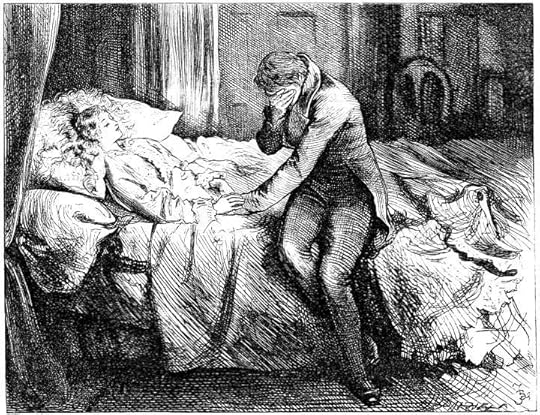
"It is much better as it is!"
Chapter 53
Fred Barnard
1872 Household Edition
Text Illustrated:
‘I am going to speak to you, Doady. I am going to say something I have often thought of saying, lately. You won’t mind?’ with a gentle look.
‘Mind, my darling?’
‘Because I don’t know what you will think, or what you may have thought sometimes. Perhaps you have often thought the same. Doady, dear, I am afraid I was too young.’
I lay my face upon the pillow by her, and she looks into my eyes, and speaks very softly. Gradually, as she goes on, I feel, with a stricken heart, that she is speaking of herself as past.
‘I am afraid, dear, I was too young. I don’t mean in years only, but in experience, and thoughts, and everything. I was such a silly little creature! I am afraid it would have been better, if we had only loved each other as a boy and girl, and forgotten it. I have begun to think I was not fit to be a wife.’
I try to stay my tears, and to reply, ‘Oh, Dora, love, as fit as I to be a husband!’
‘I don’t know,’ with the old shake of her curls. ‘Perhaps! But if I had been more fit to be married I might have made you more so, too. Besides, you are very clever, and I never was.’
‘We have been very happy, my sweet Dora.’
‘I was very happy, very. But, as years went on, my dear boy would have wearied of his child-wife. She would have been less and less a companion for him. He would have been more and more sensible of what was wanting in his home. She wouldn’t have improved. It is better as it is.’
Mod
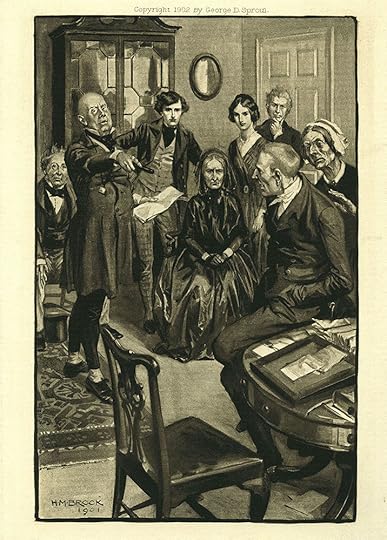
"You - you Heep of infamy."
H. M. Brock
1901
Mod
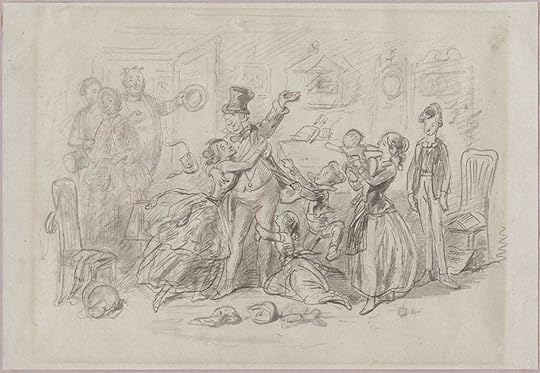
Original drawing"
Kim
Thank you for continuing to provide us with these wonderful Browne illustrations from the original drawing to illustration in the book to the colourized version. In many ways, I enjoy the original drawing the best. The image is bolder. Just imagine what a treat it would be to sit with the original drawing and the illustration in the book in front of you at a table.
I thoroughly enjoy the extended commentaries as well. They help us realize what Browne was accomplishing each month. I often wonder if Dickens, with his incredibly busy life, took the time each month to enjoy the illustrations. We know that Dickens did let Browne know when the drawing did not suit him. How often, I wonder did Dickens send a compliment to Browne?
Mod
Uriah Heep and His Mother
Chapter 52
Sol Eytinge Jr.
1867 Diamond Edition
Commentary:
The fifteenth illustration — "Uriah Heep and His Mother" — captures the moment in Chapter 52, "I Assist ..."
In the interest of full disclosure I can’t draw a straight line even with the help of a ruler. That said, I find this illustration painful. Perhaps it is because Uriah Heep is such a creepy person.
Mod
Mod
 Mod
Mod
He reminded me of Rob the Grinder."
Yes, I am sure Wilkins junior is bound to turn out to no good, with such a father as a model before him.
Mod
"
Kim
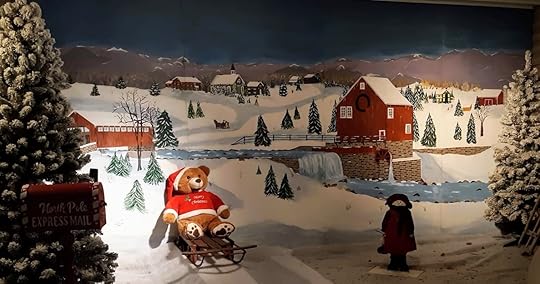
Goodness gracious. This is a wonderful painting. What are its dimensions? I love how you integrated the bear on the toboggan to give the painting its depth.
Kim, I had no idea you had such a talent. I love pastoral scenes and that snowy scene is so beautiful. And the water and trees are wonderful, which you said you were not very good at.
Mod
Mod
Mod
Mod
I'm not exactly sure I'd call it fabulous, but thanks anyway. I'm going to have to take a better look at it. Willow started barking like she was crazy the other night and my husband went to the window to see what she was barking at and there were people outside taking pictures of kids standing in front of it. :-)
Mod

Here it is when it snows which isn't often.
Mod
 Mod
Mod
 Mod
Mod
 Mod
Mod


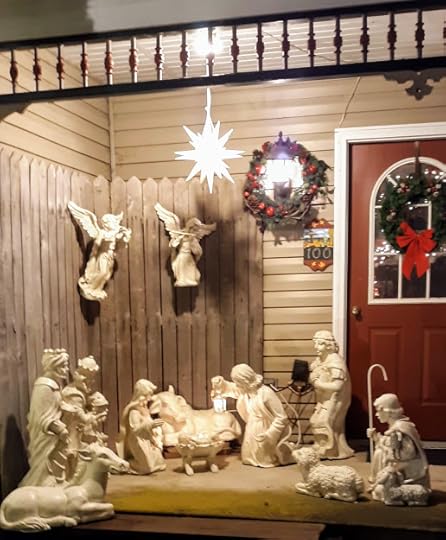

 Oh, how beautiful, Kim. I haven't even started decorating yet. My son will be coming over soon to put up our tree and his wife will put the lights on the tree for me. I simply cannot do certain things anymore and my husband can't either. But once the tree is up I will decorate it and the rest of the house.
Mod
Oh, how beautiful, Kim. I haven't even started decorating yet. My son will be coming over soon to put up our tree and his wife will put the lights on the tree for me. I simply cannot do certain things anymore and my husband can't either. But once the tree is up I will decorate it and the rest of the house.
Mod
Have fun Bobbie!


Here are the next three recaps of David Copperfield, and one can see that things are being wrapped up pretty quickly now, which leaves me wondering what is going to happen in the chapters that are yet to come.
Chapter 51 is named “The Beginning of a Longer Journey”, and we can understand this in two ways. The chapter is set on the day following Emily and Mr. Peggotty’s reunion, and Mr. Peggotty is coming to David’s house in order to tell him the story of Emily’s escape. If it had not been for a young Italian woman, who gave Emily shelter and food for several weeks (?) although she knew that she had a “fallen woman” before her, Emily would probably never have been able to find her way back to England but died from a fever. In telling his story, Mr. Peggotty often uses allusions to the Bible, as when he refers to the “dust our Saviour wrote in with his blessed hand” – no doubt because in John 8, 6 it is said that Jesus started writing in the dust when they brought the adulteress before Him and when they asked Him what to do, referring to Moses, He finally said, “He that is without sin among you, let him first cast a stone at her.” This way, Mr. Peggotty might suggest that there are people who dealt with Emily in a true Christian spirit. I am not very well-versed in the Bible but I noticed some other passages in Mr. Peggotty’s story where there are allusions to the Bible, one of them being
”’What they done, is laid up wheer neither moth or rust doth corrupt, and wheer thieves do not break through or steal. Mas’r Davy, it’ll outlast all the treasure in the wureld.’”
This is an allusion to the Sermon on the Mount, Matthew 6, 19-21, which refers to Christian dealings laying up treasures in Heaven. Then Martha seems to be likened to Jesus in a way, when she says to Emily, “’Rise up from worse than death, and come with me!’” Even the following sentence, “Them belonging to the house would have stopped her, but they might as soon have stopped the sea” reminded me of Jesus stopping the waves and the storm, and Martha’s cry “Stand away from me” put Matthew 4, 10 – “Get thee hence, Satan” – into my mind, some more allusions to Jesus. It’s also quite noteworthy that Mr. Peggotty’s account of Emily’s story is relatively free from the influence of his dialect, probably because otherwise it would spoil the dramatic effect of the story and not live up to its seriousness.
I came across another passage I found noteworthy:
”He saw everything he related. It passed before him, as he spoke, so vividly, that, in the intensity of his earnestness, he presented what he described to me, with greater distinctness than I can express. I can hardly believe, writing now long afterwards, but that I was actually present in these scenes; they are impressed upon me with such an astonishing air of fidelity.”
Maybe we can see this as another passage showing how difficult Dickens found it to come to terms with the limitations of the first person perspective: After all he longs to give a detailed description of events that the narrator got at third hand, i.e. Mr. Peggotty is telling him what Emily had told Mr. Peggotty, and David is writing it down after many, many years.
Then there was a question came haunting me to which I have not found a satisfactory answer, and it came when I read these words:
”'It was a gleam of light upon me, Trot,' said my aunt, drying her eyes, 'when I formed the resolution of being godmother to your sister Betsey Trotwood, who disappointed me; but, next to that, hardly anything would have given me greater pleasure, than to be godmother to that good young creature's baby!'
Mr. Peggotty nodded his understanding of my aunt's feelings, but could not trust himself with any verbal reference to the subject of her commendation. We all remained silent, and occupied with our own reflections (my aunt drying her eyes, and now sobbing convulsively, and now laughing and calling herself a fool); until I spoke.”
Later – after Mr. Peggotty has told David and his aunt about their resolution to emigrate to Australia – I found this passage:
”'Em'ly,' he continued, 'will keep along with me—poor child, she's sore in need of peace and rest!—until such time as we goes upon our voyage. She'll work at them clothes, as must be made; and I hope her troubles will begin to seem longer ago than they was, when she finds herself once more by her rough but loving uncle.'”
Putting these two underlined passages together made me think that maybe Emily is with child, but I am not sure. Dickens would not have been able to give any more direct hints at a child born out of wedlock, would he?
The first longer journey alluded to in the title of the chapter is definitely that of Mr. Peggotty and Little Emily, whereas there also are several hints at Dora’s journey out of this life. Nevertheless David accompanies Mr. Peggotty to Yarmouth once more, where he also meets Mr. Omer, who has grown old and frail but bears it well. Once again, the journey motif is taken up, this time by Mr. Omer, the undertaker, who says,
”’'because, sir, the way I look at it is, that we are all drawing on to the bottom of the hill, whatever age we are, on account of time never standing still for a single moment. So let us always do a kindness, and be over-rejoiced. To be sure!'“
when he explains why he is eager to do something for Martha. David later has a talk with Ham, who seems to have come round to the idea that by pressing his affection on Emily, he is at least partly responsible for what has happened. Whereas he, of course, will not accompany his uncle to Australia, Mrs. Gummidge entreats Mr. Peggotty not to leave her behind but to take her with him, and on being granted her wish, Mrs. Gummidge finally looks happy!