
Dickensians! discussion

This topic is about
A Christmas Carol
Novellas and Collaborative Works
>
A Christmas Carol - Staves 3 - 5 (hosted by Sara, Debra and Rosemarie)

message 2:
by
Bionic Jean, "Dickens Duchess"
(last edited Dec 11, 2020 02:49AM)
(new)
-
rated it 3 stars
 Mod
Mod
We are reading this wonderful book throughout December, and it is ably led by four of our lovely group members. Here is the schedule:
December 1 - 6: Stave 1
Led by Connie
December 7 - 12: Stave 2
Led by Sara
December 13 - 18: Stave 3
Led by Sara
December 19 - 24: Stave 4
Led by Debra
December 25 - 31: Stave 5
Led by Rosemarie
Please refer back to the First thread for Staves 1 and 2. Thanks.
 This is a list of all the chapters in this thread. Clicking on each chapter will automatically link you to the summary for that chapter. For the first thread for Staves 1 and 2 link here
Stave 3 (Message 4)
Stave 4 (Message 47)
Stave 5 (Message 79)
 I apologize for starting the thread two days early, but due to unavoidable circumstances, I will not be online much, if at all, next week. I know you will all carry on the conversation of this stave perfectly without me. I may be able to join back in for the next stave, but in case I am not...happy holidays to you all. You enrich my life.
Stave III: The Second of the Three Ghosts
The Ghost of Christmas Present
Scrooge wakes to hear the clock strike and waits for the second ghost, who does not appear. He sees a ghostly light coming from the adjoining room, and enters the room to find it transformed with greenery, a roaring fire, and a feast of good foods. Amid the plenty lounges the Ghost of Christmas Present.
The spirit is gigantic, simply robed, dark curls and bare feet. He wears a rusting antique scabbard in which there is no sword. (I would like to know what others think this might symbolize). He points out that Scrooge has failed to know any of his brothers in previous years, then he transports the two of them into the street where boys are playing in the snow, people are clearing sidewalks and bustling about. There is joy, aromatic foods, smiles and cheerfulness, even from the busy grocers. Bells are ringing, crowds rush for church, and the spirit sprinkles everyone with his torch, spreading the Christmas spirit.
Scrooge finds himself before Bob Cratchit’s door and the spirit pauses to sprinkle the house. Inside Mrs. Cratchit, with Belinda, Peter and two small Cratchits are preparing for Christmas dinner. The eldest, Martha, arrives and the young children hide her to tease her father, but when Bob enters with Tiny Tim upon his shoulder, asking where Martha is, she gives up the sport and pops out into his arms. Tim goes off with the other children to listen to the pudding “singing in the copper.”
Tim sits before the fire and the other children go for the rare goose that will be dinner. They are busy working together and excited. The bird is small, but the relish it and celebrate when the pudding is brought in, also too small for such a large family, but no one would “hint at such a thing.”
They toast and Tiny Tim says, “God bless us everyone”, at which Scrooge asks if Tim will live and is told he will not unless changes are made. The spirit throws Scrooge’s former comments regarding the death of the excess population in his face.
Then, with generous spirit, Bob Cratchit proposes a toast to Scrooge, which Mrs. Cratchit and the children do reluctantly, and Cratchit tells Peter of a position he is to have.
As Scrooge and the spirit leave in the snow, they see the bright fires in the houses, people coming and going, laughing and sharing Christmas. They sail over the world visiting minors in a barren place, a lighthouse, a ship at sea, and they find Christmas in each place, being kept despite any circumstances.
Suddenly Scrooge hears his nephew laugh and we find him at a party at his home, telling his guests of his earlier visit to Scrooge. He says he feels sorry for Scrooge and that he will continue to invite him every year, for the only person Scrooge hurts is himself. The guests turn to music and the whistling of a tune reminds Scrooge of Fanny. Then the guests begin to play parlor games, forfeit, blindman’s bluff, yes and no. Scrooge finds himself entranced by the company and joining in the gaiety.
They are off again, traveling far and wide and seeing the celebrations of Christmas, and Scrooge notices that the ghost is older and quite grey. The ghost says he lives but one night. At which, Scrooge notices a foot beneath the spirit’s skirts. Two children emerge, dreadful and emaciated. They are ignorance and want. “Are they yours?” asks Scrooge; “They are man’s”, the ghost replies. On ignorance’s brow the ghost says he sees doom, and he quotes Scrooge’s remarks regarding the prisons and workhouses.
The stroke of midnight comes and the ghost is gone. Scrooge looks to see “a solemn phantom, draped and hooded, coming, like a mist along the ground, towards him.
The Ghost of Christmas Present is jovial and brings with him abundance and merriment. He shows Scrooge the proper use of money in the sharing of the goodness of the season, but also the happiness that can spring from even a small fare when shared with loved ones and friends.This is Father Christmas as we imagine him, but just as our image of Santa comes from Moore’s A Visit From Saint Nicholas, perhaps this image of Christmas became our norm because Dickens gave it to us.
Here Scrooge sees the poverty of the Cratchits and many others across the world and is shown the spirit of Christmas living in the hearts of those who have little wealth but goodness and generosity. The fate of a good child like Tim, who thinks of himself as a reminder of Christ’s goodness, lies with men like Scrooge who fail to act on their behalf or care for their needs. For the first time it occurs to Scrooge that he might intervene and change the life of such a child, and in this case, the change is literally life or death.
The effects of poverty were severe, with many ending up in the prisons and workhouses Scrooge so cavalierly mentions, and it is quite easy for Scrooge to minimalize the effects of such a system. I believe there is still much of this attitude evident today, an example being the homeless that populate our streets with often so little recognition by the populace that pass them by. The visit to Bob Cratchit’s gives Scrooge a glimpse of the real people affected by such draconian laws and rules. A reminder that the “surplus population” is humanity itself.
Nephew Fred represents the importance of family and friends. Fred is the mirror image of Belle, but Fred is a relationship that can still be had; while Belle is the past and can never be resurrected. Scrooge is allowed to see the things he might have but has spurned in the camaraderie of Fred and his friends. Ironically, Scrooge sees much merriment provided by little expense, while he is able to afford all the bounty the ghost brings with him, but he chooses to have a small fire and provide no comforts for himself or for others. With both Bob and Fred, Scrooge is shown that you can be happy with little if you have gratitude and love.
The ending scene with the children symbolizes the very real damage that is done when the ignorant and callous, such as Scrooge, desert the children around them to the want and poverty of the streets. Scrooge is meant to understand, as do we, that he is responsible for the fate of the children and his failure to accept that responsibility creates the situation he sees and abhors.
The words of Donne come to mind, “No man is an Island, entire of itself; every man is a piece of the Continent, a part of the main.” I believe Donne’s meaning and Dickens’ are the same. “Therefore never send to know for whom the bell tolls, it tolls for you.”
 The notion of "debtor's prison' has often intrigued me. It was obviously a scheme guaranteed to fail to serve any useful purpose to anyone: It surely cost tax money to operate; and by depriving the inmates of any opportunity to secure gainful employment, it further delayed or permanently prevented the debt ever being paid. Workhouses were of course nothing more than a form of government-sponsored slavery, which would otherwise have been unlawful in 19th century Britain.
 Sara, thank you for the summary and excellent commentary on Stave 3. Scrooge's grouchy, mean-spirited poverty despite his wealth is juxtaposed against the warmth, joy and gratitude of Bob, Fred, and their families who take delight in the rare but meager servings of goose and pudding. Bob giving a toast to Scrooge and Fred's persistent invitations to Scrooge to share their family dinners are gracious gestures that are wonderful to read about. You hit it on the nail, Sara, with this observation that was not lost on Scrooge: "you can be happy with little if you have gratitude and love."
 Sara, thank you for your wonderful summary and thoughts on Stave 3. The Ghost of Christmas Present shows Scrooge a bounty of food in his rooms when the Ghost first arrives. This brought to mind something I read about the emergence of railroads and Christmas feasts. Live animals were herded to market, which was fine if you had to herd sheep or cows. But turkeys had very tender feet, were poor walkers, and had to wear little leather boots to protect their feet as they walked to the market from the farm. The turkeys lost a lot of weight on the walk so they had to go through another fattening-up period once they arrived in the city. So that increased the price of the turkey. Once the farmers could use the railroads, the price of turkey went down and more Victorian families could afford it.
As Sara and Laysee have already pointed out, people can be happy with a smaller meal when they are filled with love for each other.
The Ghost of Christmas Present carries a scabbard without a sword in it. This seems to symbolize peace and non-violence.Then, as we go through Stave 3, we see families that are full of the warmth of the Christmas season. They are not rich in money, but they are full of family love. They offer emotional support to each other. The Ghost of Christmas Present seems to have the same warm, loving attitude.
message 10:
by
Bionic Jean, "Dickens Duchess"
(last edited Dec 13, 2020 05:32AM)
(new)
-
rated it 3 stars
Mod
I particularly like your thought, when Scrooge visited Bob Cratchit, that this was:
"A reminder that the “surplus population” is humanity itself."
And also your apt reference to John Donne - a poet whose works will have been well known to Charles Dickens.
message 11:
by
Bionic Jean, "Dickens Duchess"
(last edited Dec 13, 2020 05:36AM)
(new)
-
rated it 3 stars
Mod
We have just finished our group read of Little Dorrit, which is the book in which Charles Dickens focuses most on debtors' prisons - specifically the one in which his own father was incarcerated for a while. It is also the novel in which he invents the appalling "Circumlocution Office", which is the government office charged with "How Not to Do it" - an attitude relating to all their affairs.
You might enjoy looking through our threads for Little Dorrit, as we discuss this a lot!
All the debtors in the "Marshalsea" had to pay for their own food, and for their own rooms. Doctors and cleaners (both very suspect - we see examples in the novel) had to be paid for too. Most inmates had friends or relatives who would pay on their behalf, and in the more respectable "Kings Bench" prison they would pay themselves. So I don't think it was supported by taxes - or not very much. The turnkeys would be a paid position, but nobody else.
Those inmates who had no money at all would end up in the workhouse, picking oakum (like Oliver Twist). And yes, this was virtually slave labour.
Mod
Connie - What fascinating information about the turkeys! I feel so sorry for them in their little boots :(
Dickens shows his concern for poor children in Stave 3. He felt that a society should be judged by the way it treats its children. He was upset that more was not being done for children after visiting the Field Land Ragged School in September 1843. This school was established by reformers to educate poor children. Since the children were dressed in filthy, raggedy clothes, the free schools were called Ragged Schools.Children of the poor were put out to work in factories, mills, and mines. Climbing boys helped with the cleaning of chimneys, and mudlarks searched through the mud of the Thames for things to sell. Girls helped dressmakers, or worked long hours as maids (such as Tiny Tim's sister).
The end of Stave 3 shows a boy and a girl, Ignorance and Want. The boy has Doom written on his brow. The ghost quotes Scrooge's words (from Stave 1) back to him: "Are there no prisons? Are there no workhouses?" The ghost makes the point that we are all responsible to change the plight of these children quickly, or they will be doomed.
 The book has so much more depth than film versions-which are enjoyable too, of course.
I like the way the spirit uses Scrooge's own words in a new context, as Connie has just stated.
Scrooge was eager for this spirit's visit and seems much more open and engaged than before.
 I loved the contrasts in this stave.
Scrooge is wealthy yet lives very frugally - in contrast he could surround himself with food and gifts and cheer, but chooses not to. He doesn't appreciate or enjoy his wealth - even for himself.
the Cratchits, who are so poor, nevertheless have a rich life. They surround each other with love and even though they have little they make the effort to celebrate Christmas and treat themselves on that day.
Scrooge sees how he himself could enjoy his wealth as well as using it to help others. He sees what he's missing out on and how easily he could have a different life - all he needs to do is change his current attitude and behaviour!
I can see that Scrooge has begun to regret some of the things he's said and done earlier.In Stave 2, he wished he hadn't treated the caroller that way.
In Stave 3, he realizes that the poor are people, not excess population.
 I agree with you Laura - there are many contrasts in this stave. I always wondered about all the food that was presented at the beginning of the scene. To be honest, I don't link Christmas with food in abundance, and the food presented isn't typical for the region I come from. I love the message that families can be happy regardless of the feast.
 It also must be tough for Scrooge to be confronted with his own words. Thanks to everyone for sharing their thoughts on workhouses and prisons. I might need to look this up further.
This is also the stave that makes me teary. I can deal well with the rest of the story but watching the Crachits celebrating Christmas always hits me hard.
 Although of course Dickens is right that money doesn't buy happiness, there is a risk of romanticizing the poor. One could think, "Look how happy the Cratchits are, Bob doesn't need a raise." We do get some glimpse at their lives from Martha's description of her long days of work. These people certainly aren't the idle ones that Scrooge despises, in fact it is often the rich who are idle.
 The empty scabbard is the detail that Made me think too this time around. I do agree that it represents peace, but why is it rusty? It it because at Christmas there is often a truce (like the soccer game in WWI between Englishmen and Germans in no-man land?) and so The Ghost of Christmas Present would not even have to handle it and a preceding brother has discarded the sword.
Robin P wrote: "Although of course Dickens is right that money doesn't buy happiness, there is a risk of romanticizing the poor. One could think, "Look how happy the Cratchits are, Bob doesn't need a raise." We do..."
The empty scabbard is the detail that Made me think too this time around. I do agree that it represents peace, but why is it rusty? It it because at Christmas there is often a truce (like the soccer game in WWI between Englishmen and Germans in no-man land?) and so The Ghost of Christmas Present would not even have to handle it and a preceding brother has discarded the sword.
Robin P wrote: "Although of course Dickens is right that money doesn't buy happiness, there is a risk of romanticizing the poor. One could think, "Look how happy the Cratchits are, Bob doesn't need a raise." We do..."Very true, Robin. The poor are working very long hours just to survive.
Dickens does mention that their pudding looks too small to feed a large family. The oldest son is wearing his father's shirt because he doesn't own a dress shirt, and he will also be sent out to work soon. Martha and Bob work long hours. Mrs Cratchit seems to be doing all the childcare and housework without a maid. We also wonder if Tiny Tim will live without medical care which the Cratchits cannot afford. (Tiny Tim was inspired by Dickens' disabled nephew who died, although Dickens did pay for his doctors.) Tiny Tim's situation does seem to touch Scrooge emotionally. So Dickens is showing us a family that works hard and loves each other, although they certainly could use more money.
France-Andrée wrote: "The empty scabbard is the detail that Made me think too this time around. I do agree that it represents peace, but why is it rusty? It it because at Christmas there is often a truce (like the socce..."I wonder if the scabbard is rusty from lack of use, and lack of upkeep. People who use weapons, like the military, are usually very vigilant about cleaning and oiling them. A truce at Christmas could be an explanation. So could a total lack of interest in violence to solve problems. It's fun to speculate what Dickens intended as a meaning.
Thanks, Bionic Jean for your enlightening bits regarding debtors prisons etc. The industrialists of 19th C Britain understood that human misery can be quite profitable but I guess it really took American ingenuity to have devised ways to turn the building and operation of prisons into not only a profitable private enterprise but even a growth industry!
message 23:
by
Bionic Jean, "Dickens Duchess"
(last edited Jan 07, 2022 02:48PM)
(new)
-
rated it 3 stars
Mod
Most of the social provisions in England at that time were based on economic theory. Specifically, John Stuart Mill's ideas about utilitarianism laid the foundations for the ideas behind workhouses. If the poor were too comfortable there, the argument went, they would not be motivated to work hard, so they were kept with minimum food, and spare conditions. Windows were too high for anyone to look out of, heating was nonexistent etc. Scrooge was really just parroting these ideas, which were the law.
The Poor Law Amendment Act of 1834, (9 years before A Christmas Carol was published) was intended to improve some of the worst conditions, but Charles Dickens was heavily critical of it, both in this novella and many other things he wrote - both fiction and articles for his newspaper.
Previously it had been the duty of the parishes to care for the poor through alms and taxes. They could either go to the parish workhouse or apply for "outdoor relief", which enabled them to live at home and work at outside jobs. But the new Poor Law of 1834 grouped parishes together into unions. Each union had a workhouse, and the only help available to poor people from then on was to become inmates in the workhouse.
In Oliver Twist, he said with bitter sarcasm that the workhouse was little more than a prison for the poor. Civil liberties were denied, families were separated, and human dignity was destroyed. The inadequate diet instituted in the workhouse prompted his ironic comment that:
"all poor people should have the alternative... of being starved by a gradual process in the house, or by a quick one out of it."
It is sometimes thought that Charles Dickens might have exaggerated the conditions in the workhouses, as part of his "persuasive literature" for effect. A good book investigating the conditions is by Ruth Richardson, Dickens and the Workhouse: Oliver Twist and the London Poor. She wrote it after discovering that as a boy Charles Dickens had lived within a mile of the "Cleveland Street Workhouse".
He lived in Cleveland Street from when he was nearly 3 to nearly 5 years old. But as we all know, Charles Dickens's father was then arrested for debt and the family was forced to live inside the Marshalsea Debtors' Prison in Southwark. The family returned to the same house in Norfolk/Cleveland Street several years later, when Charles Dickens was nearly seventeen, and stayed until he was almost twenty. During that time, he was out at work as a young legal clerk, and training himself to become a shorthand court reporter.
It was all very familiar to him.
Mod
It is used for education, and very popular with school parties :)
message 25:
by
Bionic Jean, "Dickens Duchess"
(last edited Dec 14, 2020 03:16PM)
(new)
-
rated it 3 stars
Mod
Everything in A Christmas Carol is larger than life, and has to be the best - or the worst. The food is the tastiest there has ever been. The carols are sung more enthusiastically and more in tune than they ever could be, the ice on the pond is thicker than ever before, and glinting more spectacularly in the sun, the shops are filled to bursting with good things to tempt and delight the shoppers. Here is part of the description of the Second Spirit:
"The walls and ceiling were so hung with living green, that it looked a perfect grove; from every part of which bright gleaming berries glistened. The crisp leaves of holly, mistletoe, and ivy reflected back the light, as if so many little mirrors had been scattered there; and such a mighty blaze went roaring up the chimney as that dull petrifaction of a hearth had never known in Scrooge's time, or Marley's, or for many and many a winter season gone. Heaped up on the floor, to form a kind of throne, were turkeys, geese, game, poultry, brawn, great joints of meat, sucking-pigs, long wreaths of sausages, mince-pies, plum-puddings, barrels of oysters, red-hot chestnuts, cherry-cheeked apples, juicy oranges, luscious pears, immense twelfth-cakes, and seething bowls of punch, that made the chamber dim with their delicious steam."
I've never known such a feast either - but it certainly makes me smile! Here's another idealised description:
"the people who were shovelling away on the housetops were jovial and full of glee; calling out to one another from the parapets, and now and then exchanging a facetious snowball—better-natured missile far than many a wordy jest—laughing heartily if it went right, and not less heartily if it went wrong. The poulterers' shops were still half open, and the fruiterers' were radiant in their glory. There were great, round, pot-bellied baskets of chestnuts, shaped like the waistcoats of jolly old gentlemen, lolling at the doors, and tumbling out into the street in their apoplectic opulence. There were ruddy, brown-faced, broad-girthed Spanish onions, shining in the fatness of their growth like Spanish Friars, and winking from their shelves in wanton slyness at the girls as they went by, and glanced demurely at the hung-up mistletoe. There were pears and apples clustered high in blooming pyramids; there were bunches of grapes, made, in the shopkeepers' benevolence, to dangle from conspicuous hooks that people's mouths might water gratis as they passed; there ... yellow ... oranges and lemons, in the great compactness of their juicy persons, urgently entreating and beseeching to be carried home in paper bags, and eaten after dinner."
He chooses his words to tell us that everything is at its very choicest: "plentiful and rare", "delicious", "everything was good to eat and in its Christmas dress", "in the hopeful promise of the day" and "in the best humour possible". Yes, it's a lot larger than life. Some of those snow shovellers would surely have been grumbling - and some of the fruit would have been small and rotten!
But this exaggerated wonderland bursts through our gloom at the perfect time of year. When in Great Britain in reality we have have cold dreary weather and long dark nights, we also have in imagination Charles Dickens's heightened perception to uplift us. No wonder then that it stays in our memory and in the memories of generation after generation.
 Sara wrote: "The Ghost of Christmas Present is jovial and brings with him abundance and merriment. He shows Scrooge the proper use of money in the sharing of the goodness of the season, but also the happiness t..."
Wonderful critique, Sara!
 Sara, wonderful summary and critique. As I am reading this book, I think to today and what is happening in the world. This book makes one realize that happiness and joy can be found in the smallest of places, such as the Cratchit home. It invites us all to make the most of what we have and to be generous with others. This year is an especially hard year for so many people- this story gives me pause to think “ Have I done enough for my fellow man?”
 Thank you ALL for this lively and enriching discussion of A Christmas Carol!! I have not submitted any comments, but I have read the book (my 4th read thru :-) and I have mostly kept up with this tread of comments.
 There is such a spirit of warmth and camaraderie among you, it has lifted my mood! I have enjoyed both the thoughtful analysis of Dickens' beloved work, as well as the feeling of friendship among this group. Thank you again, and have a blessed holiday season!
The same wishes to you, Cheryl!
 I agree that this group has been a wonderful joy to be a part of especially now!
In thinking about the Ghost of Christmas Present, I can't help but mention his torch. He uses it to shower people, preferably the poor because they need it most, with joy. How wonderful to read about how he sprinkled a little joy over a couple of men who were about to argue and then they quickly changed their mood. Wouldn't it be nice to have a Joy Torch to sprinkle over a lot of people right now!?! 😊
I was also moved by this quote which comes right after Fred begins his laughing:
It is a fair, even-handed, noble adjustment of things, that while there is infection in disease and sorrow, there is nothing in the world so irresistibly contagious as laughter and good-humour.
Such a poignant quote from Dickens that uses some negative words to teach a positive point.
Mod
You made such a lovely comment Cheryl, thank you! I'm so glad you're enjoying the group, and my good wishes to you too :) And we would love you to comment any time, with your thoughts.
Several theaters are giving online performances of Christmas Carol, including free ones. Milwaukee Rep is one of them. You just have to go to their website to get a code. I think it is available thru Dec. 24. I just haven't taken the time to watch it yet. There is another one which is a 1-man show. The actor portrays many different characters. I don't remember the name but I'm sure you could search for it.
message 33:
by
Bionic Jean, "Dickens Duchess"
(last edited Dec 16, 2020 03:20PM)
(new)
-
rated it 3 stars
Mod
It makes me think of Tinkerbell's fairy dust in Peter Pan :)
I've been wondering about the Cratchit children. There seem to be six, and they correspond to Charles Dickens's own siblings! Fanny, his sister who was so musical, and whom he adored is the eldest, Martha Cratchit, who had to work on Christmas morning! (Even Bob Cratchitt didn't have to do that!) Charles Dickens once said that milliners' apprentices were among "the hardest worked, the worst paid, and too often, the worst used class of the community".
Charles himself is Peter, who was going to earn a salary less than the young Charles Dickens had earned in the blacking factory. Letitia is Belinda; Frederick and Harriet are the unnamed Cratchits, also a boy and girl; and the youngest, Alfred, who died in infancy, is Tiny Tim.
We do not yet know what will happen to Tiny Tim, but the worry by Scrooge in this chapter about Tiny Tim was perhaps a reflection of Charles Dickens's own, about his little brother Alfred.
Mod
Great info! Perhaps you could post it LINK HERE please, so it doesn't get lost in the discussion threads :)
Bionic Jean wrote: "~ Cheryl ~ wrote: "You made such a lovely comment Cheryl, thank you! I'm so glad you're enjoying the group, ..."Thanks for inviting me, Jean!
I don't know if this is out of place here, but I would like to suggest a little extra Christmastime reading to all 'Dickensians.' I have been dipping into The Pickwick Papers lately (a favorite of mine), and so happened upon the Christmas chapter at Dingley Dell. (Chapter 28)
Jean, you commented recently about Carol:
'He chooses his words to tell us that everything is at its very choicest: "plentiful and rare", "delicious", "everything was good to eat and in its Christmas dress", "in the hopeful promise of the day" and "in the best humour possible". Yes, it's a lot larger than life. Some of those snow shovellers would surely have been grumbling - and some of the fruit would have been small and rotten!
But this exaggerated wonderland bursts through our gloom at the perfect time of year.'
I love that observation. The Christmas at Dingley Dell chapter of Pickwick is spilling over with just that kind of exuberance. You don't even have to have read the book before to enjoy it, and you can read it in a single sitting. On Christmas Eve, perhaps? You might want to carve out a bit of time for more of that magical Dickens "wonderland" to burst through the gloom.
message 36:
by
Bionic Jean, "Dickens Duchess"
(last edited Dec 17, 2020 09:32AM)
(new)
-
rated it 3 stars
Mod
When I first read The Pickwick Papers a long time ago, I didn't really care for it, but now I love its "exuberance", as you so rightly say. It's very much the work of a young man - his first, if you don't count the sketches - and it's just so energetic, silly, and full of life.
I've been surprised it hasn't made it to our polls by now, but I'm sure it will in time. Thank you so much for recommending chapter 28. Nearly all the chapters can be read in isolation, as stand-alones, and this is a perfect example :)
message 37:
by
Bionic Jean, "Dickens Duchess"
(last edited Dec 17, 2020 12:09PM)
(new)
-
rated it 3 stars
Mod
This Third Stave seem to be a good place to explore this idea, because of what is hidden under the Second Spirit's robe.
I've often thought that A Christmas Carol is an Interfaith story. Even though ostensibly it is a Christian tale, my Muslim, Jewish, Hindu and Humanist friends here also appreciate the message. And it seems to have a broad parallel with Buddhism too.
It can be viewed as a story about spiritual transformation. We've see already how Ebenezer Scrooge is softening, regretting his comments (which the Spirit quotes back to him), feeling guilty, feeling pity, and empathising with the Cratchitts. It's a story of human redemption - and also karma. Scrooge has just begun his journey, and is deeply moved to change his ways for the better. But he will need to be observant of his earlier patterns of thought, and needs reinforcement from the other Spirits.
Scrooge has Jacob Marley's warning fresh in his mind:
"I wear the chain I forged in life. I made it link by link, yard by yard: I girded it on my own free will, and of my own free will I wore it."
He know he will be visited by three spirits, whose lessons he must heed in order to redeem himself:
"Without their visits you cannot hope to shun the path I tread."
Then we see a Dickensian image of the Buddhist "lower realms". Outside the window, Scrooge sees a swarm of ghostly phantoms, suffering and weighed down by heavy chains of remorse:
"The air was filled with phantoms, wandering hither and thither in restless haste, and moaning as they went ... The misery with them all was, clearly, that they sought to interfere, for good, in human matters, and had lost this power for ever."
Then later, Scrooge's nephew Fred continues the tuition about karma:
"Scrooge's offences carry their own punishment ... Who suffers by his ill whims? Himself, always."
The Spirits are like helpful bodhisattvas, showing Scrooge scenes from his life, again to help him realise the law of karma.
The Spirit of Christmas Past Scrooge shows him painful images from his childhood suffering - and also the kindness shown to him by others - by which he (and we) learn how he has been shaped by these experiences.
The Spirit of Christmas Present now reminds Scrooge of the opportunities he has all round him, to do good for others. And under his robe the Spirit of Christmas Present reveals to Scrooge “the banes of Man”: Ignorance and Want. These banes of Man, which cause and contribute to our suffering, are two of the three roots of disease and suffering in Tibetan Buddhist Medicine.
I have a feeling that the final two staves will also reveal clear parallels. As with many great novels and literature, we find embedded, many other messages. Here we see a message that is taught across world religions and philosophies, a fundamental principle to so many, and certainly consistent with Buddhist teaching.
I just received an email from The National Archive with a link to this video about Charles Dickens and a court case in which he sued someone who had created a cheap rip off.https://youtu.be/r4YEHsqmikk
message 39:
by
Bionic Jean, "Dickens Duchess"
(last edited Dec 18, 2020 11:36AM)
(new)
-
rated it 3 stars
Mod
Charles Dickens was a campaigner for authors' rights and was instrumental in establishing tighter laws of copyright. He knew that a "reimagination" just months later was theft by any other words, and I think those whom he sued were on pretty thin grounds when they said they'd "improved" his tale and made it "more artistic"! So did the courts, who upheld his claim :)
I like that Charles Dickens's preoccupation with issues of copyright inspired him to parody the Courts of Chancery in Bleak House; in a way it was sweet revenge. But Charles Dickens did remain annoyed with the USA for many years, as pirated copies of his novels continued to proliferate there - with no prosecutions, as they had no copyright law.
As for A Christmas Carol, as Connie told us back in the introduction, Charles Dickens had written it because he was in need of money at that point. Yet he produced a lavish edition, against his publishers' wishes, because he knew he had written something special, which deserved it.
So not only was Charles Dickens then out of pocket from that, rather than making the profit he needed, but paying all the costs for prosecuting those who created these so-called "reimaginings", or "rip-offs", as Laura says (at last 4 of them) cost him hundreds (thousands, in today's money) of pounds, as the culprits declared themselves bankrupt, with no funds to pay legal costs.
 Thanks for the link, Laura. And the info, Jean. It is so strange that the USA did not have copyright laws back then. It would be interesting to read the pirated book.
Jean - thank you so much for all the supplementary info. I'm just beginning my Dickens journey and this is all fascinating!
Mod
Mod
Thanks for the link, Laura. And the info, Jean. It is so strange that the USA did not have copyright laws back then. It would be interesting to read the pirated book.
Jean - thank you so much for all the supplementary info. I'm just beginning my Dickens journey and this is all fascinating!
Mod
Mod
I was thinking that snow is pretty rare in London nowadays - and hardly ever at Christmas! And the South East of England rarely has the depth described here.
Looking into it, it looks as if Charles Dickens might have been remembering his own childhood, and describing conditions a couple of decades earlier. Between 1817 and 1822, when he was a child of five to ten years of age, the South of England had six White Christmases in a row, with the top daytime temperatures of -2 to -6 Celsius!
Newspapers called this a "little Ice Age"and said it was because of "a series of colossal volcanic eruptions that enveloped the globe in dust and shrouded the sun". During this period, Mary Wollstonecraft Shelley in Switzerland endured one of Europe's coldest summers on record in 1818, and this produced the tale that would become Frankenstein.
Probably then, the snow is all part of Charles Dickens's nostalgia for his own childhood, and the Christmases with his family before his father fell into debt and was sent to the Marshalsea prison.
Even though I live in town now and the Christmases are hardly ever white, I normally go up north to see family and they have mostly white Christmases so I can relate to Dickens remembering a snowy holiday. There was always snow when I was a kid (though memories are not to be relied on), I think the climate change is affecting the holidays too, does it mean that it had started as early as Dickens' time? I wonder.
message 45:
by
Bionic Jean, "Dickens Duchess"
(last edited Dec 18, 2020 12:43PM)
(new)
-
rated it 3 stars
Mod
Yes, me too, as the North of England is very different from the South. I could not believe how different it was. A mere smattering in London was worthy of comment, but in Yorkshire we used to walk to school through small channels cut through banks of snow piled many feet high, which would stay there for weeks.
But in London it was unusual. To be reported as a mini Ice Age, means that it isn't Charles Dickens misremembering, or fantasising about things. Clearly for those 6 years, which just happened to be when Charles Dickens was a child, it was much more snowy even in London. Not before, or after.
And this is useful to know, for any nowadays who might suppose that Charles Dickens is exaggerating. It really was like that!
message 46:
by
Bionic Jean, "Dickens Duchess"
(last edited Dec 19, 2020 02:29AM)
(new)
-
rated it 3 stars
Mod
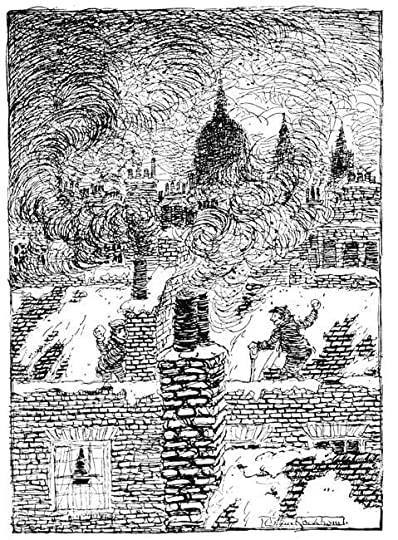
Arthur Rackham 1915
This scene was illustrated by several artists, which is strange as it isn't in the text! It's just imagined by the Spirit and Scrooge:
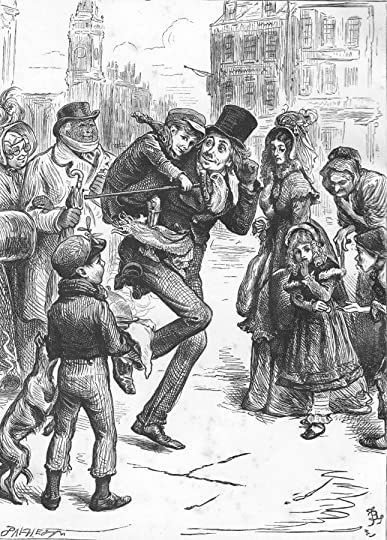
Tiny Tim "riding" home on Bob Cratchit's shoulders - Fred Barnard 1878
And here is a very famous painting of it, years later:
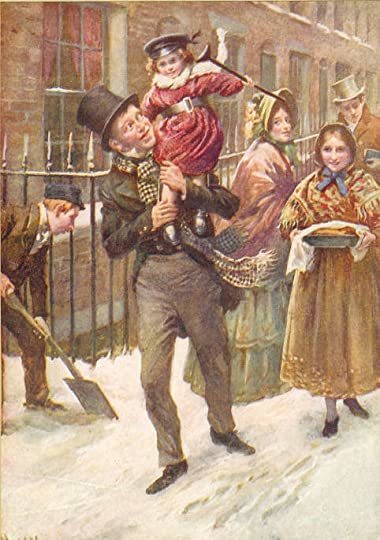
Harold Copping 1924
Harold Copping's illustrations are attractive, but more like a middle class family than the Cratchits really would have been. This was after World War I, so perhaps he wanted to portray them more idealistically. Here is another by him:
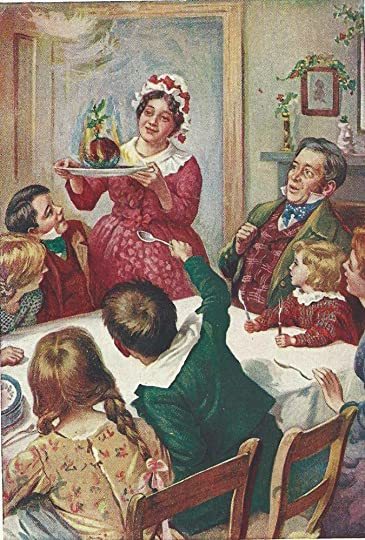
The Wonderful Pudding - Harold Copping 1924
These next two are more accurate depictions:
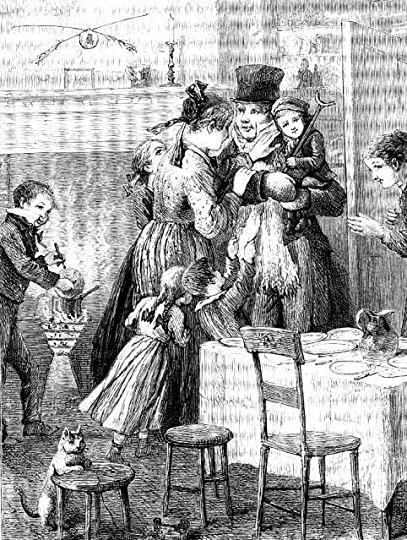
Sol Eytinge
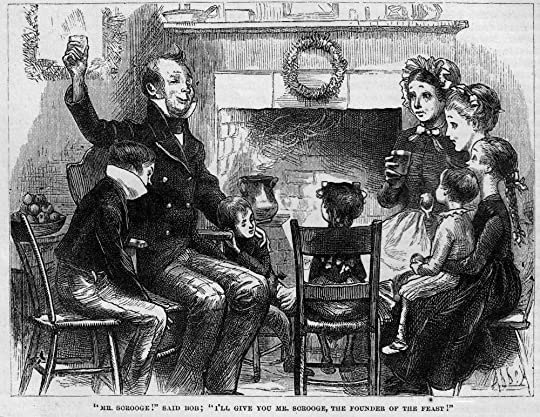
E.A. Abbey 1876
Here is one from Scrooge's nephew's house:
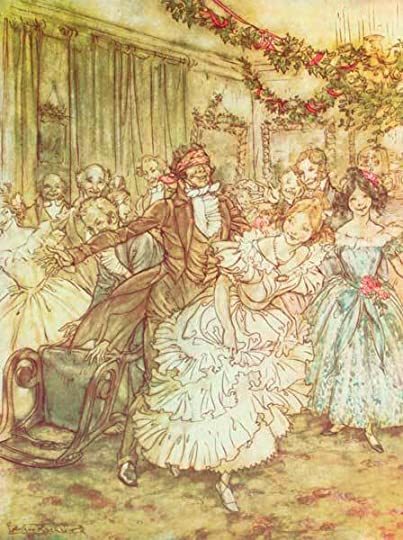
'How he went after that plump sister in the lace tucker' - Arthur Rackham
And the end part:
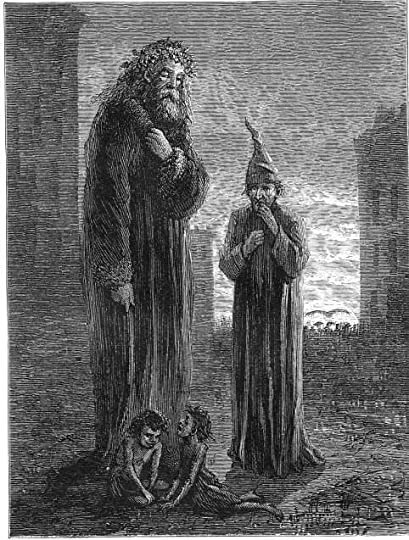
The Second Spirit, with Want and Ignorance - Sol Eytinge 1869
Tomorrow we begin Stave 4, with Debra leading :)
The Last of the Spirits - Stave 4The Ghost of Christmas Yet to Come
The last spirit is dressed in a black garment, a hand is all that is visible. This spirit does not speak but it is watching Scrooge. Scrooge speaks to the spirit, asking it to show what is to come. Scrooge is scared but he wants to be a better man. "'Ghost of the Future!' he exclaimed, 'I fear you more than any spectre I have seen. But as I know your purpose is to do me good, and as I hope to live to be another man from what I was, I am prepared to bear you company, and to do it with a thankful heart. Will you not speak to me?'"
They visit a group of businesses men who are speaking ill about someone's death. One of them says "'I thought he'd never die.'" The men say there will be a cheap funeral and they don't know of anyone that will go to it. One man jokes that he will go if lunch is served. Scrooge waits for the spirit to explain but instead they move on to a group of wealthy, important business men who mention a death in passing. Scrooge tries to figure out why he is shown these visions. He wants to see his changed future self.
Next they go to a rundown part of town. The people here are also discussing someone's death and they are selling the belongings of the dead man. The items are stolen and the people are speaking poorly of the dead man. One woman has bed curtains, blankets and a shirt that she took off the dead corpse! They laughed about making a profit off him when he was dead. Scrooge is appalled.
Scrooge and the spirit are now in a dark room with an uncared for dead body, not one single person with it, no one crying over it. The spirit is pointing at the dead body and Scrooge is scared. He understands that he is suppose to remove the ragged sheet covering the body and look but cannot bring himself to do it. Scrooge says that he has learned his lesson and wants to see someone who feels emotion about this dead person.
So they move on to a family that was in debt to Scrooge. They are trying to suppress their happiness that Scrooge is gone. They think whoever takes over the debt will be better. "...and it was a happier house for this man's death! The only emotion that the Ghost could show him, caused by the event, was one of pleasure."
Next, the spirit and Scrooge are at Bob Cratchit's house. Everyone is quiet. Tiny Tim is dead. Bob Cratchet says that Tiny Tim's gravesite will be green. Then he cried and went upstairs to sit beside the body of Tiny Tim in a room "which was lighted cheerfully, and hung with Christmas".
Scrooge asks about the dead man and about his future self. The spirit takes Scrooge to a neglected churchyard. The Spirit points to a grave. Before Scrooge reads the name he asks the spirit if things can change or is he beyond hope. The spirit does not answer. Scrooge reads his name on the tombstone and cries out that he not the man he was. The spirit's hand trembles. Scrooge says to the spirit "...'Assure me that I may yet change these shadows you have shown me, by an altered life!'". The spirit's hand trembles again. Scrooge pledges to change his life and holds his hands in prayer to have his fate reversed. The spirit goes away by shrinking into a bed post.
My Thoughts The last spirit arrives. He has to drive the point home. Scrooge must change! This spirit represents the Grim Reaper, a future unwritten, and a possible doomed future.
It surprises me that Scrooge keeps looking for his future self. He doesn't even realize that the dead person being discussed is him. I suppose this is to show his ignorance. But Scrooge knew who the dead body was when the spirit took him there. That is why he would not move the ragged sheet to look.
I like the contrast between the settings of Scrooge's dead body and Tiny Tim's. Scrooge's body is lying alone in a dark room while Tiny Tim's body has his father crying by his bedside, in a well lighted room, with family downstairs. Also, Scrooge's grave is neglected while Tiny Tim's grave is in a nice, green place where the family will visit on Sundays.
The spirit's trembling hand at the end is interesting. All this time the spirit has been watching Scrooge and now he sees a chance for a different future. The shaking hand represents things changing.
"The future is not set. There is no fate but what we make for ourselves." from The Terminator.
Thanks for all the illustrations Jean, they are great and my small paperback copy has no illustrations. And appreciate Debra's commentary. Well once again, Dickens sets the mood right off the bat as he opens this last visitation. The Phantom slowly, gravely, silently, approached. When it came near him....the air through which this spirit moved seemed to scatter gloom & mystery. ....its mysterious presence filled him with dread.
Gives one shivers!! And what a smooth transition to this most dreaded section. Scrooge had left the gaiety of his Nephew's party but was faced with the children representing Ignorance and Want before this last Spirit is introduced. and now he will see the results of Ignorance and Want.
I was a little taken aback that Scrooge's comments that Debra highlights reveals that he has already decided he needed to change. I really don't remember that. I had it in my mind that it wasn't until what this final Spirit reveals that finally breaks through all that Scrooge has protected himself from.
On another note, did anyone else have to look up what an "excrescence" was?
I thought the scene where the three women took all the things they had stolen to a dealer in stolen goods was very creepy. They even took the clothes that he should have been buried in. That really shows what those women thought of Scrooge-a source of plunder.If anyone has seen the musical with Albert Finney, the song "Thank you very much, Thank you very much, That's the nicest thing that anyone's ever done for me" is sung during Stave 4.

Dickensians!
Books mentioned in this topic
The Man Who Invented Christmas: How Charles Dickens's A Christmas Carol Rescued His Career and Revived Our Holiday Spirits (other topics)The Annotated Christmas Carol (other topics)
Jorrock's Jaunts and Jollities (other topics)
Memoirs of Extraordinary Popular Delusions and the Madness of Crowds (other topics)
Brewer's Dictionary of Phrase and Fable (other topics)
More...
Authors mentioned in this topic
Les Standiford (other topics)Ebenezer Cobham Brewer (other topics)
John Badcock (other topics)
Charles Mackay (other topics)
Robert Smith Surtees (other topics)
More...

John Leech - 1st edition 1843