
Dickensians! discussion

This topic is about
Bleak House
Bleak House - Group Read 4
>
Bleak House: Chapters 43 - 53

 This is a list of all the chapters in this thread, beginning with Bleak House's chapter 43, which is the first chapter in Charles Dickens's original monthly installment 14.
Clicking on each chapter will automatically link you to the summary for that chapter.
XIV - April 1853 - chapters 43–46
Chapter 43 (Message 3)
Chapter 44 (Message 25)
Chapter 45 (Message 60)
Chapter 46 (Message94)
XV - May 1853 - chapters 47–49
Chapter 47 (Message154)
Chapter 48 (Message191)
Chapter 49 (Message 232)
XVI - June 1853 - chapters 50–53
Chapter 50 (Message 300)
Chapter 51 (Message 318)
Chapter 52 (Message 341)
Chapter 53 (Message 357)
message 3:
by
Bionic Jean, "Dickens Duchess"
(last edited Apr 25, 2022 05:11AM)
(new)
-
rated it 5 stars
 Mod
Mod
Chapter 43: Esther’s Narrative
We have a long chapter, to begin this installment, about the Skimpole family, (we meet his wife and three daughters) and Sir Leicester Dedlock’s visit to Bleak House. Esther tells Mr. Jarndyce who her mother is.
Esther is our narrator once more, and she begins by telling us that she avoids mentioning Lady Dedlock, and she does her best not to think about her. Although it is not easy, Esther does all she can, to not let the secret she knows about her mother’s identity adversely affect her. One way to cope with it is to focus on Richard’s worsening situation, and she has many conversations with both Ada and Mr. Jarndyce about Richard. Ada is troubled that Richard now regards Mr. Jarndyce as his enemy, but because of her love for him, Ada cannot bring herself to blame Richard. Mr. Jarndyce never criticises Richard; indeed they learn later that he had often tried to help Richard see his errors:
“That he had written to him, gone to him, talked with him, tried every gentle and persuasive art his kindness could devise”
but all in vain. Everything always came back to Jarndyce and Jarndyce, and when that was settled, Richard was sure that everything else would be sorted out too. Esther says:
“I took one of these opportunities of mentioning my doubts of Mr. Skimpole as a good adviser for Richard”
but Mr. Jarndyce just laughs it off. He even thinks that the fact that Harold Skimpole told them about Mr. Vholes giving him a present of five pounds for an introduction to Richard, proves that there was no subterfuge, and therefore no harm in the innocent “infant”. Mr. Skimpole:
“he is all sentiment, and—and susceptibility, and—and sensibility, and—and imagination.”
But when Mr. Jarndyce learns that Richard is paying for various outings with Mr. Skimpole, Mr. Jarndyce decides that they must go and call on him, to try to prevent him from worsening Richard’s financial situation. Thus Ada, Esther, and Mr. Jarndyce pay Mr. Skimpole a visit, at his home in the Polygon in Somers Town:
“where there were at that time a number of poor Spanish refugees walking about in cloaks, smoking little paper cigars …
he had occupied the same house some years. It was in a state of dilapidation quite equal to our expectation. Two or three of the area railings were gone, the water-butt was broken, the knocker was loose, the bell-handle had been pulled off a long time to judge from the rusty state of the wire, and dirty footprints on the steps were the only signs of its being inhabited.“
They are shown upstairs by a slatternly servant, and they find Mr. Skimpole reclining upon the sofa in a dressing gown. He is happy to see them, and greets them in his usual airy, light manner. Mr. Jarndyce explains that this is the room where he would practise, if Mr. Skimpole were still a physician. Esther can see that everything Mr. Skimpole says, confirms Mr. Jarndyce’s belief that he is an “unworldly baby”.
Mr. Skimpole introduces them to his wife and three daughters: Arethusa, Laura and Kitty:
“I have a blue-eyed daughter who is my Beauty daughter, I have a Sentiment daughter, and I have a Comedy daughter. You must see them all.”
We learn that all his sons have run away from home by now, but that his daughters are just like him:
“In this family we are all children, and I am the youngest.”
Arethusa, the beauty, has a husband and two children of her own, and the little family of four all also live in the house. Harold Skimpole’s wife, however, seems to be a little worn down. Mr. Skimpole says that although she used to be a beauty, she is now an invalid suffering from several complicated disorders.
Mr. Jarndyce tries to impress Mr. Skimpole that he must not let Richard pay for him, however much he loves his friend. Mr. Skimpole, predictably enough, says he is unable to do such a thing, because of his ignorance about money. He simply does not understand worldly affairs, and:
“he shook his head and smiled at Ada and me with an ingenuous foreboding that he never could be made to understand”.
In that case, Mr. Jarndyce says, Harold must borrow the money from him, and never breathe a word about it to Richard. Mr. Skimpole is surprised, saying that he had thought Richard Carstone to be rich, but Ada assures him that this is not the case. He once more reiterates at length how he does not understand affairs of money. Esther comments:
“The more I saw of him, the more unlikely it seemed to me, when he was present, that he could design, conceal, or influence anything”
and yet whenever she thought about him afterwards, she began to mistrust him again, and: “the less agreeable it was to think of his having anything to do with any one for whom I cared”.
Mr. Skimpole decides to visit Bleak House for a few days, so that he may: “ hear the larks sing and preserve my amiability”. He says he has been harassed of late by a baker, because of a pair of armchairs which Mr. Skimpole had borrowed, and had tried to return much the worse for wear. His daughters are all sympathy. As they leave, Esther notices that Mr.. Skimpole’s own rooms are palatial, compared with the rest of the house.
As soon as they arrive back at Bleak House, she says, something happened which was very startling to her at the time, and very memorable, because of what happened as a result of it. They are astonished to receive an unexpected visit from Sir Leicester Dedlock, of all people:
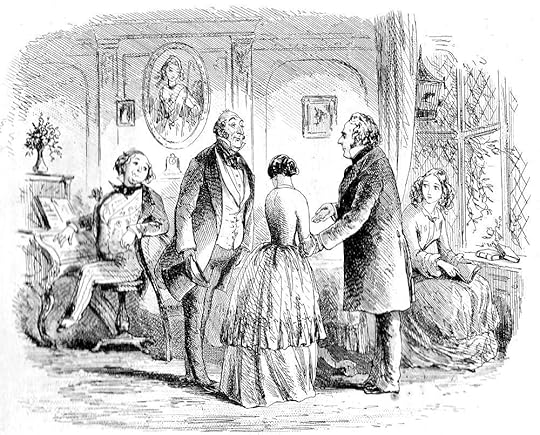
Sir Leicester Dedlock - "Phiz" (Hablot Knight Browne)
He says that he hopes they are not under the impression that, because of his feud with Mr. Boythorn, they are not welcome at Chesney Wold.
He says that Mrs. Rouncewell had told him that a friend of theirs named:
“Mr. Hirrold—Herald—Harold—Skampling—Skumpling—I beg your pardon—Skimpole … who would appear to possess a cultivated taste for the fine arts”
was also prevented from seeing inside Chesney Wold. Sir Leicester regrets this and wishes to make it clear that they may visit at any time. Mr. Jarndyce introduces him to Harold Skimpole, who is actually in the room. Mr. Skimpole praises the landed gentry such as Sir Leicester, for being “public benefactors” in maintaining all these artistic treasures. This thought pleases Sir Leicester very much. All three men express gentlemanly politesse, and insist how they feel flattered, and Sir Leicester says he very much regrets if there was any confusion about their welcome at Chesney Wold. All this time, Esther has tried to keep her head down, and herself in the background, to avoid any interaction with Sir Leicester.
However, now Sir Leicester moves on, and says that Lady Dedlock has told him that when they were in the vicinity, she had met Mr. Jarndyce and his wards. They are to please understand that the prohibition on entering the house was for Mr. Boythorn alone, and not for them. Not realising that he would be putting his foot in it, Mr. Skimpole remarks:
“You know my old opinion of him, … An amiable bull who is determined to make every colour scarlet!”
Sir Leicester leaves hurriedly, before there is any more inappropriate conversation, and Esther escapes just as hurriedly to her room. After a while she is calmer, and goes back downstairs, and is teased for having been “shy and mute before the great Lincolnshire baronet”.
Esther now realises how close she had been to having the secret of her birth revealed, and decides that she must tell Mr. Jarndyce about Lady Dedlock being her mother. Later that night, Esther goes to have a word with her guardian in the Growlery. First she says, she wants to talk about herself, and notices a:
“curious expression [on his face, which] I had observed in it once before—on that night when he had said that he was in no trouble which I could readily understand”.
Esther does not understand what this could imply, but is keen to seek his advice. She says how troubled she has been by Sir Leicester’s visit, which astonishes Mr. Jarndyce. Next she reminds him of when they had met Lady Dedlock, in the grounds of Chesney Wold, sheltering from the storm, and how she became aware that he had known Lady Dedlock’s sister, many years ago. She asks him why Lady Dedlock and her sister had parted. He is puzzled by her question, but says:
“No one but themselves ever did know, I believe. Who could tell what the secrets of those two handsome and proud women were! You have seen Lady Dedlock. If you had ever seen her sister, you would know her to have been as resolute and haughty as she.”
Esther says she has seen Lady Dedlock’s sister: “many and many a time!”
Mr. Jarndyce is startled by this, and now troubled, thinking that Esther might have guessed the truth as he knows it. For he had known that Lady Dedlock’s sister had been the lady whom Mr. Boythorn had been nearly married to, and who had jilted him. Now he tells Esther that this was so, and she wants to know the reason. He says that it had been her own decision, and that she had kept the motive secret: “in her inflexible heart”. But Laurence Boythorn had suspected that it might have been “some injury which her haughty spirit had received in her cause of quarrel with her sister [which] had wounded her beyond all reason”.
Whatever the truth of it was, he says, Lady Dedlock’s sister had written Laurence Boythorn a letter, saying that that from that day she was as dead to him, because of his “proud temper and his strained sense of honour”. Mr. Jarndyce says that these tendencies were in her nature too! But Lady Dedlock’s sister had said that because of this, she made the sacrifice, and would live it, and die in it. This must be so because Mr. Boythorn had never heard of her again, and nor did any one else.
Esther is now distraught, seeing the whole picture for the first time, even though Mr. Jarndyce cannot. She weeps, blaming herself for causing so much unhappiness.:
“”Oh, guardian, what have I done!“ I cried, giving way to my grief; ”what sorrow have I innocently caused! … That secluded sister is my first remembrance … And HER sister is my mother!“”
Mr. John Jarndyce, now realising that Esther’s aunt was Laurence Boythorn’s intended wife, is as shocked as she is, but talks so tenderly and wisely to her, that Esther begins to feel better:
“I believed I had never loved him so dearly, never thanked him in my heart so fully, as I did that night.”
And Esther is so grateful, that she is determined to work even harder, to make her existence worthwhile:
“how could I ever be busy enough, how could I ever be good enough, how in my little way could I ever hope to be forgetful enough of myself, devoted enough to him, and useful enough to others, to show him how I blessed and honoured him.”
message 4:
by
Bionic Jean, "Dickens Duchess"
(last edited Apr 25, 2022 05:40AM)
(new)
-
rated it 5 stars
Mod
This is where Harold Skimpole and his family lived. What's more, Charles Dickens himself lived here between 1827 and 1829! (He would have been 15 - 17 years old).
Polygon Buildings, Clarendon Square, Somers Town was a building of four storeys, possibly over a basement:
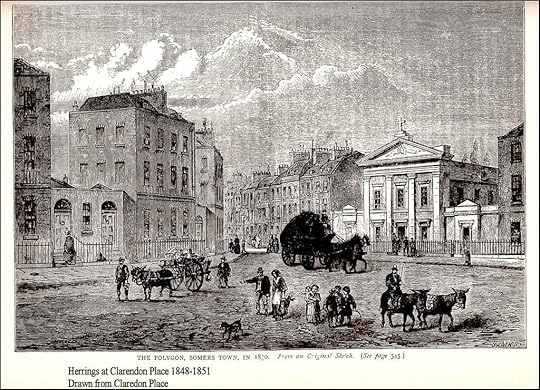
The housing development was four blocks, each of 72 homes. There was a letter box visible at the street corner and we can see horse-drawn carts. Later the street would be lined with trees, with protective guards around them. The roadway was cobbled.
Polygon Buildings no longer exists and now Oakshott Court occupies the site.
Somers Town is an inner-city district in North West London https://en.wikipedia.org/wiki/Somers_...
message 5:
by
Bionic Jean, "Dickens Duchess"
(last edited Apr 25, 2022 03:36PM)
(new)
-
rated it 5 stars
Mod
Verulamium is an Ancient Roman town in what is now Hertfordshire. Therefore it is in the same county as Bleak House. Quite a lot of it has now been excavated, including some walls and pavements. (They are beautiful!) This is what Harold Skimpole was talking of sketching when Sir Leicester Dedlock arrived:

Roman Theatre at Verulamium
https://en.wikipedia.org/wiki/Verulamium
If you google, you can find artist's sketches of how it would have first looked.
message 6:
by
Bionic Jean, "Dickens Duchess"
(last edited Apr 25, 2022 06:01AM)
(new)
-
rated it 5 stars
Mod
We have yet more bird references—Mr. Skimpole compares his rooms with a birdcage. Also, Hablot Knight Browne (Phiz) includes a birdcage in his illustration.
I was impressed by the stylistic “tells” in this chapter. Esther is talking, and she writes “it matters little” no less than three times in the first two paragraphs. Then in the final sentence, we have “in my little way”. By framing the chapter thus, we can see Esther wants to appear small and insignificant.
Esther has a great sense of guilt towards her mother, and now also toward her aunt, Miss Barbary, and Laurence Boythorn, whom her aunt had never married, because of bringing up Esther. Esther feels as if she has ruined all these lives by being born—and wishes she had never been born. She is belittling herself all the time, and we can see her agony of thought behind the words she uses. It's very skilful writing by Charles Dickens.
message 7:
by
Bionic Jean, "Dickens Duchess"
(last edited Apr 25, 2022 08:46AM)
(new)
-
rated it 5 stars
Mod
Other thoughts about this chapter?
 A visit to Mr Skimpole - oh, joy! I realize there were no credit bureaus then, but still... hasn't word got around his credit rating is awful? (Yes, Jarndyce bails him out but he is still a high risk customer). Is this the first time we learn he's a trained physician? He honestly seems narcissistic, although they aren't open about their sponging as he is. No wonder the wife has maladies! I suppose today mimosas and screwdrivers are standard at brunches, but claret with breakfast doesn't sound all that... interesting a beverage.
 Perhaps I've missed it, but there doesn't seem to have been any mention by Esther of her mother divulging the identity of Esther's father? I'm assuming almost anyone would have asked a birth mother about it.
Did Esther's aunt drop Boythorn to take in her niece? Stupid vanity and assumption on her part as I infer that Boythorn would've likely been fine with 'adopting' Esther officially had she told him the truth.
My 2¢ anyway...
 This chapter shows Skimpole (at least, in my estimation) at his worst: his laziness and selfishness keeps his dependents in shabby circumstances; and he's brainwashed his daughters to grow up as his admiring sycophants, and to have a mentality of lazy, sponging parasitism just like his. Some pundits, like Osbert Sitwell (who did the Introduction to the Oxford Illustrated Dickens edition of this novel) are quite taken with his supposed "charm" and "wit." but he utterly fails to charm me.
message 10:
by
Bionic Jean, "Dickens Duchess"
(last edited Apr 25, 2022 07:26AM)
(new)
-
rated it 5 stars
Mod
As I mentioned before, most critics believe Mr. Skimpole to be one of Charles Dickens's least successful characters. We do need the whole picture of him to form an assessment though, and he is still very much present, unfortunately! Nowadays even the humour seems to wear thin, so he has few fans. Mrs. Skimpole seems to have a very raw deal.
I've detailed Mr. Skimpole's origins in Leigh Hunt before LINK HERE, and if you use the search field you can find other refences to how critics viewed him, and how Leigh Hunt himself did.
Although Charles Dickens himself said:
“I suppose he is the most exact portrait that was ever painted in words! … It is an absolute reproduction of a real man” I am wondering if that was the "whole truth". Now I've discovered that Mr. Skimpole's lodgings were once where Charles Dickens once lived as a young man, I can now see elements of Dickens's own father in him too! The charming personality, the fecklessness, and yes, the sponging! But Charles Dickens himself might not have spoken openly about such a portrayal. John Dickens had only recently died (1851) when Bleak House started to be serialised. In a way, those aspects might have been an affectionate tribute to the charming but irresponsible side of his father.
 I think it was the shame of Esther's birth that caused the aunt to drop Boythorn. She cites his “proud temper and his strained sense of honour”, which I think she believes would make revealing the truth to him unthinkable. By the same token she has that same proud temper and strained sense of honour, so she doesn't want anyone to connect her with the shame of her sister.
Esther feels responsible, but it is the choices of these two women that have driven this narrative, none of her doing. I'm not sure if there are still secrets Mr. Jarndyce is keeping. He was genuinely surprised to learn the identity of Esther's aunt and mother.
Just when you think you cannot like Skimpole less, there he is again stirring your distaste. I cannot see how a man as obviously intelligent as Mr. Jarndyce cannot see that Skimpole's attitude is not harmless, it is in fact, IMHO, very harmful to others--Richard being an example. Perhaps he would follow the same path in any case, but Skimpole bilks him of his small monies and feeds the flame of his discontent through introducing him to Vholes and encouraging him to pursue his "fortune".
How horrible to think he is raising three little Skimpoles to take his misguided philosophy out into the world, and as he himself predicts, there will be another passel of such creatures to come from these.
 It is mindboggling that even after everything that took place in the visit to Skimpole’s, Jarndyce still defends him.
Pride goeth before a fall, and as Sara says, it was the two sisters who created the mess here, and it is a pride that drives them both. Maybe it’s easier for me, from our current timeframe, to see the extension to others (Boythorn and Dedlock) pride as just as much of a fault, but their attempts to “protect” due to it have certainly backfired.
Didn’t Esther say that she didn’t tell her guardian all that was in the letter? And I assumed this meant tell who her father was?
 I did wonder if Jarndyce was beginning to look at Skimpole differently when evidence of the “east wind” began to show up and rattle Jarndyce by the end of the chapter. Always a sign of his discontent.
 I have no sympathy for Skimpole at all and noticed that Esther seems to have seen through him more than before. Ism very glad she and Ada made sure that Jarndyce knows about Skimpole’s connection to Vholes.
 Skimpole has a history that I hope we are told one day. His behaviour in this book has been deplorable and totally irresponsible.
 Yet, as a physician, he would have had a large responsibility, so he must not always have been the way he is now. He must have been raised and acted responsibly until......when? What happened to make him throw responsibility out of his life?
It's sad that he's brought up another generation of Moochers in his daughters. I am curious about whether his sons are more responsible. It seems that they may be because they left the family home. If so, it's interesting that the sons became responsible adults, while the girls didn't. It's a strong division.
Poor Mrs. Skimpole. She is stuck and miserable, it appears.
I wonder also about the motivations and/or thought processes of Miss Barbary.
The two sisters are going to marry their loves. One has a baby. The other takes the baby, leaves her fiance, tells the sister the baby died, moves away, never sees either sister or fiance again and raises the baby without family or friend contact, never telling the child anything about her past.
It's a very odd scenario and one has to wonder why one person would manipulate a situation to such detriment for all participants and without any indication that it was done for Love. Miss Barbary took on a big responsibility, changed her life and gave up a lot of joy & love when she took Esther. I wonder what her motivation was.
Jean, I also wonder about Mr. Jarndyce's reactions when Esther's past is brought up. It appears that he knows something. Yet, he was surprised at the identity of her mother. Therefore, what he knows has nothing to do with her parentage. Unless he has ties with Captain Hawdon?
 Petra wrote: " Miss Barbary took on a big responsibility, changed her life and gave up a lot of joy & love when she took Esther. I wonder what her motivation was. "
Disappearing from Boythorn's life would have been absolutely mandatory because Boythorn certainly would have known her sister. Keeping the fact that Esther was still alive a secret from Lady D (presumably still a Miss Barbary herself at that time) would have been impossible if Boythorn had known about the baby.
Petra wrote: "Skimpole has a history that I hope we are told one day. His behaviour in this book has been deplorable and totally irresponsible.
Yet, as a physician, he would have had a large responsibility, so ..."
I like your thoughts on Miss Barbary's motive in raising Esther, breaking with Boythorn and Lady D, etc. Miss B completely changed her life, cut herself off from anyone she had a loving or familial relationship with, and raised a child she loathed. Why would she make that choice for herself?
Heaven help me, a chapter overflowing with Skimpole. I wish someone would have stuffed that peach in his mouth to shut him up. Jean the information on the Polygon is great. Interesting that Dickens lived there for a time, and more interesting to me is your idea that Dickens may have pulled his father's traits/personality into the character of Skimpole, along with Leigh Hunt.
I keep comparing Micawber and Skimpole while reading BH. I love Micawber, he's funny, warm, and likable despite his ineptitude with money and finances. Skimpole is the polar opposite IMHO, there's nothing charming or genuine about him.
What angers me most in this chapter (and there's a lot) is Skimpole saying his wife used to be a beauty but now is afflicted with poor health. Wow, rude, insulting, horrid, unloving etc etc etc. When you genuinely love someone, their changed appearance over the years (due to aging or poor health) isn't noticeable. You still see them as beautiful or handsome as they were the day you met them. Mr J and Ada and all who love Esther are the perfect example of this - they still love her and view her no differently after smallpox scarred her face.
Jean thank you for the information on the ancient Roman town Skimpole sketched. I love the bonus material like this that you give us! :)
Yet, as a physician, he would have had a large responsibility, so ..."
I like your thoughts on Miss Barbary's motive in raising Esther, breaking with Boythorn and Lady D, etc. Miss B completely changed her life, cut herself off from anyone she had a loving or familial relationship with, and raised a child she loathed. Why would she make that choice for herself?
Heaven help me, a chapter overflowing with Skimpole. I wish someone would have stuffed that peach in his mouth to shut him up. Jean the information on the Polygon is great. Interesting that Dickens lived there for a time, and more interesting to me is your idea that Dickens may have pulled his father's traits/personality into the character of Skimpole, along with Leigh Hunt.
I keep comparing Micawber and Skimpole while reading BH. I love Micawber, he's funny, warm, and likable despite his ineptitude with money and finances. Skimpole is the polar opposite IMHO, there's nothing charming or genuine about him.
What angers me most in this chapter (and there's a lot) is Skimpole saying his wife used to be a beauty but now is afflicted with poor health. Wow, rude, insulting, horrid, unloving etc etc etc. When you genuinely love someone, their changed appearance over the years (due to aging or poor health) isn't noticeable. You still see them as beautiful or handsome as they were the day you met them. Mr J and Ada and all who love Esther are the perfect example of this - they still love her and view her no differently after smallpox scarred her face.
Jean thank you for the information on the ancient Roman town Skimpole sketched. I love the bonus material like this that you give us! :)
Paul, I agree. My question was for the larger picture. This woman was, presumably, in love with Boythorn and he in her. Her sister has a baby and she gives up her future happiness to raise a child that she tells her sister has died. Yes, she has to "disappear" and break all ties. But that's a high price to pay for someone else's "mistake". Not many sisters would change their life and give away happiness to raise a "secret".
It seems like a big sacrifice and for what gain? Miss Barbary loses everything in this plan and gains nothing.
message 18:
by
Bionic Jean, "Dickens Duchess"
(last edited Apr 25, 2022 03:37PM)
(new)
-
rated it 5 stars
Mod
I also think of Mr. Micawber, reading about Mr. Skimpole - and you are right that they are opposites: two halves of the same personal type. But one is so much more appealing.
 I found this chapter really frustrating. I didn’t need all that extra information about Skimpole, I already totally dislike him! And then the interesting stuff at the end of the chapter, the conversation between Esther and Jarndyce is too brief to be satisfying to the reader. This is Esther’s narrative, so why is she writing so much waffle? It makes me wonder about the purpose of her writing her story, who is it for?
I finally had time to come back and thoroughly read the information on Verulaneum. How fascinating to think you can visit there. In my next life I am going to be a historic traveler! Thank you, Jean, as Cozy says this extra information is such a marvelous bonus.
I found this chapter really frustrating. I didn’t need all that extra information about Skimpole, I already totally dislike him! And then the interesting stuff at the end of the chapter, the conversation between Esther and Jarndyce is too brief to be satisfying to the reader. This is Esther’s narrative, so why is she writing so much waffle? It makes me wonder about the purpose of her writing her story, who is it for?
I finally had time to come back and thoroughly read the information on Verulaneum. How fascinating to think you can visit there. In my next life I am going to be a historic traveler! Thank you, Jean, as Cozy says this extra information is such a marvelous bonus.Just a thought, but when a family member disgraced themselves in these times, it was a reflection on the entire family. So, the sister, Miss Barbary's reputation and standing would have been affected had anyone known about Lady D's indiscretion. Even at this point, if Lady D. is found out it will cast aspersions on the Dedlocks and their house and name...even though Sir Leicester and his family had nothing to do with the transgression and he is, in a way of speaking, another victim of it.
What she chose to do was make herself a martyr to the cause of keeping the secret and protecting their names, although she obviously loathed her sister and the child. Some people like resentment and thrive on feeling they are the injured party and she sounds very much like one of those people. She has no regard for how her sister or the child feel, only that she can repudiate the one and punish the other. In fact, she punishes them both in separating them and lying to Lady D about the child's death. She must surely know that the grief she inflicts is horrible.
Sara wrote: "I finally had time to come back and thoroughly read the information on Verulaneum. How fascinating to think you can visit there. In my next life I am going to be a historic traveler! Thank you, Jea..."
That's really good reasoning on Miss Barbary's motive for what she did. Totally plausible.
That's really good reasoning on Miss Barbary's motive for what she did. Totally plausible.
Sara, thank you! That does make sense. It's sad. Miss Barbary gave up a lot of happiness for a life of resentment and martyrhood.
message 23:
by
Bionic Jean, "Dickens Duchess"
(last edited Apr 26, 2022 04:44AM)
(new)
-
rated it 5 stars
Mod
Many here will remember that Charles Dickens was to visit this damaged personality type again in Little Dorrit, with (view spoiler). We only have an outline picture of Miss Barbary (Honoria's sister), and have only ever had reported accounts of her behaviour, mostly from Esther, but also from Mr. Jarndyce and briefly Mrs. Chadband (ex. Mrs. Rachael). However in Little Dorrit we have a fully realised "fire and damnation" character. (view spoiler), who closed themselves off from the world and became a martyr, sacrificing every chance at happiness (and making sure everyone knows it) because of resentment, and a certain knowledge in their mind that this was right; that this was what the Bible had instructed.
Miss Barbary was a sort of practice run!
message 24:
by
Bionic Jean, "Dickens Duchess"
(last edited Apr 26, 2022 04:44AM)
(new)
-
rated it 5 stars
Mod
It is an odd chapter, and Sir Leicester's visit might feels a little contrived. I wondered if anyone would comment on that. Charles Dickens was trying very hard to entertain us with Mr. Skimpole, I think! But in a way it feels unbalanced as the important information: what Janelle calls "the interesting stuff at the end of the chapter", lies with Esther and Mr. Jarndyce.
I tried to put this part in my summary as the section needs careful reading after all the lighter prose - but also especially paying attention to demeanour, and what is not said.
On to the next one ...
message 25:
by
Bionic Jean, "Dickens Duchess"
(last edited Apr 26, 2022 03:38AM)
(new)
-
rated it 5 stars
Mod
Esther is still narrating, and it is now the following morning. Mr. Jarndyce calls her into his room, and Esther tells him all she knows, filling in the details about her mother, Lady Dedlock. He agrees with her that they must keep the secret, and avoid any further meetings between Esther and the Dedlocks.
“He understood my feeling and entirely shared it.”
Mr. Jarndyce says he will even try to discourage Mr. Skimpole from visiting. As for Mr. Tulkinghorn, whom he did not name, he said:
“If [Lady Dedlock’s] mistrust of the lawyer whom she had mentioned were well-founded, which he scarcely doubted, he dreaded discovery … it was certain that he was a dangerous man.”
Esther tells him that she believes that Mr. Guppy may also know, but that she is sure that he can be trusted. However, she believes that Mademoiselle Hortense may have suspicions:
“”Ha!“ he returned thoughtfully. ”That is a more alarming person than the clerk”
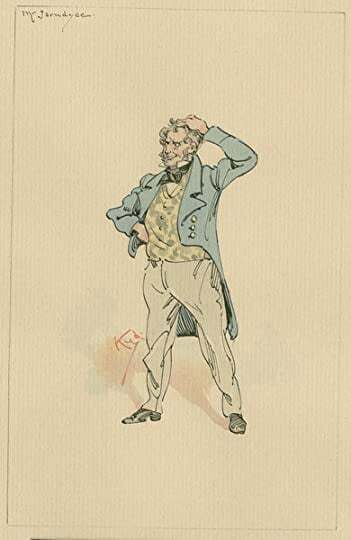
Mr. Jarndyce - 'Kyd'
but he decides on reflection that it is better not to worry about her, but to concentrate on keeping the secret. Esther is grateful, and says how much sharing the secret with him has lightened her load, and Mr. Jarndyce assures her that if he can ever do anything for Lady Dedlock, then he will do it, “for her dear daughter’s sake”.
Esther thanks him sincerely, and is about to leave, when Mr. Jarndyce calls her back.
“Quickly turning round, I saw that same expression on his face again; and all at once, I don’t know how, it flashed upon me as a new and far-off possibility that I understood it.”
He tells Esther that there is something he’s been meaning to propose to her, but is having difficulty in approaching the subject. He says that he would rather write it down in a letter and asks if she would mind:
“with the same genuine freshness and faithfulness of manner—the old protecting manner which had made that house my home in a moment”.
Mr. Jarndyce tells Esther that she has done him a world of good ever since she arrived, and that no matter what happens, he will never change from how he is towards her right now. If she thinks this over for a while, and believes him, then he would like her to send Charley for the letter, in a week’s time. If Esther decides not to send Charley, then he will never write the letter.
After a week, Esther does send Charley for the letter. She sits looking at it without reading it, and thinking through all her life up to that point, from the time in her aunt’s house: “when my aunt lay dead, with her resolute face so cold and set”, then the lonely time with Mrs. Rachael, and the happier time at the school. Then she considers the supremely happy time at “Bleak House”, and her terrible disfiguring illness, after which she is:
“so altered and of those around me so unchanged; and all this happiness shone like a light from one central figure, represented before me by the letter on the table.”
Now Esther feels ready to read the letter itself, and is not surprised to find that Mr. Jarndyce would like her to be “the mistress of Bleak House”. It is, therefore, a proposal of marriage. She reads it three times:
“It was not a love letter, though it expressed so much love, but was written just as he would at any time have spoken to me. I saw his face, and heard his voice, and felt the influence of his kind protecting manner in every line …
[It was] written throughout with a justice and a dignity, as if he were indeed my responsible guardian impartially representing the proposal of a friend“.
Esther believes that this is a perfect way for her to thank him, and make him happy, and moreover that the letter proves:
“that his generosity rose above my disfigurement and my inheritance of shame”.
She knows that she can trust him implicitly. Yet it makes her cry very much, feeling as though she has lost something, although she says she cannot say quite what it is. She talks to her reflection very firmly in the mirror, and reminds herself of what old Mrs.Woodcourt had said about marrying …
And then she remembers Mr. Woodcourt’s flowers, which he had left for her, before leaving for China and India. She had kept them “in memory of something wholly past and gone”. Now she decides it would no longer be right to keep them, so she burns them in the candle, “and they were dust in an instant”. She waits for a week for Mr. Jarndyce to ask her for her answer but he doesn’t bring it up. She waits a further week for him to broach the subject, but then decides to go to him instead, while he is standing by the window in the drawing room, waiting for them all to go out.
Esther asks Mr. Jarndyce when he would like a reply to his letter, and he says when it is ready. Then he wonders mildly if it is in writing, but Esther says:
“”No. I have brought it myself, guardian,” I returned.
I put my two arms round his neck and kissed him, and he said was this the mistress of Bleak House, and I said yes“
But she does not tell Ada anything about it just yet.
message 26:
by
Bionic Jean, "Dickens Duchess"
(last edited Apr 26, 2022 04:22AM)
(new)
-
rated it 5 stars
Mod
Ideas?
Why does Esther burn Allan Woodcourt’s flowers, rather than just throwing them away? It seems symbolic in some way, like burying her doll as a child. Should it remind us of Krook? Or something else being ignited—for instance passion?
 This chapter completely threw me for a loop. I had no clue a proposal was in the wings. I have to confess a need to put aside a little squeamishness at the age difference and look at it through a more Victorian lens.
 And the Skimpole. Geez, I know we Americans overemphasize productivity and individual responsibility but COME ON dude. It was particularly disgusting to learn how palatial his own quarters are. The thing is he could "know" about money but chooses not to and the folks around him indulge this. Why? Argh. I am looking forward to him exiting the novel.
 There have been several times when Dickens has written that Mr Jarndyce has looked at Esther in a strange way, and I wondered if his love for her was more than just his role as a guardian. I feel that Esther loves him as a father figure, and would feel comfortable living as the mistress of Bleak House. Her changed appearance after the smallpox might ruin her chances with some men. But she feels excitement and passion when she thinks of Allan Woodcourt, so something would be missing if she married Mr Jarndyce.
 There’s no question that Esther and John Jarndyce deeply care for one another, and could most likely live together as a married couple in great harmony. However, I think burning the flowers from Alan Woodcourt is symbolic of Esther giving up on “true love” as she no longer believes it is possible for her because of her altered looks. She’s turning a page in her life much like she did when she buried her doll.
 Connie wrote "But she feels excitement and passion when she thinks of Allan Woodcourt, so something would be missing if she married Mr Jarndyce."
I agree. I think it is that passionate and romantic type of love as she feels for Allan Woodcourt that would be missing. What came to my mind when she burned the flowers which "turn to dust in an instance" is the death of this other type of love... dust as in the burial service of the dead "dust to dust, ashes to ashes." This is also what she cries about.
I can't say that I like this idea of a marriage to Jarndyce. It changes the way I think of him now and not in a good way. He is her much older guardian and if he really knows her he would know that she would not be able to say no to him. If she marries him she will have to try to kill the part of herself that loves Woodcourt and wishes for romantic love. I don't think she would be successful at that despite her symbolic burning of his flowers.
 Connie, I agree with what you say about the excitement Esther felt about Allan Woodcourt and something would be missing with Mr Jarndyce. This is a tough one. The looks he gave her several times - were they love - passionate love or fatherly love? I think Mr. Jarndyce does love Esther but something about this proposal seems more to do with keeping the status quo at Bleak House as Ada becomes of age to marry and leave. Mr. Jarndyce said that he didn't want to break up what they had there. Is he suggesting that Esther would have to find a new place when Ada leaves? She couldn't stay on as housekeeper? I'm not sure what his actual motivation is for elevating her to the role as Mistress of Bleak House other than pity. He feels badly for her lot and maybe as his wife, he thinks when the secret comes out (because it's likely to) her newly married status would alter other's judgment of Lady D and Esther.
Donna wrote: "There’s no question that Esther and John Jarndyce deeply care for one another, and could most likely live together as a married couple in great harmony. However, I think burning the flowers from Al..."
Connie, I agree with what you say about the excitement Esther felt about Allan Woodcourt and something would be missing with Mr Jarndyce. This is a tough one. The looks he gave her several times - were they love - passionate love or fatherly love? I think Mr. Jarndyce does love Esther but something about this proposal seems more to do with keeping the status quo at Bleak House as Ada becomes of age to marry and leave. Mr. Jarndyce said that he didn't want to break up what they had there. Is he suggesting that Esther would have to find a new place when Ada leaves? She couldn't stay on as housekeeper? I'm not sure what his actual motivation is for elevating her to the role as Mistress of Bleak House other than pity. He feels badly for her lot and maybe as his wife, he thinks when the secret comes out (because it's likely to) her newly married status would alter other's judgment of Lady D and Esther.
Donna wrote: "There’s no question that Esther and John Jarndyce deeply care for one another, and could most likely live together as a married couple in great harmony. However, I think burning the flowers from Al..."This is what my thoughts on burning the flowers were, Donna. It's Esther's way of putting a close on that chapter to move forward.
Anne (On semi-hiatus) wrote: "I can't say that I like this idea of a marriage to Jarndyce. It changes the way I think of him now and not in a good way. He is her much older guardian and if he really knows her he would know that she would not be able to say no to him. I would have liked him to reflect upon that before proposing marriage. If she marries him she will have to kill forever the part of herself that loves Woodcourt and wishes for romantic love. "Well said, Anne. He is most likely thinking of Esther's security in this proposal but not quite thinking through what would really make her happy. And not realizing that his question would elicit an automatic yes because he is her guardian.
Bombshell chapter! I agree that burning the flowers was symbolic and related to fire again, and her doll. But here's where my mind went: When Esther goes to talk to him about her mother, she says she wants to talk to him about herself. I want to know more about himself. First of all, he's at least middle aged. What has he been up to all these years? Surely he has secrets we haven't heard. Then I thought, I wonder if he's dying and wants to set Esther up with permanent security and status before he goes? After all this time with him, I can't see him in a negative light, so it doesn't give me the yuck feeling I might normally get in this situation. I have to think he's trying to protect her, and I also have to think she will still, later, have a chance to rekindle those romantic feelings she had for Woodcourt.
Kathleen: "it doesn't give me the yuck feeling I might normally get in this situation."I have to admit to having those yuck feelings. He may mean well and only be thinking about Esther but it doesn't feel that way at the moment. The way he had her ask for the letter is rather coy and makes me think that he has more than "guardian" feelings for her in which case he is also thinking about his own desires here.
Anne (On semi-hiatus) wrote: "Kathleen: "it doesn't give me the yuck feeling I might normally get in this situation."I have to admit to having those yuck feelings. He may mean well and only be thinking about Esther but it doe..."
Don't misunderstand me to be saying I have no yuck feelings. I think the turn from guardian to lover gives all of us yuck feelings. I just felt they weren't as strong as they would normally be if my scenario unfolds--that he is dying and trying to protect her.
About his age, how old is he anyway? (There was an almost 20 yr difference between my parents, and they had over 40 years of happily married life, so I may feel different than many do about an age difference.)
Kathleen, for me the age difference per se isn't a problem. The problem for me is that they've had a relationship akin to father and daughter.
This is where I think you have to set aside 21st century views and try to be 19th century for a moment. Esther is a girl of questionable (unknown to the world) parentage, no family, no status except that given to her by Mr. Jarndyce. If Ada marries, which a beautiful girl of good family like Ada is bound to do, Mr. Jarndyce and Esther cannot live alone at Bleak House. It would be inappropriate and very destructive to Esther if her parentage were then discovered. There would be huge questions for society, a lot of whispering, and a "like mother, like daughter" rumor sure to spread. With her dis-figuration, Esther's chances of marriage are slim. Her beauty might have won her a suitor, but that is gone, even the despicable Guppy has backed away. Mrs. Woodcourt has made it clear to all and sundry, and Esther herself, that it will not be Allan. In marrying her, Mr. Jarndyce confers upon her the right to remain at Bleak House, a status in the community, some protection should the secret become public, and a promise of security after he is gone. As things stand, he can leave her a bequest in his will, but I think with entailment being the norm, he could not leave her the bulk of his fortune nor the house itself.
What he is doing is noble, as befits the man we have seen to this point. He makes it clear "nothing must change". I think we can read into that what we wish, but I read that he will be happy to accept a companionship rather than a "marriage" if she desires it. I think he is well aware there can be no passionate love for them and I also think that explains the looks he gives her, because he is considering this move for a long time and wondering always if it is the right thing for Esther. I think he is still offering her mostly a father's love and we have every evidence that she offers him only the same kind of feeling.
Sara, you've answered my questions about whether Esther can stay on at Bleak House as housekeeper once Ada marries. I was thinking that was the case, but I can always count on you and others to much more eloquently explain what I would like to. Ha! Thanks. I do think this would be a companionship as opposed to a true marriage.
Great explanation, Sara! What you are saying makes a lot of sense when we consider the mores of the day. I disagree only on one small point. If Alan Woodcourt is a person of any worth, I don’t think he would let his mother have the last word on whom he should marry. Likewise, we’ve seen that the people who love Esther totally look past the scars from her illness, and so, too, might Alan. And, lastly, I admit I would be a bit disappointed if Dickens left things as they now stand with regard to Esther’s romantic life.
Oh, Donna, I completely agree about Alan, but I am thinking of Mr. Jarndyce's view and Alan has not declared himself as interested and his mother has absolutely made it clear he is not. Of course, she is not speaking for Alan, but those she speaks to might not know that. In any case, Mr. Jarndyce cannot depend upon Alan to take the responsibility of Esther and I think he feels pressed to make sure she is taken care of before Ada marries or he dies.
Donna: "And, lastly, I admit I would be a bit disappointed if Dickens left things as they now stand with regard to Esther’s romantic life."I feel the same way. When is Alan Woodcourt supposed to return? I have lost all sense of time within this novel. I'd like him to sweep in immediately upon his return with a proposal of marriage in mind and much to his mothers dismay (and my delight) go to Esther and see her just as he did before and see past all of her scars just as all who love her have done. I'm such a romantic.
The last we heard, I think Alan had just saved some people in a shipwreck and was on his way back...maybe soon.
Sara wrote: "The last we heard, I think Alan had just saved some people in a shipwreck and was on his way back...maybe soon."Thanks, Sara. Oh, right. Do you have a sense of how long ago that was in Bleak House time? :))
This was a surprise of a chapter. I did not see the proposal coming, despite it being brought up in our discussions earlierI had a bit of a yuck moment when Mr. Jarndyce said that he'd felt this way since seeing Esther in the carriage that first time. She was about 12 then, wasn't she?
I feel so sad for Esther for making this move out of gratitude. I think the two of them can live together in peaceful companionship, but not as a loving couple.
I can see the points made by Sara about the need for propriety and "face" saving. Esther and Mr. Jarndyce can't live together after Ada leaves. Yet this seems like a solution that stops Esther's chances for a romantically fulfilling and happy future. In a way, it may save her current situation but it leaves her in a place of limbo and existence, not living to the fullest.
Anne, the time frame is in the second post of each thread. It's been quite helpful for me to keep track when I need to check on it.
message 46:
by
Bionic Jean, "Dickens Duchess"
(last edited Apr 26, 2022 10:16AM)
(new)
-
rated it 5 stars
Mod
(referring to the shipwreck)
Esther was told this by Miss Flite (if we believe her reliability) in chapter 35 LINK HERE, near the end of my summary.
As Petra says, the links at the beginning are ideal for finding this, or in this case I searched for "shipwreck".
Sara - your posts about English conventions in society, and Mr. Jardndyce's delicacy, are spot on :) I'd prepared a post about this, for a few days' time. We still need to examine what is not said, to establish if this is all it is. Had Mr. Jarndyce planned this from when Esther was 12, or is his protection a recent plan, as a result of her disfigured face? It may take a while to learn the truth.
And what would Mr. Jarndyce like for himself? We know he is charitable, but marriage is an enormous step. We are only hearing Esther's view - from the future - and then it is only what she chooses to divulge.
I'm in the minority, but I like the idea of Mr J and Esther marrying. I don't think he meant he'd wanted to marry her from the day they rode in the coach together, when she was still a little girl. I think he meant he cared for her then in a fatherly way, sensing she needed someone to love her and care for her.
I think when they met again, when the gang came to live with Mr J at Bleak House, he still cared for her in a protective way. But it's not unreasonable to me that his paternal type affection could evolve into romantic love. If that's what Dickens is asking us to believe, I'm onboard 100%.
I'm not put off by the "spring/autumn" marriage this would be, I think Mr J and Esther would make a lovely couple. And there's no reason why Esther, if she doesn't love Mr J romantically now, can't grow to love him romantically in time.
I don't know what Mr J's true motive is in proposing to Esther, but it made me happy. I definitely happy gasped and squealed. :)
I think when they met again, when the gang came to live with Mr J at Bleak House, he still cared for her in a protective way. But it's not unreasonable to me that his paternal type affection could evolve into romantic love. If that's what Dickens is asking us to believe, I'm onboard 100%.
I'm not put off by the "spring/autumn" marriage this would be, I think Mr J and Esther would make a lovely couple. And there's no reason why Esther, if she doesn't love Mr J romantically now, can't grow to love him romantically in time.
I don't know what Mr J's true motive is in proposing to Esther, but it made me happy. I definitely happy gasped and squealed. :)
 This chapter made me so sad for Esther. It is obvious that she is agreeing to marry Jarndyce out of gratitude and paternal love for him. This was so obvious when she is talking to herself and says "I was very happy, very thankful, very hopeful; but I cried very much." and "When you are mistress of Bleak House, you are to be as cheerful as a bird (a caged bird?). In fact, you are always to be cheerful; so let us begin for once and for all". Esther is really trying to talk herself into believing this marriage to Jarndyce will bring her (and him) happiness.
I understand what you're saying, Sara, and I agree with everything you said. Jarndyce proposed to Edith to protect her in all the ways she could be harmed, but when Esther threw her arms around his neck and kissed him, it was just so wrong to me because up to this time, Jarndyce was a father figure to her and a woman can't just transition emotionally from paternal love to romantic love like that. I think all of the crying she did was because she was dealing with that.
There is no doubt that she still loves Allan Woodcourt, and the burning of the flowers was her "burning her bridges" to her hopes and dreams with him. Romantic that I am, I am hoping that Jarndyce and Esther will secretly continue in their platonic relationship, that Allan Woodcourt will come calling on Esther, that he will propose to her not knowing of her changed relationship to Jarndyce, and that Jarndyce will step aside and give his blessings to her marriage to Woodcourt!
Sara your explanation is the best of all my takes on this development. I hope you are correct!
I feel, as you do, Shirley. This marriage is one of convenience and obligation. Esther may be happy, she will certainly be cared for, but she will never experience the joy that comes with passion and she can burn the flowers, but the feeling in her heart will not be that easily eradicated. So few people married for love at this time, that anyone would have viewed Esther as very, very lucky to have this proposal. Still, we can see she is determining to make the best of the situation and do what is right for others, more than for her emotional self (so typically Esther). If Alan returns, and I feel certain he will, Esther will still feel obligated to Mr. Jarndyce and any break will absolutely have to come from his side and not hers. He is a kind man, and I feel sure he would set aside his own feelings to have Esther happy if he is able to see that he is standing between her and a real love.
I absolutely do not think he was having any sexual thoughts about Esther when she was twelve. I think he admires her and loves her in a platonic way, and that he truly believes he is offering her the best option. He loves her despite her scars, but I do not think he would expect that those who do not know her well, which would be almost any suitor except Alan, would necessarily look beyond her face to her sweet soul. He does not think he is stepping between her and an opportunity for a romantic love.

Dickensians!
Books mentioned in this topic
Nicholas Nickleby (other topics)Bleak House (other topics)
The Victorian City: Everyday Life in Dickens' London (other topics)
The Woman in White (other topics)
The Moonstone (other topics)
More...
Authors mentioned in this topic
Charles Dickens (other topics)Charles Dickens (other topics)
Charles Dickens (other topics)
Wilkie Collins (other topics)
Charles Dickens (other topics)
More...

The Ghost's Walk - Hablot Knight Browne ('Phiz') 1853