
The Readers Review: Literature from 1714 to 1910 discussion
Christmas Stories 2025
>
Nov. 30-Dec 6th: The Phantom Coach by Amelia B. Edwards and The Kit-Bag by Algernon Blackwood
date newest »
newest »
 Mod
Mod
 Mod
Mod
1. How Does Edwards build the suspense of her tale?
2. What did you think of the host/isolated manor house?
3. Do you think the host intended to send him out to a ghost coach?
4. Why was there a space for him in the coach? The tale of the accident mentioned 6 people found dead.
5. What was your overall impression of this story?
Mod
1. How does Blackwood build the suspense here?
2. Did you expect the significance of the Kit Bag (the title notwithstanding)?
3. What were you expecting the murderer to want from Johnson?
4. What was your overall impression of this story?
 Frances wrote: " The Kit Bag is set in London, following the resolution of a murder case, and the junior of the defence counsel is preparing to take a holiday in the alps and to get away from the foul London weath..."
I suppose many Christmas Stories are ghost stories. This one has many audio versions out there. It has obviously been a favourite for years.
There are many hints as to the provenance of the Kit Bag. "...it was old and dirty, the canvas faded and worn, and that it had obviously been subjected to rather rough treatment." It's after Johnson notices the condition of the bag that he starts to hear spooky sounds. The implication is that Johnson talks himself into his panic attack. Until the punch line, of course.
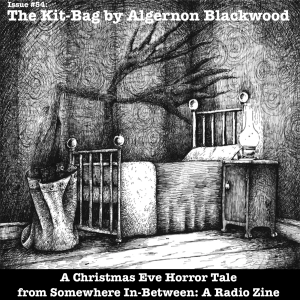
It's interesting that Johnson has "a delicate face like a girl's." I liked this illustration for one of the recordings of the story.
 Mod
Mod
I liked the twist at the end.
Mod
Mod
 Christmas is in fact mentioned in the fourth paragraph of The Kit Bag:
They were more than employer and employed; for family and other reasons, they were friends. ‘Ah, I remember; yes,’ [the KC] said with a kind smile, ‘and you want to get away for Christmas? You’re going to skate and ski in the Alps, aren’t you? If I was your age I’d come with you.’ Johnson laughed shortly. He was a young man of twenty-six, with a delicate face like a girl’s.
Mod
They were more than employer and employed; for family and other reasons, they were friends. ‘Ah, I remember; yes,’ [the KC] s..."
Thanks for catching that, Janet. I listened to an audio version and missed the reference.
 Mod
Mod
The narrator spent so much time on it, and particularly its owner, that I thought it would be more significant than it was. I figured the owner was a ghost who had been a passenger in the coach until Jacob said the accident was nine years ago rather than 23.
Mod
I think I listened to the same recording. I enjoyed this one much more than the other. Because of the title, I figured the kit bag would be significant, but I thought the ghost would be the murdered man, angry at the lawyers who let the murderer get away with it (if I understood the legal terms correctly). The writer and the reciter both did a good job building suspense.
(And I realized I had been conflating Algernon Blackwood and Ambrose Bierce, who are not even from the same country.)
Mod
Mod
True. I'm not sure why I assumed it would have been a man.
Mod
Frances wrote: "The Phantom Coach is set in Northern England at the beginning of December, and our protagonist finds himself lost on the moors after a day of hunting. Convinced he will perish in the cold and snow,..."It's somewhat eerie that I am presently reading a novella involving the character lost in a blizzard. A Long Winter
I could answer # 3 if we knew if there ever was actually a mail-coach expected. Unlikely. So did the old Merlin character send our hero out to die in the winter's night? The glass of usquebaugh (a precursor to whiskey) would contribute to hypothermia, and the hallucinations that often accompany it.
Connecting the story to contemporary times, the Merlin figure has experienced cancel culture. And the creatures in the coach are undoubtedly zombies.
I have used this blog before. I don't agree with all the interpretations, but it has some intriguing ideas.
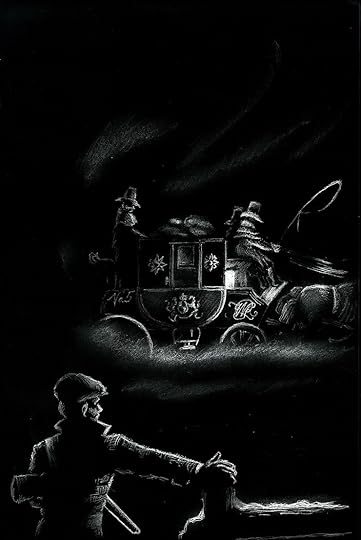
https://www.oldstyletales.com/single-...
Mod
I also wondered if the mansion and the old man were ghosts/ghostly as well. As for sending him out to catch the mail coach, it could also be that, having cut himself off from all outside society, he wasn't aware that the mail coach no longer ran at this time.
Mod
Mod
That's what I think.
I could feel myself getting colder and colder as the author describes the walk in the snow. The narrator was very matter of fact with the owner house when he stated that he would die if he sent him back out again. But the narrator ended up going out again anyway. I don't think the owner of the house had any malicious intentions when he mentioned the mail coach.
The actual description of the coach and the figures inside it were creepy.

The Readers Review: Literature from 1714 to 1910
Books mentioned in this topic
A Long Winter (other topics)Authors mentioned in this topic
Amelia B Edwards (other topics)Algernon Blackwood CBE (other topics)

Algernon Blackwood CBE (1869-1951) was an English broadcast journalist, novelist and short story writer, and was a very prolific ghost story writer. Born just outside London and educated at Wellington College,Blackwood had a varied career including stints as a dairy farmer in Canada, a newspaper reporter in New York City, a bartender, a model, a private secretary and a violin teacher. He moved back to England in his late 30s and started to write short stories of the supernatural which he later began to read on radio and television. He also wrote novels, children's stories and plays. He was interested in both mysticism/the supernatural and was also a keen outdoorsman, enjoying skiing and mountain climbing. He never married, and was described as a loner. He died in 1951 at the age of 82, and he was cremated and had his ashes scattered in his beloved Swiss Alps.