
The History Book Club discussion
THE FIRST WORLD WAR
>
THE HINDENBURG LINE (SIEGFRIED LINE)
date newest »
newest »
 Here are a few links to the First and Second Battles of Bullecourt:
First Bullecourt
Second Bullecourt
 Mod
My pleasure Bentley,
Mod
My pleasure Bentley, Many Australians believe that their troops were sacrificed at First Bullecourt due to bad and hasty planning by the High Command and an unsubstantiated belief in the Tank by the High Command as a new wonder weapon.
Mod
Here are two suggestions for books covering the Battle of Cambrai, one recent one published in 1992:Cambrai: The First Great Tank Battle 1917 (no cover) by A.J. Smithers (read)
 by Bryn Hammond (not read)
Publishers blurb:
Cambrai was the last battle fought by the British on the Western Front in 1917. With Russia out of the war, Italy on the brink of collapse, and the French still reeling from the effects of widespread mutiny, Britain was the only member of the Western Allies still capable of holding the mighty German Army at bay. They did so by taking the fight to the Germans in one of the greatest turning point battles of twentieth-century warfare. At dawn on 20 November 1917, the British attacked the German lines with almost 400 tanks - the first ever mass use of this brand new weapon of war. The Germans were taken completely by surprise and crumpled beneath the blow. For a brief moment it looked as though a stunning breakthrough had been achieved, and church bells rang out across England in celebration. But the Germans were not defeated. Indeed, they used their counterattack as an opportunity to pioneer their own new 'stormtroop' tactics, and suddenly the British were in disarray. In a series of bloody and terrifying reverses the British were driven right back to their start lines. Over the decades many myths have grown up about this iconic battle. For one thing, it was not the tanks that most shocked the Germans at Cambrai at all, but brilliant British innovations in artillery techniques. But such was the potency of the tank myth that after the war it seduced generals and historians on both sides, until the myth was finally brought to reality in the mobile battles that engulfed Europe just thirty years later. In this new look at one of the century's most important battles, Bryn Hammond tells the story of what exactly happened at the end of 1917, and how the myths that were created in those tragic two weeks were to change the face of warfare forever.
Mod
Another account offering the German perspective of Cambrai: by Jack Sheldon
Publishers blurb;
Jack Sheldon's latest book in his acclaimed `German Army' series concentrates on German aspects of the bitter battle of Cambrai November/December 1917. Making full use of primary source material he first covers the defensive battle 20 - 29 November followed by the counter-attack which saw the German Army regain not only most of the ground lost and more besides. Flesquières Ridge and other battles for key terrain, including Bourlon Wood, are described in detail as are the controversial interventions of Ludendorf, criticised by Crown Prince Rupprecht. But the experiences of the fighting man will be of most interest to many.
Here is a book covering the German counter-offensive after the British Battle at Cambrai in 1917 and the effects of that German victory. A Wood Called Bourlon The Cover-Up After Cambrai, 1917 by William Moore
Publishers blurb:
The distinguished First World War historian attempts to explain what went wrong and why all the advantages gained were thrown away; thousands of British troops were captured and hundreds of guns lost.
 An excellent book written by a Canadian soldier who was there.
Through the Hindenburg Line: Crowning Days on the Western Front
 by Frederick Arthur McKenzie (no photo)
Synopsis:
Arthur McKenzie was a member of a fiercely proud band of Canadians who made the trip across the Atlantic to fight alongside the British and Dominion troops. He served from the days of 1915 to the end of the war in 1918, surviving the many terrible dangers of the front-line. He recounts the tales of the band of brothers that he fought with, and the “family” feeling that permeated the Canadian troops, from the commanding General right down to the lowliest private.
The author’s main focus is in describing his experience in the battles that he took part in during 1917 and 1918 as the title suggests including at Vimy ridge and at Passchendaele and Amiens in 1918. He describes the different elements of trench warfare, from raiding the enemy line with knob-kerries and grenades, to the shelling, tanks and mayhem of a full offensive “push”.
Mod
The inexperienced American troops (AEF) get a taste of the intense battle of the Meuse-Argonne on the Hindenburg Line.The Test of Battle: The American Expeditionary Forces in the Meuse-Argonne Campaign
 by Paul F. Braim(no photo)
Synopsis:
In this revised edition, Dr. Paul Braim analyzes the history of the Meuse-Argonne Campaign, the most significant challenge to the American Expeditionary Forces (AEF) in World War I. Delving into newly acquired sources, he details the great difficulties encountered by the fledgling AEF, sent to fight in cooperation with Allies in France. Deployed to France from an army hastily expanded twenty times over its peacetime strength, the AEF was forced to organize a theater of operations, train the hundreds of thousands of arriving U.S. troops, and commit its partially trained forces into battle prematurely. Braim recounts the commitment of the lesser trained soldiers of the AEF into positions for a major offensive into the Meuse-Argonne, the "test of battle" for the Americans in France. His description of the grim fighting evokes the sounds and smells of front-line battle, as the army drove north through the strong defenses in the Meuse-Argonne sector, and gained a bloody victory on the heights overlooking Sedan. Braim analyzes this costly victory by inadequately trained and inexpertly led forces as "learning to fight by fighting!"
Breaking the Hindenburg Line: The Story of the 46th (North Midland) Division. by Major R E Priestley (no photo)
Synopsis:
At an hour and date to be notified later, the 46th Division, as part of a major operation, will cross the St. Quentin Canal, capture the Hindenburg Line, and advance to a position shown on the attached map A. This was the opening paragraph of the preliminary operation order which was to lead to one of the most outstanding feats of arms of the Great War, and that is where this story begins.
The Australian troops of the British Empire proved once more that they could fight like demons!!Bullecourt 1917: Breaching the Hindenburg Line
 by Paul Kendall(no photo)
Synopsis:
n the spring of 1917 the Arras offensive was begun to break the stalemate of the Western Front by piercing the formidable German defenses of the Hindenburg Line. The village of Bullecourt lay at the southern end of the battle front, and the fighting there over a period of six weeks from 11 April until late May 1917, epitomized the awful trench warfare of World War I. In Bullecourt 1917, Paul Kendall tells the stories of the fierce battles fought by three British and three Australian divisions in an attempt to aid Allenby's Third Army break out from Arras. Approximately 10,000 Australian and 7,000 British soldiers died, many of whom were listed as missing and have no known grave. The battle caused much consternation due to the failure of British tanks in supporting Australian infantry on April 11th, but despite the lack of tank and artillery support the Australian infantry valiantly fought their way into the German trenches. It took a further six weeks for British and Australian infantry to capture the village. This book tells the story of this bitter battle and pays tribute to the men who took part. Crucially, Paul Kendall has contacted as many of the surviving relatives of the combatants as he could, to gain new insight into those terrible events on the Hindenburg Line.
Paul Von Hindenburg by Russell A. Berman(no photo)
Synopsis
Unfortunately there is no text about this book on GR but I would imagine it might be entertaining to learn about the Field Marshall during WWI and his plan for the Hindenburg Line. As we know, in his advanced years he was a puppet for Adolph Hitler at the beginning of WWII.
The Hindenburg Line on the Western Front in 1917.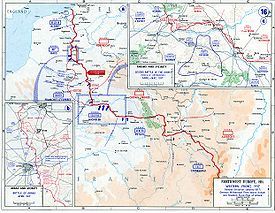
 It's interesting that the Germans withdrew to the Hindenburg Line to make it more difficult for the Allies to attack over a "desert", and for an easier defense. Seems like popular ideas repeat themselves war after war.
The last gasp of the Hindenburg Line.
It's interesting that the Germans withdrew to the Hindenburg Line to make it more difficult for the Allies to attack over a "desert", and for an easier defense. Seems like popular ideas repeat themselves war after war.
The last gasp of the Hindenburg Line.To Conquer Hell: The Meuse Argonne
 by
by
 Edward G. Lengel
Synopsis
On September 26, 1918, more than one million American soldiers prepared to assault the German-held Meuse-Argonne region of France. Their commander, General John J. Pershing, believed in the superiority of American "guts" over barbed wire, machine guns, massed artillery, and poison gas. In thirty-six hours, he said, the Doughboys would crack the German defenses and open the road to Berlin. Six weeks later, after savage fighting across swamps, forests, towns, and rugged hills, the battle finally ended with the signing of the armistice that concluded the First World War. The Meuse-Argonne had fallen, at the cost of more than 120,000 American casualties, including 26,000 dead. In the bloodiest battle the country had ever seen, an entire generation of young Americans had been transformed forever. To Conquer Hell is gripping in its accounts of combat, studded with portraits of remarkable soldiers like Pershing, Harry Truman, George Patton, and Alvin York, and authoritative in presenting the big picture. It is military history of the first rank and, incredibly, the first in-depth account of this fascinating and important battle.
Don't be misled by the title. This book cover Ludendorff's complete power in the Great War and later life as an advocate of Hitler. He overpowered von Hindenburg in his planning of the Hindenburg line.The First Nazi: The Life and Times of General Erich Ludendorff
 by William Brownell (no photo)
Synopsis:
General Erich Luddendorf was one of the most important military individuals of the last century, yet today, one of the least known. One of the top two German generals of World War I, Luddendorf dominated not only his superior – General Paul von Hindenburg – but also Germany’s head of state, Kaiser Wilhelm II. For years, Luddendorf was the military dictator of Germany.
Ludendorff not only dictated all aspects of World War I, he refused all opportunities to make peace; he antagonized the Americans until they declared war; he sent Lenin into Russia to forge a revolution in order to shut down the Russian front; and then he pushed for total military victory in 1918, in a rabid slaughter known as “The Ludendorff Offensive.”
Luddendorf lost the War in 1918. Shortly thereafter, he created the murderous legend that Germany had lost this war only because Jews had conspired on the home front, in what he called a “stab in the back.” He soon forged an alliance with Hitler, endorsed the Nazis, and wrote maniacally about how Germans needed a new world war, to redeem the Fatherland.
This savage man had staggering designs to build a gigantic state that would dwarf the British Empire, sweep across all of Africa, then the Middle East, Central Europe, Persia and even India. Simply stated, he wanted the world. His plans, person, and ambitions were the prototype for his good younger friend, Adolf Hitler.
All in all, Luddendorf was the key German, instrumental in both world wars and the Russian Revolution. He changed the 20th century beyond recognition.
Here is the German perspective on WWI by the man who was instrumental in waging it.The Great War
 by Paul Von Hindenberg (no photo)
Synopsis:
In August 1914, von Hindenburg defeated the Russians at Tannenburg, overcoming a much larger enemy force. He was promoted to Commander-in-Chief of the German armies in the East, where he achieved a number of significant victories, most notably at the Battle of the Masurian Lakes. Much of this success has been put down to the brilliance of his chief-of-staff, Erich Ludendorff, who served as von Hindenburg's deputy throughout the war. These victories on the Eastern Front caused von Hindenburg to become a cult figure in Germany, where he was seen as the perfect embodiment of Germanic strength and moral decency. Wooden statues of von Hindenburg were built all over Germany, onto which people nailed money and cheques for war bonds.
'The Great War' gives unparalleled insight into German military thinking during World War I, and offers the rare perspective of one of Germany's most senior military figures. This is the first edition of von Hindenburg's memoirs in more than fifty years.
 The editor was wise enough to weed the two-volume original for passages that deal strictly with Hindenburg's personal life, pre-war career, and whatever whistful musings about the Empire he wrote down in the Weimar period.
Sounds like an interesting and unusual book.
The editor was wise enough to weed the two-volume original for passages that deal strictly with Hindenburg's personal life, pre-war career, and whatever whistful musings about the Empire he wrote down in the Weimar period.
Sounds like an interesting and unusual book.Facing the Hindenburg Line
 by Burris Jenkins (no photo)
Synopsis:
The Shelf2Life WWI Memoirs Collection is an engaging set of pre-1923 materials that describe life during the Great War through memoirs, letters and diaries. Poignant personal narratives from soldiers, doctors and nurses on the front lines to munitions workers and land girls on the home front, offer invaluable insight into the sacrifices men and women made for their country. Photographs and illustrations intensify stories of struggle and survival from the trenches, hospitals, prison camps and battlefields. The WWI Memoirs Collection captures the pride and fear of the war as experienced by combatants and non-combatants alike and provides historians, researchers and students extensive perspective on individual emotional responses to the war.
Mod
 by Peter Oldham (no photo)
Synopsis:
The Hindenburg Line, or Siegfriedstellung, achieved almost mythical status in the minds of the British public: the strongest defence system the world had then seen, scientifically designed by fortification experts with only one aim, to keep at bay the British Army. So pleased and delighted were the British that church bells were rung when the Line was pierced at Cambrai in November 1917. The new wonder-weapon, the Tank, had shown itself to be capable of great deeds and British Generals were seen to be capable of showing the Germans what Tommy could do when properly organised. The initial elation was followed by disappointment as the Germans fought back and the Hindenburg defences were retaken when the Germans used "defence-in-depth" and "elastic-defence", both new concepts to the British who were to learn from their mistakes. The British were to witness triumph and joy again, when, towards the end of the Great War, the Hindenburg Line was to be broken by men from the Midlands.
This book examines the reasons for the German's decision to fall back to a strong defence line while their Navy starved Britain into submission, and the "burnt earth" policy of devastation in the area evacuated. The design and layout of the Hindenburg Line, and the Battles for its possession in 1917 and 1918, are given: with numerous maps covering different sectors and the struggles for each village and farm, together with the part played by many British Regiments. The maps contain information on how to find all remaining vestiges of both German and British defences in the region, most of which are rarely visited and many of which have not been seen by British eyes for many years.
No book since the Great War has examined this area in such detail, nor has any single account contained so much for the battlefield visitor to see. The sites of individual acts of bravery, including the winning of many Victoria Crosses are featured, and existing locations of battle lines, headquarters, artillery observation and machine gun posts are also included, together with an absorbing narrative which also guides the armchair reader.
About the Author:
Peter Oldham has a special interest in defence strategies and tactics of the First World War, ranging from the grand planning and organization of defence schemes to the parts played by the sapper who dug the trench and the tommy who has to man it.
Having studied the evolution and changing theories of fixed and elastic systems, he then researched the part played by permanent fortifications and shell-proof protection for troops and services.
His understanding of the problems of the supply and use of building and concreting materials is unrivalled. As a concrete technologist, he has spent twenty-five years testing and producing concrete materials and structures.

The History Book Club
Books mentioned in this topic
The Hindenburg Line (other topics)Facing the Hindenburg Line (other topics)
The Great War (other topics)
The First Nazi, the Life and Times of General Erich Ludendorff of Germany (other topics)
To Conquer Hell: The Meuse-Argonne, 1918 (other topics)
More...
Authors mentioned in this topic
Peter Oldham (other topics)Burris Jenkins (other topics)
Paul Von Hindenberg (other topics)
William Brownell (other topics)
Edward G. Lengel (other topics)
More...

The decision to build the line was made by Field-Marshal Paul von Hindenburg and General Erich Ludendorff, who had taken over command of Germany's war effort in August 1916, during the final stages of the First Battle of the Somme. The Hindenburg Line was built across a salient in the German front, so that by withdrawing to these fortifications the German army was shortening its front. The length of the front was reduced by 50 km (30 miles) and enabled the Germans to release 13 divisions for service in reserve.
The withdrawal to the line began in February 1917 and the territory between the old front and the new line was devastated by the German arm
Associated battles:
Battle of Cambrai - for the first (temporarily) successful attack of the Wotan Stellung in November 1917
Second Battle of Bullecourt - Where the British 5th Army (using Australian and British troops, of the 2nd and 62nd Divisions.) nearly penetrated the Siegfried Stellung in May 1917
Battle of the Drocourt-Quéant Switch - breaking a switch line of the Siegfried Stellung in front of the Wotan Line in September 1918
Battle of St Quentin Canal - a 30 mile break (by British, Australian and American troops) in the Siegfried Stellung around the village of Bellicourt in late September 1918
Battle of Cambrai (1918) - Canadian troops (continuing after breaking the Siegfried Stellung at the Battle of the Drocourt-Quéant Switch) breaking the Wotan Stellung at the 2nd Battle of Cambrai in October 1918
Meuse-Argonne Offensive - American troops breaking the Kriemhilde Stellung in late October 1918