
The History Book Club discussion

This topic is about
Guns, Germs, and Steel
HEALTH- MEDICINE - SCIENCE
>
3. GUNS, GERMS AND STEEL ~ CHAPTERS 4, 5, AND 6 (83 - 113) (09/27/10 - 10/03/10) ~ No spoilers, please
date newest »
newest »
 Mod
Mod
We begin Part II entitled "The Rise and Spread of Food Production" which consists of Chapters 4 - 10 and which is devoted to what Diamond believes to be the most important constellation of ultimate causes.
Chapter Four sketches how food production - that is, the growing of food by agriculture or herding, instead of the hunting and gathering of wild foods - ultimately led to the immediate factors permitting Pizarro's triumph. But the rise of food production varied around the globe.
Chapter Five documents how peoples in some parts of the world developed food production by themselves; how some other peoples acquired it in prehistoric times from those independent centers; and how still others neither developed nor acquired food production prehistorically but remained hunter-gatherers until modern times.
Chapter Six explores the numerous factors driving the shift from the hunter-gatherer lifestyle toward food production, in some areas but not in others.
message 3:
by
Bentley, Group Founder, Leader, Chief
(last edited Sep 25, 2010 07:04PM)
(new)
-
rated it 3 stars
Mod
Any spoiler discussions can take place on the glossary thread or any of the supplemental threads including the Book as a Whole thread. Also, there is an off topic cafe where expansive discussions beyond the discussions at hand can also take place.
Please feel free to open up topics of interest on this thread by posting here: you may have some topics you would like to open for discussion from any of the chapters noted above (1 - 6).
I am opening up this thread a bit earlier this week because of some engagements and I want to make sure everyone has as much time as possible with these three chapters.
Mod
He had come over from Switzerland and had settled in Southwestern Montana and proceeded to develop one of the first farms in the area in the 1890s.
When he had arrived in the 1890s, the original Native American population of hunter gatherers was still living there.
What was your impression of Levi, one of the Farmhands from the Blackfoot Indian tribe, and the fact that he blurted out one night; "Damn you, Fred Hirschy, and damn the ship that brought you from Switzerland!"
Do you sympathize with the Native Americans who had been robbed of their lands by an immigrant white farmer like Fred?
And how did these brand new farmers win out over the famous warriors from Levi's tribes?
message 5:
by
Bentley, Group Founder, Leader, Chief
(last edited Sep 27, 2010 05:09PM)
(new)
-
rated it 3 stars
Mod
http://www.blackfeetnation.com/about-...
Some wonderful photographs of the Blackfoot in this collection. Here is one.
[image error]
message 6:
by
Bentley, Group Founder, Leader, Chief
(last edited Sep 27, 2010 05:03PM)
(new)
-
rated it 3 stars
Mod
[image error]
message 7:
by
Bentley, Group Founder, Leader, Chief
(last edited Sep 27, 2010 05:06PM)
(new)
-
rated it 3 stars
Mod
All of these are from the Yale Collection of Western Americana, Beinecke Rare Book and Manuscript Library - Amazing photographs.
http://beinecke.library.yale.edu/dl_c...
Mod
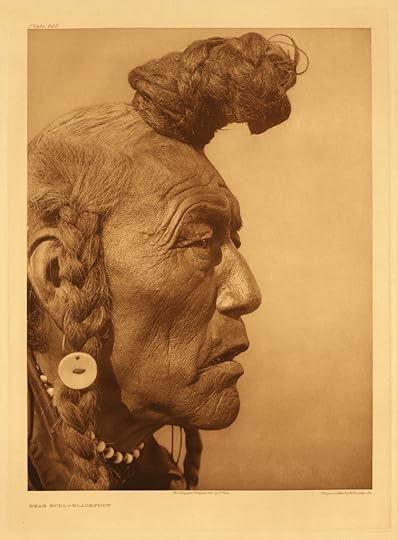
Bear Bull - Blackfoot
Mod
Today, most people on Earth consume food that they produced themselves or that someone else produced for them. At current rates of change, within the next decade the few remaining bands of hunter gatherers will abandon their ways, disintegrate, or die out, thereby ending our millions of years of commitment to the hunter-gatherer lifestyle.
I am curious why Diamond feels that even in the most remote places that hunter gatherers will eventually die out. Is it because civilization will need more land and will encroach upon these last vestiges of hunter gatherers no matter where they happen to be? Will global warming and climate change make it impossible for these hunter gatherers to acquire food? Or will they yearn for some other form of life which will force them to abandon theirs?
message 11:
by
Bentley, Group Founder, Leader, Chief
(last edited Sep 28, 2010 07:52AM)
(new)
-
rated it 3 stars
Mod
But I was surprised (and I am not sure why) that Aboriginal Australians, never acquired it at all.
I was just reading that the Aboriginal Australians really respected the land and thought that spirits lived in the land itself. Possibly a reason for their not disturbing it.
A site about the Aboriginal Australians (then and today):
http://www.crystalinks.com/aboriginal...
And this year - an interesting article about the plight of today's aborigines in Australia:
Australia’s new Aboriginal policy falls short of expectations
http://worldfocus.org/blog/2010/02/15...
message 12:
by
Bentley, Group Founder, Leader, Chief
(last edited Sep 28, 2010 07:59AM)
(new)
-
rated it 3 stars
Mod
Hence geographic variation in whether, or when, the peoples of different continents became farmers and herders explains to a large extent their subsequent contrasting fates.
So I guess what Diamond is insinuating is the earlier a group became farmers and herders; the sooner their lives would become better overall and their fate would improve for them and for their future generations. I guess he is also saying that the other folks who rejected this type of progression were doomed: doomed with the onslaught of guns, germs and steel from the others.
Do you agree or reject Diamond's assertion? Why and/or why not?
message 13:
by
Bentley, Group Founder, Leader, Chief
(last edited Sep 28, 2010 08:13AM)
(new)
-
rated it 3 stars
Mod
The First Connection:
The first connection is the most direct one: availability of more consumable calories means more people.
Diamond states that as a result of growing even a few species of plants and animals that we eat so that they constitute 90 percent rather than 0.1 percent of the biomass on an acre of land, we obtain far more edible calories per acre.
As a result, one acre can feed many more herders and farmers - typically, 10 to 100 times more - than hunter gatherers.
This led to what Diamond called one of many "military advantages" that the producing tribes gained over hunter-gatherer tribes.
Resulting in "the strength of brute numbers".
Going along with this way of thinking and that there is the strength of brute numbers - China's population is staggering compared to other countries. Is that something we should worry about in today's civilized world? Are numbers of people a worry or does military might more dependent upon technology and other weaponry, etc. China is an interesting dynamic given Diamond's statement about human societies.
message 14:
by
Bentley, Group Founder, Leader, Chief
(last edited Sep 28, 2010 09:27AM)
(new)
-
rated it 3 stars
Mod
Two parts: (with Banjo Clarke) - He has since passed away.
Part I: (very interesting man and story)
http://www.youtube.com/watch?v=C3WT1k...
Part II:
http://www.youtube.com/watch?v=zQE-8o... (playing the didgeridoo)
Also,
Didgeridoo - Jeremy Donovan, Aboriginal Artist
http://www.youtube.com/watch?v=9g592I...
A little about him: (Banjo Clarke)
http://www.wisdommanbook.com/banjo.html
http://www.suite101.com/content/banjo...
 by Camilla Chance
This is a long podcast with Camilla Chance; the author of Wisdom Man and who became friends with Banjo Clarke.
http://www.blogtalkradio.com/onlinewi...
Description of Program:
5/11/2010 7:30 PM - 2 hrs 30 min
Description:
Author Camilla Chance goes onlinewithandrea Live from Australia to share the compassionate life and beliefs of the remarkable Aboriginal Elder Wisdom Man Banjo Clarke. Hosted by Andrea R. Garrison.
 Bently, thank you again for the great background, it's really adding to the experience. I will take a shot at the three asked questions.
What was your impression of Levi, one of the Farmhands from the Blackfoot Indian tribe, and the fact that he blurted out one night; "Damn you, Fred Hirschy, and damn the ship that brought you from Switzerland!"
There are a lot of immediate emotions that raise up. It appears that Levi is being ungrateful, shortsighted and other disrespectful terms. I think I then realized that I will never fully be able to understand Levi's point of view. I can empathize, but I don't have the same experiences of Levi to explain his outburst. I think my thoughts would trend towards the fact that Levi's anger is holding him back and he now has some simple choices. Keep the grudge alive or move on. One appears destructive to Levi's independence the second is destructive to his very identity.
Do you sympathize with the Native Americans who had been robbed of their lands by an immigrant white farmer like Fred?
I very much sympathize with the Native Americans. However, I will put forth an idea that may come across different than intended. My concern still is with this book that the author does give the impression that events that unfolded during a different time period should be judged under modern day attitudes, morality and mentality. This is not to overlook the impact of the events. However, we can either chose to learn from these events or be stuck in the morass of hatred.
And how did these brand new farmers win out over the famous warriors from Levi's tribes?
I think one aspect that has been overlooked somewhat is not only the effectiveness of food production, but efficiency of the economic system as well. Food production not only allowed greater population survival and caloric intake. It also generated wealth. Wealth that could be used to purchase superior weapons, medical care and shelter.
Thank you again for the added postings.
Mod
As far as your response about Levi, I think you have hit the nail on the head. Levi is the one who had choices to make now. He has been dealt a hand and he has to play it.
Very true words about the past not polluting the present and ultimately the future. It is always best to face the day just as it is without bringing in the winds and baggage of the past.
Excellent take on food production as well; it gave folks a way to a better life.
And of course you are welcome. Thank you for your post.
Mod
I want to place some of the questions that we still need to focus on in this thread as well. This is the post from last week's thread:
These are the questions which we should have answered and discussed in last week's discussion. However, one of the questions is really answered throughout the book. I will place these first four questions once more at the beginning of this thread so that we can continue to discuss these.
Here they are:
1. What are the other commonly espoused answers to "Yali's questions," and how does Jared Diamond address and refute each of them?
2. Why does Diamond hypothesize that New Guineans might be, on the average, "smarter" than Westerners?
3. Why is it important to differentiate between proximate and ultimate causes?
4. Do you find some of Diamond's methodologies more compelling than others? Which, and why.
Additionally,
I believe that in Chapters Two and Three we can begin to start discussing the answers to a few more, specifically the following:
5. What is the importance of the order of the chapters?
Why, for example, is "Collision at Cajamarca" - which describes events that occur thousands of years after those described in the subsequent chapters - placed where it is?
6. How are Polynesian Islands "an experiment of history"? What conclusions does Diamond draw from their history?
7. How does Diamond challenge our assumptions about the transition from hunter-gathering to farming?
Although some of these we can continue to add to as we go through the chapters. I am posting them here to keep these foremost in our mind and please feel free to add more detail to any of them and/or post some other questions or comments you may have.
message 18:
by
Bentley, Group Founder, Leader, Chief
(last edited Sep 30, 2010 06:51PM)
(new)
-
rated it 3 stars
Mod
The Collision in 1532 was the clash of the old world and the new world and it had been a long time coming.
Diamond is really asking us to consider "why was the balance of power so uneven between the old world and the new world?"
And "why were the Europeans - the ones who conquered so much of the globe?" With the placement of the collision where he placed it in relationship to the order of the chapters themselves, Jared Diamond shows us an event and then flashes back to focus on the proximate and ultimate causes of this event and ones that were similar.
message 19:
by
Bentley, Group Founder, Leader, Chief
(last edited Sep 30, 2010 06:56PM)
(new)
-
rated it 3 stars
Mod
8. How is farming an "auto-catalytic" process? Hows does this account for the great disparities in societies, as well as for the possibilities of parallel evolution?
message 20:
by
Bentley, Group Founder, Leader, Chief
(last edited Oct 01, 2010 04:50AM)
(new)
-
rated it 3 stars
Mod
First, Diamond is beginning to make the case that what separates the losers from the winners is the land itself - geography!
Second, it was even the shape of the land as well as its animals and crops which allowed some cultures to flourish while other cultures were left behind.
What do you think of these two basic premises at this juncture now that we are about a third of the way into the book? We can re-evaluate these theories as we move along and gain more information from Diamond.
message 21:
by
Bentley, Group Founder, Leader, Chief
(last edited Oct 01, 2010 07:41AM)
(new)
-
rated it 3 stars
Mod
I am sure that there are some who are reading Diamond's assessment and wondering - is this just another guy trying to make money off of yet another half baked theory? I have decided that whether you want to agree with Diamond or not, it is painfully obvious that he is making sense and has the goods to back himself up.
I guess that when I started reading this book I never realized the impact that organized farming had on the development of mankind, its culture, and its ability to succeed.
Even now in the book, one can see that Diamond is building his case that farming and the organization that it brought transformed the human race from hunter-gatherers into how we function even to this day.
It is really hard to imagine how a simple scenario of tools, plantings, a plow, large animals and a desire to mass produce food actually set the stage for the globalized, technological envirnoment we live in?
What are your thoughts so far about the spreading of seed, movement of plantable crops, and farming in general?
Also, man's appearance has changed since prehistoric times and the stone age; what changes in appearance do you think will occur over time. Do you think our ears will change because we use ear plugs and cell phones; will they get larger? Our stature, bone structure and the like have become so much larger than even our founding fathers for the most part. Is that the result of nutrition or evolution and/or both? Do you think our hands and fingers will change in some way because of all the texting and computer work we do; will our eyes become bigger and stronger in order to do more close work? This book really opens your mind to all sorts of changes on the horizon. What do you think the impact of the environment, the tools we use, our hobbies, the food we eat will have on our bodies and future appearance? Or do you feel like some scientists that we have evolved about as far as we will go?
 One of the questions I come back to is the evolution of the ruling class from the "non-food specialists" that emerge out of a settled, agricultural existence.
From chapter 4: "A separate consequence of a settled existence is that it permits one to store food surpluses, since storage would be pointless (if everyone was committed,full-time to procuring food and no one remained) nearby to guard the stored food... Hence nomadic hunter gatherer societies have few or no such full-time specialists, who instead appear in sedentary societies.
"Two types of such specialists are kings and bureaucrats. Hunter-gatherer societies tend to be relatively egalitarian, to lack full-time bureacucrats and hereditary chiefs, and to have small-scale political organization at the level of the band or tribe. That's because all able-bodied hunter-gatherers are obliged to devote much of their time to acquiring food. In contrast, once food can be stockpiled, a political elite can gain control of food produced by others, assert the right of taxation, escape the need to feed itself, and engage full-time in political activities. Hence moderate-sized agricultural societies are often organized in chiefdoms, and kingdoms are confined to large agricultural societies. Those complex political units are much better able to mount a sustained war of conquest than is an egalitarian band of hunters...
"A stored food surplus built up by taxation can support other full-time specialists besides kings and bureaucrats. Of most direct relevance to wars of conquest, it an be used to feed professional soldiers... Stored food can also feed priests, who provide religious justification for wars of conquest; artisans such as metalworkers, who develop swords, guns, and other technologies; and scribes, who preserve far more information than can be remembered accurately."
My initial question was how the non-food specialists become rulers and when they become artisans. I assume Diamond comes back to this later in the book, but for now he suggests surplus yields bureaucrats before artisans, almost as if the process proceeds in the following way:
Surplus leads to bureaucrats who distribute resources to emerging artisans, who roll innovations into more efficient/improved food production and martial conquest.
Isn't a more efficient model:
Surplus makes possible innovations to improve food production which introduces the need for increased central leadership to preserve the groups interest and expand its territory.
In other words, it seems like the immediate need for bureaurats could be short-circuited. The fact that it isn't is suggestive of at least two possible explanations:
1. The easiest way to increase food yield is actually to increase territory, not improve technology. The shortest route to surplus is to take extant resources from others. Then when territorial stasis is achieved, the task of optmizing territory for crop yield can begin in earnest.
2. There's something inherent in human sociology that needs a leader caste to drive the progress of the group. I think this idea is so simple that it strains credulity (how likely is it that the answer is actually so simple?), but nevertheless has compelling evidence. Few primate societies are purely egalitarian. Someone in an earlier thread discussed the behavior of macaques of India and baboons of Kenya. I think it's interesting that, of all the primates I can call to mind, only bonobos resolve conflict peacefully.
Of course, if primatology isn't a compelling proof, look at the recent political disposition of Mayor Yuri Luzhkov of Moscow. Luzkov was a classic figure in Russian social pathology: the khozyain. Luzhkov is one of a long line of a classic type patrician, running more or less intact from Ivan through Stalin through Putin - down and out, including smaller potentates like Luzhkov. Presuming this isn't a wholly recent phenomenon, this social tendency to rely on a strong patrician may have effected the neolithic people Diamond studies as well.*
Regardless of whether the bureaucrat can be short circuited, Diamond places a strong emphasis on the immediate appearance of warfare following agriculture. The book is titled, Guns, Germs, and Steel, after all. I look forward to later chapters, where I presume the author talks more about why warfare is so apparently inevitable.
*Cited:

 David E. Hoffman
Mod
David E. Hoffman
Mod
Yes, unfortunately everybody had to duke it out macho style like primitive animals. And unfortunately that seems to be where Diamond is headed. We had the foreshadowing with the story of Pizarro and the poor Incas. Guns, germs and steel seem to be three end results of organized agriculture.
Good post Patrick. And thank you for the citation of Hoffman's book.
Bentley (emphasis mine): "I imagine that the surplus led to some sort of tension in the group and a mini power struggle which ended up in somebody being in charge in order ostensibly to protect everybody's interests. Of course, then a grab for power occurs by the "overseer" and whether he intended this to begin with (maybe even he does not know) - we see the budding development of our first bureaucratic government."That's very interesting. The "whether he intended/knew or not" part is in keeping with Diamond's overall complimentary compatibility with human societies' following the basic evolutionary model of On the Origin of Species .* The emergence of bureaucracy is a process of natural selection that is preferred before democracy because of environmental realities.
Good insight.
*

 Charles Darwin
message 25:
by
Bentley, Group Founder, Leader, Chief
(last edited Oct 02, 2010 06:21PM)
(new)
-
rated it 3 stars
Mod
But you are correct that natural selection probably played a part in this. They might have chosen the strongest, biggest, most clever person in their group. A person who looked like they could protect the wheat or whatever the crop.
Of course, then the unintended recipient of this new "position" then figures out for himself that he likes this new power.
And yes, then our first bureaucracies began.
BTW: thank you for the add.
How does Diamond challenge our assumptions about the transition from hunter-gathering to farming?I believe one of the assumptions has always been that animals were hunted until they were extinct and then there was no other choice but to move towards farming.
While the author does present evidence that in certain areas, large animals were hunted to extinction, overall the trend toward farming evolved separately of this fact.
One other aspect that has been coming to my mind is did farming emerge as brain power and knowledge expanded? If someone was not an effective hunter, could he not focus on whatever was necessary to survive? This would help explain the questions raised in some of the threads that on average the first farmers were not as well fed or healthy as the hunters. However, as time went on, their knowledge grew and we start to see some of the dominance these chapters have explained.
message 27:
by
Bentley, Group Founder, Leader, Chief
(last edited Oct 01, 2010 07:51PM)
(new)
-
rated it 3 stars
Mod
I am not sure that brain power and knowledge had much to do with it; in fact, Diamond seems to focus on the fact that the New Guinea tribesmen (who were hunter gatherers) were among the most intelligent. From what Diamond stated, it was not the ineffectiveness of hunting which led to agriculture; but more a focus on the land itself and geography. In fact, Diamond even focuses on the shape of the continents themselves.
Sometimes hunter gatherers did a bit of farming too; but their lifestyle was much more mobile than an agrarian society. I am not sure that Diamond alluded to any problems in supply. Diamond did mention however that from agriculture certain yields and certain crops had a much higher protein level which would lead to better nutrition in the long run.
I may be mistaken but I believe that Diamond was focusing on being able to gain a higher yield from their efforts through tools such as plows and the help of large animals.
But you do raise some interesting points.
I think there's a chicken and the egg quandary between game animal extinctions and a society's permanent move to agrarianism. In the case of Mesopotamia, the principle game animal for most of human prehistory was the gazelle. Man did not domesticate the gazelle (out of respect to the no-spoilers rule, I'll leave it at that). But there used to be a lot of them and now they're gone.
(A) Did humans expend all the available hunting stock before investing the energy to domesticate agriculture? (B) Or did a simultaneous move toward agriculture reduce the gazelle's range, thus stressing the species toward eventual extinction? (C) Or was there a "eureka" moment when the humans decided it was no longer worth chasing gazelles at all - ramping up agricultural production so quickly that gazelle populations were quickly driven away or killed preemptively to inhibit their grazing?
The lesson I am learning from Diamond is to go with the hybrid answer: "B." What do you guys think?
message 29:
by
Bentley, Group Founder, Leader, Chief
(last edited Oct 02, 2010 04:46PM)
(new)
-
rated it 3 stars
Mod
It is possible that the grazing land was taken over for agriculture. They would panic easily.
Remember Patrick there are the spoiler threads that I identified before if you want to pursue a side and more expansive discussion.
And in many cases the hybrid answer can and will work.
The potential to spoil was very limited, or else I would have taken the koan elsewhere. Diamond mentions Mesopotamian gazelle explicitly in the "Zebras and Unhappy Marriages" chapter - but doesn't give the reason for their extinction. However, Diamond does talk about land animal extinction (and the presumed link to human predation) in an earlier chapter when he discusses the major debates over the disappearance of pleistocene megafauna in North America. Since all previous chapters are fair game in this thread, I believe I am in compliance with the rules of engagement.Even though Diamond covered this a couple of chapters back, I keep thinking back to the question of Clovis hunting on North American land animal populations. Since I am not a paleontologist or zoologist, I have no urgent need to know exactly how the mass extinction went down. For casual purposes, I am completely comfortable with Diamond's conviction that if humans didn't personally kill the pleistocene animals, their rise was concomitant with the others'decline. But there are some nagging points that don't neatly tie up if one follows the logic to its natural conclusion (that we should just simplify and assume humans were the direct cause).
1. Diamond points out in chapter four that"nomadic hunter-gatherers may occasionally bag more food than they can consume in a few days, (but) such a bonanza is of little use to them because they cannot protect it." This calls into question the practice of hunting mammoths, rhinoceroses, and sloths.
But we know Clovis people hunted these animals because tools and cuts are found among the bones discarded at cook sites. With so many smaller game animals supposedly available (horses, camels, deer, even the less dangerous bison), it seems very strange that human groups would risk so many valuable personnel on a mammoth hunt. Then, a society without wheels existing in a big range, across varied terrain, has issues bringing the kill back to the group to eat. The amount of spoilage inevitable in a big kill suggests mega game like mammoths would have been resorted to only in times of duress.
2. Then there is the issue that big predators also went extinct. Clovis people could have eaten saber tooth cat and dire wolf for food - there's no rule saying not to - but danger would have been a significant deterrent. Still, it's no mystery why wolves and cats went extinct - game populations were diminishing, presumably to human predation.
There's a problem with this though. What about bears? A prominent species of bear, the arctodus, went extinct at approximately the same time as the other pleistocene megafauna. Human predation seems unlikely, for the same danger inhibitors affecting lion and wolf hunting. And the idea of competition for game is less compelling, since bears don't necessarily eat the same things as human hunter-gatherers. At the very least, they exploit niches with different emphases and can theoretically coexist (as evidenced by the survival of the other North American bear species).
3. The chicken and egg quandary I described in message #28 doesn't quite apply either, as California is one of the places Diamond makes a point of repeatedly visiting as an anomalous "dead zone" where humans didn't make the great leap forward to agricultural revolution. The horses, camels, rhinos, sloths, mammoths, cats, wolves, and bears of North America didn't get squeezed like a Mesopotamian gazelle by expanding pastureland.
I suppose what I'm saying is that the idea that humans played the angel of death to so many extant species upon arrival in new environments or extensive manipulation of the environment doesn't completely wash with me. And it isn't just avoiding some deep form of "liberal guilt" driving this skepticism either. I don't think the appearance of humans at the precise time animal populations went into decline is a total coincidence - probably the factors that made the environment less hospitable to some species made it more hospitable to others. When the end of one era coincides with the beginning of a human epoch, we probably assume humans were the catalytic element.
This line of thinking probably causes us to think that the disappearance of a species means we hunted it to extinction, then without any other recourse trusted our fate to agriculture. In all probability, the two things (extinction, agriculture) were happening simultaneously and fairly independently of one another.
message 31:
by
Bentley, Group Founder, Leader, Chief
(last edited Oct 03, 2010 07:39AM)
(new)
-
rated it 3 stars
Mod
Your post really examines these issues well. Good post and very interesting.
 Bentley wrote: "My take would be a) NO and the gazelles are darn fast; try to catch one on foot (smile) - don't think they had all terrain vehicles at that time either (smile).
It is possible that the grazing lan..."
The mid-east is full of large funnel shapes that were used as gazelle traps. You get the women, kids and dogs to drive the gazelle herds into the wide mouth of the trap and then the men could spear or shoot them as they came out the narrow end. You don't have to run them down that way.
Mod
Bentley wrote: "There is a posting that I made awhile back and I will try to find it that indicates that there was a line of ash found above the remains of these extinct animals, tools, etc. If that is the case, ..."the latest I've been seeing on that says the evidence is not there for any wide ash layer.
Patrick wrote: "The potential to spoil was very limited, or else I would have taken the koan elsewhere. Diamond mentions Mesopotamian gazelle explicitly in the "Zebras and Unhappy Marriages" chapter - but doesn't..."I agree that the transition had to be gradual. Those of us who have tried to eat wheat straight out of the field know it isn't all that great. There had to be a lot of technique and technology developed to rely on it as a food source. I'm sure the wild food was treated as a seasonal food like berries for many a century.
Mod
Good info Patricrk.
Mod
Patricrk, when you present an opposing view (and we welcome all views in any discussion) could you provide a source for your opposing opinion and a link to the source possibly. When we cited the source, originally we provided the link as well. It is good to cite your sources and provide links; that way folks can make up their mind accordingly and they have the links at hand.
 But we know Clovis people hunted these animals because tools and cuts are found among the bones discarded at cook sites. With so many smaller game animals supposedly available (horses, camels, deer, even the less dangerous bison), it seems very strange that human groups would risk so many valuable personnel on a mammoth hunt. Then, a society without wheels existing in a big range, across varied terrain, has issues bringing the kill back to the group to eat. The amount of spoilage inevitable in a big kill suggests mega game like mammoths would have been resorted to only in times of duress.
First of all I feel the need to remind everyone the inventory of animals in pre-Columbian America did not include horses or camels. Each of these animals was introduced by Europeans.

 Kenneth Thomasma Is a great kids book about the introduction of horses to the Blackfoot tribes of Western Montana. One of those classic children's history series (Landmark?) has a book about the army cavalry office who tried to introduce camels to Texas, and I can't remember or find it.
 Second there are several ways to preserve meat that also make it easier to carry. (This is a weakness of Diamond's argument.) Drying and smoking meat, and drying fruits and vegetables are both ancient preservation methods which because they remove the water from the product make it lighter and easier to carry. In my region of the country local Native Americans make pemican a mixture of meat and fruit and suet -- trust me though, unless you're a Native American eating for nostalgic reasons ediblility doesn't really enter into it.
Another thing about food that we in our industrial food society don't remember very well is the seasonality of food. When the particular food comes into season you eat it, you eat it in everything, you eat it three meals a day, you eat in unitl you could happily never see it again, and then when it's gone you remember it fondly and wait eagerly until it's in season again. Personally, I like the apple season, my mom lives for the strawberry season and my dad likes the stonefruit season.
If you're a band of hunters and you kill a big beast you eat the most tender parts right away. North American Indians would eat the liver at the scene, as it comes. Then you would eat the tenderloin that night, well-roasted and the juice running down your chin. Then you would smoke or dry or dry-smoke everything else. Then you would eagerly await the next fresh meat. You also don't bring the animal to camp. You're a nomadic group. You bring the camp to the kill.
I agree that the transition had to be gradual. Those of us who have tried to eat wheat straight out of the field know it isn't all that great. There had to be a lot of technique and technology developed to rely on it as a food source. I'm sure the wild food was treated as a seasonal food like berries for many a century.And you would travel yearly to your favorite (secret) berry patch.
In my area of America the local Native Americans would travel annually to the camas region and harvest the root. It's a root that is fairly dry and light to carry, high in carbs and protein and preservable either dried alone, or combined with meat in pemican.
My high school spanish teacher took vacation for camas season and brought us back some. She said that you never harvest all the camas, you always leave some. So even nomadic non-agraian culture can have a small idea about growing food.
I think that in some areas with some foods eventually nomadic people rather than returning once a year to harvest what might happen would settle next to a reliable wild source and protect it. Keeping others away, and maybe adding water. This would eventually develope into established feilds and agriculture if the plants needed more help to grow than camas. Camas didn't develop this way. Local Indians use, and used, it as a chance to meet and have a big party.
"First of all I feel the need to remind everyone the inventory of animals in pre-Columbian America did not include horses or camels. Each of these animals was introduced by Europeans."Both horses and camels were present in North America as late as the end of the last ice age, which is when the Clovis people are believed to have migrated to North America. It is important to point out that North American horses were smaller than the Eurasian horses we immediately think of when we hear the word "horse" today. And North American camels were very different than dromedary and bactrian camels.
North American horse and camel species died off in the mass exinction/extermination at the end of the pleistocene and were reintroduced only in modern times by European colonists.
The Smithsonian National Museum of Natural History has numerous fossils of both on display, for anyone who has the chance to visit DC. I was struck by the size of the native North American varieties, which are akin to deer or large dogs.
But don't take my word for it,read for yourself.
Shannon wrote: "But we know Clovis people hunted these animals because tools and cuts are found among the bones discarded at cook sites. With so many smaller game animals supposedly available (horses, camels, deer..."http://www.flmnh.ufl.edu/fossilhall/l... American camels (Llamas) go extinct in North America at the same time the other large species do, around 11,000 years ago. http://en.wikipedia.org/wiki/Evolutio... Horse are present in North America until the same time. I agree with everything else in your post.
message 42:
by
Bentley, Group Founder, Leader, Chief
(last edited Oct 07, 2010 10:15AM)
(new)
-
rated it 3 stars
Mod
This is a non spoiler thread and even though you see no harm done, we of course feel differently.
Thanks for your understanding. The post has been moved to the Glossary thread.
And by the way...all of us at times get carried away even the moderators. It is the excitement of the discussion (smile).
message 43:
by
Bentley, Group Founder, Leader, Chief
(last edited Oct 07, 2010 09:32AM)
(new)
-
rated it 3 stars
Mod
Shannon, you raise a good point which was evidenced by the archaelogical findings which unearthed the Clovis points to begin with.
They are always found for the most part with the bones of their kill. They obviously did a lot of eating there and did not recapture their weapon or their point while preparing their food back at any camp.
message 44:
by
Bentley, Group Founder, Leader, Chief
(last edited Oct 07, 2010 09:41AM)
(new)
-
rated it 3 stars
Mod
So remember to go to the Book as a Whole thread and you can knock yourself out with expansive and Spoiler discussions and everybody will be happy or the Glossary thread.
But here you have to be careful and non spoiler comments will be moved to those threads. And if you recognize at some level to begin with that you have a spoiler segment in your post -either eliminate that segment and/or just post it in the glossary or the Book as a Whole thread. It will always be moved otherwise unless the spoiler segment is deleted (which we cannot do). The majority of you are doing great and making the necessary citations of outside sources while at the same time staying within the reading material's framework for this week's syllabus and/or any of the chapters which have come before. That means that the Prologue and chapters 1, 2 and 3 are also fair game here. But not for example anything from 7, 8 and 9.
Good citations Patricrk; thank you for the source citations.
Also, with any book we do; we must respect the author and the work itself. I have not found that not to be the case but I feel it is worth mentioning.

The History Book Club
Books mentioned in this topic
Om-Kas-Toe: Blackfeet Twin Captures an Elkdog (other topics)The Origin of Species / The Descent of Man (other topics)
The Oligarchs: Wealth and Power in the New Russia (other topics)
Wisdom Man (other topics)
Guns, Germs, and Steel: The Fates of Human Societies (other topics)
Authors mentioned in this topic
Kenneth Thomasma (other topics)Charles Darwin (other topics)
David E. Hoffman (other topics)
Camilla Chance (other topics)
Jared Diamond (other topics)

For the week of September 27th through October 3rd, we are reading approximately the next 30 pages of Guns, Germs and Steel.
This thread will discuss the following Chapters and pages (it opens up on Sept 27 or the evening of the 26th):
Week Three - September 27th - October 3rd -> Chapters FOUR, FIVE and SIX p. 83 - 113
FOUR – Farmer Power and FIVE – History’s Haves and Have-Nots and SIX – To Farm or Not To Farm
We will open up a thread for each week's reading. Please make sure to post in the particular thread dedicated to those specific chapters and page numbers to avoid spoilers. We will also open up supplemental threads as we have done for other spotlighted reads.
We kicked everything off on September 12th. We look forward to your participation. Amazon, Barnes and Noble and other noted on line booksellers do have copies of the book and shipment can be expedited. The book can also be obtained easily at your local library, on iTunes for the ipad, etc. However, be careful, some audible formats are abridged and not unabridged.
There is still remaining time to obtain the book and get started.
There is no rush and we are thrilled to have you join us. It is never too late to get started and/or to post.
Welcome,
~Bentley
Week of September 27th - October 3rd
Week Three - September 27th - October 3rd -> Chapters FOUR, FIVE and SIX p. 83 - 113
FOUR – Farmer Power and FIVE – History’s Haves and Have-Nots and SIX – To Farm or Not To Farm
This is a link to the complete table of contents and syllabus thread:
http://www.goodreads.com/topic/show/3...
We are off to a good beginning.
TO SEE ALL WEEK'S THREADS SELECT VIEW ALL