Goodreads helps you follow your favorite authors. Be the first to learn about new releases!
Start by following Rana Mitter.

Showing 1-6 of 6
“If we wish to understand the role of China in today's global society, we would do well to remind ourselves of the tragic, titanic struggle which that country waged in the 1930s and 1940s not just for its own national dignity and survival, but for the victory of all the Allies, west and east, against some of the darkest forces that history has ever produced.”
― China's War with Japan, 1937-1945: The Struggle for Survival
― China's War with Japan, 1937-1945: The Struggle for Survival
“Contemporary China is thought of as the inheritor of Mao’s Cultural Revolution, or even of the humiliation incurred by the Opium Wars of the nineteenth century, but rarely as the product of the war against Japan.”
― Forgotten Ally: China's World War II, 1937-1945
― Forgotten Ally: China's World War II, 1937-1945
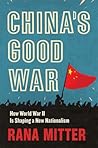
“China is the major Allied belligerent whose position on the meaning of the war has shifted most thoroughly during the postwar era.”
― China’s Good War: How World War II Is Shaping a New Nationalism
― China’s Good War: How World War II Is Shaping a New Nationalism
“If [the Allies] open a second frontline, Germany will definitely lose.” Zhou was prescient: the battle was indeed the turning point, when the Soviet Union began to turn back the Nazi invasion. Yet Zhou still believed that there might be a place for a Japanese-dominated sphere in the postwar world. Rightly suspecting that the Americans and British did not really trust the USSR, he thought they might try and prop up Japanese power to contain the Soviets: “They’ll still allow Germany a certain level of power so as to contain the USSR. Otherwise the whole of Europe and Asia will all be controlled by the Soviet Union . . . so the US, Britain, Germany, and Japan will all have to compromise to face the USSR.”4”
― Forgotten Ally: China's World War II, 1937-1945
― Forgotten Ally: China's World War II, 1937-1945
“This book argues that a very useful concept for understanding how collective memory flows across both time and space is that of circuits of memory. This idea is distinct from Henry Rousso’s conception of “vectors” of memory, which describes institutions and entities that help transmit memory across time; the circuit transmits memory geographically, across national borders, as well as chronologically. Collective memory of war, or of any historical event, is rarely truly global. During the long postwar, several different circuits have emerged in which certain experiences, understandings, and judgments of the Second World War are shared (such as a core purpose of the war being to fight fascism), but the memories within them are distinct and self-contained. One such circuit exists in northwestern Europe and North America, another in Russia and some of its neighbors, a third in Japan, and a fourth in China.”
― China’s Good War: How World War II Is Shaping a New Nationalism
― China’s Good War: How World War II Is Shaping a New Nationalism
“Since 1945, the United States has supported a liberal international order underpinned by a variety of international institutions intended to strengthen military and economic security. The United States has violated the liberal values underlying that order on frequent occasions, most notably in Asia and Latin America, but these same values did become norms that could then be used to criticize such behavior.”
― China’s Good War: How World War II Is Shaping a New Nationalism
― China’s Good War: How World War II Is Shaping a New Nationalism