Goodreads helps you follow your favorite authors. Be the first to learn about new releases!
Start by following Erin Moore.

Showing 1-12 of 12
“E. B. White explained it well: To foreigners, a Yankee is an American. To Americans, a Yankee is a Northerner. To Northerners, a Yankee is a New Englander. To New Englanders, a Yankee is a Vermonter. And in Vermont, a Yankee is somebody who eats pie for breakfast.”
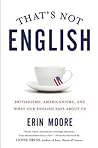
― That's Not English: Britishisms, Americanisms, and What Our English Says About Us
― That's Not English: Britishisms, Americanisms, and What Our English Says About Us
“Americans are sociable and approval-seeking. They look for common ground with others and genuinely want to connect.”
― That's Not English: Britishisms, Americanisms, and What Our English Says About Us
― That's Not English: Britishisms, Americanisms, and What Our English Says About Us
“The Americans have been obliged to invent a new verb for which we have no use over here—‘to enthuse.’ Why don’t we enthuse? And why, if we do conjugate this verb in secret, are we so afraid to let it be known? . . . We fear terribly to encourage ourselves or others. The people over there are not afraid. They let themselves go individually and independently over what they like or admire, and pour forth torrents of generous praise which we should shrink from voicing unless we were quite sure that everybody else agreed with us, or unless the object of our admiration had been a long time dead.” The English may detect a note of condescension here, but an American won’t.”
― That's Not English: Britishisms, Americanisms, and What Our English Says About Us
― That's Not English: Britishisms, Americanisms, and What Our English Says About Us
“words like rapscallionly, conbobberation, and helliferocious. Such words seem outlandish today only because of their unfamiliarity. Whether or not they were widely used in the Wild West, they made Americans seem badass.”
― That's Not English: Britishisms, Americanisms, and What Our English Says About Us
― That's Not English: Britishisms, Americanisms, and What Our English Says About Us
“A majority of both Americans and English people describe themselves as middle-class. However, as we have seen, just because they use the same words doesn’t mean that Americans and the English are thinking the same way. In America, the middle class is more an economic category than a state of mind, and membership in it is not predicated on as many complicated and specific class markers. Where Americans shop, what they buy, and how they entertain themselves are only mild predictors of whether they will identify as middle-class. The same is not true in England, where membership in the middle class is more dependent upon being the product of specific types of families and schools, and the shared tastes that one develops as a result.”
― That's Not English: Britishisms, Americanisms, and What Our English Says About Us
― That's Not English: Britishisms, Americanisms, and What Our English Says About Us
“In English English, quite means “rather” or “fairly,” and is a subtle way of damning with faint praise. To an American, quite simply means “very,” and amps the adjective. No subtlety there.”
― That's Not English: Britishisms, Americanisms, and What Our English Says About Us
― That's Not English: Britishisms, Americanisms, and What Our English Says About Us
“The English are great snafflers. To snaffle is to eat something quickly, and sometimes without permission. Snaffling is what you do with the last brownie in the breakroom, or the chocolate-covered biscuits that you bought “for the children.” Snaffling is to the kitchen cabinet what foraging is to the wilderness.”
― That's Not English: Britishisms, Americanisms, and What Our English Says About Us
― That's Not English: Britishisms, Americanisms, and What Our English Says About Us
“A snowy winter is an anomaly, though famously, in 1991 after a snowstorm that halted most of British Rail’s trains, they put out a press release blaming the disruption on “the wrong kind of snow”—a phrase that has since become a British metonym for bullshit excuses.”
― That's Not English: Britishisms, Americanisms, and What Our English Says About Us
― That's Not English: Britishisms, Americanisms, and What Our English Says About Us
“the future is something which everyone reaches at the rate of 60 minutes an hour, whatever he does, whoever he is.”
― That's Not English: Britishisms, Americanisms, and What Our English Says About Us
― That's Not English: Britishisms, Americanisms, and What Our English Says About Us
“What is an American interlocutor to do? Look no further for advice than Debrett’s, the self-proclaimed “trusted source on British social skills, etiquette and style . . . originally founded as the expert on British aristocracy.” Debrett’s warns against mistaking understatement for underreaction: “read between the lines and you’ll find the missing drama and emotion.”
― That's Not English: Britishisms, Americanisms, and What Our English Says About Us
― That's Not English: Britishisms, Americanisms, and What Our English Says About Us
“Philip Thody explains in Don’t Do It! A Dictionary of the Forbidden,”
― That's Not English: Britishisms, Americanisms, and What Our English Says About Us
― That's Not English: Britishisms, Americanisms, and What Our English Says About Us
“avoid food products that make health claims.”
― That's Not English: Britishisms, Americanisms, and What Our English Says About Us
― That's Not English: Britishisms, Americanisms, and What Our English Says About Us