Goodreads helps you follow your favorite authors. Be the first to learn about new releases!
Start by following Harry Braverman.

Showing 1-3 of 3
“A class cannot exist in society without in some degree manifesting a consciousness of itself as a group with common problems, interests and prospects - although this manifestation may for long periods be weak, confused, and subject to manipulation by other classes.”
―
―
“The issue here turned on the work content of a day's labor
power, which Taylor defines in the phrase "a fair day's work."
To this term he gave a crude physiological interpretation: all
the work a worker can do without injury to his health, at a
pace that can be sustained throughout a working lifetime. (In
practice, he tended to define this level of activity at an extreme
limit, choosing a pace that only a few could maintain, and
then only under strain.) Why a "fair day's work" should be
defined as a physiological maximum is never made clear. In
attempting to give concrete meaning to the abstraction
"fairness," it would make just as much if not more sense to
express a fair day's work as the amount of labor necessary to
add to the product a value equal to the worker's pay; under
such conditions, of course, profit would be impossible. The
phrase "a fair day's work" must therefore be regarded as
inherently meaningless, and filled with such content as the
adversaries in the purchase-sale relationship try to give it.”
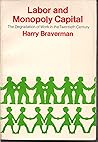
― Labor and Monopoly Capital: The Degradation of Work in the Twentieth Century
power, which Taylor defines in the phrase "a fair day's work."
To this term he gave a crude physiological interpretation: all
the work a worker can do without injury to his health, at a
pace that can be sustained throughout a working lifetime. (In
practice, he tended to define this level of activity at an extreme
limit, choosing a pace that only a few could maintain, and
then only under strain.) Why a "fair day's work" should be
defined as a physiological maximum is never made clear. In
attempting to give concrete meaning to the abstraction
"fairness," it would make just as much if not more sense to
express a fair day's work as the amount of labor necessary to
add to the product a value equal to the worker's pay; under
such conditions, of course, profit would be impossible. The
phrase "a fair day's work" must therefore be regarded as
inherently meaningless, and filled with such content as the
adversaries in the purchase-sale relationship try to give it.”
― Labor and Monopoly Capital: The Degradation of Work in the Twentieth Century
“Scientific management, so-called, is an attempt to apply the methods of science to the increasingly complex problems of the control of labor in rapidly growing capitalist enterprises. It lacks the characteristics of a true science because its assumptions reflect nothing more than the outlook of the capitalist with regard to the conditions of production. It starts, despite occasional protestations to the contrary, not from the human point of view but from the capitalist point of view, from the point of view of the management of a refractory work force in a setting of antagonistic social relations. It does not attempt to discover and confront the cause of this condition, but accepts it as an inexorable given, a “natural” condition. It investigates not labor in general, but the adaptation of labor to the needs of capital.”
― Labor and Monopoly Capital: The Degradation of Work in the Twentieth Century
― Labor and Monopoly Capital: The Degradation of Work in the Twentieth Century