Goodreads helps you follow your favorite authors. Be the first to learn about new releases!
Start by following Roger Ariew.

Showing 1-30 of 61
“As Descartes said to his close correspondent, Marin Mersenne, “I may tell you, between ourselves, that these six Meditations contain all the foundations of my physics. But please do not tell people, for that might make it harder for supporters of Aristotle to approve of them. I hope that readers will gradually get used to my principles, and recognize their truth, before they notice that they destroy the principles of Aristotle” (18 January 1641). The Meditations attempts a complete intellectual revolution: the replacement of Aristotelian philosophy with a new philosophy in order to replace Aristotelian science with a new science. For a 17th-century Aristotelian, a body is matter informed by substantial and accidental forms, and change is explained by the gain or loss of such forms: in mutation by the acquisition of a substantial form, and in what Aristotelians would call true motion (that is, augmentation and diminution, alteration, or local motion) by the successive acquisition of places or of qualitative or quantitative forms. The mechanist program consisted in doing away with qualitative forms and reducing all changes to something mathematically quantifiable: matter in motion. As Descartes said in The World, not only the four qualities called heat, cold, moistness, and dryness, “but also all the others”
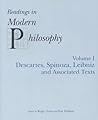
― Modern Philosophy: An Anthology of Primary Sources
― Modern Philosophy: An Anthology of Primary Sources
“Descartes does not champion induction, and, although he advances the corpuscularian or mechanical philosophy to the extent that he reduces physical objects to matter in motion, he makes it clear that he does not accept the reality of atoms as ultimate indivisible constituents of”
― Modern Philosophy: An Anthology of Primary Sources
― Modern Philosophy: An Anthology of Primary Sources
“Indeed, it would not be an exaggeration to state that all of modern philosophy constitutes reactions to and criticisms of Descartes’ Meditations.”
― Modern Philosophy: An Anthology of Primary Sources
― Modern Philosophy: An Anthology of Primary Sources
“(and even all the forms of inanimate bodies) can be explained without the need of supposing for that purpose anything in their matter other than the motion, size, shape, and arrangement of its parts” (The World, Chapter 5). Accordingly, Descartes does not need substantial forms and does not explain mutation as change of form, whether substantial or accidental. He finds no forms other than the ones he has described quantitatively. For Descartes, the only motion is local motion; hence he states, “The philosophers also suppose several motions that they think can be accomplished without any body changing place…. As for me, I know of none except the one which is easiest to conceive …, the motion by which bodies pass from one place to another” (The World, Chapter 7).”
― Modern Philosophy: An Anthology of Primary Sources
― Modern Philosophy: An Anthology of Primary Sources
“remain confined to the particles themselves, their motion will be temporary and their operation will be merely that of heating. But once we arrive at the point of ultimate and maximum dissolution into truly indivisible atoms, light itself may be created, with an instantaneous motion or (I should rather say) an instantaneous diffusion and expansion, capable—I do not know if by the atoms’ subtlety, rarity, immateriality, or by different and as yet unspecifiable conditions—capable, I say, of filling vast spaces.”
― Modern Philosophy: An Anthology of Primary Sources
― Modern Philosophy: An Anthology of Primary Sources
“31. It is idle to expect any great advancement in science from the superinducing and engrafting of new things upon old. We must begin anew from the very foundations, unless we would revolve forever in a circle with mean and contemptible progress. [ … ] 36. One method of discovery alone remains to us, which is simply this: We must lead men to the particulars themselves, and their series and order, while men on their side must force themselves for a while to lay their notions by and begin to familiarize themselves with facts. 37. The doctrine of those who have denied certainty could be attained at all has some agreement with my way of proceeding at the first setting out, but they end in being infinitely separated and opposed. For the holders of that doctrine assert simply that nothing can be known. I also assert that not much can be known in nature by the way which is now in use. But then they go on to destroy the authority of the senses and understanding; whereas I proceed to devise and supply helps for the same.”
― Modern Philosophy: An Anthology of Primary Sources
― Modern Philosophy: An Anthology of Primary Sources
“Nor can man raise himself above himself and humanity, for he cannot see but with his eyes nor grasp except with his grip. He will raise himself if God extraordinarily gives him his hand; he will raise himself, abandoning and renouncing his own means, and letting himself be lifted and sustained by purely celestial ones. <>”
― Modern Philosophy: An Anthology of Primary Sources
― Modern Philosophy: An Anthology of Primary Sources
“The Meditations is one of the great works of philosophy, a seminal treatise for subsequent philosophers. In its compact form it raises most of the problems that they will need to address skepticism, the existence and nature of the self, the existence of God, the possibility of error, the nature of truth— including the truth of mathematics—the essence and existence of bodies, and so forth. The great Cartesian commentator Martial Gueroult described the Meditations as a diptych, a work of art in two panels. He saw the first three Meditations as the first panel, ruled by the darkness of the principle of universal deception, with a battle being fought against it by the truth of the existence of the self—a mere point of light— a narrow but piercing exception to the principle of doubt,”
― Modern Philosophy: An Anthology of Primary Sources
― Modern Philosophy: An Anthology of Primary Sources
“The Apology puts forward in two major moves the thesis that the only proper attitude for a Christian is squarely based on faith, not reason. First, if it is objected to Sebond that he should not be presenting arguments in support of Christianity, it is conceded that these must always be based on the prior acceptance of revelation; if revelation comes first, reason may have a secondary, merely ancillary place. As it is, Montaigne remarks, our acceptance of religion is merely conventional; we need to turn back to living faith as the true source of our beliefs. Second, if objections are raised to Sebond’s arguments themselves, this objection again supports the priority of faith, since nothing our reason produces is of much use in any case. Montaigne proceeds to undermine any claims people may make to any special knowledge, drawing in part from the tropes of Sextus Empiricus, whom he had recently been reading. Ultimately, a thoroughgoing critique of the “knowledge” gained through our senses undermines any claims we might have to any knowledge whatsoever. All our seeming knowledge arises from our five senses. But, first, how do we know there are not other senses we are lacking? Further, the senses we do have constantly deceive us. There are illusions of sense, false opinions induced by passion, dreams very like waking appearances and vice versa. Our senses, again, differ from those of animals; maybe”
― Modern Philosophy: An Anthology of Primary Sources
― Modern Philosophy: An Anthology of Primary Sources
“39. There are four classes of idols that beset men’s minds. To these for distinction’s sake I have assigned names, calling the first class idols of the tribe; the second, idols of the cave; the third, idols of the market place; the fourth, idols of the theater.”
― Modern Philosophy: An Anthology of Primary Sources
― Modern Philosophy: An Anthology of Primary Sources
“For the rest, who can be fit to judge of these differences? As we say of debates about religion, that we need a judge who is not attached to one or the other side, exempt from choice or affection, which is not possible among Christians, so it is likewise in this case.”
― Modern Philosophy: An Anthology of Primary Sources
― Modern Philosophy: An Anthology of Primary Sources
“It seems the soul retreats into itself and smiles at the powers of the senses. And so both the inside and the outside of man are full of weakness and falsehood.”
― Modern Philosophy: An Anthology of Primary Sources
― Modern Philosophy: An Anthology of Primary Sources
“We have fashioned a truth through the consultation and concurrence of our five senses; but perhaps it would need the accord of eight or ten senses and their contribution to apprehend the truth certainly and in its essence. The sects that oppose man’s knowledge do so chiefly through the uncertainty and weakness of our senses: for, since our knowledge comes to us through and by means of them, if they fail in the report they give us, if they corrupt and alter what they bring us from outside, if the light that flows into the soul is obscured in its passage, we have nothing else to hold on to. From this extreme difficulty arise all those ideas: that every subject has in itself everything we find in it; that it has nothing of what we think we find in it; and that the sun is no larger than it looks to us, as the Epicureans contend.”
― Modern Philosophy: An Anthology of Primary Sources
― Modern Philosophy: An Anthology of Primary Sources
“As to the properties we call occult in a number of things, like the magnet’s ability to attract iron, is it not likely that there are sensitive capacities in nature fit for judging and perceiving them, and that the lack of such capacities produces our ignorance of the true essence of such things? It is perhaps some particular sense that lets cocks know the hour of morning and of midnight, and moves them to crow,”
― Modern Philosophy: An Anthology of Primary Sources
― Modern Philosophy: An Anthology of Primary Sources
“The object we love seems to us more beautiful than it is:”
― Modern Philosophy: An Anthology of Primary Sources
― Modern Philosophy: An Anthology of Primary Sources
“41. The idols of the tribe have their foundation in human nature itself, and in the tribe or race of men. For it is a false assertion that the sense of man is the measure of things. On the contrary, all perceptions both of the sense and of the mind are according to the measure of the individual, and not according to the measure of the universe. And the human understanding is like a false mirror, which, receiving rays irregularly, distorts and discolors the nature of things by mingling its own nature with it. 42. The idols of the cave are the idols of the individual man. For every one (besides the errors common to human nature in general) has a cave or den of his own, which refracts and discolors the light of nature, owing either to his own proper and peculiar nature; or to his education and conversation with others; or to the reading of books and the authority of those whom he esteems and admires; or to the differences of impressions, accordingly as they take place in a mind preoccupied and predisposed or in a mind indifferent and settled; or the like. So that the spirit of man (according as it is meted out to different individuals) is in fact a thing variable and full of perturbation, and governed as it were by chance.”
― Modern Philosophy: An Anthology of Primary Sources
― Modern Philosophy: An Anthology of Primary Sources
“Our senses are not only altered, but often stupefied by the passions of the soul.”
― Modern Philosophy: An Anthology of Primary Sources
― Modern Philosophy: An Anthology of Primary Sources
“The first consideration I have on the subject of the senses is that I doubt that man is provided with all the natural senses.”
― Modern Philosophy: An Anthology of Primary Sources
― Modern Philosophy: An Anthology of Primary Sources
“Knowledge begins through them and is”
― Modern Philosophy: An Anthology of Primary Sources
― Modern Philosophy: An Anthology of Primary Sources
“according to what we are and to how they appear to us. Now, since what appears to us is so uncertain and controversial, it is no longer a miracle if we are told that we can affirm that snow looks white to us, but that to establish if it is such in its essence and in truth is more than we are able to resolve; and, with this beginning shaken, all knowledge of the world must necessarily go to rack and ruin. What about our senses themselves contradicting one another? To the sight a painting seems embossed; when handled it seems fat. Shall we say that musk, which smells good and tastes bad, is agreeable or not?”
― Modern Philosophy: An Anthology of Primary Sources
― Modern Philosophy: An Anthology of Primary Sources
“Is it our senses that lend the subject these different conditions, while the subjects nevertheless have only one? That is what we see in the bread we eat; it is only bread, but our use makes of it bones, blood, flesh, hair, and nails:”
― Modern Philosophy: An Anthology of Primary Sources
― Modern Philosophy: An Anthology of Primary Sources
“3. Human knowledge and human power meet in one; for where the cause is not known, the effect cannot be produced. Nature to be commanded must be obeyed; and that which is in contemplation is as the cause is in operation as the rule. [ … ] 11. As the sciences we now have do not help us in finding out new works, so neither does the logic we now have help us in finding out new sciences. 12. The logic now in use serves rather to fix and give stability to the errors which have their foundation in commonly received notions than to help the search for truth. So it does more harm than good. 13. The syllogism is not applied to the first principles of science, and is applied in vain to intermediate axioms, being no match for the subtlety of nature. It commands assent therefore to the proposition, but does not take hold of the thing. 14. The syllogism consists of propositions, propositions consist of words, words are symbols of notions. Therefore, if the notions themselves (which is the root of the matter) are confused and too hastily abstracted from the facts, there can be no firmness in the superstructure. Our only hope therefore lies in a true induction. 15. There is no soundness in our notions, whether logical or physical. Substance, quality, passion, essence itself are not sound notions; much less are heavy, light, dense, rare, moist, dry, generation, corruption, attraction, repulsion, element, matter, form, and the like. But all are fantastical and ill defined. 16. Our notions of less general species, as man, dog, dove, and of the intermediate perceptions of the sense, as hot, cold, black, white, do not materially mislead us; yet even these are sometimes confused by the flux and alteration of matter and the mixing of one thing with another. All the others which men have adopted up to now are but wanderings, not being abstracted and formed from things by proper methods. 17. Nor is there less willfulness and wandering in the construction of axioms than in the formation of notions, not excepting even those very principles which are obtained by common induction, but much more in the axioms and lower propositions educed by the syllogism.”
― Modern Philosophy: An Anthology of Primary Sources
― Modern Philosophy: An Anthology of Primary Sources
“Now since our condition accommodates things to itself and transforms them according to itself, we no longer know what things are in truth; for nothing comes to us except as falsified and altered by our senses.”
― Modern Philosophy: An Anthology of Primary Sources
― Modern Philosophy: An Anthology of Primary Sources
“It is likely that the eyes of animals, which we see are of a different color, produce for them appearances of bodies corresponding to their eyes. To judge the action of the senses we would first have to be in agreement with the animals, and secondly among ourselves. That is what we decidedly are not; and we enter into debate all the time about the fact that we hear, see, or taste something differently from someone else, and we debate about the diversity of images the senses bring us as much as we do about anything. By the ordinary rule of nature, a child hears and sees differently from a man of thirty years, and he in turn hears and sees differently from a man in his sixties. For some the senses are more obscure and darker, for others more open and sharper. We receive things differently,”
― Modern Philosophy: An Anthology of Primary Sources
― Modern Philosophy: An Anthology of Primary Sources
“Set a plank between those two towers, of a size such as is needed for us to walk on it: there is no philosophical wisdom of such firmness as to give us the courage to walk on it as we would do if it was on the ground.”
― Modern Philosophy: An Anthology of Primary Sources
― Modern Philosophy: An Anthology of Primary Sources
“For it is not likely that we would take on different passions without changing; and what suffers change does not remain one and the same, and if it is not one and the same, then it also is not. But, as to being a complete being, that also changes being simply, constantly becoming another from another. And consequently the senses deceive us and lie to us by nature, taking what appears for what is, for lack of knowing what it is that is. But what is it, then, that truly is? What is eternal, that is, what has never been born, will never have an end; time never brings it any change. For time is a mobile thing, which appears as in shadow, with matter always running and flowing, without ever remaining stable or permanent. Anything to which the words before and after, has been and will be, is applied shows on the face of it that it is not a thing that is. For it would be great stupidity and a very obvious falsehood to say that that thing is which is not yet in being or has already ceased to be. As to the words present, instant, now, by which it seems we chiefly support and found our awareness of time, when reason discovers it, it destroys everything on the spot, for it immediately splits and divides it into future and past, as if it wanted necessarily to see it cut in two. The same thing happens to the nature that is being measured as to the time that measures it. For there is nothing there either that remains, or that is subsistent, but all things there are are born, or being born, or dying. Thus it would be a sin to say of God, who alone is, that he was or will be. For these are terms of variation, passage, or vicissitude concerning things that cannot last or remain in being. Hence we must conclude that only God is, not in the least according to some measure of time, but according to an immutable and immobile eternity, not measured by time, nor subject to any variation, before which nothing is, nor will be afterward, nor newer or more recent, but one really real being, who with one single now fills always; and there is nothing that is truly real but him alone, without one’s being able to say: He has been, or he will be without beginning and without end.”
― Modern Philosophy: An Anthology of Primary Sources
― Modern Philosophy: An Anthology of Primary Sources
“all our instruction is routed by their means and mediation.”
― Modern Philosophy: An Anthology of Primary Sources
― Modern Philosophy: An Anthology of Primary Sources
“from the passion and suffering of the senses, which passion and which object are different things; thus he who judges by appearances judges by something other than the object. And if you say that the passions of the senses convey to the soul by resemblance the quality of the foreign objects, how can the soul and the understanding assure themselves of this resemblance, since they have in themselves no commerce with the foreign objects? Just as someone who did not know Socrates could not say that his portrait resembles him. Now if nevertheless someone wanted to judge by appearances, if by all of them, that is impossible, for they interfere with one another by their contrarieties and discrepancies, as we see by experience. Will it be the case that certain chosen appearances govern the others? That choice would have to be verified by another choice, the second by a third, and so this will never be accomplished.”
― Modern Philosophy: An Anthology of Primary Sources
― Modern Philosophy: An Anthology of Primary Sources
“43. There are also idols formed by the intercourse and association of men with each other, which I call idols of the market place, on account of the commerce and consort of men there. For it is by discourse that men associate; and words are imposed according to the apprehension of the vulgar. And therefore the ill and unfit choice of words wonderfully obstructs the understanding. Nor do the definitions or explanations, with what in some things learned men are accustomed to guard and defend themselves, by any means set the matter right. But words plainly force and overrule the understanding, and throw all into confusion, and lead men away into numberless empty controversies and idle fancies. 44. Lastly, there are idols which have immigrated into men’s minds from the various dogmas of philosophies, and also from wrong laws of demonstration. These I call idols of the theater, because in my judgment all the received systems are but so many stage plays, representing worlds of their own creation after an unreal and scenic fashion. Nor is it only of the systems now in vogue or only of the ancient sects and philosophies that I speak; for many more plays of the same kind may yet be composed and in like artificial manner set forth, seeing that the most widely different errors have causes which are for the most part alike. Neither again do I mean this only of entire systems, but also of many principles and axioms in science which by tradition, credulity, and negligence have come to be received. But of these several kinds of idols I must speak more largely and exactly, that the understanding may be duly cautioned. 45. The human understanding is of its own nature prone to suppose the existence of more order and regularity in the world than it finds. And though there may be things in nature which are singular and unmatched, yet it devises for them parallels and conjugate relatives which do not exist.”
― Modern Philosophy: An Anthology of Primary Sources
― Modern Philosophy: An Anthology of Primary Sources
“26. The conclusions of human reasoning as ordinarily applied in matters of nature, I call for the sake of distinction anticipations of nature (as something rash or premature). That reason which is elicited from facts by a just and methodical process, I call interpretation of nature.”
― Modern Philosophy: An Anthology of Primary Sources
― Modern Philosophy: An Anthology of Primary Sources