Goodreads helps you follow your favorite authors. Be the first to learn about new releases!
Start by following John Mark Reynolds.

Showing 1-30 of 30
“Some Christians believe the harder that one thinks, the colder faith will grow. Augustine grew more brilliant as he grew more pious, more creative as he became more orthodox. His period of heresy was imitative, but his traditional Christianity took mental risks.”
―
―
“God bestows great gifts on human beings with perfect justice, but not All gifts we are given come from God. Some gifts come from society or culture, and it is here that problems develop.”
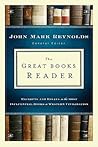
― The Great Books Reader: Excerpts and Essays on the Most Influential Books in Western Civilization
― The Great Books Reader: Excerpts and Essays on the Most Influential Books in Western Civilization
“Erasmus’s Bible-saturated mind. His was a mind too broad for fundamentalism, which rejects reason, and too honest for intellectualism, which rejects revelation.”
― The Great Books Reader: Excerpts and Essays on the Most Influential Books in Western Civilization
― The Great Books Reader: Excerpts and Essays on the Most Influential Books in Western Civilization
“Chaucer, like Homer, writes about a journey, but as a Christian he has a different goal. Homer wanted to go home, but Chaucer's pilgrims want a place of man's true home: paradise”
― The Great Books Reader: Excerpts and Essays on the Most Influential Books in Western Civilization
― The Great Books Reader: Excerpts and Essays on the Most Influential Books in Western Civilization
“Try to get inside the world of Homer and see what it would be like to think with his view of reality. Only then can you begin to judge it, because only then do you really understand it.”
― The Great Books Reader: Excerpts and Essays on the Most Influential Books in Western Civilization
― The Great Books Reader: Excerpts and Essays on the Most Influential Books in Western Civilization
“Every nation needs more people who love liberty, fear mob rule, and hate tyranny with the consistent logic and passion of Alexis de Tocqueville. He is still quoted by presidential candidates, but too often he’s ignored by presidents, and therein lies the danger. Tocqueville reads beautifully but governs even better.”
― The Great Books Reader: Excerpts and Essays on the Most Influential Books in Western Civilization
― The Great Books Reader: Excerpts and Essays on the Most Influential Books in Western Civilization
“For Aristotle, it's not enough simply to act in accordance with the reason once in a while. We must cultivate habits of virtue that develop into a firmly established moral character over a lifetime.”
― The Great Books Reader: Excerpts and Essays on the Most Influential Books in Western Civilization
― The Great Books Reader: Excerpts and Essays on the Most Influential Books in Western Civilization
“Austen knew nothing of our modern quest for equality. People are not numbers, and so they are never “equal.” Some folk are higher placed than others, have more money, were more fortunate in their parents, or are brighter. These gifts do not come to us by merit but by the unfathomable providence of God.”
― The Great Books Reader: Excerpts and Essays on the Most Influential Books in Western Civilization
― The Great Books Reader: Excerpts and Essays on the Most Influential Books in Western Civilization
“What makes Geoffrey Chaucer such compelling reading is his creation of a riveting conversation between the ideal and the everyday.”
―
―
“A culture will tolerate criticism of its idols only when the criticism is made by those who worship the idols.”
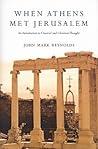
― When Athens Met Jerusalem: An Introduction to Classical and Christian Thought
― When Athens Met Jerusalem: An Introduction to Classical and Christian Thought
“Boethius moved from considering history from the actor's point of view to a "timeless" eternal view. From the divine perspective, nothing is ever utterly lost, because all of life is possessed by God in the eternal now. Though time was gnawing away at Boethius and stealing all he valued, God was beyond time and loss. Gaining this philosophical vantage allowed the last Roman to become one of the first men of the Middle Ages.”
―
―
“By reading older books we get a taste of the conversation of Heaven.”
― The Great Books Reader: Excerpts and Essays on the Most Influential Books in Western Civilization
― The Great Books Reader: Excerpts and Essays on the Most Influential Books in Western Civilization
“If Christianity is true, then every argument will, if pursued to the end, lead to Jesus.”
― The Great Books Reader: Excerpts and Essays on the Most Influential Books in Western Civilization
― The Great Books Reader: Excerpts and Essays on the Most Influential Books in Western Civilization
“The Romans were a strong power before Virgil, but the Greeks had captured their imaginations. While Rome conquered physical Greece, Greek mythology had enveloped Rome. The Empire coul be confident in itself until a Roman poet matched Homer and harmonized Greek civilization with Roman ideals”
― The Great Books Reader: Excerpts and Essays on the Most Influential Books in Western Civilization
― The Great Books Reader: Excerpts and Essays on the Most Influential Books in Western Civilization
“Being will-read is not sufficient, and it isn't the highest virtue to which we can strive, but it is both necessary and practical. We are, after all, people of the Great Book; no Christian leader ought to choose the illiteracy or intentionally fail to develop the intellectual skills needed to read well.”
―
―
“Can we really fix ourselves? Can we really see what needs to be seen and do what needs to be done? Tolstoy suggests we can, even though the road will be long and arduous. He is Orthodox enough to see that humans are sinners in need of mercy, but not Orthodox enough to get to the root of the problem. The prophet does not plunge deeply enough into the human heart. Tolstoy was Christian enough to see that evil exists but not Orthodox enough to get to the root of the problem.”
― The Great Books Reader: Excerpts and Essays on the Most Influential Books in Western Civilization
― The Great Books Reader: Excerpts and Essays on the Most Influential Books in Western Civilization
“Modernity gone wrong has isolated humanity and made human reason autonomous of (and dismissive toward) revelation.”
― The Great Books Reader: Excerpts and Essays on the Most Influential Books in Western Civilization
― The Great Books Reader: Excerpts and Essays on the Most Influential Books in Western Civilization
“It has never been easier to get books but never harder to find the quiet needed to study them.”
―
―
“The fundamentalist burns with anti-intellectual zeal, and in reaction sophists are often swollen up with intellectualism. The fundamentalist and the sophist justify their excesses by the sin of their opposite. Fundamentalism and sophistry give piety and philosophy bad reputations with society.”
―
―
“Growing up loving the Bible made me apt to love other books. I don't love them in the same way I love the Bible, but a lesser love came easily. The splendor of sunlight does not take away”
― The Great Books Reader: Excerpts and Essays on the Most Influential Books in Western Civilization
― The Great Books Reader: Excerpts and Essays on the Most Influential Books in Western Civilization
“I cannot recognize Christianity in his (Nietzsche's) rants against the church, but I do recognize too much of myself.”
―
―
“Ideas after Aristotle multiplied but did not progress.”
― When Athens Met Jerusalem: An Introduction to Classical and Christian Thought
― When Athens Met Jerusalem: An Introduction to Classical and Christian Thought
“Tolstoy does not tell us how things look to the author; he tells us how they look to the characters. In short, he does not use simile and metaphor. (That astonishing assertion in Wood’s review is what got me started reading Tolstoy in the first place. How can anyone write without using metaphor and simile? That would be like—never mind.)”
― The Great Books Reader: Excerpts and Essays on the Most Influential Books in Western Civilization
― The Great Books Reader: Excerpts and Essays on the Most Influential Books in Western Civilization
“while modernity is not Christianity, modernity is the product of a Christian civilization. Lately the defects of modernity have been made plain to us while its virtues have been taken for granted.”
― The Great Books Reader: Excerpts and Essays on the Most Influential Books in Western Civilization
― The Great Books Reader: Excerpts and Essays on the Most Influential Books in Western Civilization
“In the time of to Augustine, the conversation in the West mostly had been a Christian reaction to outside ideas. After Augustine, the Great Conversation would be about his ideas for centuries.”
―
―
“Here (in Thomas Aquinas) is the mind that prepared the way for the scientific and industrial revolutions. Here is the mind that was Catholic enough to embrace any good idea, from wherever it came.”
― The Great Books Reader: Excerpts and Essays on the Most Influential Books in Western Civilization
― The Great Books Reader: Excerpts and Essays on the Most Influential Books in Western Civilization
“Past ages come to us in new ways. For instance, they bore or disturb us. The dead say things we would or could not say in ways that appall , bless, and startle us. Reading them is part of diversity. The easiest voices to ignore are those of the dead; nevertheless, they often on the ones we need most.”
―
―
“Plato understood love as a powerful engine that can destroy mankind or turn us to the good. Christ made that turn possible, and Spenser shows what can be done in the human soul if we take it.”
―
―
“It is not that one has to have exhaustive knowledge of love to live, but it would be much better if one had it.”
― When Athens Met Jerusalem: An Introduction to Classical and Christian Thought
― When Athens Met Jerusalem: An Introduction to Classical and Christian Thought
“Ask a conventional person for an answer, and you are likely to get it; ask for a reason for his answer, and you are likely to get a punch in the mouth.”
― When Athens Met Jerusalem: An Introduction to Classical and Christian Thought
― When Athens Met Jerusalem: An Introduction to Classical and Christian Thought