Goodreads helps you follow your favorite authors. Be the first to learn about new releases!
Start by following Ori Brafman.

Showing 1-30 of 40
“Having a long-term plan--and not casting it aside--is the key to dealing with our fear of loss (loss aversion).”
― Sway: The Irresistible Pull of Irrational Behavior
― Sway: The Irresistible Pull of Irrational Behavior
“In open organizations, a catalyst is the person who initiates a circle and then fades away into the background.”
― The Starfish and the Spider: The Unstoppable Power of Leaderless Organizations
― The Starfish and the Spider: The Unstoppable Power of Leaderless Organizations
“We tend to match the emotions of those around us. For example, we’re more prone to become stressed when we’re around someone who is high-strung. And we’re more likely to be in a good mood when others around us are laughing.”
― Click: The Magic of Instant Connections
― Click: The Magic of Instant Connections
“Ideology is the glue that holds decentralized organizations together.”
― The Starfish and the Spider: The Unstoppable Power of Leaderless Organizations
― The Starfish and the Spider: The Unstoppable Power of Leaderless Organizations
“when attacked, centralized organizations tend to become even more centralized.”
― The Starfish and the Spider: The Unstoppable Power of Leaderless Organizations
― The Starfish and the Spider: The Unstoppable Power of Leaderless Organizations
“The moment you introduce property rights into the equation, everything changes: the starfish organization turns into a spider. If you really want to centralize an organization, hand property rights to the catalyst and tell him to distribute resources as he sees fit. With power over property rights, the catalyst turns into a CEO and circles become competitive.”
― The Starfish and the Spider: The Unstoppable Power of Leaderless Organizations
― The Starfish and the Spider: The Unstoppable Power of Leaderless Organizations
“Dopamine is the chemical that fuels the brain’s pleasure center, producing the kind of euphoria we associate with feeling fully alive. This”
― Click: The Forces Behind How We Fully Engage with People, Work, and Everything We Do
― Click: The Forces Behind How We Fully Engage with People, Work, and Everything We Do
“The harder you fight a decentralized opponent, the stronger it gets. The labels had the power to annihilate Napster and destroy Kazaa. But waging that battle was possibly the worst strategic move the labels made. It started a chain reaction that now threatens the entire industry. As the labels go after the Napsters and Kazaas of the world, little programs like eMule start popping up.
Now, it's not that MGM and the other labels are stupid, nor are they alone. It's just that MGM hasn't stopped to fully understand this new force. What we've seen with the P2P companies is just the tip of the iceberg.”
― The Starfish and the Spider: The Unstoppable Power of Leaderless Organizations
Now, it's not that MGM and the other labels are stupid, nor are they alone. It's just that MGM hasn't stopped to fully understand this new force. What we've seen with the P2P companies is just the tip of the iceberg.”
― The Starfish and the Spider: The Unstoppable Power of Leaderless Organizations
“But without a Montezuma, how do you lead? Instead of a chief, the Apaches had a Nant'an-a spiritual and cultural leader. The Nant'an led by example and held no coercive power. Tribe members followed the Nant'an because they wanted to, not because they had to. One of the most famous Nant'ans in history was Geronimo, who defended his people against the American forces for decades. Geronimo never commanded an army. Rather, he himself started fighting, and everyone around him joined in. The idea was, "If Geronimo is taking arms, maybe it's a good idea. Geronimo's been right in the past, so it makes sense to fight alongside him." You wanted to follow Geronimo? You followed Geronimo. You didn't want to follow him? Then you didn't. The power lay with each individual-you were free to do what you wanted. The phrase "you should" doesn't even exist in the Apache language. Coercion is a foreign concept.”
― The Starfish and the Spider: The Unstoppable Power of Leaderless Organizations
― The Starfish and the Spider: The Unstoppable Power of Leaderless Organizations
“Not only did the Apaches survive the Spanish attacks, but amazingly, the attacks served to make them even stronger. When the Spanish attacked them, the Apaches became even more decentralized and even more difficult to conquer. When the Spanish destroyed their villages, the Apaches might have surrendered if the villages had been crucial to their society. But they weren't. Instead, the Apaches abandoned their old houses and became nomads. (Try to catch us now.)”
― The Starfish and the Spider: The Unstoppable Power of Leaderless Organizations
― The Starfish and the Spider: The Unstoppable Power of Leaderless Organizations
“Nevins explained that the traits of a decentralized society-flexibility, shared power, ambiguity-made the Apaches immune to attacks that would have destroyed a centralized society.”
― The Starfish and the Spider: The Unstoppable Power of Leaderless Organizations
― The Starfish and the Spider: The Unstoppable Power of Leaderless Organizations
“The forces that motivate jpgm to write reviews are the same ones that inspire people to edit Wikipedia articles: everyone wants to contribute, and everyone has something to contribute somewhere.”
― The Starfish and the Spider: The Unstoppable Power of Leaderless Organizations
― The Starfish and the Spider: The Unstoppable Power of Leaderless Organizations
“If they had been, explained Falk, they would have had to come up with a falsifiable hypothesis. For instance, if the hypothesis is that all tomatoes are red, you can disprove the hypothesis by finding a yellow tomato. “What I said in my paper,” Falk told us, “that [the Hobbit] is not a microcephalic, can be falsified with one specimen from a proven microcephalic whose virtual endocast looks identical. And that is scientific.”
― Sway
― Sway
“We need to find a common language, understand each other’s quirks, and establish an emotional bond. But sometimes this process is greatly accelerated, and the connection seems to form almost magically and instantaneously.”
― Click: The Forces Behind How We Fully Engage with People, Work, and Everything We Do
― Click: The Forces Behind How We Fully Engage with People, Work, and Everything We Do
“Let's see what happens when a coercive system takes on an open system. The Spanish (a centralized body) had been used to seeing everything through the lens of a centralized, or coercive, system. When they encountered the Apaches, they went with the tactics that had worked in the past (the take the gold and kill the leader strategy) and started eliminating Nant'ans. But as soon as they killed one off, a new Nant'an would emerge. The strategy failed because no one person was essential to the overall well-being of Apache society.”
― The Starfish and the Spider: The Unstoppable Power of Leaderless Organizations
― The Starfish and the Spider: The Unstoppable Power of Leaderless Organizations
“At the core of what happened with the Apaches and with AA was the concentration of power. Once people gain a right to property, be it cows or book royalties, they quickly seek out a centralized system to protect their interests. It's why we want our banks to be centralized. We want control, we want structure, we want reporting when it comes to our money.”
― The Starfish and the Spider: The Unstoppable Power of Leaderless Organizations
― The Starfish and the Spider: The Unstoppable Power of Leaderless Organizations
“Decentralized systems, on the other hand, are a little trickier to understand. In a decentralized organization, there's no clear leader, no hierarchy, and no headquarters. If and when a leader does emerge, that person has little power over others. The best that person can do to influence people is to lead by example. Nevins calls this an open system, because everyone is entitled to make his or her own decisions. This doesn't mean that a decentralized system is the same as anarchy. There are rules and norms, but these aren't enforced by any one person. Rather, the power is distributed among all the people and across geographic regions. Basically, there's no Tenochtitlan, and no Montezuma.”
― The Starfish and the Spider: The Unstoppable Power of Leaderless Organizations
― The Starfish and the Spider: The Unstoppable Power of Leaderless Organizations
“But Welch's approach benefited GE because it made each unit accountable and did away with inefficiencies. The business rules across the company were: be number one or two in a market or get out, and generate high returns on investments. If a business unit failed in either of these areas, it was sold. Welch's method ensured that each unit was being run profitably, while allowing unit heads significant flexibility and independence. The plan worked. GE's market value skyrocketed. Valued at $12 billion in 1981, it was valued at $375 billion twenty-five years later.”
― The Starfish and the Spider: The Unstoppable Power of Leaderless Organizations
― The Starfish and the Spider: The Unstoppable Power of Leaderless Organizations
“The Nant'ans were crucial to the well-being of this open system, but decentralization affect more than just leadership. Because there was not capital and no central command post, Apache decisions were made all over the place. A raid on a Spanish settlement, for example, could be conceived in one place, organized in another, and carried out in yet another. You never knew where the Apaches would be coming from. In one sense, there was no place where important decisions were made, and in another sense, decisions were made by everybody everywhere.”
― The Starfish and the Spider: The Unstoppable Power of Leaderless Organizations
― The Starfish and the Spider: The Unstoppable Power of Leaderless Organizations
“about itself: “There are times”
― Click: The Forces Behind How We Fully Engage with People, Work, and Everything We Do
― Click: The Forces Behind How We Fully Engage with People, Work, and Everything We Do
“In its simplest terms, clicking can be defined as an immediate, deep, and meaningful connection with another person or with the world around us. Typically,”
― Click: The Forces Behind How We Fully Engage with People, Work, and Everything We Do
― Click: The Forces Behind How We Fully Engage with People, Work, and Everything We Do
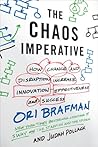
“Information doesn’t change behavior,” quips Lisa. “If it did, none of us would smoke and we’d all floss.”
― The Chaos Imperative: How Chance and Disruption Increase Innovation, Effectiveness, and Success
― The Chaos Imperative: How Chance and Disruption Increase Innovation, Effectiveness, and Success
“When Who Wants to Be a Millionaire was introduced in Russia, though, the production team noticed that the audiences there would often give the wrong answer—and not just to confused souls like Henri. Russian audiences didn’t discriminate—they deliberately misled both smart and less smart contestants alike.”
― Sway
― Sway
“These three elements of contained chaos—white space, unusual suspects, and planned serendipity—can help both large businesses and small start-ups to introduce more innovation, drive growth, and propel excellence.”
― The Chaos Imperative: How Chance and Disruption Increase Innovation, Effectiveness, and Success
― The Chaos Imperative: How Chance and Disruption Increase Innovation, Effectiveness, and Success
“adaptive thinking, being flexible, and encouraging innovation.”
― The Chaos Imperative: How Chance and Disruption Increase Innovation, Effectiveness, and Success
― The Chaos Imperative: How Chance and Disruption Increase Innovation, Effectiveness, and Success
“To an outsider, the chaos might appear overwhelming.”
― The Starfish and the Spider: The Unstoppable Power of Leaderless Organizations
― The Starfish and the Spider: The Unstoppable Power of Leaderless Organizations
“Every time we feel that sense of being fully engaged and alive, whether as a result of a connection with another person, an activity such as sports—being “in the zone”—or simply feeling at one with the world around us, we experience a surge of dopamine through our brain. The”
― Click: The Forces Behind How We Fully Engage with People, Work, and Everything We Do
― Click: The Forces Behind How We Fully Engage with People, Work, and Everything We Do
“Having a goal is very different from having an agenda. You want to focus people without constraining them, something that is equally true in a corporate environment.”
― The Chaos Imperative: How Chance and Disruption Increase Innovation, Effectiveness, and Success
― The Chaos Imperative: How Chance and Disruption Increase Innovation, Effectiveness, and Success
“Representing the first of two types of hybrid organizations, eBay is a centralized company that decentralizes the customer experience.”
― The Starfish and the Spider: The Unstoppable Power of Leaderless Organizations
― The Starfish and the Spider: The Unstoppable Power of Leaderless Organizations
“Occasionally, though, an introduction to someone new is more intense and intimate from the get-go. Maybe we share the same sense of humor or we admire the other individual’s personality or passion. Or we immediately sense that we can just be ourselves around that person. Things feel right; we hit it off. There is an immediate sense of familiarity and comfort. Conversation flows easily, without embarrassing pauses or self-consciousness. In essence, we click.”
― Click: The Forces Behind How We Fully Engage with People, Work, and Everything We Do
― Click: The Forces Behind How We Fully Engage with People, Work, and Everything We Do