Goodreads helps you follow your favorite authors. Be the first to learn about new releases!
Start by following Charles Seife.

Showing 1-30 of 87
“Zero is powerful because it is infinity’s twin. They are equal and opposite, yin and
yang. They are equally paradoxical and troubling. The biggest questions in science
and religion are about nothingness and eternity, the void and the infinite, zero and
infinity. The clashes over zero were the battles that shook the foundations of philosophy,
of science, of mathematics, and of religion. Underneath every revolution lay a
zero – and an infinity.”
― Zero: The Biography of a Dangerous Idea
yang. They are equally paradoxical and troubling. The biggest questions in science
and religion are about nothingness and eternity, the void and the infinite, zero and
infinity. The clashes over zero were the battles that shook the foundations of philosophy,
of science, of mathematics, and of religion. Underneath every revolution lay a
zero – and an infinity.”
― Zero: The Biography of a Dangerous Idea
“If you want to get people to believe something really, really stupid, just stick a number on it.”
―
―
“The body, the house of the spirit, is under the power of pleasure and pain,” explains a god. “And if a man is ruled by his body then this man can never be free.”
― Zero: The Biography of a Dangerous Idea
― Zero: The Biography of a Dangerous Idea
“As mathematicians were uncovering the connection between zero and infinity, physicists began to encounter zeros in the natural world; zero crossed over from mathematics to physics. In thermodynamics a zero became an uncrossable barrier: the coldest temperature possible. In Einstein's theory of general relativity, a zero became a black hole, a monstrous star that swallows entire suns. In quantum mechanics, a zero is responsible for a bizarre source of energy-infinite and ubiquitous, present even in the deepest vacuum-and a phantom force exerted by nothing at all.”
― Zero: The Biography of a Dangerous Idea
― Zero: The Biography of a Dangerous Idea
“We tend to shy away from data that challenges our assumptions, that erodes our preconceptions. Getting rid of our wrong ideas is a painful and difficult process, yet it's that very process that makes data truly useful. A fact becomes information when it challenges our assumptions. These challenges are the raw material that forces our ideas to evolve, our tastes to change, our minds to grow.”
― Virtual Unreality: Just Because the Internet Told You, How Do You Know It's True?
― Virtual Unreality: Just Because the Internet Told You, How Do You Know It's True?
“My theory stands as firm as a rock; every arrow directed against it will return quickly to its archer. How do I know this? I have studied it…I have followed its roots, so to speak, to the first infallible cause of all created things. —GEORG CANTOR”
― Zero: The Biography of a Dangerous Idea
― Zero: The Biography of a Dangerous Idea
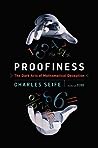
“There are many ways to generate numerical falsehoods from data, many ways to create proofiness from even valid meaurements. Causuistry distorts the relationships between two sets of numbers. Randumbness creates patterns where none are to be found. Regression to the moon disguises nonsense in mathematical-looking lines or equations or formulae, making even the silliest ideas seem respectable. Such as the one described by this formula:
Callipygianness=(S+C)x(B+F)/T-V)
Where S is shape, C is circularity, B is bounciness, F ir firmness, T is texture, and V is waist-to-hip ratio. This formula was devised by a team of academic psychologists after many hours of serious research into the female derriere. Yes, indeed. This is supposed to be the formula for the perfect butt.
It fact, it's merely a formula for a perfect ass”
― Proofiness: The Dark Arts of Mathematical Deception
Callipygianness=(S+C)x(B+F)/T-V)
Where S is shape, C is circularity, B is bounciness, F ir firmness, T is texture, and V is waist-to-hip ratio. This formula was devised by a team of academic psychologists after many hours of serious research into the female derriere. Yes, indeed. This is supposed to be the formula for the perfect butt.
It fact, it's merely a formula for a perfect ass”
― Proofiness: The Dark Arts of Mathematical Deception
“Bad information is a disease that attacks the brain. It messes with your head, making you do things that you shouldn't, causing you to make wrong decisions. Just as a potent virus co-opts your cells' machinery, bad information can co-opt your behavior. It can alter the way you interact with the world and, as a result, it can change the world.”
― Virtual Unreality: Just Because the Internet Told You, How Do You Know It's True?
― Virtual Unreality: Just Because the Internet Told You, How Do You Know It's True?
“The Greeks couldn't do this neat little mathematical trick. They didn't have the concept of a limit because they didn't believe in zero. The terms in the infinite series didn't have a limit or a destination; they seemed to get smaller and smaller without any particular end in sight. As a result, the Greeks couldn't handle the infinite. They pondered the concept of the void but rejected zero as a number, and they toyed with the concept of the infinite but refused to allow infinity-numbers that are infinitely small and infinitely large-anywhere near the realm of numbers. This is the biggest failure in Greek mathematics, and it is the only thing that kept them from discovering calculus.”
― Zero: The Biography of a Dangerous Idea
― Zero: The Biography of a Dangerous Idea
“When you can measure what you are speaking about, and express it in numbers, you know something about it; but when you cannot measure it, when you cannot express it in numbers, your knowledge is of a meager and unsatisfactory kind: it may be the beginning of knowledge, but you have scarcely, in your thoughts, advanced to the stage of science. —WILLIAM THOMSON, LORD KELVIN”
― Zero: The Biography of a Dangerous Idea
― Zero: The Biography of a Dangerous Idea
“Where there is the Infinite there is joy. There is no joy in the finite. —THE CHANDOGYA UPANISHAD”
― Zero: The Biography of a Dangerous Idea
― Zero: The Biography of a Dangerous Idea
“This is the definition of the infinite: it is something that can stay the same size even when you subtract from it.”
― Zero: The Biography of a Dangerous Idea
― Zero: The Biography of a Dangerous Idea
“Digital information has an unbelievably high R0 [basic reproductive rate], and this means that it's hard to stop once it emerges. It spreads from person to person - even those at a great distance - incredibly quickly, thanks to its high transmissibility and the high interconnectedness of digital society. Once it escapes into the wild, it's all but impossible to stop its spread. This is wonderful, so long as the information is correct and useful. But if it's wrong, if it alters our brains for the worse, if it makes us make mistakes and think incorrect things, it's a scourge.”
― Virtual Unreality: Just Because the Internet Told You, How Do You Know It's True?
― Virtual Unreality: Just Because the Internet Told You, How Do You Know It's True?
“With news and data that is tailored to our prejudices, we deprive ourselves of true information. We wind up wallowing in our own false ideas, reflected back at us by the media. The news is ceasing to be a window unto the world; it is becoming a mirror that allows us to gaze only upon our own beliefs.”
― Virtual Unreality: Just Because the Internet Told You, How Do You Know It's True?
― Virtual Unreality: Just Because the Internet Told You, How Do You Know It's True?
“Skinnerian conditioning, crossed with social pressure, is now an ever-present invisibly hand that tries to manipulate all of your actions on the internet. This is the hand that is making you act against your own self-interest. Once you recognize it, you see it everywhere, hovering over you, trying to make you click your mouse or press buttons on your smartphone, giving up your valuable time, money, or information in return for little or nothing at all.”
― Virtual Unreality: Just Because the Internet Told You, How Do You Know It's True?
― Virtual Unreality: Just Because the Internet Told You, How Do You Know It's True?
“Nature speaks in equations.”
― Zero: The Biography of a Dangerous Idea
― Zero: The Biography of a Dangerous Idea
“The infinite zero of a black hole-mass crammed into zero space, curving space infinitely-punches a hole in the smooth rubber sheet. The equations of general relativity cannot deal with the sharpness of zero. In a black hole, space and time are meaningless.”
― Zero: The Biography of a Dangerous Idea
― Zero: The Biography of a Dangerous Idea
“Not only does the media fail to challenge our preconceptions - instead reinforcing them as media outlets try to cater to smaller audiences - but we all are able to find small groups of people who share and fortify the beliefs we have, no matter how quirky or outright wrong they might be. Ironically, all this interconnection is isolating us. We are becoming solipsists, trapped in worlds of our own creation.”
― Virtual Unreality: Just Because the Internet Told You, How Do You Know It's True?
― Virtual Unreality: Just Because the Internet Told You, How Do You Know It's True?
“See appendix A for a proof that Winston Churchill was a carrot.”
― Zero: The Biography of a Dangerous Idea
― Zero: The Biography of a Dangerous Idea
“Zero dwells at the juxtaposition of quantum mechanics and relativity; zero lives where the two theories meet, and zero causes the two theories to clash. A black hole is a zero in the equations of general relativity; the energy of the vacuum is a zero in the mathematics of quantum theory. The big bang, the most puzzling event in the history of the universe, is a zero in both theories. The universe came from nothing-and both theories break down when they try to explain the origin of the cosmos.”
― Zero: The Biography of a Dangerous Idea
― Zero: The Biography of a Dangerous Idea
“The justice system can't be totally free of lies and distortion; after all, courts are chock-full of lawyers.”
―
―
“A bad idea, a wrong piece of information, a digital brain-altering virus can spread at the speed of light through the internet and quickly find a home among a dispersed but digitally interconnected group of true believers. This group acts as a reservoir for the bad idea, allowing it to gather strength and reinfect people; as the group grows, the belief, no matter how crazy, becomes more and more solidly established among the faithful.”
― Virtual Unreality: Just Because the Internet Told You, How Do You Know It's True?
― Virtual Unreality: Just Because the Internet Told You, How Do You Know It's True?
“Just as it's important to take the changing value of a dollar into account when comparing spending over time, it's important to take doctors' changing diagnoses into account when looking at disease trends”
― Proofiness: The Dark Arts of Mathematical Deception
― Proofiness: The Dark Arts of Mathematical Deception
“Skinnerian conditioning, crossed with social pressure, is now an ever-present invisible hand that tries to manipulate all of your actions on the internet. This is the hand that is making you act against your own self-interest. Once you recognize it, you see it everywhere, hovering over you, trying to make you click your mouse or press buttons on your smartphone, giving up your valuable time, money, or information in return for little or nothing at all.”
― Virtual Unreality: Just Because the Internet Told You, How Do You Know It's True?
― Virtual Unreality: Just Because the Internet Told You, How Do You Know It's True?
“In the battle between Kronecker and Cantor, Cantor would ultimately prevail. Cantor's theory would show that Kronecker's precious integers-and even the rational numbers-were nothing at all. They were an infinite zero.”
― Zero: The Biography of a Dangerous Idea
― Zero: The Biography of a Dangerous Idea
“The Mayan system made more sense than the Western system does. Since the Western calendar was created at a time when there was no zero, we never see a day zero, or a year zero. This apparently insignificant omission caused a great deal of trouble; it kindled the controversy over the start of the millenium. The Mayans would never have argued about whether 2000 or 2001 was the first year in the twenty-first century. But it was not the Mayans who formed our calendar; it was the Egyptians and, later, the Romans. For this reason, we are stuck with a troublesome, zero-free calendar.”
― Zero: The Biography of a Dangerous Idea
― Zero: The Biography of a Dangerous Idea
“Zero and infinity are eternally locked in a struggle to engulf all the numbers. Like a Manichaean nightmare, the two sit on opposite poles of the number sphere, sucking numbers in like tiny black holes. Take any number on the plane. For the sake of argument, we'll choose i/2. Square it. Cube it. Raise it to the fourth power. The fifth. The sixth. The seventh. Keep multiplying. It slowly spirals toward zero like water down a drain. What happens to 2i? The exact opposite. Square it. Cube it. Raise it to the fourth power. It spirals outward. But on the number sphere, the two curves are duplicates of each other; they are mirror images. All numbers in the complex plane suffer this fate. They are drawn inexorably toward 0 or toward infinity. The only numbers that escape are the ones that are equally distant from the two rivals-the numbers on the equator, like 1, -1, and i. These numbers, pulled by the tug of both zero and infinity, spiral around on the equator forever and ever, never able to escape the grasp of either. (You can see this on your calculator. Enter a number- any number. Square it. Square it again. Do it again and again; the number will quickly zoom toward infinity or toward zero, except if you entered 1 or -1 to begin with. There is no escape.)”
― Zero: The Biography of a Dangerous Idea
― Zero: The Biography of a Dangerous Idea
“is no question that the vacuum has energy; the Casimir force is witness to that fact. But is it possible that the energy of the vacuum is truly the lowest possible energy? If not, danger might be lurking in the vacuum. In 1983 two scientists suggested in Nature that tinkering with the energy of the vacuum might cause the universe to self-destruct. The paper argued that our vacuum might be a “false” vacuum in an unnaturally energetic state—like a ball perched precariously on the side of a hill. If we give the vacuum a big enough nudge, it might start rolling down the hill—settling into a lower energy state—and we would not be able to stop it. We would release a huge bubble of energy that expands at the speed of light, leaving a vast trail of destruction in its wake. It might be so bad that every one of our atoms would be torn apart during the apocalypse.”
― Zero: The Biography of a Dangerous Idea
― Zero: The Biography of a Dangerous Idea
“Zero is powerful because it is infinity's twin. They are equal and opposite, yin and yang.”
―
―
“Christianity initially rejected zero, but trade would soon demand it. The man who reintroduced zero to the West was Leonardo of Pisa. The son of an Italian trader, he traveled to northern Africa. There the young man-better known as Fibonacci-learned Mathematics from the Muslims and soon became a good mathematician in his own right.”
― Zero: The Biography of a Dangerous Idea
― Zero: The Biography of a Dangerous Idea