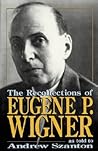
Goodreads helps you follow your favorite authors. Be the first to learn about new releases!
Start by following Eugene P. Wigner.

Showing 1-19 of 19
“Physics is becoming so unbelievably complex that it is taking longer and longer to train a physicist. It is taking so long, in fact, to train a physicist to the place where he understands the nature of physical problems that he is already too old to solve them.”
―
―
“The miracle of the appropriateness of the language of mathematics for the formulation of the laws of physics is a wonderful gift which we neither understand nor deserve. We should be grateful for it and hope that it will remain valid in future research and that it will extend, for better or for worse, to our pleasure, even though perhaps also to our bafflement, to wide branches of learning.”
―
―
“I have known a great many intelligent people in my life. I knew Max Planck, Max von Laue, and Wemer Heisenberg. Paul Dirac was my brother-in-Iaw; Leo Szilard and Edward Teller have been among my closest friends; and Albert Einstein was a good friend, too. And I have known many of the brightest younger scientists. But none of them had a mind as quick and acute as Jancsi von Neumann. I have often remarked this in the presence of those men, and no one ever disputed me. [...] But Einstein's understanding was deeper than even Jancsi von Neumann's. His mind was both more penetrating and more original than von Neumann's. And that is a very remarkable statement. Einstein took an extraordinary pleasure in invention. Two of his greatest inventions are the Special and General Theories of Relativity; and for all of Jancsi's brilliance, he never produced anything so original.”
― The Recollections Of Eugene P. Wigner: As Told To Andrew Szanton
― The Recollections Of Eugene P. Wigner: As Told To Andrew Szanton
“The present writer had occasion, some time ago, to call attention to the succession of layers of "laws of nature," each layer containing more general and more encompassing laws than the previous one and its discovery constituting a deeper penetration into the structure of the universe than the layers recognized before. However, the point which is most significant in the present context is that all these laws of nature contain, in even their remotest consequences, only a small part of our knowledge of the inanimate world. All the laws of nature are conditional statements which permit a prediction of some future events on the basis of the knowledge of the present, except that some aspects of the present state of the world, in practice the overwhelming majority of the determinants of the present state of the world, are irrelevant from the point of view of the prediction.”
―
―
“Relativity theory applies to macroscopic bodies, such as stars. The event of coincidence, that is, in ultimate analysis of collision, is the primitive event in the theory of relativity and defines a point in space-time, or at least would define a point if the colliding panicles were infinitely small. Quantum theory has its roots in the microscopic world and, from its point of view, the event of coincidence, or of collision, even if it takes place between particles of no spatial extent, is not primitive and not at all sharply isolated in space-time. The two theories operate with different mathematical conceptsãthe four dimensional Riemann space and the infinite dimensional Hilbert space, respectively. So far, the two theories could not be united, that is, no mathematical formulation exists to which both of these theories are approximations. All physicists believe that a union of the two theories is inherently possible and that we shall find it. Nevertheless, it is possible also to imagine that no union of the two theories can be found. This example illustrates the two possibilities, of union and of conflict, mentioned before, both of which are conceivable.”
― The Unreasonable Effectiveness of Mathematics in the Natural Sciences
― The Unreasonable Effectiveness of Mathematics in the Natural Sciences
“Considered from this point of view, the fact that some of the theories which we know to be false give such amazingly accurate results is an adverse factor. Had we somewhat less knowledge, the group of phenomena which these "false" theories explain would appear to us to be large enough to "prove" these theories. However, these theories are considered to be "false" by us just for the reason that they are, in ultimate analysis, incompatible with more encompassing pictures and, if sufficiently many such false theories are discovered, they are bound to prove also to be in conflict with each other. Similarly, it is possible that the theories, which we consider to be "proved" by a number of numerical agreements which appears to be large enough for us, are false because they are in conflict with a possible more encompassing theory which is beyond our means of discovery. If this were true, we would have to expect conflicts between our theories as soon as their number grows beyond a certain point and as soon as they cover a sufficiently large number of groups of phenomena. In contrast to the article of faith of the theoretical physicist mentioned before, this is the nightmare of the theorist.”
― The Unreasonable Effectiveness of Mathematics in the Natural Sciences
― The Unreasonable Effectiveness of Mathematics in the Natural Sciences
“Let me end on a more cheerful note. The miracle of the appropriateness of the language of mathematics for the formulation of the laws of physics is a wonderful gift which we neither understand nor deserve. We should be grateful for it and hope that it will remain valid in future research and that it will extend, for better or for worse, to our pleasure, even though perhaps also to our bafflement, to wide branches of learning.”
― The Unreasonable Effectiveness of Mathematics in the Natural Sciences
― The Unreasonable Effectiveness of Mathematics in the Natural Sciences
“It is important to point out that the mathematical formulation of the physicist's often crude experience leads in an uncanny number of cases to an amazingly accurate description of a large class of phenomena.”
― The Unreasonable Effectiveness of Mathematics in the Natural Sciences
― The Unreasonable Effectiveness of Mathematics in the Natural Sciences
“A much more difficult and confusing situation would arise if we could, some day, establish a theory of the phenomena of consciousness, or of biology, which would be as coherent and convincing as our present theories of the inanimate world. Mendel's laws of inheritance and the subsequent work on genes may well form the beginning of such a theory as far as biology is concerned. Furthermore,, it is quite possible that an abstract argument can be found which shows that there is a conflict between such a theory and the accepted principles of physics. The argument could be of such abstract nature that it might not be possible to resolve the conflict, in favor of one or of the other theory, by an experiment. Such a situation would put a heavy strain on our faith in our theories and on our belief in the reality of the concepts which we form. It would give us a deep sense of frustration in our search for what I called "the ultimate truth." The reason that such a situation is conceivable is that, fundamentally, we do not know why our theories work so well. Hence, their accuracy may not prove their truth and consistency. Indeed, it is this writer's belief that something rather akin to the situation which was described above exists if the present laws of heredity and of physics are confronted.”
― The Unreasonable Effectiveness of Mathematics in the Natural Sciences
― The Unreasonable Effectiveness of Mathematics in the Natural Sciences
“In science, it is not speed that is the most important. It is the dedication, the commitment, the interest and the will to know something and to understand it — these are the things that come first.”
―
―
“We are all guests in this world.”
― The Recollections Of Eugene P. Wigner: As Told To Andrew Szanton
― The Recollections Of Eugene P. Wigner: As Told To Andrew Szanton
“All the laws of nature are conditional statements which permit a prediction of some future events on the basis of the knowledge of the present, except that some aspects of the present state of the world, in practice the overwhelming majority of the determinants of the present state of the world, are irrelevant from the point of view of the prediction.”
― The Unreasonable Effectiveness of Mathematics in the Natural Sciences
― The Unreasonable Effectiveness of Mathematics in the Natural Sciences
“Indeed, if a mathematician is asked to justify his interest in complex numbers, he will point, with some indignation, to the many beautiful theorems in the theory of equations, of power series, and of analytic functions in general, which owe their origin to the introduction of complex numbers. The mathematician is not willing to give up his interest in these most beautiful accomplishments of his genius.”
― The Unreasonable Effectiveness of Mathematics in the Natural Sciences
― The Unreasonable Effectiveness of Mathematics in the Natural Sciences
“Naturally, we do use mathematics in everyday physics to evaluate the results of the laws of nature, to apply the conditional statements to the particular conditions which happen to prevail or happen to interest us. In order that this be possible, the laws of nature must already be formulated in mathematical language.”
― The Unreasonable Effectiveness of Mathematics in the Natural Sciences
― The Unreasonable Effectiveness of Mathematics in the Natural Sciences
“It is the skill and ingenuity of the experimenter which show him phenomena which depend on a relatively narrow set of relatively easily realizable and reproducible conditions. If there were no phenomena which are independent of all but a manageably small set of conditions, physics would be impossible.”
―
―
“The mathematician could formulate only a handful of interesting theorems without defining concepts beyond those contained in the axioms and that the concepts outside those contained in the axioms are defined with a view of permitting ingenious logical operations which appeal to our aesthetic sense both as operations and also in their results of great generality and simplicity.”
― The Unreasonable Effectiveness of Mathematics in the Natural Sciences
― The Unreasonable Effectiveness of Mathematics in the Natural Sciences
“When the rods were pushed back in and the clicking had died down, we suddenly experiences a let-down feeling, for all of us understood the language of the counter. Even though we had anticipated the success of the experiment, its accomplishment had a deep impact on us. For some time we had known that we were about to unlock a giant; still we could not escape an eerie feeling when we had actually done it. We felt as, I presume, everyone feels who has done something that he knowns will have very far-reaching consequences which he cannot foresee.”
―
―
“The miracle of the appropriateness of the language of mathematics for the formulation of the laws of physics is a wonderful gift which we neither understand nor deserve. We should be grateful for it and hope that it will remain valid in future research and that it will extend, for better if for worse, to our pleasure, even though perhaps also to our bafflement, to wide branches of learning.”
―
―
“We cannot know whether a theory formulated in terms of mathematical concepts is uniquely appropriate. We are in a position similar to that of a man who was provided with a bunch of keys and who, having to open several doors in succession, always hit on the right key on the first or second trial. He became skeptical concerning the uniqueness of the coordination between keys and doors.”
― The Unreasonable Effectiveness of Mathematics in the Natural Sciences
― The Unreasonable Effectiveness of Mathematics in the Natural Sciences