Goodreads helps you follow your favorite authors. Be the first to learn about new releases!
Start by following Mark Galeotti.

Showing 1-30 of 51
“Those who do not regret the collapse of the Soviet Union have no heart, and those who do regret it have no brain.”
― We Need to Talk About Putin: Why the West Gets Him Wrong, and How to Get Him Right
― We Need to Talk About Putin: Why the West Gets Him Wrong, and How to Get Him Right
“History becomes a guidebook for geopolitics.”
― A Short History of Russia: How the World's Largest Country Invented Itself, from the Pagans to Putin
― A Short History of Russia: How the World's Largest Country Invented Itself, from the Pagans to Putin
“Language is intrinsically political, as how we talk about something conditions how we think about it,”
― A Short History of Russia: How the World's Largest Country Invented Itself, from the Pagans to Putin
― A Short History of Russia: How the World's Largest Country Invented Itself, from the Pagans to Putin
“Between 1918 and 1922, the country was wracked by a vicious civil war, from which the Bolsheviks would emerge victorious, and regions such as Ukraine and the Caucasus had been reconquered, but only at a terrible cost. As many as 12 million people had died, many from famine and disease.”
― A Short History of Russia: From the Pagans to Putin
― A Short History of Russia: From the Pagans to Putin
“The leather satchel on his right hip holds documents and notebook; the canvas haversack is for supplies”
― Russian Security and Paramilitary Forces since 1991
― Russian Security and Paramilitary Forces since 1991
“Larger countries that seek to cover every base may well find that it doesn’t matter if you have the latest fighters or even lots of soft power if your infrastructure is especially vulnerable to hackers or your political elite is susceptible to unchecked bribe-taking and foreign influence.”
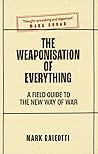
― The Weaponisation of Everything: A Field Guide to the New Way of War
― The Weaponisation of Everything: A Field Guide to the New Way of War
“Our very vocabulary is outdated: war, enemy, victory, all these concepts need to be re-thought. Welcome to a potential world of permanent, sublimated conflict, of the political struggle of all against all.”
― The Weaponisation of Everything: A Field Guide to the New Way of War
― The Weaponisation of Everything: A Field Guide to the New Way of War
“In 1991, not counting the regular police, there had been more than 400,000 internal security troops and paramilitaries across the whole USSR – one for every 700 Soviet citizens, and one for every ten regular soldiers. By 1995 there were some 382,500 security and paramilitary troops in the Russian Federation alone, or one for every 392 citizens.”
― Russian Security and Paramilitary Forces since 1991
― Russian Security and Paramilitary Forces since 1991
“Yet who does much of the bribery in the poorer countries? And where does most of that money end up? Italian supercars, French yachts, London penthouses, Scandinavian money laundries, shell corporations in Delaware and bank accounts in Liechtenstein. Corrupt is in many ways a racket that transfers assets from the poorer Global South to the richer North, but that’s a whole other book.”
― The Weaponisation of Everything: A Field Guide to the New Way of War
― The Weaponisation of Everything: A Field Guide to the New Way of War
“Putin je milosrdný autokrat. Nechce vás zabít - pokud ho k tomu nedonutíte.”
― We Need to Talk About Putin: Why the West Gets Him Wrong, and How to Get Him Right
― We Need to Talk About Putin: Why the West Gets Him Wrong, and How to Get Him Right
“If smugglers are crossing your borders with impunity, if hackers seem to be able to make sport of your critical systems without trouble, if gangs are brawling and killing in your streets without fear, then how credible does your state appear, and how likely is it that people will start looking for alternative, radical solutions to their worries?”
― The Weaponisation of Everything: A Field Guide to the New Way of War
― The Weaponisation of Everything: A Field Guide to the New Way of War
“Mnoho Rusů stále Putina chová v úctě, když už pro nic jiného, tak proto, že díky němu mají pocit, že jejich země má ve světě nějakou váhu.”
― We Need to Talk About Putin: Why the West Gets Him Wrong, and How to Get Him Right
― We Need to Talk About Putin: Why the West Gets Him Wrong, and How to Get Him Right
“There is truth in the cliché ‘give a man a fish and you feed him for a day, teach a man to fish and you feed him for a lifetime’. But as the Somalis learned, there’s little value in knowing how to fish if all your fish stocks have been raided. And as many other marginal communities around the world have discovered, if the fish you catch are then seized by warlords, kleptocrats or other exploiters, then you’re still going hungry. Few Western countries really want to get seriously into the nation-building business, identifying it with the seemingly endless and fruitless US campaigns in Iraq and Afghanistan.”
― The Weaponisation of Everything: A Field Guide to the New Way of War
― The Weaponisation of Everything: A Field Guide to the New Way of War
“It would be nice to think that the genuinely global threats that face us – not least climate change – would likewise mean a new, global mindset. The trouble is that human beings are complex beasts, able to cooperate wholeheartedly for one cause while still completing fiercely on another.”
― The Weaponisation of Everything: A Field Guide to the New Way of War
― The Weaponisation of Everything: A Field Guide to the New Way of War
“Russians can be unhappy, yet still loyal. Putin is to a large extent being rated not as a man, not even as a politician, but as an icon of Russia. To vote for him is not to endorse a program, but to express patriotism”
― We Need to Talk About Putin: Why the West Gets Him Wrong, and How to Get Him Right
― We Need to Talk About Putin: Why the West Gets Him Wrong, and How to Get Him Right
“The vory and regular criminals who had served in the army and were now considered to have broken their code were joined by maybe half a million former soldiers and partisans whose ‘crime’ had been to be captured by the enemy when Stalin expected – demanded – that they fight to the death. For them, ‘liberation’ meant an inglorious transfer from a foreign prison camp to a Soviet one. Over a third of a million Red Army soldiers ended up in the NKVD’s ‘verification and filtration camps’, and while most were eventually freed to civilian life or returned into the military, at least a third of them ended up in the Gulag.15”
― The Vory: Russia's Super Mafia
― The Vory: Russia's Super Mafia
“every war since one gang of cavemen squared off against another over possession of the driest cave has been ‘hybrid’. Only in video games do you win a war by killing every one of the enemy. Instead, wars are an extreme form of coercive diplomacy, intrinsically political acts, ways of imposing your will on another by degrading their ability to resist. Skewering their soldiers and levelling their cities is just a means to an end and is only likely to work when combined with efforts to undermine their fighting spirit.”
― The Weaponisation of Everything: A Field Guide to the New Way of War
― The Weaponisation of Everything: A Field Guide to the New Way of War
“Stejně jako nejsou všichni, kteří Putina podporují, našimi nepřáteli, nejsou ani všichni, kteří mu oponují, našimi přáteli.”
― We Need to Talk About Putin: Why the West Gets Him Wrong, and How to Get Him Right
― We Need to Talk About Putin: Why the West Gets Him Wrong, and How to Get Him Right
“Indeed, since the end of the Cold War, which channelled so many other rivalries and tensions into a single confrontation, one could argue that a post-ideological age is also a deeply conflicted one. Close allies compete viciously for trade deals and a technological edge, for precedence and prestige. If now we have no real enemies, the sad corollary is that we have no real friends, either.”
― The Weaponisation of Everything: A Field Guide to the New Way of War
― The Weaponisation of Everything: A Field Guide to the New Way of War
“Unwilling to accept the changes reshaping Europe, unwilling to accept exclusion from Europe, Russia was being torn apart by the contradictions in the stories it told itself about itself.”
― A Short History of Russia: From the Pagans to Putin
― A Short History of Russia: From the Pagans to Putin
“Beijing’s real advantages are foreign greed, short-termism and naivety.”
― The Weaponisation of Everything: A Field Guide to the New Way of War
― The Weaponisation of Everything: A Field Guide to the New Way of War
“During his reign, Russia invaded neighboring Georgia (2008), annexed the Crimean Peninsula from Ukraine (2014), stirred up a civil war in Ukraine’s southeastern Donbas region (2014–) and intervened in the Syrian Civil War (2015–”
― A Short History of Russia: How the World's Largest Country Invented Itself, from the Pagans to Putin
― A Short History of Russia: How the World's Largest Country Invented Itself, from the Pagans to Putin
“Under Putin, resources once again began to be allocated to the police, but there was no substantive reform. Instead, it was during the single term in which he retreated to the position of prime minister (as the Russian constitution forbade anyone serving three consecutive terms as president), with his client Dmitry Medvedev as titular president (2008–12), that this process began. A lawyer by training, Medvedev appreciated the problems with Russian law enforcement. He introduced a new Law on the Police in 2011, which not only changed the force’s name back to politsiya, “police,” but also mandated compulsory re-accreditation of all serving officers, with the aim of cutting the size of the force by 22 percent to 1,106,472 officers. At the same time, salaries were to be increased by 30 percent.”
― Russian Security and Paramilitary Forces since 1991
― Russian Security and Paramilitary Forces since 1991
“Peníze ti nutně nezaručí moc, ale moc ti vždycky přinese peníze.”
― We Need to Talk About Putin: Why the West Gets Him Wrong, and How to Get Him Right
― We Need to Talk About Putin: Why the West Gets Him Wrong, and How to Get Him Right
“Vladimir allegedly noting that “drinking is the joy of all Rus’. We cannot exist without that pleasure.” (Some stereotypes have a long pedigree, it seems.)”
― A Short History of Russia: How the World's Largest Country Invented Itself, from the Pagans to Putin
― A Short History of Russia: How the World's Largest Country Invented Itself, from the Pagans to Putin
“Dambisa Moyo, a Zambian who went on to work at Goldman Sachs and the World Bank, asked ‘what if, one by one, African countries each received a phone call, telling them that in exactly five years the aid taps would be shut off — permanently?’ Her view was that this would be an energising wake-up call, forcing countries rapidly to pivot to increase trade and attractiveness to foreign investment. Of course, the risk is that some countries would spread their wings and fly, others crash and burn. And, of course, that China would buy all of the ones in between. Such provocative ideas likely work better on the page than in the field, but they do challenge us all to recognise that current aid strategies have too often been ineffective.”
― The Weaponisation of Everything: A Field Guide to the New Way of War
― The Weaponisation of Everything: A Field Guide to the New Way of War
“According to the Cost of War programme at Brown University’s Watson Institute, in the first 20 years of the twenty-first century, the US’s ‘War on Terror’ – including invading Afghanistan and Iraq – cost the country $6.4 trillion through direct and indirect costs. By contrast, the decade-long Vietnam War cost an estimated $168 billion, or $1 trillion in today’s money. As for the 12 years of the Napoleonic Wars, they cost Britain £831 million in the coin of the day, or £75 billion ($93 billion) in modern terms. Wars aren’t what they used to be; they are rather more expensive.”
― The Weaponisation of Everything: A Field Guide to the New Way of War
― The Weaponisation of Everything: A Field Guide to the New Way of War