Goodreads helps you follow your favorite authors. Be the first to learn about new releases!
Start by following Julian T. Jackson.
Showing 1-13 of 13
“Thus Lebrun had not so much resigned as faded away. The coup d’état of 10 July 1940, if coup d’état it was, could hardly have been a politer affair. As de Gaulle later wrote scathingly of Lebrun in his Memoirs: ‘As Head of State he lacked two things: that he was a Head; and that there was a State.”
― France on Trial: The Case of Marshal Pétain
― France on Trial: The Case of Marshal Pétain
“France’s prime minister during the Great War, who had been dubbed ‘le Père la Victoire’ – Father of Victory.”
― France on Trial: The Case of Marshal Pétain
― France on Trial: The Case of Marshal Pétain
“He wrote: I would have liked to make the following declaration: ‘Pétain was named head of State by the National Assembly composed of men properly elected by the Nation. The fact of choosing the Jurors among the Resisters and among the 80 parliamentarians who voted against Pétain in 1940 while 800 voted for, will taint the judgement that is made. I am happy to participate in the judgement, I do not want to participate in an assassination.’9”
― France on Trial: The Case of Marshal Pétain
― France on Trial: The Case of Marshal Pétain
“One can however permit Spear the last word on one other detail of the journey when the plane touched down in Jersey to refuel:
"I asked de Gaulle if he wanted anything, and he said he would like a cup of coffee. I handed it to him, whereupon, taking a sip, he said, in a voice which indicated that without implying criticism he must nevertheless proclaim the truth, that this was tea and he had asked for coffee. It was his first introduction to the tepid liquid which, in England, passes for either one or the other. His martyrdom had begun.”
― De Gaulle
"I asked de Gaulle if he wanted anything, and he said he would like a cup of coffee. I handed it to him, whereupon, taking a sip, he said, in a voice which indicated that without implying criticism he must nevertheless proclaim the truth, that this was tea and he had asked for coffee. It was his first introduction to the tepid liquid which, in England, passes for either one or the other. His martyrdom had begun.”
― De Gaulle
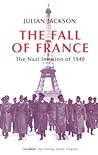
“This time it’s the real war; so much the better since at last we can see the end.’ ‘If you knew how confident and full of hope I am.’27 These two comments come from letters written by soldiers of the 21DI between 11 and 13 May as they headed into Belgium after the German invasion. They should remind us that the soldiers’ demoralization during the Phoney War represented not so much hostility to the war in itself as boredom caused by waiting for a war that never seemed to come.”
― The Fall of France: The Nazi Invasion of 1940
― The Fall of France: The Nazi Invasion of 1940
“The room was barely half-lit. Major Navereau was repeating in a low voice the information coming in. Everyone else was silent. General Roton, the Chief of Staff, was stretched out in the armchair. The atmosphere was that of a family in which there has been a death. Georges got up quickly and came to Doumenc. He was terribly pale. ‘Our front has been broken at Sedan! There has been a collapse …’ He flung himself into a chair and burst into tears.”
― The Fall of France: The Nazi Invasion of 1940
― The Fall of France: The Nazi Invasion of 1940
“History will one day judge the judges, and will also certainly judge the atmosphere in which his trial has been conducted.”
― France on Trial: The Case of Marshal Pétain
― France on Trial: The Case of Marshal Pétain
“Reynaud ended his testimony with a defence of his former ministers: It is not my intention to condemn them, Messieurs. You need to put yourself back in the atmosphere of the period. These men saw the force of the Germans which seemed irresistible, and then the crowds of unfortunate refugees pouring south with mattresses on their car roofs, towards the Pyrenees … But I will be much more severe about those who told them, because they had the authority to say such things … that in three weeks England would have her throat cut like a chicken. I am more severe about those who weighed in the decision of these ministers, those who corrupted them – Pétain and Weygand.”
― France on Trial: The Case of Marshal Pétain
― France on Trial: The Case of Marshal Pétain
“More time would be devoted in the trial to this single document than to the fact that in the month it was sent – or not sent – over 11,000 Jewish men, women and children were arrested by French police in the Unoccupied Zone of France for deportation to Auschwitz.”
― France on Trial: The Case of Marshal Pétain
― France on Trial: The Case of Marshal Pétain
“One eligible candidate would have been the jurist Léon Lyon-Caen, who had been sacked from the Cour de Cassation under Vichy legislation excluding Jews. Later, he had narrowly escaped arrest by the Gestapo, one of his sons had died at Auschwitz, and two others in the Resistance. Lyon-Caen was readmitted to the Cour de Cassation in 1945, but he refused to be considered for the role of premier président on the grounds that he could not be impartial.”
― France on Trial: The Case of Marshal Pétain
― France on Trial: The Case of Marshal Pétain
“Vichy emerged not only from what divided the French but also what united them: pacifism, fear of population decline, loss of confidence in national identity, anti-Semitism, discontent with existing political institutions, ambivalence about modernity. The existence of this common”
― France: The Dark Years, 1940-1944
― France: The Dark Years, 1940-1944
“most quintessentially ‘French’ region of France, the granitic Auvergne, where the Gauls had held out against the Romans.”
― France on Trial: The Case of Marshal Pétain
― France on Trial: The Case of Marshal Pétain