Goodreads helps you follow your favorite authors. Be the first to learn about new releases!
Start by following Jim Holt.

Showing 1-30 of 55
“Having just enough life to enjoy being dead.”
― Why Does the World Exist?: An Existential Detective Story
― Why Does the World Exist?: An Existential Detective Story
“In 1921, a New York rabbi asked Einstein if he believed in God. "I believe in Spinoza's God," he answered, "who reveals himself in the orderly harmony of what exists, not in a God who concerns himself with the fates and actions of human beings.”
― Why Does the World Exist?: An Existential Detective Story
― Why Does the World Exist?: An Existential Detective Story
“Suppose you turn your attention inward in search of this 'I'. You may encounter nothing more than an ever changing stream of consciousness, a flow of thoughts and feelings in which there is no real self to be discovered.”
― Why Does the World Exist?: An Existential Detective Story
― Why Does the World Exist?: An Existential Detective Story
“I really don’t like to formulate what I believe because, like a quantum phenomenon, it varies from day to day, and anyway there’s a sort of bad luck attached to expressing yourself too clearly.”
― Why Does the World Exist?: An Existential Detective Story
― Why Does the World Exist?: An Existential Detective Story
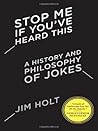
“In both jokes and dreams, Freud observed, meanings are condensed and displaced, things are represented indirectly or by their opposites, fallacious reasoning trumps logic. Jokes often arise involuntarily, like dreams, and tend to be swiftly forgotten. From these similarities Freud inferred that jokes and dreams share a common origin in the unconscious. Both are essentially means of outwitting our inner "censor.”
― Stop Me If You've Heard This: A History and Philosophy of Jokes
― Stop Me If You've Heard This: A History and Philosophy of Jokes
“The effort to understand the universe is one of the very few things that lifts human life above the level of farce, and gives it some of the grace of tragedy.”
― Why Does the World Exist?: An Existential Detective Story
― Why Does the World Exist?: An Existential Detective Story
“The total absence of humor from the Bible,” Alfred North Whitehead once observed, “is one of the most singular things in all literature.”
― Stop Me If You've Heard This: A History and Philosophy of Jokes
― Stop Me If You've Heard This: A History and Philosophy of Jokes
“It has even been conjectured that the human mind plays a critical role in the self-causing mechanism. Although we seem to be a negligible part of the cosmos, it is our consciousness that gives reality to it as a whole. On this picture, sometimes called the “participatory universe,” reality is a self-sustaining causal loop: the world creates us, and we in turn create the world.”
― Why Does the World Exist?: An Existential Detective Story
― Why Does the World Exist?: An Existential Detective Story
“Science is a differential equation. Religion is a boundary condition.”
― Why Does the World Exist?: An Existential Detective Story
― Why Does the World Exist?: An Existential Detective Story
“I would earnestly warn you against trying to find out the reason for and explanation of everything. . . . To try and find out the reason for everything is very dangerous and leads to nothing but disappointment and dissatisfaction, unsettling your mind and in the end making you miserable. —QUEEN”
― Why Does the World Exist?: An Existential Detective Story
― Why Does the World Exist?: An Existential Detective Story
“(It is interesting that the words “cosmos” and “cosmetic” have the same root, the Greek word for “adornment” or “arrangement.”)”
― Why Does the World Exist?: An Existential Detective Story
― Why Does the World Exist?: An Existential Detective Story
“Instead of being an inert object, nothingness would appear to be a dynamic thing, a sort of annihilating force.”
― Why Does the World Exist?: An Existential Detective Story
― Why Does the World Exist?: An Existential Detective Story
“In some cases, the reaction to Cantor’s theory broke along national lines. French mathematicians, on the whole, were wary of its metaphysical aura. Henri Poincaré (who rivaled Germany’s Hilbert as the greatest mathematician of the era) observed that higher infinities “have a whiff of form without matter, which is repugnant to the French spirit.” Russian mathematicians, by contrast, enthusiastically embraced the newly revealed hierarchy of infinities. Why the contrary French and Russian reactions? Some observers have chalked it up to French rationalism versus Russian mysticism. That is the explanation proffered, for example, by Loren Graham, an American historian of science retired from MIT, and Jean-Michel Kantor, a mathematician at the Institut de Mathématiques de Jussieu in Paris, in their book Naming Infinity (2009). And it was the Russian mystics who better served the cause of mathematical progress—so argue Graham and Kantor. The intellectual milieu of the French mathematicians, they observe, was dominated by Descartes, for whom clarity and distinctness were warrants of truth, and by Auguste Comte, who insisted that science be purged of metaphysical speculation. Cantor’s vision of a never-ending hierarchy of infinities seemed to offend against both. The Russians, by contrast, warmed to the spiritual nimbus of Cantor’s theory. In fact, the founding figures of the most influential school of twentieth-century Russian mathematics were adepts of a heretical religious sect called the Name Worshippers. Members of the sect believed that by repetitively chanting God’s name, they could achieve fusion with the divine. Name Worshipping, traceable to fourth-century Christian hermits in the deserts of Palestine, was revived in the modern era by a Russian monk called Ilarion. In 1907, Ilarion published On the Mountains of the Caucasus, a book that described the ecstatic experiences he induced in himself while chanting the names of Christ and God over and over again until his breathing and heartbeat were in tune with the words.”
― When Einstein Walked with Gödel: Excursions to the Edge of Thought
― When Einstein Walked with Gödel: Excursions to the Edge of Thought
“But Mandelbrot continued to feel oppressed by France’s purist mathematical establishment. “I saw no compatibility between a university position in France and my still-burning wild ambition,” he writes. So, spurred by the return to power in 1958 of Charles de Gaulle (for whom Mandelbrot seems to have had a special loathing), he accepted the offer of a summer job at IBM in Yorktown Heights, north of New York City. There he found his scientific home. As a large and somewhat bureaucratic corporation, IBM would hardly seem a suitable playground for a self-styled maverick. The late 1950s, though, were the beginning of a golden age of pure research at IBM. “We can easily afford a few great scientists doing their own thing,” the director of research told Mandelbrot on his arrival. Best of all, he could use IBM’s computers to make geometric pictures. Programming back then was a laborious business that involved transporting punch cards from one facility to another in the backs of station wagons.”
― When Einstein Walked with Gödel: Excursions to the Edge of Thought
― When Einstein Walked with Gödel: Excursions to the Edge of Thought
“Consistency is the virtue of small minds, and Spinoza had a great mind—he was inconsistent all over the place.”
― Why Does the World Exist?: An Existential Detective Story
― Why Does the World Exist?: An Existential Detective Story
“Time is a great teacher, but unfortunately it kills all its pupils.”
― When Einstein Walked with Gödel: Excursions to the Edge of Thought
― When Einstein Walked with Gödel: Excursions to the Edge of Thought
“As Grünbaum is fond of saying, even though the universe is finite in age, it has always existed, if by “always” you mean at all instants of time.”
― Why Does the World Exist?: One Man's Quest for the Big Answer
― Why Does the World Exist?: One Man's Quest for the Big Answer
“Our mild anxiety about the precariousness of being may give way to confidence in a world that turns out to be coherent, luminous, and intellectually secure. Or it might yield to cosmic terror when we realize that the whole show is a mere ontological soap bubble that could pop into nothingness at any moment, without the slightest warning. And our present sense of the potential reach of human thought may give way to a newfound humility at its limits, or to a newfound wonder at its leaps and bounds—or a bit of both.”
― Why Does the World Exist?: An Existential Detective Story
― Why Does the World Exist?: An Existential Detective Story
“Since then, several other conjectures have been resolved with the aid of computers (notably, in 1988, the nonexistence of a projective plane of order 10). Meanwhile, mathematicians have tidied up the Haken-Appel argument so that the computer part is much shorter, and some still hope that a traditional, elegant, and illuminating proof of the four-color theorem will someday be found. It was the desire for illumination, after all, that motivated so many to work on the problem, even to devote their lives to it, during its long history. (One mathematician had his bride color maps on their honeymoon.) Even if the four-color theorem is itself mathematically otiose, a lot of useful mathematics got created in failed attempts to prove it, and it has certainly made grist for philosophers in the last few decades. As for its having wider repercussions, I’m not so sure. When I looked at the map of the United States in the back of a huge dictionary that I once won in a spelling bee for New York journalists, I noticed with mild surprise that it was colored with precisely four colors. Sadly, though, the states of Arkansas and Louisiana, which share a border, were both blue.”
― When Einstein Walked with Gödel: Excursions to the Edge of Thought
― When Einstein Walked with Gödel: Excursions to the Edge of Thought
“Grothendieck transformed modern mathematics. However, much of the credit for this transformation should go to a lesser-known forerunner of his, Emmy Noether. It was Noether, born in Bavaria in 1882, who largely created the abstract approach that inspired category theory.1 Yet as a woman in a male academic world, she was barred from holding a professorship in Göttingen, and the classicists and historians on the faculty even tried to block her from giving unpaid lectures—leading David Hilbert, the dean of German mathematics, to comment, “I see no reason why her sex should be an impediment to her appointment. After all, we are a university, not a bathhouse.” Noether, who was Jewish, fled to the United States when the Nazis took power, teaching at Bryn Mawr until her death from a sudden infection in 1935.”
― When Einstein Walked with Gödel: Excursions to the Edge of Thought
― When Einstein Walked with Gödel: Excursions to the Edge of Thought
“Today, Arabic numerals are in use pretty much around the world, while the words with which we name numbers naturally differ from language to language. And, as Dehaene and others have noted, these differences are far from trivial. English is cumbersome. There are special words for the numbers from 11 to 19 and for the decades from 20 to 90. This makes counting a challenge for English-speaking children, who are prone to such errors as “twenty-eight, twenty-nine, twenty-ten, twenty-eleven.” French is just as bad, with vestigial base-twenty monstrosities, like quatre-vingt-dix-neuf (four twenty ten nine) for 99. Chinese, by contrast, is simplicity itself; its number syntax perfectly mirrors the base-ten form of Arabic numerals, with a minimum of terms. Consequently, the average Chinese four-year-old can count up to forty, whereas American children of the same age struggle to get to fifteen. And the advantages extend to adults. Because Chinese number words are so brief—they take less than a quarter of a second to say, on average, compared with a third of a second for English—the average Chinese speaker has a memory span of nine digits, versus seven digits for English speakers. (Speakers of the marvelously efficient Cantonese dialect, common in Hong Kong, can juggle ten digits in active memory.)”
― When Einstein Walked with Gödel: Excursions to the Edge of Thought
― When Einstein Walked with Gödel: Excursions to the Edge of Thought
“I find it hard to swallow the notion that the world is improved by extra suffering. And that goes for a lot of Christian doctrine. Jones commits a crime, so you expiate the evil by nailing Smith to a cross and it's all better. - John Leslie”
― Why Does the World Exist?: An Existential Detective Story
― Why Does the World Exist?: An Existential Detective Story
“The fundamental problem with learning mathematics is that while the number sense may be genetic, exact calculation requires cultural tools—symbols and algorithms—that have been around for only a few thousand years and must therefore be absorbed by areas of the brain that evolved for other purposes. The process is made easier when what we are learning harmonizes with built-in circuitry. If we can’t change the architecture of our brains, we can at least adapt our teaching methods to the constraints it imposes. For nearly three decades, American educators have pushed “reform math,” in which children are encouraged to explore their own ways of solving problems. Before reform math, there was the “new math,” now widely thought to have been an educational disaster. (In France, it was called les maths modernes and is similarly despised.) The new math was grounded in the theories of the influential Swiss psychologist Jean Piaget, who believed that children are born without any sense of number and only gradually build up the concept in a series of developmental stages. Piaget thought that children, until the age of four or five, cannot grasp the simple principle that moving objects around does not affect how many of them there are, and that there was therefore no point in trying to teach them arithmetic before the age of six or seven.”
― When Einstein Walked with Gödel: Excursions to the Edge of Thought
― When Einstein Walked with Gödel: Excursions to the Edge of Thought
“messages from the unseen” that the great Alan Turing left behind at his death: Science is a differential equation. Religion is a boundary condition.”
― Why Does the World Exist?: An Existential Detective Story
― Why Does the World Exist?: An Existential Detective Story
“Dehaene marveled at the fact that mathematics is simultaneously a product of the human mind and a powerful instrument for discovering the laws by which the human mind operates.”
― When Einstein Walked with Gödel: Excursions to the Edge of Thought
― When Einstein Walked with Gödel: Excursions to the Edge of Thought
“As the physicist Nima Arkani-Hamed has put it, “The earth is not the center of the solar system, the sun is not the center of our galaxy, our galaxy is just one of billions in a universe that has no center, and now our entire three-dimensional universe would be just a thin membrane in the full space of dimensions. If we consider slices across the extra dimensions, our universe would occupy a single infinitesimal point in each slice, surrounded by a void.”
― When Einstein Walked with Gödel: Excursions to the Edge of Thought
― When Einstein Walked with Gödel: Excursions to the Edge of Thought
“For, as the German diplomat and philosopher Max Scheler wrote, “He who has not, as it were, looked into the abyss of the absolute Nothing will completely overlook the eminently positive content of the realization that there is something rather than nothing.” Let us, then, dip briefly into that abyss, with full assurance that we will not come up empty-handed. For, as the old saying goes: Nothing seek, nothing find.”
― Why Does the World Exist?: An Existential Detective Story
― Why Does the World Exist?: An Existential Detective Story
“To begin with, if existence arose out of a need for goodness, then it must be essentially mental. In other words, existence must ultimately consist of mind, of consciousness.”
― Why Does the World Exist?: An Existential Detective Story
― Why Does the World Exist?: An Existential Detective Story
“The important thing is sincerity. If you can fake that, you’ve got it made.”)”
― When Einstein Walked with Gödel: Excursions to the Edge of Thought
― When Einstein Walked with Gödel: Excursions to the Edge of Thought
“It is the best of times in physics. Physicists are on the verge of obtaining the long-sought theory of everything. In a few elegant equations, perhaps concise enough to be emblazoned on a T-shirt, this theory will reveal how the universe began and how it will end. The key insight is that the smallest constituents of the world are not particles, as had been supposed since ancient times, but “strings”—tiny strands of energy. By vibrating in different ways, these strings produce the essential phenomena of nature, the way violin strings produce musical notes. String theory isn’t just powerful; it’s also mathematically beautiful. All that remains to be done is to write down the actual equations. This is taking a little longer than expected. But, with almost the entire theoretical-physics community working on the problem—presided over by a sage in Princeton, New Jersey—the millennia-old dream of a final theory is sure to be realized before long. It is the worst of times in physics. For more than a generation, physicists have been chasing a will-o’-the-wisp called string theory. The beginning of this chase marked the end of what had been three-quarters of a century of progress. Dozens of string-theory conferences have been held, hundreds of new Ph.D.’s have been minted, and thousands of papers have been written. Yet, for all this activity, not a single new testable prediction has been made; not a single theoretical puzzle has been solved. In fact, there is no theory so far—just a set of hunches and calculations suggesting that a theory might exist. And, even if it does, this theory will come in such a bewildering number of versions that it will be of no practical use: a theory of nothing. Yet the physics establishment promotes string theory with irrational fervor, ruthlessly weeding dissenting physicists from the profession. Meanwhile, physics is stuck in a paradigm doomed to barrenness.”
― When Einstein Walked with Gödel: Excursions to the Edge of Thought
― When Einstein Walked with Gödel: Excursions to the Edge of Thought