Goodreads helps you follow your favorite authors. Be the first to learn about new releases!
Start by following Andrew Bernstein.

Showing 1-11 of 11
“Each one of us has the power — and must develop the will — to be the hero of his own life. We believe in goals, in purposes, in achievement and in the joy of living.”
―
―
“Theologians, and religionists in general, start with a fantasy premise and then proceed to apply rigorous formal logic to tease out its implications. Stark himself points out that “theology consists of formal reasoning about God.” This is admirably exact. Theologians, beginning with a wished-for creation of their own minds, analyze that creation’s characteristics by rigorous application of the principles of formal—that is, deductive—logic.”
―
―
“In the history of philosophy, the term “rationalism” has two distinct meanings. In one sense, it signifies an unbreached commitment to reasoned thought in contrast to any irrationalist rejection of the mind. In this sense, Aristotle and Ayn Rand are preeminent rationalists, opposed to any form of unreason, including faith. In a narrower sense, however, rationalism contrasts with empiricism as regards the false dichotomy between commitment to so-called “pure” reason (i.e., reason detached from perceptual reality) and an exclusive reliance on sense experience (i.e., observation without inference therefrom). Rationalism, in this sense, is a commitment to reason construed as logical deduction from non-observational starting points, and a distrust of sense experience (e.g., the method of Descartes). Empiricism, according to this mistaken dichotomy, is a belief that sense experience provides factual knowledge, but any inference beyond observation is a mere manipulation of words or verbal symbols (e.g., the approach of Hume). Both Aristotle and Ayn Rand reject such a false dichotomy between reason and sense experience; neither are rationalists in this narrow sense.
Theology is the purest expression of rationalism in the sense of proceeding by logical deduction from premises ungrounded in observable fact—deduction without reference to reality. The so-called “thinking” involved here is purely formal, observationally baseless, devoid of facts, cut off from reality. Thomas Aquinas, for example, was history’s foremost expert regarding the field of “angelology.” No one could match his “knowledge” of angels, and he devoted far more of his massive Summa Theologica to them than to physics.”
―
Theology is the purest expression of rationalism in the sense of proceeding by logical deduction from premises ungrounded in observable fact—deduction without reference to reality. The so-called “thinking” involved here is purely formal, observationally baseless, devoid of facts, cut off from reality. Thomas Aquinas, for example, was history’s foremost expert regarding the field of “angelology.” No one could match his “knowledge” of angels, and he devoted far more of his massive Summa Theologica to them than to physics.”
―
“Here is the tragedy of theology in its distilled essence: The employment of high-powered human intellect, of genius, of profoundly rigorous logical deduction—studying nothing. In the Middle Ages, the great minds capable of transforming the world did not study the world; and so, for most of a millennium, as human beings screamed in agony—decaying from starvation, eaten by leprosy and plague, dying in droves in their twenties—the men of the mind, who could have provided their earthly salvation, abandoned them for otherworldly fantasies.”
―
―
“Stress never comes directly from your circumstances. It comes from your thoughts about your circumstances.”
― Breaking the Stress Cycle: 7 Steps to Greater Resilience, Happiness, and Peace of Mind
― Breaking the Stress Cycle: 7 Steps to Greater Resilience, Happiness, and Peace of Mind
“Releasing contracted thoughts through insight is completely natural. When a child is scared of monsters in the dark, you don’t teach him to relax, breathe, or cope. You turn on the lights.”
― Breaking the Stress Cycle: 7 Steps to Greater Resilience, Happiness, and Peace of Mind
― Breaking the Stress Cycle: 7 Steps to Greater Resilience, Happiness, and Peace of Mind
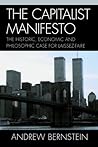
“[Capitalism's] critics argue on moral grounds; the supporters on economic grounds. The critics, wedded to a moral code of self-sacrifice, are oblivious to capitalism's practical success. The supporters, equally wedded to such a code, are morally disarmed against the onslaught of their antagonists — and are reduced to the citation of empirical facts and figures. The supporters, unable to break free of the conventional creed urging selflessness, have too often regarded capitalism's inherent pursuit of self-interest as a guilty secret, akin to an unsavory skeleton in a family closet.”
― The Capitalist Manifesto
― The Capitalist Manifesto
“There is, among several others, one very inconvenient truth for AGW theorists. For at least the past 240,000 years, Earth’s warming has preceded rising CO2 levels, not vice versa. Analyses of ice cores from Antarctica’s Vostok Glacier, for example, reveal that over the Earth’s past three glaciations and ensuing warmer periods, rising CO2 levels lag behind rising temperatures by several centuries.”
― The Truth About Climate Change: Is nature’s inherent dynamism responsible for the climate change of our era? Or are the cause(s) man-made?
― The Truth About Climate Change: Is nature’s inherent dynamism responsible for the climate change of our era? Or are the cause(s) man-made?
“Loyalty in action, regardless obstacles or challenges, to one’s most cherished values—this is the essence of moral rectitude—and it is the foundation of heroism.”
―
―
“We, the human race, must recognize the truth of—and embrace—the principle of color-blind individualism. We must acknowledge that race does not matter—that skin pigmentation, hair texture, facial bone structure, and so forth—signify zero regarding the only human attribute that does matter: Strength of character.
There is only one race—the human race.”
― American Racism: Its Decline, Its Baleful Resurgence, and Our Looming Race War
There is only one race—the human race.”
― American Racism: Its Decline, Its Baleful Resurgence, and Our Looming Race War
“The bad news is that, measured in terms of geologic time, if the Earth’s history is an accurate guide, glaciers will soon return to more southerly latitudes of the Northern Hemisphere.”
― The Truth About Climate Change: Is nature’s inherent dynamism responsible for the climate change of our era? Or are the cause(s) man-made?
― The Truth About Climate Change: Is nature’s inherent dynamism responsible for the climate change of our era? Or are the cause(s) man-made?