Goodreads helps you follow your favorite authors. Be the first to learn about new releases!
Start by following Brian P. Copenhaver.

Showing 1-7 of 7
“This hollow of the world, round like a sphere, cannot itself, become of its quality or shape, be wholly visible. Choose any place high on the sphere from which to look down, and you cannot see bottom from there. Because of this, many believe it has the same quality as place. They believe it is visible after a fashion, but only through shapes of the forms whose images seem to be imprinted when one shows a picture of it. In itself, however, the real thing remains always invisible. Hence, the bottom - {if it is a part or a place} in the sphere - is called Haides in Greek because in Greek 'to see' is idein, and there is no-seeing the bottom of a sphere. And the forms are called 'ideas' because they are visible forms. The (regions) called Haides in Greek because they are deprived of visibility are called 'infernal' in Latin because they are at the bottom of the sphere.
Such, then, are the original things, the primeval things, the sources or beginnings of all, as it were, for all are in them or from them or through them.”
― Hermetica: The Greek Corpus Hermeticum and the Latin Asclepius
Such, then, are the original things, the primeval things, the sources or beginnings of all, as it were, for all are in them or from them or through them.”
― Hermetica: The Greek Corpus Hermeticum and the Latin Asclepius
“If you are mindful, Asclepius, these things should seem true to you, but they will be beyond belief if you have no knowledge. To understand is to believe, and not to believe is not to understand. Reasoned discourse does get to the truth, but mind is powerful, and, when it has been guided by reason up to a point, it has the means to get the truth. After mind had considered all this carefully and had discovered that all of it is in harmony with the discoveries of reason, it came to believe, and in this beautiful belief it found rest. By an act of god, then, those who have understood find what I have been saying believable, but those who have not understood do not find it believable. Let this much be told about understanding and sensation.”
― Hermetica: The Greek Corpus Hermeticum and the Latin Asclepius
― Hermetica: The Greek Corpus Hermeticum and the Latin Asclepius
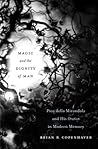
“To be free is to escape restraint. Style becomes manner, introspection breeds narcissism, asserting the self leads to exhibition. Fame decays into celebrity, public presence into publicity, public judgement is a noise in the street. The individual as subject becomes an ego. Yet this egotism, liberated by its illegitimacy from the discipline of family and community, makes a display of what unrestrained talent can attain - inviting others, whatever their birth or position, to do the same. If individualism is a demonic power, it is also a force for democracy.”
― Magic and the Dignity of Man: Pico della Mirandola and His Oration in Modern Memory
― Magic and the Dignity of Man: Pico della Mirandola and His Oration in Modern Memory
“If you are mindful, Asclepius, these things should seem true to you, but they will be beyond belief if you have no knowledge. To understand is to believe, and not to believe is not to understand. Reasoned discourse does [not] get to the truth, but mind is powerful, and, when it has been guided by reason up to a point, it has the means to get [as far as] the truth. After mind had considered all this carefully and had discovered that all of it is in harmony with the discoveries of reason, it came to believe, and in this beautiful belief it found rest. By an act of god, then, those who have understood find what I have been saying believable, but those who have not understood do not find it believable. Let this much be told about understanding and sensation.”
― Hermetica: The Greek Corpus Hermeticum and the Latin Asclepius
― Hermetica: The Greek Corpus Hermeticum and the Latin Asclepius
“To lead the soul through ascetic praxis to erotic ecstasy was the aim of Platonic spirituality, described immortally by Plotinus:
'Exulting like Bacchus ... straining upwards, ... and longing to break away from the body ... are emotions of souls under the spel of love .... The ancients teach that ... every virtue ... is purification .... In the soul's becoming a good and beautiful thing is its becoming like God.... Therefore we must ascend again towards the Good, the desired of every soul ... until, passing on the upward way all that is other than God, each in the solitude of himself shall behold that solitary-dwelling Existence, the Apart, the Unmingled, the Pure .... And one that shall know this vision - with what passion of love shall he not be seized, with what pang of desire, what longing to be molten into one with This, what wondering delight?'
Despite the sensual language, love's proper object is immaterial, and eros must escape the world in order to meld with the One.”
― Magic and the Dignity of Man: Pico della Mirandola and His Oration in Modern Memory
'Exulting like Bacchus ... straining upwards, ... and longing to break away from the body ... are emotions of souls under the spel of love .... The ancients teach that ... every virtue ... is purification .... In the soul's becoming a good and beautiful thing is its becoming like God.... Therefore we must ascend again towards the Good, the desired of every soul ... until, passing on the upward way all that is other than God, each in the solitude of himself shall behold that solitary-dwelling Existence, the Apart, the Unmingled, the Pure .... And one that shall know this vision - with what passion of love shall he not be seized, with what pang of desire, what longing to be molten into one with This, what wondering delight?'
Despite the sensual language, love's proper object is immaterial, and eros must escape the world in order to meld with the One.”
― Magic and the Dignity of Man: Pico della Mirandola and His Oration in Modern Memory
“Even sublimated ecstasy is unruly, however. Synesus, a Christian Neoplatonist studied by Ficino and known to Pico, therefore argued for a modified rapture that could sustain community, culture, and politics. To jump past human frailty straight to contemplation would be impulsive and ineffective. A rush to ecstasy would be barbarian, a 'Bacchic frenzy, a manic, enthusiastic leap to win the race without running it.' Synesius conceded that the mysteries aim 'not to learn anything but to have an experience and be put in a certain state.' Yet the Greek way of taking small steps, like going up a ladder, seemed better to him than a direct assault on the deity. Since humans are not pure contemplators, their best path to the visionary state would start with educated experience. To rise above all experience, both Greeks and barbarians cultivated cathartic virtues, but only Greeks like himself, according to Synesius, practiced them in a measured and effective way.”
― Magic and the Dignity of Man: Pico della Mirandola and His Oration in Modern Memory
― Magic and the Dignity of Man: Pico della Mirandola and His Oration in Modern Memory
“If you are mindful, Asclepius, these things should seem true to you, but they will be beyond belief if you have no knowledge. To understand is to believe, and not to believe is not to understand. Reasoned discourse does (not) get to the truth, but mind is powerful, and, when it has been guided by reason up to a point, it has the means to get (as far as) the truth. After mind had considered all this carefully and had discovered that all of it is in harmony with the discoveries of reason, it came to believe, and in this beautiful belief it found rest. By an act of god, then, those who have understood find what I have been saying believable, but those who have not understood do not find it believable. Let this much be told about understanding and sensation.”
― Hermetica: The Greek Corpus Hermeticum and the Latin Asclepius
― Hermetica: The Greek Corpus Hermeticum and the Latin Asclepius