Goodreads helps you follow your favorite authors. Be the first to learn about new releases!
Start by following Sasha Abramsky.

Showing 1-10 of 10
“Like a man who pinches himself to make sure he still has feeling, Chimen read to reassure himself that he was still alive.”
― The House of Twenty Thousand Books
― The House of Twenty Thousand Books
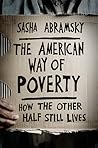
“As long as people think poverty is the problem,” Ganz explained, “they’re missing the whole point. Poverty is evidence of a problem; it’s not the source of the problem. They’re all based on the weakening of collective institutions—the decline of labor, of common interests. The core question is not about poverty, it’s really about democracy. The galloping poverty in the United States is evidence of a retreat from democratic beliefs and practices.”
― The American Way of Poverty: How the Other Half Still Lives
― The American Way of Poverty: How the Other Half Still Lives
“Poverty is, in other words, as diverse as the United States itself. What the poor have in common, however, is an increasingly precarious existence in a country seemingly unable—or at least unwilling—to come to grips with their collective despair.”
― The American Way of Poverty: How the Other Half Still Lives
― The American Way of Poverty: How the Other Half Still Lives
“Faith is a wondrous thing; it is not only capable of moving mountains, but also of making you believe that a herring is a race horse.”
― The House of Twenty Thousand Books
― The House of Twenty Thousand Books
“Pascal had formulated a famous wager in favor of the existence of God: If you bet there is no God and you are wrong, a wrathful deity is likely to condemn your eternal soul to hellfire; but if you gamble that there is a God and there is not, your consciousness will cease to exist upon your death and you will never know that you were wrong.”
― The House of Twenty Thousand Books
― The House of Twenty Thousand Books
“For while white conservatives use government assistance copiously--whether it be Social Security, or mortgage tax relief, low-interest federal college loans or Medicare--in their political discussions they tend to define their benefits as not being "welfare," in contrast to the somehow less noble assistance provided to their black and brown neighbors.”
―
―
“...the most successful eighth graders from poor economic backgrounds had only the same chance of attaining a bachelor's degree as the least successful eighth graders from the wealthiest echelon of society”
― The American Way of Poverty: How the Other Half Still Lives
― The American Way of Poverty: How the Other Half Still Lives
“In the decades after the Civil War, as bankrupt former Confederate states with a historical aversion to raising taxes tried to restore their public finances, priosner leasing became standard practice across the South. Not only did it negate the need to build large prisons but, since private companies essentially bought the right to prisoners' labor from the state, it also served to generate revenue.”
―
―
“The poor live on society's scraps--a few dollars in government assistance or charity, donated food, thrift-store clothes. They can afford neither transport to venture out of their communities nor simple luxuries such as movies or a cup of coffee with friends in a cafe. They cannot afford to vary the routines of their daily lives. Embarrassed by their poverty, worried about being judged failures in life, humiliated by that judgement, many told me they have essentially withdrawn from all but the most necessary, unavoidable social interactions,”
―
―
“How could so many people, believing so passionately in the language of universalism, so quick to latch onto the language of justice in their arguments, make such appalling political choices regarding whom they trusted and what political institutions they supported? . . . At least in part, the answer must remain somewhat metaphysical. It was the zeitgeist, the atmosphere of the times, the immediacy of history -- a time when history was seen as a living, breathing, pulsating entity . . . It was part of a search for certainty, unfathomable with hindsight but at the times was all too easy to fall into . . . For the writer Arthur Koestler, embracing Marxism allowed him to think that 'the whole universe falls into a pattern like the stray pieces of a puzzle assembled by magic at one stroke . . . Faith is a wondrous thing; it is not only capable of moving mountains, but also of making you believe that a herring is a race horse.”
― The House of Twenty Thousand Books
― The House of Twenty Thousand Books