Goodreads helps you follow your favorite authors. Be the first to learn about new releases!
Start by following T.R. Reid.

Showing 1-30 of 85
“The Universal Laws of Health Care Systems:
1. "No matter how good the health care in a particular country, people will complain about it"
2. "No matter how much money is spent on health care, the doctors and hospitas will argue that it is not enough"
3. "The last reform always failed”
― The Healing of America: A Global Quest for Better, Cheaper, and Fairer Health Care
1. "No matter how good the health care in a particular country, people will complain about it"
2. "No matter how much money is spent on health care, the doctors and hospitas will argue that it is not enough"
3. "The last reform always failed”
― The Healing of America: A Global Quest for Better, Cheaper, and Fairer Health Care
“A lot of what we "know" about other nations' approach to health care is simply myth.”
― The Healing of America: A Global Quest for Better, Cheaper, and Fairer Health Care
― The Healing of America: A Global Quest for Better, Cheaper, and Fairer Health Care
“For the mass prevention of disease, mass education is a key weapon.”
― The Healing of America: A Global Quest for Better, Cheaper, and Fairer Health Care
― The Healing of America: A Global Quest for Better, Cheaper, and Fairer Health Care
“One reason (though not the main one) is that American health care “providers”—doctors, nurses, hospitals, drug companies—make more money for what they do than their counterparts overseas do.”
― The Healing of America: A Global Quest for Better, Cheaper, and Fairer Health Care
― The Healing of America: A Global Quest for Better, Cheaper, and Fairer Health Care
“Von Köckritz’s entire higher education was free. She considers that perfectly normal—and in Europe, it is.”
― The Healing of America: A Global Quest for Better, Cheaper, and Fairer Health Care
― The Healing of America: A Global Quest for Better, Cheaper, and Fairer Health Care
“Believe me," Dr. Tamalet summed up, "if you wanted that operation in France, you could get it"
Which is, of course, the boon and the bane of France's health care system. It offers a maximum of free choice among skillful doctors and well-equipped hospitals, with little or not waiting, at bargain-basement prices [in out-of-pocket terms to the consumer]. It's a system that enables the French to live longer and healthier lives, with zero risk of financial loss due to illness. But somebody has to pay for all that high-quality, ready-when-you-need-it care--and the patients, so far, have not been willing to do so. As a result, the major health insurance funds are all operating at a deficit, and the costs of the health care system are increasing significantly faster than the economy as a whole. That's why the doctors keep striking and the sickness funds keep negotiating and the government keeps going back to the drawing board, with a new 'major health care reform' every few years. So far, the saving grace for France's system has been the high level of efficiency, as exemplified by the 'carte vitale,' that keeps administrative costs low--much lower than in the United States.”
― The Healing of America: A Global Quest for Better, Cheaper, and Fairer Health Care
Which is, of course, the boon and the bane of France's health care system. It offers a maximum of free choice among skillful doctors and well-equipped hospitals, with little or not waiting, at bargain-basement prices [in out-of-pocket terms to the consumer]. It's a system that enables the French to live longer and healthier lives, with zero risk of financial loss due to illness. But somebody has to pay for all that high-quality, ready-when-you-need-it care--and the patients, so far, have not been willing to do so. As a result, the major health insurance funds are all operating at a deficit, and the costs of the health care system are increasing significantly faster than the economy as a whole. That's why the doctors keep striking and the sickness funds keep negotiating and the government keeps going back to the drawing board, with a new 'major health care reform' every few years. So far, the saving grace for France's system has been the high level of efficiency, as exemplified by the 'carte vitale,' that keeps administrative costs low--much lower than in the United States.”
― The Healing of America: A Global Quest for Better, Cheaper, and Fairer Health Care
“When Americans fill a prescription, the price is routinely twice as much—sometimes ten times as much—as a Briton or a German would pay for precisely the same pills made in the same factory.”
― The Healing of America: A Global Quest for Better, Cheaper, and Fairer Health Care
― The Healing of America: A Global Quest for Better, Cheaper, and Fairer Health Care
“The award of an integrated circuit patent to Noyce evoked consternation, but not outright panic, at Texas Instruments. Kilby and his lawyers, after all, were veterans of the patent game; they knew that some applications move through the Patent Office faster than others, and that it is not particularly unusual for the second version of an invention to be the first patented. This happens so often, in fact, that the government has a special procedure—called an interference proceeding—and a special board—the Board of Patent Interferences—to consider the claims of inventors who find themselves in Kilby’s position. The basic rule governing an interference is that priority prevails—that is, whichever inventor can prove to have had the idea first gets the patent.”
― The Chip: How Two Americans Invented the Microchip and Launched a Revolution
― The Chip: How Two Americans Invented the Microchip and Launched a Revolution
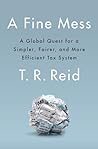
“By the mid-1980s, the tax code allowed depletion or depreciation allowances that cut taxes for cement companies, Christmas tree farms, apple orchards, gravel pits, railroad cars, rubber importers, cattle growers, and many, many more. There was even a depreciation allowance for human beings; professional sports teams were allowed to write off their players as “depreciable assets” as they slowed down with age.”
― A Fine Mess: A Global Quest for a Simpler, Fairer, and More Efficient Tax System
― A Fine Mess: A Global Quest for a Simpler, Fairer, and More Efficient Tax System
“Over time, Jack came to realize that if he approached a problem correctly, worked at it long enough, and refused to let initial failures get him down, he could find a solution. One”
― The Chip: How Two Americans Invented the Microchip and Launched a Revolution
― The Chip: How Two Americans Invented the Microchip and Launched a Revolution
“The great breakthrough that permitted man to count far beyond 10 with just ten different symbols was the invention of this turning point—a concept that mathematicians call positional notation. Positional notation means that each digit in a number has a particular value based on its position. In a decimal number, the first (farthest right) digit represents 1’s, the next digit 10’s, the next 100’s, and so on. The number 206 stands for six 1’s, no 10’s, and two 100’s: Add it all up: and you get 206. This number, incidentally, demonstrates why mathematicians consider the invention of a symbol that represents nothing (i.e., the number 0) to have been a revolutionary event in man’s intellectual history. Without zero, there would be no positional notation, because there would be no difference between 26 and 206 and 2,000,006. The Romans, for all their other achievements, never hit on the idea of zero and thus were stuck with a cumbersome system of M’s, C’s, X’s, and I’s which made higher math just about impossible. With”
― The Chip: How Two Americans Invented the Microchip and Launched a Revolution
― The Chip: How Two Americans Invented the Microchip and Launched a Revolution
“We’ve wasted our shining medical assets because of a health care payment system—or, more precisely, a crazy quilt of several overlapping and often conflicting systems—that prevents millions from receiving the treatment they need and that undermines the quality of care for millions more.”
― The Healing of America: A Global Quest for Better, Cheaper, and Fairer Health Care
― The Healing of America: A Global Quest for Better, Cheaper, and Fairer Health Care
“The income tax burden, he says, should fall more heavily on those who make their money on financial dealing; he says the U.S. system, in which the tax on capital gains is much lower than the tax on wages and salaries, is simply upside-down and thus counterproductive for dealing with the growth of inequality.”
― A Fine Mess: A Global Quest for a Simpler, Fairer, and More Efficient Tax System
― A Fine Mess: A Global Quest for a Simpler, Fairer, and More Efficient Tax System
“A consumption tax like the VAT is paid by everybody, including those who pay no income tax and those who are in the country illegally.”
― A Fine Mess: A Global Quest for a Simpler, Fairer, and More Efficient Tax System
― A Fine Mess: A Global Quest for a Simpler, Fairer, and More Efficient Tax System
“The crucial point is not how much somebody pays in taxes but rather how much she has left after paying. This biblical lesson has been invoked time and again to justify a tax code that calls on the rich to pay higher rates than the poor.”
― A Fine Mess: A Global Quest for a Simpler, Fairer, and More Efficient Tax System
― A Fine Mess: A Global Quest for a Simpler, Fairer, and More Efficient Tax System
“Switzerland, and the Netherlands, any resident can choose any insurance plan on the market—and change to a new plan on short notice. That’s a wider choice of health insurance than any American has.”
― The Healing of America: A Global Quest for Better, Cheaper, and Fairer Health Care
― The Healing of America: A Global Quest for Better, Cheaper, and Fairer Health Care
“According to their filings with the Securities and Exchange Commission, most for-profit insurance companies maintain a medical loss ratio of about 80 percent, which is to say that 20 cents of every dollar people pay in premiums for health insurance doesn’t buy any health care.”
― The Healing of America: A Global Quest for Better, Cheaper, and Fairer Health Care
― The Healing of America: A Global Quest for Better, Cheaper, and Fairer Health Care
“The burgeoning government sales not only provided profits for the chip makers but also conferred respectability. “From a marketing standpoint, Apollo and the Minuteman were ideal customers,” Kilby said. “When they decided that they could use these solid circuits, that had quite an impact on a lot of people who bought electronic equipment. Both of those projects were recognized as outstanding engineering operations, and if the integrated circuit was good enough for them, well, that meant it was good enough for a lot of other people.” One of the major pastimes among professional economists is an apparently endless debate as to whether military-funded research helps or hurts the civilian economy. As a general matter, there seem to be enough arguments on both sides to keep the debaters fruitfully occupied for years to come. In the specific case of the integrated circuit, however, there is no doubt that the Pentagon’s money produced real benefits for the civilian electronics business—and for civilian consumers. Unlike armored personnel carriers or nuclear cannon or zero-gravity food tubes, the electronic logic gates, radios, etc., that space and military programs use are fairly easily converted to earthbound civilian applications. The first chip sold for the commercial market—used in a Zenith hearing aid that went on sale in 1964—was the same integrated amplifier circuit used in the IMP satellite.”
― The Chip: How Two Americans Invented the Microchip and Launched a Revolution
― The Chip: How Two Americans Invented the Microchip and Launched a Revolution
“Some are rich, some are poor. Some are beautiful, some aren't. Some are brilliant, some aren't. But when we get sick - then everybody is equal. Everybody must have equal right to the best medical treatment we can provide. That is the basic rule of French health care. Surely, that's the basic rule of health care in every country. -pg 64”
―
―
“ALL THOSE ISSUES SHOULD be enough to demonstrate that the deduction for charitable contributions is costly, unfair, and easy to abuse. But there’s actually a more fundamental problem with this particular deduction: It doesn’t work.”
― A Fine Mess: A Global Quest for a Simpler, Fairer, and More Efficient Tax System
― A Fine Mess: A Global Quest for a Simpler, Fairer, and More Efficient Tax System
“If you want to know why modern man has settled on a base-10 number system, just spread your hands and count the digits. All creatures develop a number system based on their basic counting equipment; for us, that means our ten fingers. The Mayans, who went around barefoot, used a base-20 (vigesimal) number system; their calendars employ twenty different digits. The ancient Babylonians, who counted on their two arms as well as their ten fingers, devised a base-12 number system that still lives today in the methods we use to tell time and buy eggs. Someday a diligent grad student doing interdisciplinary work in mathematics and the history of film may produce a dissertation demonstrating that the residents of E.T.’s planet use an octal number system; the movie shows plainly that E.T. has eight fingers. For earthbound humans, however, the handy counting system is base-10.”
― The Chip: How Two Americans Invented the Microchip and Launched a Revolution
― The Chip: How Two Americans Invented the Microchip and Launched a Revolution
“By routing its manufacturing through a tiny factory in Puerto Rico, Microsoft saved over $4.5 billion in taxes on goods sold in the United States” over a three-year period.”
― A Fine Mess: A Global Quest for a Simpler, Fairer, and More Efficient Tax System
― A Fine Mess: A Global Quest for a Simpler, Fairer, and More Efficient Tax System
“Economic growth is not the sole aim of our society,” the Hall Report said. “The value of a human life must be decided without regard to . . . economic considerations. We must take into account the human and spiritual aspects involved.”
― The Healing of America: A Global Quest for Better, Cheaper, and Fairer Health Care
― The Healing of America: A Global Quest for Better, Cheaper, and Fairer Health Care
“In the 1960s, the corporate tax brought in about 33% of U.S. tax revenues. Today, the same tax provides less than 9% of revenues; that means individual taxpayers have to take up the slack and pay more.”
― A Fine Mess: A Global Quest for a Simpler, Fairer, and More Efficient Tax System
― A Fine Mess: A Global Quest for a Simpler, Fairer, and More Efficient Tax System
“Recently, there has been considerable public concern about the fact that 47% of Americans pay no income tax; the presidential candidate Mitt Romney opined that these are people “who are dependent upon government, who believe that they are victims, who believe the government has a responsibility to care for them. . . . These are people who pay no income tax.”
― A Fine Mess: A Global Quest for a Simpler, Fairer, and More Efficient Tax System
― A Fine Mess: A Global Quest for a Simpler, Fairer, and More Efficient Tax System
“Does the flat tax work?...The flat tax works in a country that is a former Communist state, with no investment capital, and low wage rates, which needs to build a capitalist economy from a base of approximately zero. The flat tax works if people are willing to pay a 20% sales tax on everything they buy to make up for lower revenue. The flat tax works if employers are willing to pay 34%, or more, in Social Security taxes for every employee they hire. The flat tax works in a country where almost everyone has the same amount of wealth so there's no need for the distributive effect of graduated rates. And if all these conditions are met, the flat-rate tax will probably work as long as the economy is on a path of steady growth.”
― A Fine Mess: A Global Quest for a Simpler, Fairer, and More Efficient Tax System
― A Fine Mess: A Global Quest for a Simpler, Fairer, and More Efficient Tax System
“The notion that government has to create a mechanism to provide medical care for all who are sick was born in the late 19th century in the very heart of Europe, in a newly created nation called German. - pg 55”
―
―
“The argument for a lower tax rate on capital income—an argument supported by many economists—runs as follows: (1) economies need capital investment to grow and create new jobs; (2) capital investment by definition is risky (you could lose it all); and (3) therefore, a lower rate of tax on potential gains is necessary to encourage people to make those essential, but risky, investments.”
― A Fine Mess: A Global Quest for a Simpler, Fairer, and More Efficient Tax System
― A Fine Mess: A Global Quest for a Simpler, Fairer, and More Efficient Tax System
“[Beveridge] was a driven man, right to the end; his last words, enunciated clearly from his death bed at the age of eighty-four, showed that the aging social reformer was still haunted by the memory of those sick men on the East London streets. 'I have a thousand things to do,' he said, and died.”
―
―
“The integrated circuit made its debut before electronic society at the New York Coliseum on March 24, 1959. The occasion was the industry’s most important yearly get-together—the annual convention of the Institute of Radio Engineers. Texas Instruments had managed, in the nick of time, to turn out a few chips that had no flying wires, and there was a lavish display at the TI booth featuring the new “solid circuits.” There was also a lavish prediction (which we know today to have been a massive understatement) from TI’s president, who said that Jack Kilby’s invention would prove to be the most important and must lucrative technological development since the silicon transistor. Nonetheless, the new circuit-on-a-chip received a frosty reception.”
― The Chip: How Two Americans Invented the Microchip and Launched a Revolution
― The Chip: How Two Americans Invented the Microchip and Launched a Revolution