Goodreads helps you follow your favorite authors. Be the first to learn about new releases!
Start by following Alison Gopnik.

Showing 1-30 of 51
“It’s not that children are little scientists — it’s that scientists are big children. Scientists actually are the few people who as adults get to have this protected time when they can just explore, play, figure out what the world is like.”
―
―
“Love doesn’t have goals or benchmarks or blueprints, but it does have a purpose. The purpose is not to change the people we love, but to give them what they need to thrive. Love’s purpose is not to shape our beloved’s destiny, but to help them shape their own. It isn’t to show them the way, but to help them find a path for themselves, even if the path they take isn’t one we would choose ourselves, or even one we would choose for them. The”
― The Gardener and the Carpenter: What the New Science of Child Development Tells Us About the Relationship Between Parents and Children
― The Gardener and the Carpenter: What the New Science of Child Development Tells Us About the Relationship Between Parents and Children
“Asking questions is what brains were born to do, at least when we were young children. For young children, quite literally, seeking explanations is as deeply rooted a drive as seeking food or water.”
―
―
“Knowledge guides emotion more than emotion distorts knowledge.”
― The Scientist in the Crib: What Early Learning Tells Us About the Mind
― The Scientist in the Crib: What Early Learning Tells Us About the Mind
“It’s not that children are little scientists but that scientists are big children.”
― The Scientist in the Crib: What Early Learning Tells Us About the Mind
― The Scientist in the Crib: What Early Learning Tells Us About the Mind
“So our job as parents is not to make a particular kind of child. Instead, our job is to provide a protected space of love, safety, and stability in which children of many unpredictable kinds can flourish. Our job is not to shape our children’s minds; it’s to let those minds explore all the possibilities that the world allows. Our job is not to tell children how to play; it’s to give them the toys and pick the toys up again after the kids are done. We can’t make children learn, but we can let them learn.”
― The Gardener and the Carpenter: What the New Science of Child Development Tells Us About the Relationship Between Parents and Children
― The Gardener and the Carpenter: What the New Science of Child Development Tells Us About the Relationship Between Parents and Children
“If the child is a budding psychologist, we parents are the laboratory rats.”
― The Scientist in the Crib: What Early Learning Tells Us About the Mind
― The Scientist in the Crib: What Early Learning Tells Us About the Mind
“Literature is the equivalent of the climate scientist’s computer simulations: set up some new starting conditions, run the whole complicated process and see what happens.”
―
―
“Imagine if we taught baseball the way we teach science. Until they were twelve, children would read about baseball technique and history, and occasionally hear inspirational stories of the great baseball players. They would fill out quizzes about baseball rules. College undergraduates might be allowed, under strict supervision, to reproduce famous historic baseball plays. But only in the second or third year of graduate school, would they, at last, actually get to play a game. If we taught baseball this way, we might expect about the same degree of success in the Little League World Series that we currently see in our children’s science scores.”
― The Gardener and the Carpenter: What the New Science of Child Development Tells Us About the Relationship Between Parents and Children
― The Gardener and the Carpenter: What the New Science of Child Development Tells Us About the Relationship Between Parents and Children
“We decided to become development psychologists and study children because there aren't any Martians. These brilliant beings with the little bodies and big heads are the closest we can get to a truly alien intelligence (even if we may occasionally suspect that they are bent on making us their slaves.)”
― The Scientist in the Crib: What Early Learning Tells Us About the Mind
― The Scientist in the Crib: What Early Learning Tells Us About the Mind
“Initially children use just a few names, mostly for familiar things and people. But when they are still just beginning to talk, many babies will suddenly start naming everything and asking for the names of everything they see. In fact, what’sat? is itself often one of the earliest words. An eighteen-month-old baby will go into a triumphant frenzy of pointing and naming: “What’sat! Dog! What’sat! Clock! What’sat juice, spoon, orange, high chair, clock! Clock! Clock!” Often this is the point at which even fondly attentive parents lose track of how many new words the baby has learned. It’s as if the baby discovers that everything has a name, and this discovery triggers a kind of naming explosion.”
― The Scientist in the Crib: What Early Learning Tells Us About the Mind
― The Scientist in the Crib: What Early Learning Tells Us About the Mind
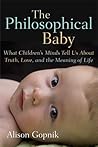
“I’ll show that babies, like scientists, use statistics and experiments to learn about the world.”
― The Philosophical Baby: What Children's Minds Tell Us About Truth, Love, and the Meaning of Life
― The Philosophical Baby: What Children's Minds Tell Us About Truth, Love, and the Meaning of Life
“From an evolutionary perspective, parenting isn't a good model for parents and children. Caring for children, nurturing them and investing in them, is absolutely critical for human thriving. Teaching children implicitly and explicitly is certainly important. But, from the point of view of evolution, trying to consciously shape how your children will turn out is both futile and self-defeating.”
―
―
“even toddlers know that rules should be followed but that they can be changed. These two capacities, capacities for love and law, for caring about others and following the rules, allow our characteristically human combination of moral depth and flexibility.”
― The Philosophical Baby: What Children's Minds Tell Us About Truth, Love, and the Meaning of Life
― The Philosophical Baby: What Children's Minds Tell Us About Truth, Love, and the Meaning of Life
“We decided to become developmental psychologists and study children because there aren't any Martians. These brilliant beings with the little bodies and big heads are the closest we can get to a truly alien intelligence (even if we may occasionally suspect that they are bent on making us their slaves.)”
― The Scientist in the Crib: What Early Learning Tells Us About the Mind
― The Scientist in the Crib: What Early Learning Tells Us About the Mind
“The most interesting thing about babies is that they are so enormously interested; the most wonderful thing about them is their infinite capacity for wonder.”
― The Scientist in the Crib: What Early Learning Tells Us About the Mind
― The Scientist in the Crib: What Early Learning Tells Us About the Mind
“..children only begin to understand differences in desires when they are about eighteen months old...Toddlers are systematically testing the dimensions on which their desires and the desires of others may be in conflict... The terrible twos reflects a genuine clash between children's need to understand other people and their need to live happily with them.”
― The Scientist in the Crib: What Early Learning Tells Us About the Mind
― The Scientist in the Crib: What Early Learning Tells Us About the Mind
“In fact, our brains are most active, and hungriest, in the first few years of life. Even as adults, our brains use a lot of energy: when you just sit still, about 20 percent of your calories go to your brain. One-year-olds use much more than that, and by four, fully 66 percent of calories go to the brain, more than at any other period of development. In fact, the physical growth of children slows down in early childhood to compensate for the explosive activity of their brains.”
― The Gardener and the Carpenter: What the New Science of Child Development Tells Us About the Relationship Between Parents and Children
― The Gardener and the Carpenter: What the New Science of Child Development Tells Us About the Relationship Between Parents and Children
“The very best outcome is that our children will end up as decent, independent adults who will regard us with bemused and tolerant affection; for them to continue to treat us with the passionate attachment of infancy would be pathological. Almost every hard decision of child-rearing, each tiny step—Should I let her cross the street? Can he walk to school yet? Should I look in her dresser drawer?—is about how to give up control, not how to increase it; how to cede power, not how to gain it.”
― The Scientist in the Crib: What Early Learning Tells Us About the Mind
― The Scientist in the Crib: What Early Learning Tells Us About the Mind
“Our brains are designed to arrive at an accurate picture of the world, and to use that accurate picture to act on the world effectively, at least overall and in the long run. The same computational and neurological capacities that let us make discoveries about physics or biology also let us make discoveries about love.”
― The Philosophical Baby: What Children's Minds Tell Us About Truth, Love, and the Meaning of Life
― The Philosophical Baby: What Children's Minds Tell Us About Truth, Love, and the Meaning of Life
“raising children is one of the most significant, meaningful, and profound experiences of their lives. Is this just an evolutionary illusion, a trick to make us keep on reproducing? I’ll argue that it’s the real thing, that children really do put us in touch with truth, beauty, and meaning.”
― The Philosophical Baby: What Children's Minds Tell Us About Truth, Love, and the Meaning of Life
― The Philosophical Baby: What Children's Minds Tell Us About Truth, Love, and the Meaning of Life
“In a groundbreaking study, Judith Smetana presented children as young as two and a half with simple, everyday scenarios. In some of the stories children broke a preschool rule—they didn’t put their clothes in the cubby or they talked at naptime. In others, they caused real physical or psychological harm to another child, by hitting, teasing, or stealing a snack. Smetana asked the children how bad the transgressions were, and whether they deserved punishment. But, most important, she asked whether the actions would be OK if the rules were different or if they took place in a school with different rules. Would it be OK to talk at naptime if the teachers all said so? Would it be OK to hit another child if the teachers all said so? Even the youngest children differentiated between rules and harm. Children thought that breaking rules and causing harm were both bad, but that causing harm was a lot worse. They also said that the rules could be changed or might not apply at a different school, but they insisted that causing harm would always be wrong, no matter what the rules said or where you were. Children made similar judgments about actual incidents that had happened in the preschool, not just hypothetical cases. And when you looked at the natural interactions in the playground you saw much the same pattern. Children reacted differently to harm and rulebreaking. Children in the Virgin Islands, South Korea, and Colombia behaved like American children. Poignantly, even abused children thought that hurting someone was intrinsically wrong. These children had seen their own parents cause harm, but they knew how much it hurt, and thought it was wrong.”
― The Philosophical Baby: What Children's Minds Tell Us About Truth, Love, and the Meaning of Life
― The Philosophical Baby: What Children's Minds Tell Us About Truth, Love, and the Meaning of Life
“And not incidentally, it came to give children a protected haven while their caregivers were, for the first time in human history, far away at work.”
― The Gardener and the Carpenter: What the New Science of Child Development Tells Us About the Relationship Between Parents and Children
― The Gardener and the Carpenter: What the New Science of Child Development Tells Us About the Relationship Between Parents and Children
“The dominant view was that children were essentially defective adults. They were defined by the things they didn’t know and couldn’t do.”
― The Scientist in the Crib: What Early Learning Tells Us About the Mind
― The Scientist in the Crib: What Early Learning Tells Us About the Mind
“The human mind is more like a hand than a Swiss Army knife. A human hand isn't designed to do any one thing in particular. But it is an exceptionally flexible and effective device for doing many things, including things we might never have imagined.”
― The Gardener and the Carpenter: What the New Science of Child Development Tells Us About the Relationship Between Parents and Children
― The Gardener and the Carpenter: What the New Science of Child Development Tells Us About the Relationship Between Parents and Children
“Like their parents, the Korean children used more verbs than the English-speaking kids, while the English-speaking kids used more nouns. But in addition, the Korean-speaking children learned how to solve problems like using the rake to get the out-of-reach toy well before the English-speaking children. English speakers, though, started categorizing objects earlier than the Korean speakers.”
― The Scientist in the Crib: What Early Learning Tells Us About the Mind
― The Scientist in the Crib: What Early Learning Tells Us About the Mind
“Toddlers turn everything from blocks to shoes to bowls of cereal into means of transportation by the simple expedient of saying “brrmbrrm” and pushing them along the floor.”
― The Philosophical Baby: What Children's Minds Tell Us About Truth, Love, and the Meaning of Life
― The Philosophical Baby: What Children's Minds Tell Us About Truth, Love, and the Meaning of Life
“historia. La ampliación de la niñez incluye no solo una prolongación de la primera infancia, sino también un periodo más largo de infancia intermedia y de adolescencia. Además, la infancia se hizo más larga a medida que los seres humanos evolucionaban. Los primeros homínidos, como el Homo erectus, ya caminaban erguidos, pero no tenían la prolongada infancia”
― ¿Padres jardineros o padres carpinteros?: Los últimos descubrimientos ciéntificos sobre cómo aprenden los niños
― ¿Padres jardineros o padres carpinteros?: Los últimos descubrimientos ciéntificos sobre cómo aprenden los niños
“Loving children doesn't give them a destination. It gives them sustenance for the journey.”
―
―
“All that really reaches us from the outside world is a play of colors and shapes, light and sound. Take the people around the table. We seem to see husbands and wives and friends and little brothers. But what we really see are bags of skin stuffed into pieces of cloth and draped over chairs.”
― The Scientist in the Crib: What Early Learning Tells Us About the Mind
― The Scientist in the Crib: What Early Learning Tells Us About the Mind