Goodreads helps you follow your favorite authors. Be the first to learn about new releases!
Start by following Stephen Wershing.

Showing 1-10 of 10
“As John Jantsch says in his book, The Referral Engine: Teaching Your Business to Market Itself, “Being recognized as a source of good information, including referrals, is a great way to connect with others. Think about how eagerly you responded the last time someone asked you for directions, offering up your favorite shortcut and tips for avoiding traffic. We all do it. Making referrals is a deeply satisfying way to connect with others, and asking for referrals is just the other side of the same phenomenon. I think the growth of many popular social networks can be traced to the fact that people love to connect and form communities around shared ideas.”1”
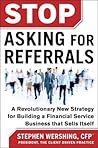
― Stop Asking for Referrals: A Revolutionary New Strategy for Building a Financial Service Business that Sells Itself
― Stop Asking for Referrals: A Revolutionary New Strategy for Building a Financial Service Business that Sells Itself
“In her survey of more than 1,000 clients who use financial advisors, one of the questions Littlechild asked was, “What were the circumstances of the last referral you gave to your advisor?” Half of the people said that they were asked specifically by a friend to recommend a financial advisor. Over half the people communicated some financial need for which the person knew his financial advisor had a solution. And how many people said that the circumstance of their last referral was that the advisor asked for it? Two percent, which is statistically equivalent to zero. Essentially no one gave a referral because the advisor asked for it. They gave a referral because their friend expressed a need, and they wanted to help (Figure 1.1). Most referral programs reflect a hunter mentality. We must go out and stalk and capture the referral. How do you suppose the prey feels in this relationship?”
― Stop Asking for Referrals: A Revolutionary New Strategy for Building a Financial Service Business that Sells Itself
― Stop Asking for Referrals: A Revolutionary New Strategy for Building a Financial Service Business that Sells Itself
“less an authority than financial advisor marketing expert Bill Good recognizes this, and he refuses to allow his salespeople to ask for referrals. As he puts it, “They manifestly do not work.”1 In fact, Good tells the story of an advisor who got a pesky client to stop calling him by asking for a referral each time she called!”
― Stop Asking for Referrals: A Revolutionary New Strategy for Building a Financial Service Business that Sells Itself
― Stop Asking for Referrals: A Revolutionary New Strategy for Building a Financial Service Business that Sells Itself
“In the past year, a book and a study were published that gave me insight into finding a better way. The study was “Anatomy of the Referral” by Julie Littlechild.5 In her survey of clients of financial advisors, she discovered that practically everyone who answered the question indicated that they were responding to the need of a friend. And, essentially, no one reported that it was because their advisor asked for it. This proved to me that asking is not the natural way referrals happen. The book was The Referral Engine, by John Jantsch.6 In it, Jantsch lays out how referrals happen, why we refer, and a host of ideas on how to stimulate referrals. With these ideas in hand, I did a lot more research on strategies that proved effective in attracting referrals. I incorporated these ideas into my work with financial advisors. The book you are holding is the product of what I have learned and what I have helped advisors to put into action. In her studies “The Economics of Loyalty” and “Anatomy of the Referral,” Julie Littlechild demonstrates that receiving referrals from clients has little statistical relationship to how or how often clients are asked. There is simply no clear straight line between asking clients for referrals the way we have been traditionally trained to do it and the best referrals you actually receive.”
― Stop Asking for Referrals: A Revolutionary New Strategy for Building a Financial Service Business that Sells Itself
― Stop Asking for Referrals: A Revolutionary New Strategy for Building a Financial Service Business that Sells Itself
“Referral consultant Paul McCord says, “The traditional method of ‘do a good job and ask for referrals’ does not give your client a reason to give you referrals. We make the assumption that if we have done a good job, the client will like and respect us and be willing to give us referrals. Again, this is far from the case. Most clients will not give good, quality referrals just because they like you or because you have done a good job for them. You must give them a reason to give you referrals. They need to understand why it is in their best interest to give you referrals.”7”
― Stop Asking for Referrals: A Revolutionary New Strategy for Building a Financial Service Business that Sells Itself
― Stop Asking for Referrals: A Revolutionary New Strategy for Building a Financial Service Business that Sells Itself
“In the past year, a book and a study were published that gave me insight into finding a better way. The study was “Anatomy of the Referral” by Julie Littlechild.5 In her survey of clients of financial advisors, she discovered that practically everyone who answered the question indicated that they were responding to the need of a friend. And, essentially, no one reported that it was because their advisor asked for it. This proved to me that asking is not the natural way referrals happen. The book was The Referral Engine, by John Jantsch.6 In it, Jantsch lays out how referrals happen, why we refer, and a host of ideas on how to stimulate referrals. With these ideas in hand, I did a lot more research on strategies that proved effective in attracting referrals. I incorporated these ideas into my work with financial advisors. The book you are holding is the product of what I have learned and what I have helped advisors to put into action. In her studies “The Economics of Loyalty” and “Anatomy of the Referral,” Julie Littlechild demonstrates that receiving referrals from clients has little statistical relationship to how or how often clients are asked. There is simply no clear straight line between asking clients for referrals the way we have been traditionally trained to do it and the best referrals you actually receive. In her survey of more than 1,000 clients who use financial advisors, one of the questions Littlechild asked was, “What were the circumstances of the last referral you gave to your advisor?”
― Stop Asking for Referrals: A Revolutionary New Strategy for Building a Financial Service Business that Sells Itself
― Stop Asking for Referrals: A Revolutionary New Strategy for Building a Financial Service Business that Sells Itself
“In his book, The New Art and Science of Referral Marketing, Scott Degraffenreid used social network analysis to examine why people make referrals. His study demonstrated something that makes intuitive sense—people refer to elevate their standing with their peers.2”
― Stop Asking for Referrals: A Revolutionary New Strategy for Building a Financial Service Business that Sells Itself
― Stop Asking for Referrals: A Revolutionary New Strategy for Building a Financial Service Business that Sells Itself
“Once you reflect on it, you will likely realize that you make referrals pretty regularly. Your clients do, too. They likely refer people to you more than you realize. In her study, “Anatomy of the Referral,”4 Julie Littlechild found that 91 percent of clients were comfortable providing a referral to their financial advisor, and 29 percent had made a referral. One of the primary questions she hoped to shed light on was why, when such a large majority of clients are comfortable providing referrals, “only” 29 percent actually did. It’s a good question, and she uncovered some answers I will address later on. In addition, I am intrigued by the 29 percent. Most of the advisors I know would be thrilled to receive referrals from almost a third of their client base. What portion of your client base do you think referred someone to you in the last year? If you asked, I bet a much larger proportion would tell you that they did. We will get back to this statistic in a little while. For now, let’s take a look at whether clients feel comfortable making a referral to you and why they would.”
― Stop Asking for Referrals: A Revolutionary New Strategy for Building a Financial Service Business that Sells Itself
― Stop Asking for Referrals: A Revolutionary New Strategy for Building a Financial Service Business that Sells Itself
“What we need is for clients to recall us when the opportunity to refer arises—and to mention us. We can build a strategy to help increase the odds that this will happen at those moments of truth. We can pursue a strategy to generate referrals without being in constant control of each referral, made when the time is right, for reasons that benefit the client if we understand the principles. In order to do this, we first need to understand how referrals happen.”
― Stop Asking for Referrals: A Revolutionary New Strategy for Building a Financial Service Business that Sells Itself
― Stop Asking for Referrals: A Revolutionary New Strategy for Building a Financial Service Business that Sells Itself
“In his book, The New Art and Science of Referral Marketing, Scott Degraffenreid used social network analysis to examine why people make referrals. His study demonstrated something that makes intuitive sense—people refer to elevate their standing”
― Stop Asking for Referrals: A Revolutionary New Strategy for Building a Financial Service Business that Sells Itself
― Stop Asking for Referrals: A Revolutionary New Strategy for Building a Financial Service Business that Sells Itself