Goodreads helps you follow your favorite authors. Be the first to learn about new releases!
Start by following Heinrich Meier.

Showing 1-8 of 8
“Strauss expressly refers to the “Notes.” He continues: “If ‘religion’ and ‘politics’ are the facts that transcend ‘culture’ or, to speak more exactly, are the original facts, then the radical critique of the concept of ‘culture’ is possible only in the form of a ‘theological-political treatise,’ which must, however, if it is not to lead again to the foundation of ‘culture,’ have the very opposite tendency to that of seventeenth-century theological-political treatises, especially those of Hobbes and Spinoza.”
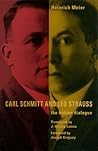
― Carl Schmitt and Leo Strauss: The Hidden Dialogue
― Carl Schmitt and Leo Strauss: The Hidden Dialogue
“Wenn das Leben bös von sich spricht, glaubt er der Unglaublichten nicht. Dagegen verführt die Weisheit dann am meisten, wenn sie von sich schlecht spricht. Die Weisheit gewinnt Zarathustra gerade durch ihre Fähigkeit zur Selbskritik. Dagegen findet das Leben keinen Glauben bei ihm, wenn es böse von sich redet, weil sein tiefster Glaube sagt, daß das Leben gut sei.”
― What Is Nietzsche's Zarathustra?: A Philosophical Confrontation
― What Is Nietzsche's Zarathustra?: A Philosophical Confrontation
“(6) The understanding that philosophers have of man is superficial: they are not able to fathom his depths, his despair, what is hidden in his craving for distraction and in the mood of boredom, which discloses more of man’s reality than all his rational activities.”
― Leo Strauss and the Theologico-Political Problem
― Leo Strauss and the Theologico-Political Problem
“In the second Unzeitgemäße Betrachtung Nietzsche speaks about “individuals who form a kind of bridge over the wild stream of becoming” and live in “timeless simultaneity” “thanks to history, which allows for such cooperation”; “they live as the republic of geniuses, of which Schopenhauer speaks somewhere.” Individuals live in timeless simultaneity insofar as they are inspired in turn “to the production of what is great” by the great individuals of the past, who are made present by the monumental consideration of history. Schopenhauer, who in his last work will make Rousseau’s motto, Vitam impendere vero, his own, using it as an epigraph, says about the republic of geniuses: “In this it goes as follows:—one giant calls out to another across the bleak interval of centuries, without the world of dwarfs, creeping along below, perceiving any more than noise and without understanding any more than that something is happening: and again, this tribe of dwarfs below ceaselessly pulls its pranks and makes a lot of noise, drags along what those giants have let fall from above, proclaims heroes who are themselves dwarfs, and more of the same, which leaves those giant minds undisturbed, to continue their elevated conversation of spirits. I mean: each genius understands what those of his kind once said, with- out being understood by the living, either contemporary or during the interval, and he says what those he lives among do not understand, but which someday his equal will appreciate and an- swer.” The agreement with Rousseau is obvious. Still, there are differences. Unlike Rousseau’s “inhabitants of the ideal world,” Schopenhauer’s “giants,” to judge by this short text, remain in their historical location. And neither Schopenhauer’s geniuses nor Nietzsche’s individuals are more specifically determined or more precisely identified by un signe caractéristique. Despite all his dissatisfactions with historicism, Schopenhauer’s speech about the conversation of spirits among the geniuses, which impressed the young Nietzsche on his way to philosophy, does not rise to the concise reply Rousseau gave to historicism in his allegory of the world of the philoso- phers.”
― On the Happiness of the Philosophic Life: Reflections on Rousseau's "Rêveries" in Two Books
― On the Happiness of the Philosophic Life: Reflections on Rousseau's "Rêveries" in Two Books
“The Nemo contra hominem nisi homo ipse could not be in sharper conflict with the doctrine of original sin, and the way in which the Promethean self-authorization and self-salvation attacked by Schmitt behaves towards it is no less evident; for the will of man to lead his life based entirely on his own resources and his own efforts, following reason alone and his own judgment—that is the original sin: man's impudence does not begin when he believes that he can make anything and everything, but rather when he forgets that there is nothing that he may do on his own authority, i.e., outside of the realm of obedience. The romantic is defined by Schmitt as the virtual embodiment of the incapacity to make the demanding moral decision; the romantic, like the bourgeois in general, would like to adjourn and postpone the decision forever; the "higher third" to which he appeals when confronted with a choie is in truth "not a higher but another third, i.e., always the way out in the fact of the Either-Or"; however, the matter does not rest there: religion, morality, and politics are for him nothing but "vehicles for his romantic interests" or just so many occasions to develop comprehensively his brilliant ego, which he raises to the "absolute center"; the romantic wants to defend the sovereignty of his limitless subjectivism against the seriousness of the political-theological reality inasmuch as he plays off one reality against the other, "never deciding in this intrigue of realities"; the romantic ego, which usurps God's place as the "final instance," lives in a "world without substance and without functional commitment, without firm guidance, without conclusion, and without definition, without decision, without a last judgment, continuing on without end, led only by the magic hand of chance"; the "secularization of God as a brilliant subject" conjures up a world in which all religious, moral, and political distinctions dissolve "into an interesting multitude of interpretations" and certainty evaporates into arbitrariness.”
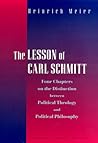
― The Lesson of Carl Schmitt: Four Chapters on the Distinction between Political Theology and Political Philosophy
― The Lesson of Carl Schmitt: Four Chapters on the Distinction between Political Theology and Political Philosophy
“When Leo Strauss disparages a world that is merely entertaining and interesting, he does so because the men in that world remain far beneath the potential of their nature and are capable of actualizing neither their most noble nor their most excellent faculties. He rejects the illusory security of a status quo of comfort and ease because a life that does not subject itself to the danger of radical questioning and the exertion of self-examination appears to him to be not worth living. A comfortable, cosy interior hinders liberation from the cave and ascent into the open. Strauss rejects the homogeneous world-state because he recognizes it as the state of Nietzsche's "last man" and because he sees the end of the particular political community as followed by the end of philosophy on earth.”
― Carl Schmitt and Leo Strauss: The Hidden Dialogue
― Carl Schmitt and Leo Strauss: The Hidden Dialogue
“The need of theory is supported by the eros of the philosopher. It is not the expression of his will to conquer nature. Therefore, the joys of contemplation are "immediate enjoyments," joys that belong intrinsically to contemplation, and they come without further setting of goals or justification to the one receptive to them. They are not tied to social use, neither dependent upon the opinion of others nor gained from the expectation of future glory. The love for the observation of nature, for the observation of the details of the structure in which nature becomes comprehensible, of the order in which nature is articulated, of the spectacle nature provides for one who takes an interest in its objects, who lets its forms, colors, and sounds affect him, this love accords with the love of oneself. Both discourage highfalutin plans to change the world by the transformation of nature. Both impose moderation on the philosopher. He will be especially adequate to his desire to "contribute" something "to this beautiful system" by his conceiving it as a "system" and as "beautiful." The contribution most his own is that he has the whole in view; that he sees things and beings within the horizon of the whole, that he investigates and orders them as parts, that he knows himself as a part and reflects on his relation to the whole or that he poses the question of the whole. But if he wants to keep the question of the whole in view, he may not lose himself. To conceive the "beautiful system," he must devote himself to it in detail and again return to himself. To be able to observe nature, he may not blend into it. Observation requires both proximity and distance.”
― On the Happiness of the Philosophic Life: Reflections on Rousseau's "Rêveries" in Two Books
― On the Happiness of the Philosophic Life: Reflections on Rousseau's "Rêveries" in Two Books
“The most outspoken rebellion need not be the most threatening, nor the most conspicuous enmity, the most decisive. It is rather unlikely that Satan will display his power most prominently where he is celebrated as the eternal rebel and world-liberator in the battle against God and State or where he, as in the Satanism of a Baudelaire, is formally enthroned with the fratricide Cain. Truly satanic is—there is no doubt about it for Schmitt—the flight into invisibility. The Old Enemy prefers cunning, he is a virtuoso of disguise. He will attempt to avoid the open battle and will hardly enlist under his own flag. Instead of declaring war on someone or something, if not "war on itself," he is much more likely to promise peace and will make every effort to lull his adversary into a false sense of security.”
― The Lesson of Carl Schmitt: Four Chapters on the Distinction between Political Theology and Political Philosophy
― The Lesson of Carl Schmitt: Four Chapters on the Distinction between Political Theology and Political Philosophy