Goodreads helps you follow your favorite authors. Be the first to learn about new releases!
Start by following Susanne K. Langer.

Showing 1-9 of 9
“Most new discoveries are suddenly seen things that were always there.”
―
―
“The assignment of meanings [in music] is a shifting, kaleidoscopic play, probably below the threshold of consciousness, certainly outside the pale of discursive thinking. The imagination that responds to music is personal and associative and logical, tinged with affect, tinged with bodily rhythm, tinged with dream, but concerned with a wealth of formulations for its wealth of wordless knowledge, its whole knowledge of emotional and organic experience, of vital impulse, balance, conflict, the ways of living and dying and feeling.”
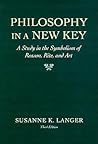
― Philosophy in a New Key: A Study in the Symbolism of Reason, Rite, and Art
― Philosophy in a New Key: A Study in the Symbolism of Reason, Rite, and Art
“Nature, as man has always known it, he knows no more.
Since he has learned to esteem signs above symbols, to suppress his emotional reactions in favor of practical ones and make use of nature instead of holding so much of it sacred, he has altered the face, if not the heart, of reality.”
― Philosophy in a New Key: A Study in the Symbolism of Reason, Rite, and Art
Since he has learned to esteem signs above symbols, to suppress his emotional reactions in favor of practical ones and make use of nature instead of holding so much of it sacred, he has altered the face, if not the heart, of reality.”
― Philosophy in a New Key: A Study in the Symbolism of Reason, Rite, and Art
“To trace the development of mind from earliest times...requires...not a categorical concept, but a functional one.... The most promising operational principle for this purpose is the principle of individuation.[p. 310]" "[yet she also says:]...we have no physical model of this endless rhythm of individuation and involvement, we do have its image in the world of art, most purely in dance;...this dialectic of vital continuity...[p. 355]”
― Mind: An Essay on Human Feeling [Abridged Edition]
― Mind: An Essay on Human Feeling [Abridged Edition]
“Real thinking is possible only in the light of genuine language, no matter how limited, how primitive;”
― Philosophy in a New Key: A Study in the Symbolism of Reason, Rite, and Art
― Philosophy in a New Key: A Study in the Symbolism of Reason, Rite, and Art
“The reaction on the part of the apes, limited as it was to about one subject in every three or four, has just that character of being common, yet individual, that belongs to aesthetic experiences. Some are sensitive to the sight, and the rest are not; to some of them it seems to convey something -- to others it is just a thing, a toadstool or what you will.”
―
―
“The world of physics is essentially the real world construed by mathematical abstractions, and the world of sense is the real world construed by the abstractions which the sense-organs immediately furnish. To suppose that the "material mode" is a primitive and groping attempt at physical conception is a fatal error in epistemology.”
― Philosophy in a New Key: A Study in the Symbolism of Reason, Rite, and Art
― Philosophy in a New Key: A Study in the Symbolism of Reason, Rite, and Art
“Even the subjective record of sense experience, the "sense-image," is not a direct copy of actual experience, but has been "projected," in the process of copying, into a new dimension, the more or less stabile form we call a picture. It has not the protean, mercurial elusiveness of real visual experience, but a unity and lasting identity that makes it an object of the mind's possession rather than a sensation. Furthermore it is not firmly and fixedly determined by the pattern of natural phenomena, as real sensations are, but is "free," in the same manner as the little noises which a baby produces by impulse and at will. We can call up images and let them fill the virtual space of vision between us and real objects, or on the screen of the dark, and dismiss them again, without altering the course of practical events. They are our own product, yet not part of ourselves as our physical actions are; rather might we compare them with our uttered words (save that they remain entirely private) , in that they are objects to us, things that may surprise, even frighten us, experiences that can be contemplated, not merely lived.
In short, images have all the characteristics of symbols. If they were weak sense-experiences, they would confuse the order of nature for us. Our salvation lies in that we do not normally take them for bona fide sensations, but attend to them only in their capacity of meaning things, being images of things — symbols whereby those things are conceived, remembered, considered, but not encountered.”
― PHILOSOPHY IN A NEW KEY A Study of the Symbolism of Reason, Rite and Art
In short, images have all the characteristics of symbols. If they were weak sense-experiences, they would confuse the order of nature for us. Our salvation lies in that we do not normally take them for bona fide sensations, but attend to them only in their capacity of meaning things, being images of things — symbols whereby those things are conceived, remembered, considered, but not encountered.”
― PHILOSOPHY IN A NEW KEY A Study of the Symbolism of Reason, Rite and Art
“Sheer self-expression requires no artistic form. A lynching-party howling round the gallows-tree, a woman wringing her hands over a sick child, a lover who has just rescued his sweetheart in an accident and stands trembling, sweating, and perhaps laughing or crying with emotion, is giving vent to intense feelings; but such scenes are not occasions for music, least of all for composing. Not even a theme, "translating an impression of keenest sorrow," is apt to come to a man, a woman, or a mob in a moment when passionate self-expression is needed. The laws of emotional catharsis are natural laws, not artistic. Verbal responses like "Ah!" "Oh-oh!" are not creations, but speech-habits ; even the expressiveness of oaths rests not on the fact that such words were invented for psycho-cathartic purposes, but that they are taboo, and the breaking of a taboo gives emotional release. Breaking a vase would do better still.”
― PHILOSOPHY IN A NEW KEY A Study of the Symbolism of Reason, Rite and Art
― PHILOSOPHY IN A NEW KEY A Study of the Symbolism of Reason, Rite and Art