Goodreads helps you follow your favorite authors. Be the first to learn about new releases!
Start by following Mary R. Lefkowitz.

Showing 1-7 of 7
“...the absence of certainty does not mean that one interpretation is as valid as any other. Probabilities and plausibilities matter; and when the evidence is less precise or less tangible than we would like it to be, some explanations are still more likely than others.”
―
―
“a filthy liar, an enemy to justice, a lawless monster, who turns everything upside-down and back again, with his double tongue, transforming friends to enemies and back.”
― The Greek Plays: Sixteen Plays by Aeschylus, Sophocles, and Euripides
― The Greek Plays: Sixteen Plays by Aeschylus, Sophocles, and Euripides
“Overjoyed at the public recognition of their achievement, their mother stood before the statue of the goddess and prayed to her to grant Cleobis and Biton, the sons who had brought her such honor, the greatest blessing that can befall mortals. After her prayer, when they had sacrificed and feasted, the two sons lay down to sleep in the temple and never rose again. They”
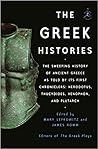
― The Greek Histories: The Sweeping History of Ancient Greece as Told by Its First Chroniclers: Herodotus, Thucydides, Xenophon, and Plutarch
― The Greek Histories: The Sweeping History of Ancient Greece as Told by Its First Chroniclers: Herodotus, Thucydides, Xenophon, and Plutarch
“There is a current tendency, at least among academics, to regard history as a form of fiction that can and should be written differently by each nation or ethnic group. The assumption seems to be that somehow all versions will simultaneously be true, even if they conflict in particular details. According to this line of argument, Afrocentric ancient history can be treated not as pseudohistory but as an alternative way of looking at the past. It can be considered as valid as the traditional version, and perhaps even more valid because of its moral agenda.”
― Not Out of Africa: How Afrocentrism Became an Excuse to Teach Myth as History
― Not Out of Africa: How Afrocentrism Became an Excuse to Teach Myth as History
“CHORUS: Many are the wonders, the terrors,*28 and none is more wonderful, more terrible than man. He makes his way, this prodigy, over the dim gray sea, riding the blast of the south wind, the swells of the deep cleaving before him; he wears away the Earth, mightiest of gods, imperishable, unwearied— his plows turn her over and over, year 340 after year his mules plod on and on. antistrophe 1 And he has cast his nets about the race of lighthearted birds and the tribes of wild beasts and the swarms bred in the depths of the sea— gathers them all in his woven coils, over-clever man! And his inventions master the beast of field 350 and crag—the shaggy-maned horse and weariless mountain bull bow beneath his yoke. strophe 2 And now he’s taught himself language and thought swift as the wind, and how to live in cities, shunning exposure on the open hills, the rain spearing down from heaven; he’s ready 360 for anything—nothing finds him unready. Death alone he will not escape. And yet he has contrived ways to defeat intractable disease. antistrophe 2 With his ingenious art, clever beyond hope, he presses on now to evil, now to good. Allowing the laws of the land and the sworn justice of the gods their place in the scheme 370 of things, he is high in his city. But he whose daring moves him to evil has no city at all. May he never share my hearth, never share my thoughts, a man who acts this way!”
― The Greek Plays: Sixteen Plays by Aeschylus, Sophocles, and Euripides
― The Greek Plays: Sixteen Plays by Aeschylus, Sophocles, and Euripides
“But I pray that civil strife with its endless greed for evil never takes a loud stand in this city. 980 May the dust never guzzle the citizens’ black blood. May lust for revenge never seize in its arms disaster for the city of murdering back and forth. May the people trade joy for joy in concord, in communion, and hate with one spirit— which is good against all sorts of human ailments.”
― The Greek Plays: Sixteen Plays by Aeschylus, Sophocles, and Euripides
― The Greek Plays: Sixteen Plays by Aeschylus, Sophocles, and Euripides
“they engage our emotions and our moral sense in the same way that the epic poems of Homer do, for indeed those poems, the Iliad in particular, were the primary model with which the first Greek historian, Herodotus, worked.”
― The Greek Histories: The Sweeping History of Ancient Greece as Told by Its First Chroniclers: Herodotus, Thucydides, Xenophon, and Plutarch
― The Greek Histories: The Sweeping History of Ancient Greece as Told by Its First Chroniclers: Herodotus, Thucydides, Xenophon, and Plutarch