Goodreads helps you follow your favorite authors. Be the first to learn about new releases!
Start by following Gary North.

Showing 1-15 of 15
“The negative penalties of the Old Testament case laws were not harsh but just, not a threat to society but rather the necessary judicial foundation of civic freedom… the Old Testament was harsh on criminals because it was soft on victims.”
― Victim's Rights: The Biblical View of Civil Justice
― Victim's Rights: The Biblical View of Civil Justice
“When you criticize someone with followers, the followers recognize that, if you are correct, they have been sucked in. If they had been sucked in, then they must not be too bright, or at least they were not well enough informed to form a critical judgment which would have led them to identify their leader as someone not worth following. So, a criticism of the leader produces a particular response in the followers. They feel that there has been an attack on them personally. The critic is saying, loud and clear, that anyone who has followed this particular leader is not a good judge of character, intellect, or facts. They are quite correct. This is exactly what the critic is saying.”
―
―
“Grape juice at the communion table symbolizes the historical impotence of Christ’s blood, Christ’s gospel, Christ’s church, and Christ’s expanding kingdom. Grape juice stays ‘bottled up’, confined to the historical skins of Palestine.”
―
―
“There is no doubt that Christianity teaches pluralism, but a very special kind of pluralism: plural institutions under God's single comprehensive law system. It does not teach a pluralism of law structures, or a pluralism of moralities, for this sort of hypothetical legal pluralism (as distinguished from institutional pluralism) is always either polytheistic or humanistic...”
― Political Polytheism: The Myth of Pluralism
― Political Polytheism: The Myth of Pluralism
“A state that claims to be a savior of mankind necessarily becomes the final judge of mankind.”
―
―
“To challenge humanism in any field, you must possess a uniquely biblical view of God, man, law, and time.”
― Rapture Fever: Why Dispensationalism Is Paralyzed
― Rapture Fever: Why Dispensationalism Is Paralyzed
“The basis for building a Christian society is evangelism and missions that lead to a widespread Christian revival, so that the great mass of earth's inhabitants will place themselves under Christ's protection, and then voluntarily use his covenantal laws for self-government. Christian reconstruction begins with personal conversion to Christ and self-government under God's law; then it spreads to others through revival; and only later does it bring comprehensive changes in civil law, when the vast majority of voters voluntarily agree to live under biblical blueprints.”
―
―
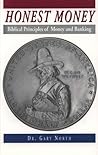
“The trouble is, nobody knows exactly how the world really works. We are all fallible people with limited knowledge. It is only through Biblical revelation from the One who knows how the world really works because He made it and actively sustains it that anyone can come to a competent understanding of the world.”
― Honest Money: Biblical Principles of Money and Banking
― Honest Money: Biblical Principles of Money and Banking
“If you don't know what money is, how will you obtain more of it?”
― What Is Money?
― What Is Money?
“Creator and Sustainer. Men are to make their own mistakes and successes. Each man is to work out his salvation (or damnation) in fear and trembling (Philippians 2:12). Other men are to sit in judgment over him only when he commits public evil. They are not to command him as imitation gods. They are not to issue comprehensive commands and monitor him constantly. That is God’s job, not man’s. Thus, God’s hierarchy produces social freedom. It relieves mankind from any pretended autonomy from God’s total sovereignty. Men are not to seek to create predestinating hierarchies. They can leave their fellow men alone, so long as God’s institutional laws are obeyed in public.”
― Liberating Planet Earth: An Introduction To Biblical Blueprints
― Liberating Planet Earth: An Introduction To Biblical Blueprints
“201 years after the deception was ratified by representatives of the states, who created a new covenant and a new nation by their collective act of ratification-incorporation. This new covenant meant a new god. The ratification of the United States Constitution in 1787–88 was not an act of covenant renewal. It was an act of covenant-breaking: the substitution of a new covenant in the name of a new god.”
― Conspiracy in Philadelphia
― Conspiracy in Philadelphia
“But a few of the heirs rail against the humanistic historians who have told the story of the new American nation: a “grand experiment” in which the God of the Bible was first formally and publicly abandoned by any Western nation. They have argued that there was no deception, that America is still a Christian nation, that the Constitution “in principle” was and remains a Christian document, and it is only the nefarious work of the U.S. Supreme Court and the American Civil Liberties Union that has stripped the Constitution of its original Christian character. There is no greater deception than one which continues to deceive the victims, over two centuries after the deed was done.”
― Conspiracy in Philadelphia
― Conspiracy in Philadelphia
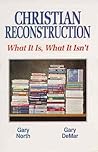
“There are millions of Christians today (and in the past) who have denied the obvious implications of such a view of God's earthly kingdom. Nevertheless, very few of them have been ready to deny its theological premises. If you ask them this question — "What area of life today is not under the effects of sin?" — they give the proper answer: none. They give the same answer to the next question: "What area of sin-filled life will be outside of the comprehensive judgment of God at the final judgment?"
But when you ask them the obvious third question, they start squirming: "What area of life today is outside of the legitimate effects of the gospel in transforming evil into good, or spiritual death into life?" The answer is obviously the same — none — but to admit this, modern pietistic Christians would have to abandon their pietism.
What is pietism? Pietism preaches a limited salvation: "individual soul-only, family-only, church-only." It rejects the very idea of the comprehensive redeeming power of the gospel, the transforming power of the Holy Spirit, and the comprehensive responsibility of Christians in history. In this rejection of the gospel's political and judicial effects in history, the pietists agree entirely with modern humanists. There is a secret alliance between them. Christian Reconstruction challenges this alliance. This is why both Christians and humanists despise it.”
― Christian Reconstruction: What It Is, What It Isn't
But when you ask them the obvious third question, they start squirming: "What area of life today is outside of the legitimate effects of the gospel in transforming evil into good, or spiritual death into life?" The answer is obviously the same — none — but to admit this, modern pietistic Christians would have to abandon their pietism.
What is pietism? Pietism preaches a limited salvation: "individual soul-only, family-only, church-only." It rejects the very idea of the comprehensive redeeming power of the gospel, the transforming power of the Holy Spirit, and the comprehensive responsibility of Christians in history. In this rejection of the gospel's political and judicial effects in history, the pietists agree entirely with modern humanists. There is a secret alliance between them. Christian Reconstruction challenges this alliance. This is why both Christians and humanists despise it.”
― Christian Reconstruction: What It Is, What It Isn't
“I have adopted what I call
a "fat book" strategy. A movement that seeks to change the
world cannot make its claims believable with only short books.
The world is much too large and much too complex to be
capable of being restructured in terms of large-print, thin paperback
books - the only kind of books that most Christians
read these days. The best that any movement can expect to
achieve if it publishes only short books is to persuade readers
that the world cannot be changed.”
― Leviticus: An Economic Commentary
a "fat book" strategy. A movement that seeks to change the
world cannot make its claims believable with only short books.
The world is much too large and much too complex to be
capable of being restructured in terms of large-print, thin paperback
books - the only kind of books that most Christians
read these days. The best that any movement can expect to
achieve if it publishes only short books is to persuade readers
that the world cannot be changed.”
― Leviticus: An Economic Commentary
“Nothing is more unpopular today than the free market economy, i.e., capitalism.” It ended with these words: “Not mythical ‘material productive forces,’ but reason and ideas determine the course of human affairs. What is needed to stop the trend towards socialism and despotism is common sense and moral courage.” More than any other”
― Mises on Money
― Mises on Money