Goodreads helps you follow your favorite authors. Be the first to learn about new releases!
Start by following George Weller.
Showing 1-4 of 4
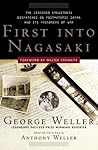
“The Chicago Daily News Foreign Service presents herewith the first attempt to recount historically one of the great American tragedies of the Pacific War: how more than 1,600 American officers and enlisted men, prisoners of the Japanese and survivors of the defenses of Bataan, Corregidor, and Mindanao, were reduced to about 300 survivors alive today. These Americans, having lived through nearly three years of Japanese prison camps, died in the course of a broken journey seven weeks long from Bilibid Prison in Manila to a chain of prison camps in Kyushu, southern Japan. They died of Japanese bullets and American bombs, of suffocation, dehydration, disease, starvation and murder. Some went insane.”
― First Into Nagasaki: The Censored Eyewitness Dispatches on Post-Atomic Japan and Its Prisoners of War
― First Into Nagasaki: The Censored Eyewitness Dispatches on Post-Atomic Japan and Its Prisoners of War
“On the afternoon of August 9, hearing the news that Nagasaki had been bombed, Emperor Hirohito called an imperial conference at which his ministers debated the wisdom of surrender. After hours of talk, at 2 a.m. Hirohito stated that he felt Japan should accept the terms of the Potsdam Declaration, terms of surrender proposed in late July by Truman (who had only become president on Roosevelt’s death in April). But Potsdam called for the emperor to step down; and his ministers insisted that their acceptance depended on Hirohito being allowed to remain as sovereign—an astute demand that would ensure a sense of national exoneration. James F. Byrnes, the U.S. secretary of state, did not deal directly with this, and on August 14 Japan surrendered at Hirohito’s command. The next day, the entire country heard with astonishment the first radio broadcast from a supreme ruler, now telling them squeakily, in the antiquated argot of the imperial court, that he was surrendering to save all mankind “from total extinction.” Until then, Japan’s goal had been full, all-out war, as a country wholly committed; any Japanese famously preferred to die for the emperor rather than to surrender. (One hundred million die together! was the slogan.) Today the goal was surrender: all-out peace. It was the emperor’s new will. Later that day a member of his cabinet, over the radio, formally denounced the United States for ignoring international law by dropping the atomic bombs. In 1988, on the forty-seventh anniversary of the Japanese attack on Pearl Harbor, when the mayor of Nagasaki accused Hirohito of responsibility for the war and its numerous atrocities, he inadvertently stirred up petitions for his own impeachment, and nationwide protests and riots calling for his assassination. A month afterward, in January 1989, Hirohito died at age eighty-seven, still emperor of Japan. Eleven days later the mayor, whom the Nagasaki police were no longer protecting, was shot in the back. He barely survived.”
― First Into Nagasaki: The Censored Eyewitness Dispatches on Post-Atomic Japan and Its Prisoners of War
― First Into Nagasaki: The Censored Eyewitness Dispatches on Post-Atomic Japan and Its Prisoners of War
“The owner of the coal mines, Baron Takaharu Mitsui (1900–1983), a graduate of Dartmouth College in New Hampshire and world famous as a philatelist, was head of one of the two most powerful industrial families in Japan (along with Mitsubishi), and among the wealthiest men in the country. His mines produced half of its coal, though those at Omuta had been closed down in the 1920s as unsafe. He was well aware of the work and living conditions of the POWs, having visited the camp several times in his open touring car. Like other companies that used Allied prisoners as slave labor—Mitsubishi, Nippon Steel, Kawasaki—Mitsui paid the Japanese army a leasing fee per prisoner of two yen per day (above the average Japanese daily income), and the army kept the money. Though the prisoners were supposedly being paid a wage that was a minuscule fraction of this, very few ever received anything.”
― First Into Nagasaki: The Censored Eyewitness Dispatches on Post-Atomic Japan and Its Prisoners of War
― First Into Nagasaki: The Censored Eyewitness Dispatches on Post-Atomic Japan and Its Prisoners of War
“Beyond the deprivations, degradations, and tortures these prisoners endured, each man often recounts how he got to the camps Weller visited. These conflicts, and all they implied, would have been instantly recognizable to the 1945 public. Many of the Dutch and the British, the Australians and Canadians, were taken in the defeats of Singapore (130,000), Java (32,000), and Hong Kong (14,000). Many of the Americans got captured on Guam or Wake; or in the Philippines (75,000), to then endure the Bataan death march, on which one in four died. Some built the Siam-Burma railroad, which claimed yet another 15,000 lives, same ratio. Nearly everywhere, in a hurry, the Japanese won and the Allies lost. The United States saw its navy smashed at Pearl Harbor and its Pacific air forces wiped out in Manila, just before MacArthur got himself safely out to Australia. This litany of early military disasters added up to astonishing numbers. In a mere six months the Japanese, at a cost of only 15,000 of their own men (deaths and casualties), took 320,000 Allied soldiers out of the war, either as deaths, casualties, or prisoners; over half these were Asiatic. White prisoners, about 140,000 total over the course of the conflict, became slave labor across the growing Japanese empire. (Asiatic prisoners were often turned loose, as good propaganda among the subjugated peoples.) Japan had not signed the 1929 Geneva Conventions regarding treatment of prisoners of war, and a Japanese soldier would sooner be killed than captured: thus every enemy soldier who surrendered was a coward, a cur, a thing. Any notion of “inhumane treatment” toward a surrendered Chinese, much less a white man, was incomprehensible. White men were the foe, so their role was to work, then die. Whether their deaths proved painful did not matter to the Japanese. Unlike the Nazi POW camps, there were few escape attempts, for it was obvious to any Allied POW in Asia that a white face was an immediate giveaway even had he succeeded, and the Japanese made it clear that they would execute ten men for every man who escaped. Statistically it was seven times healthier to be a POW under the Nazis than under the Japanese. By war’s end, one out of every three white prisoners had died as their captives—“starved to death, worked to death, beaten to death, dead of loathsome epidemic diseases that the Japanese would not treat,” as Daws puts it. Another year of war and there would have been no POWs still alive. (A Japan War Ministry directive of August 1944 iterated that “the aim is to annihilate them all, and not to leave any traces.”)”
― First Into Nagasaki: The Censored Eyewitness Dispatches on Post-Atomic Japan and Its Prisoners of War
― First Into Nagasaki: The Censored Eyewitness Dispatches on Post-Atomic Japan and Its Prisoners of War