Goodreads helps you follow your favorite authors. Be the first to learn about new releases!
Start by following George Friedman.

Showing 1-30 of 144
“In Geo-Politics, a nation has no permanent allies or permanent enemies, only permanent interests.”
―
―
“Anger does not make history. Power does. And power may be supplemented by anger, but it derives from more fundamental realities; geography, demographics, technology, and culture.”
― The Next 100 Years: A Forecast for the 21st Century
― The Next 100 Years: A Forecast for the 21st Century
“The computer focuses ruthlessly on things that can be represented in numbers. In so doing, it seduces people into thinking that other aspects of knowledge are either unreal or unimportant. The computer treats reason as an instrument for achieving things, not for contemplating things. It narrows dramatically what we know and intended by reason.”
― The Next 100 Years: A Forecast for the 21st Century
― The Next 100 Years: A Forecast for the 21st Century
“America is in the earliest phase of its power. It is not fully civilized. America, like Europe in the sixteenth century, is still barbaric (a description, not a moral judgment). Its culture is unformed. Its will is powerful. Its emotions drive it in different and contradictory directions. Cultures live in one of three states. The first state is barbarism. Barbarians believe that the customs of their village are the laws of nature and that anyone who doesn’t live the way they live is beneath contempt and requiring redemption or destruction. The third state is decadence. Decadents cynically believe that nothing is better than anything else. If they hold anyone in contempt, it is those who believe in anything. Nothing is worth fighting for. Civilization is the second and most rare state. Civilized people are able to balance two contradictory thoughts in their minds. They believe that there are truths and that their cultures approximate those truths. At the same time, they hold open in their mind the possibility that they are in error. The combination of belief and skepticism is inherently unstable. Cultures pass through barbarism to civilization and then to decadence, as skepticism undermines self-certainty Civilized people fight selectively but effectively.”
― The Next 100 Years: A Forecast for the 21st Century
― The Next 100 Years: A Forecast for the 21st Century
“A century is about events. A decade is about people.”
― The Next Decade: Where We've Been . . . and Where We're Going
― The Next Decade: Where We've Been . . . and Where We're Going
“Strategy is something that emerges from reality, while tactics might be chosen.”
―
―
“President Obama dropped the term 'war on terror', and rightly so. Terrorism is not an enemy but a type of warfare that may or may not be adopted by an enemy. Imagine if, after Pearl Harbor, an attack that relied on aircraft carriers, President Roosevelt had declared a global war on naval aviation. By focusing on terrorism instead of al Qaeda or radical Islam, Bush elevated a specific kind of assault to a position that shaped American global strategy, which left the United States strategically off-balance.
Obama may have clarified the nomenclature, but he left in place a significant portion of the imbalance, which is an obsession with the threat of terrorist attacks. As we consider presidential options in the coming decade, it appears imperative that we clear up just how much of a threat terrorism actually presents and what that threat means for U.S. policy.”
― The Next Decade: Where We've Been . . . and Where We're Going
Obama may have clarified the nomenclature, but he left in place a significant portion of the imbalance, which is an obsession with the threat of terrorist attacks. As we consider presidential options in the coming decade, it appears imperative that we clear up just how much of a threat terrorism actually presents and what that threat means for U.S. policy.”
― The Next Decade: Where We've Been . . . and Where We're Going
“The great presidents never forget the principle of the republic and seek to preserve and enhance them – in the long run– without undermining the needs of the moment. Bad presidents simply do what is expedient, heedless of principles. But the worst presidents are those who adhere to the principles regardless of what the fortunes of the moment demand.”
― The Next Decade: Where We've Been . . . and Where We're Going
― The Next Decade: Where We've Been . . . and Where We're Going
“America is a country in which the storm is essential to clear the way for the calm. Because Americans, obsessed with the present and future, have difficulty remembering the past, they will all believe that there has never been a time as uncivil and tense as this one.”
― The Storm Before the Calm: America's Discord, the Coming Crisis of the 2020s, and the Triumph Beyond
― The Storm Before the Calm: America's Discord, the Coming Crisis of the 2020s, and the Triumph Beyond
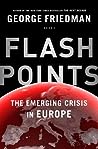
“Elsewhere I have argued that civilizations are divided into three phases. The first phase is barbarism, a time when people believe that the laws of their own village are the laws of nature, as George Bernard Shaw put it. The second phase is civilization, where people continue to believe in the justice of their ways but harbor openness to the idea that they might be in error. The third phase, decadence, is the moment in which people come to believe that there is no truth, or that all lies are equally true.”
― Flashpoints: The Emerging Crisis in Europe
― Flashpoints: The Emerging Crisis in Europe
“Here is the irony: Europe dominated the world, but it failed to dominate itself. For five hundred years Europe tore itself apart in civil wars, and as a result there was never a European empire—there was instead a British empire, a Spanish empire, a French empire, a Portuguese empire, and so on.”
― The Next 100 Years: A Forecast for the 21st Century
― The Next 100 Years: A Forecast for the 21st Century
“It has always struck me as the world's great fortune that the two great superpowers were the United States and the Soviet Union, who managed the Cold War with meticulous care in retrospect. Imagine the European diplomats of 1914 or 1938 armed with nuclear weapons. It is easy to believe they would not have been as cautious.”
―
―
“The reality is that the American people have no desire for an empire. This is not to say that they don't want the benefits, both economic and strategic. It simply means that they don't want to pay the price. Economically, Americans want the growth potential of open markets but not the pains. Politically, they want to have an enormous influence, but not the resentment of the world. Military, they want to be protected from dangers but not to bear the burdens of long-term strategy.”
― The Next Decade: Where We've Been . . . and Where We're Going
― The Next Decade: Where We've Been . . . and Where We're Going
“The foundation of any empire is not guns, something that Hitler and Stalin never grasped. It is money, and the envy that brings. But more important than money or guns is the technology that represents the future and the culture that speaks of being contemporary. All lasting empires are empires of the mind and soul, empires that cause others to crave to emulate them.”
― The Storm Before the Calm: America's Discord, the Coming Crisis of the 2020s, and the Triumph Beyond
― The Storm Before the Calm: America's Discord, the Coming Crisis of the 2020s, and the Triumph Beyond
“This highlights the single most important geopolitical fact in the world: the United States controls all of the oceans. No other power in history has been able to do this. And that control is not only the foundation of America’s security but also the foundation of its”
― The Next 100 Years: A Forecast for the 21st Century
― The Next 100 Years: A Forecast for the 21st Century
“There are many who predict that China is the next challenger to the United States, not Russia. I don’t agree with that view for three reasons. First, when you look at a map of China closely, you see that it is really a very isolated country physically. With Siberia in the north, the Himalayas and jungles to the south, and most of China’s population in the eastern part of the country, the Chinese aren’t going to easily expand. Second, China has not been a major naval power for centuries, and building a navy requires a long time not only to build ships but to create well-trained and experienced sailors. Third, there is a deeper reason for not worrying about China. China is inherently unstable. Whenever it opens its borders to the outside world, the coastal region becomes prosperous, but the vast majority of Chinese in the interior remain impoverished.”
― The Next 100 Years: A Forecast for the 21st Century
― The Next 100 Years: A Forecast for the 21st Century
“When you drill down and see the forces that are shaping nations, you can see that the menu from which they choose is limited.”
― The Next 100 Years: A Forecast for the 21st Century
― The Next 100 Years: A Forecast for the 21st Century
“... common sense is the one thing that will certainly be wrong.”
― The Next 100 Years: A Forecast for the 21st Century
― The Next 100 Years: A Forecast for the 21st Century
“Psychologically, the United States is a bizarre mixture of overconfidence and insecurity. Interestingly, this is the precise description of the adolescent mind, and that is exactly the American condition in the twenty-first century. The world’s leading power is having an extended adolescent identity crisis, complete with incredible new strength and irrational mood swings. Historically, the United States is an extraordinarily young and therefore immature society. So at this time we should expect nothing less from America than bravado and despair. How else should an adolescent feel about itself and its place in the world? But if we think of the United States as an adolescent, early in its overall history, then we also know that, regardless of its self-image, adulthood lies ahead. Adults tend to be more stable and more powerful than adolescents. Therefore, it is logical to conclude that America is in the earliest phase of its power. It is not fully civilized. America, like Europe in the sixteenth century, is still barbaric (a description, not a moral judgment). Its culture is unformed. Its will is powerful. Its emotions drive it in different and contradictory directions. Cultures live in one of three states. The first state is barbarism. Barbarians believe that the customs of their village are the laws of nature and that anyone who doesn’t live the way they live is beneath contempt and requiring redemption or destruction. The third state is decadence. Decadents cynically believe that nothing is better than anything else. If they hold anyone in contempt, it is those who believe in anything. Nothing is worth fighting for. Civilization is the second and most rare state. Civilized people are able to balance two contradictory thoughts in their minds. They believe that there are truths and that their cultures approximate those truths. At the same time, they hold open in their mind the possibility that they are in error. The combination of belief and skepticism is inherently unstable. Cultures pass through barbarism to civilization and then to decadence, as skepticism undermines self-certainty Civilized people fight selectively but effectively. Obviously all cultures contain people who are barbaric, civilized, or decadent, but each culture is dominated at different times by one principle.”
― The Next 100 Years: A Forecast for the 21st Century
― The Next 100 Years: A Forecast for the 21st Century
“Presidents and other politicians manage the appearance of things, largely by manipulating the air and hope.”
― The Next Decade: Where We've Been . . . and Where We're Going
― The Next Decade: Where We've Been . . . and Where We're Going
“The kind of president we need has little to do with ideology and more to do with a willingness to wield power to moral ends.”
― The Next Decade: Where We've Been . . . and Where We're Going
― The Next Decade: Where We've Been . . . and Where We're Going
“Europeans have always thought of U.S. presidents as either naive, as they did with Jimmy Carter, or as cowboys, as they did with Lyndon Johnson, and held them in contempt in either case.”
―
―
“Building a naval power takes generations, not so much to develop the necessary technology as to pass along the accumulated experience that creates good admirals.”
― The Next Decade: Where We've Been . . . and Where We're Going
― The Next Decade: Where We've Been . . . and Where We're Going
“the United States has a single core policy in Eurasia—preventing any power from dominating Eurasia or part of it. If China weakens or fragments and the Europeans are weak and divided, the United States will have a fundamental interest: avoiding general war, by keeping the Russians focused on the Balts and Poles, unable to think globally.”
― The Next 100 Years: A Forecast for the 21st Century
― The Next 100 Years: A Forecast for the 21st Century
“While you and I are allowed the luxury of our pain, president isn't. A president must take into account how his citizens feel and he must manage them and lead them, but he must not succumb to personal feelings. His job is to maintain a ruthless sense of proportion while keeping the coldness of his calculation to himself.”
― The Next Decade: Where We've Been . . . and Where We're Going
― The Next Decade: Where We've Been . . . and Where We're Going
“Long-term solutions are more attractive and cause much less controversy than short-term solutions, which will affect people who are still alive and voting.”
― The Next Decade: Where We've Been . . . and Where We're Going
― The Next Decade: Where We've Been . . . and Where We're Going
“Technocrats live their lives abstractly, even while they are managing their own sphere. For them, all problems are intellectual. You must think constantly, and that thinking makes action possible. Once you have thought, the doing simply follows. Reason leads to language, and the battleground of the technocrat is language. If the language is reshaped, so will be the action. Political correctness, as it’s called, is the manner in which the technocrats as the ascendant class reshaped the world. The tension of the technocracy is between their work in their own fields and the universal principles that they practice. This shows itself most clearly in the way they deal with the declining class, the heavily white, industrial working class. In the thinking of the technocracy, the fundamental cause of oppression is whites who have historically oppressed using race, nationality, and gender. But the technocrats draw a sharp distinction between themselves (predominantly white) who are at least engaged in a struggle to transcend oppression in thought and speech and those whites who continue to practice it. This declining class is plunging economically, but for the technocracy, which embraces a vast range of incomes, that decline is not of the essence. It is their unwillingness to abandon oppression.”
― The Storm Before the Calm: America's Discord, the Coming Crisis of the 2020s, and the Triumph Beyond
― The Storm Before the Calm: America's Discord, the Coming Crisis of the 2020s, and the Triumph Beyond
“The selection process at the best schools is presently designed not to find the best minds but rather to find minds already shaped to the culture and ideology the universities regard as being able to benefit from their education.”
― The Storm Before the Calm: America's Discord, the Coming Crisis of the 2020s, and the Triumph Beyond
― The Storm Before the Calm: America's Discord, the Coming Crisis of the 2020s, and the Triumph Beyond
“And from this story I learned about the geopolitics of taking out one’s salami.”
― Flashpoints: The Emerging Crisis in Europe
― Flashpoints: The Emerging Crisis in Europe
“I had a son in 1976. When I went to Europe, I met an Italian and we became friends. We would talk about what we would tell our families to do if the balloon went up. The conversation -- strange and perhaps pathological as it was -- bound us together. It was not war, it was not peace, but it was a place in the mind where the preparation for war and the anxiety that it generated created strange forms, such as plans for the movement of children in order to avoid a nuclear holocaust.”
―
―