Goodreads helps you follow your favorite authors. Be the first to learn about new releases!
Start by following Joyce Vance.

Showing 1-12 of 12
“There is a world of difference between a president who makes lawful policy choices that you or I may disagree with and a president who brazenly exceeds the powers that Article II of the Constitution assigns to the office he temporarily holds.”
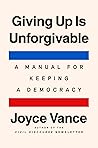
― Giving Up Is Unforgivable: A Manual for Keeping a Democracy
― Giving Up Is Unforgivable: A Manual for Keeping a Democracy
“But I learned that there was no higher honor than serving the people of the United States and nothing I wanted to do more. Even after leaving the Justice Department—I resigned the night before Trump’s first inauguration in 2017—I felt, and continue to feel, an obligation to share what I had the privilege of learning about our justice system and our democratic institutions during my time in government. But ultimately, it’s an educated public capable of informed civil discourse that sustains effective, fair government. Accountability happens when citizens demand it. Sometimes, they must demand it loudly and persistently. This is undoubtedly one of those moments. Putting these”
― Giving Up Is Unforgivable: A Manual for Keeping a Democracy
― Giving Up Is Unforgivable: A Manual for Keeping a Democracy
“In April 2025, the case of a Salvadoran man, Kilmar Armando Abrego Garcia, came to the Supreme Court after the government deported him despite the existence of an order prohibiting them from doing that because he had a credible fear he would face serious persecution. It was an “administrative error,” the government told the Court. The Supreme Court did not go as far as it could have; there was no inquiry into whether the administration intentionally violated the order. But a unanimous Supreme Court—something we don’t see too often these days—ordered the Trump administration to “facilitate” Abrego Garcia’s return from Salvadoran custody to the United States. Ultimately, it falls to the courts to stand for the rule of law when it is under attack. They must do so if it’s to hold.”
― Giving Up Is Unforgivable: A Manual for Keeping a Democracy
― Giving Up Is Unforgivable: A Manual for Keeping a Democracy
“Lawyers talk about “the practice” of law. We are “practicing” because we are constantly learning more, developing our skills, and getting better at it. We learn from our mistakes. We work harder. We get it right. We continue to practice. As Americans, we should treat democracy the same way: the practice of democracy, something we do together as Americans. When we make mistakes, even big ones, we can learn from them. We dig deeper so we can fix them. We get back to work. But what we cannot do is give up.”
― Giving Up Is Unforgivable: A Manual for Keeping a Democracy
― Giving Up Is Unforgivable: A Manual for Keeping a Democracy
“If imitation is the sincerest form of flattery, then Madison was Montesquieu’s greatest admirer. He wrote in Federalist 47, “The accumulation of all powers, legislative, executive, and judiciary, in the same hands, whether of one, a few, or many, and whether hereditary, self-appointed, or elective, may justly be pronounced the very definition of tyranny.” Those words from history might have felt rote, even irrelevant, just a few years ago, too obvious to even a casual observer as to require any reflection. But of course, it is not a few years ago. We are watching what Madison would call “the very definition of tyranny,” the effort to consolidate the power of the executive branch—while suppressing Congress, the courts, and the press—in one set of hands, those of an American president. The importance of separating power among three branches of government has never been more apparent. If there is a magic bullet for preserving democracy, it is this: prevent any one branch of government from holding too much power, especially power that the Constitution specifically gives to another branch of government. Democratic state attorneys general understood this when they joined forces and began heading into court over some of the early executive orders in 2025. The lawsuits, which involved matters including birthright citizenship, federal funding freezes and grant cancellations, DOGE access to information in possession of the Treasury Department, firing federal workers, DOGE’s constitutionality, and dramatic reductions of personnel and services at the Department of Education, asked the courts to prevent the president from seizing an outsize share of power for himself. Although the cases involved different substantive issues, their unifying goal was to restrict the president’s power to what the Founding Fathers directed in the Constitution. Various plaintiffs, including state attorneys general, civil rights groups, pro-democracy organizations, federal employees, and other individuals harmed by the administration’s actions, filed more than one hundred lawsuits in just the first two months that the new administration was in operation. More were filed after that, particularly as Trump’s deportation plans heated up. At the heart of these cases was an effort to protect the system envisioned by Montesquieu’s trias politica.”
― Giving Up Is Unforgivable: A Manual for Keeping a Democracy
― Giving Up Is Unforgivable: A Manual for Keeping a Democracy
“governance and civil society.” Just ask the recipients of programs administered by USAID who found them suddenly ripped away. The malnourished children who required the food that was left to rot on shelves. Or the older people who required oxygen and other medical assistance to stay alive but did not get it. Ask the career federal employees who lost their jobs and, instead of being thanked for their public service, suffered the additional insult of being labeled unnecessary waste by DOGE. As National Public Radio’s Scott Detrow explained in an interview on All Things Considered, “The choice to unilaterally dissolve a federal agency, one established by Congress, was a shock to Washington. But the concept at the heart of it—that the president has broad authority to act unilaterally without consequence, that the executive branch should reflect his priorities—stems from one idea, the unitary executive theory.” Donald Trump took it and ran with it.”
― Giving Up Is Unforgivable: A Manual for Keeping a Democracy
― Giving Up Is Unforgivable: A Manual for Keeping a Democracy
“They were also an attack on the court system itself and on its ability to function as a check against an overly ambitious president as the Founding Fathers had intended.”
― Giving Up Is Unforgivable: A Manual for Keeping a Democracy
― Giving Up Is Unforgivable: A Manual for Keeping a Democracy
“Make no mistake: The Founding Fathers did believe in a powerful executive. But they emphasized, at the same time, that a president must be accountable. The Federalist Papers may seem to some to be the stuff of dry history. It’s time to change that. There is a lot they can teach us that matters today if we’re going to hold on to democracy. The Founding Fathers expected the courts and Congress to act as a check on the presidency, not to succumb to it. Consider the power of the president to make foreign treaties and agreements. The founders concluded that power should be shared with the Senate. In Federalist 75, Hamilton wrote: It must indeed be clear to a demonstration that the joint possession of the power in question, by the President and Senate, would afford a greater prospect of security, than the separate possession of it by either of them. There was real appetite at the time of the founding to carefully allocate power and impose checks and balances because the colonists were done with the rule of kings. That plays out differently today, especially when the same party controls the White House and one or both bodies in Congress. There was that standout country-over-party moment during Watergate when Nixon’s criminal conduct had been exposed and Senate Republicans turned their backs on him. But that approach is not the rule. These days, a Senate majority aligned with a president will confirm almost anyone a president puts up for confirmation. When the Senate majority belongs to the opposition, even excellent nominees are rejected.”
― Giving Up Is Unforgivable: A Manual for Keeping a Democracy
― Giving Up Is Unforgivable: A Manual for Keeping a Democracy
“Federalist 47, “The accumulation of all powers, legislative, executive, and judiciary, in the same hands, whether of one, a few, or many, and whether hereditary, self-appointed, or elective, may justly be pronounced the very definition of tyranny.”
― Giving Up Is Unforgivable: A Manual for Keeping a Democracy
― Giving Up Is Unforgivable: A Manual for Keeping a Democracy
“If there is a magic bullet for preserving democracy, it is this: prevent any one branch of government from holding too much power, especially power that the Constitution specifically gives to another branch of government. P 15”
― Giving Up Is Unforgivable: A Manual for Keeping a Democracy
― Giving Up Is Unforgivable: A Manual for Keeping a Democracy
“Project 2025 became so unpopular when it was aired in public that Trump took pains to distance himself from it during the campaign. That maneuver largely succeeded. Then”
― Giving Up Is Unforgivable: A Manual for Keeping a Democracy
― Giving Up Is Unforgivable: A Manual for Keeping a Democracy
“The question that began to present itself was whether the fundamental values that underlie our system of government”
― Giving Up Is Unforgivable: A Manual for Keeping a Democracy
― Giving Up Is Unforgivable: A Manual for Keeping a Democracy