Goodreads helps you follow your favorite authors. Be the first to learn about new releases!
Start by following Moshe Halbertal.

Showing 1-7 of 7
“The distinction between political esotericism and substantive esotericism creates two different meanings for biblical language. Sociopolitical esotericism perceives the biblical parable as an allegory, whose hidden content lends itself to direct conceptual expression. In contrast, the essential concept of esotericism sees the biblical parable as a symbol, whose hidden content cannot be formulated directly in conceptual language. According to this understanding, the esoteric mode of writing and speaking in indirect and allusive way is not the product of a strategy that philosophy adopts vis-à-vis society; it is, rather, the essential nature of the philosophical realm.”
― Maimonides: Life and Thought
― Maimonides: Life and Thought
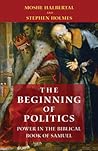
“Whether attained by craft or by chance, great power has a way of defining the person who wields it. Finding themselves venerated by those around them, the supremely powerful almost inevitably begin to worship themselves.”
― The Beginning of Politics: Power in the Biblical Book of Samuel
― The Beginning of Politics: Power in the Biblical Book of Samuel
“Between the collapse of the utopian ideology of God’s kingship on the one hand and the refusal to deify the king on the other, a semiautonomous sphere of human politics was born. God is not the king, and the king will be accepted only so long as he renounces all claims to be a god.”
― The Beginning of Politics: Power in the Biblical Book of Samuel
― The Beginning of Politics: Power in the Biblical Book of Samuel
“In his letter to Joseph, Maimonides described what he believed to be the motives and abilities of his rival: I knew and it was evident to me when I wrote [Mishneh Torah] that it without doubt would fall into the hands of malevolent and jealous men who would disparage its merits, seeing it as unnecessary or flawed; and into the hands of foolish and naïve men who would not understand what it was about and think it of little use; and into the hands of silly and confused novices who would question it because of their lack of knowledge or limited ability to replicate my reasoning; and into the hands of those who consider themselves to be God-fearing yet are stupid and will be critical of what is included in the code concerning fundamentals of faith. (Iggerot, p. 301)”
― Maimonides: Life and Thought
― Maimonides: Life and Thought
“When trying to convey God’s perspective on the establishment of human sovereignty in the form of dynastic monarchy, the author employed the following tone: I did not recommend that decision. It wasn’t the initial plan I had for you. Human kingship was your choice, which you insisted upon even after being warned. You wanted it and I couldn’t refuse you. So let us see how it unfolds, and what it means. And what will be my place in it. God’s ambivalence toward the political realm permeates the book with its nuanced and exploratory yet smolderingly critical force. Precisely because of its uncomfortable ambivalence, therefore, the Book of Samuel sets forth the proper attitude that should be assumed toward the political project as a whole. Illuminated from this systematically ambivalent stance, politics is seen as an overpowering human necessity that can never fully escape a potentially self-defeating betrayal at its very core.”
― The Beginning of Politics: Power in the Biblical Book of Samuel
― The Beginning of Politics: Power in the Biblical Book of Samuel
“At the heart of politics lies an existential urge for physical security, and the people proved willing and even eager to relinquish whatever unsupervised freedom and entitlements they enjoyed in the state of divine anarchy, and to surrender to a political sovereign who will freely tax and conscript them so long as he can also safeguard them from their pitiless enemies.”
― The Beginning of Politics: Power in the Biblical Book of Samuel
― The Beginning of Politics: Power in the Biblical Book of Samuel
“book’s central themes: the essential ambiguity of political motivation and political action, the inherent pettiness of the power game, the tendency for political power, once attained, to be redirected toward retaining political power, the ruler’s need to manipulate his public image, the centrality of blame-avoidance and blame-shifting to the exercise of sovereignty, how the possession of great power affects the ends that power wielders pursue, and the way power tends to imprison those who most ardently seek it.”
― The Beginning of Politics: Power in the Biblical Book of Samuel
― The Beginning of Politics: Power in the Biblical Book of Samuel