Goodreads helps you follow your favorite authors. Be the first to learn about new releases!
Start by following Brad Weismann.

Showing 1-9 of 9
“Horror requires an almost musical sense of editing, a firm grip on the rhythm of tension, shock, and release. That rhythm is already present in Wiene’s films.”
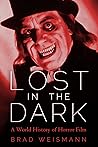
― Lost in the Dark: A World History of Horror Film
― Lost in the Dark: A World History of Horror Film
“Expressionism was an artistic symptom of the trauma World War I brought to Europe. A stylized, severe, and serious aesthetic, it emphasized abstractions and angles, an attempt to express off-kilter and intense emotional content rather than balanced, symmetric, mundane realism. Caligari production supervisor Rudolph Meinert enlisted artists Hermann Warm, Walter Reimann, and Walter Rohrig to create a completely artificial and exaggerated set design for Caligari. They painted all the settings in flat perspective on the canvas, including bolts of light and shadow. Everything, even outdoor scenes, was shot inside cramped studio confines. The result was a claustrophobic style that was to permeate not only the horror film, but would percolate into film noir as well. The style is nightmarish, a physical embodiment of the madness overtaking the characters externalized, an artistic effort that’s a sustained attack on the senses that’s just as disturbing as the story it tells—the result? The first great horror film.”
― Lost in the Dark: A World History of Horror Film
― Lost in the Dark: A World History of Horror Film
“feature horror film was built component by component. Of the 1,100-plus silent horror films he lists as made between 1896 and 1929, the majority are shorts. (And most of them are lost films, including gems such as 1915’s A Cry in the Night, which features “a winged gorilla under the control of a mad scientist.” This screams for a remake, does it not?)”
― Lost in the Dark: A World History of Horror Film
― Lost in the Dark: A World History of Horror Film
“Many of film’s future Golden Age directors—Maurice Tourneur, Cecil B. De Mille, Michael Curtiz, F. W. Murnau, Kenji Mizoguchi, and Ernst Lubitsch—got their start grinding out horror films. In fact, among the eight films Tourneur made in 1913, his first year as a director, one was Le systeme du docteur Goudron et du professeur Plume (Dr. Goudron’s System), a horror short based on Poe’s story “The System of Doctor Tarr and Professor Fether,” the original “lunatics take over the asylum” tale. (Tourneur’s director son, Jacques, would have a major impact on the horror film thirty years later.) The popular German serial Homunculus (1916), directed by Otto Rippert and written by Robert Reinert, centered on the story of the world’s first test-tube baby, who grows up to find he is immensely powerful but soulless, and”
― Lost in the Dark: A World History of Horror Film
― Lost in the Dark: A World History of Horror Film
“The screenplay was written by pacifists Hans Janowitz and Carl Mayer, whose World War I experiences left them with a profound distrust of authority. Caligari can be read as a pointed attack on the dangers of unquestioning obedience. Fritz Lang (Metropolis) was originally slated to direct before backing out at the last moment. Prior to his departure, Lang modified a framing story already present in the script, implementing the now-familiar “it-was-all-a-dream” twist that neuters the film’s anti-authoritarian thrust. (This trick is found as long ago as 1910 at the end of prolific Danish director August Blom’s Dr. Jekyll and Mr. Hyde.)”
― Lost in the Dark: A World History of Horror Film
― Lost in the Dark: A World History of Horror Film
“At the time, The Invisible Man was the special-effects equivalent of a moon shot, pulled off thanks to the efforts of visual specialists John P. Fulton, John J. Mescall, and Frank A. Williams. In the pre-digital era, this meant wrapping the lead actor in black velvet and shooting him against a black background, among other uncomfortable and painstaking procedures. As technologies advanced, so did the ability to create more effective-looking horror on film.”
― Lost in the Dark: A World History of Horror Film
― Lost in the Dark: A World History of Horror Film
“Nearly every horror theme and twist of plot is prefigured in these one-reel, seven- to eight-minute experiments of early filmmakers. Here are the seeds of feature-length horror subjects to come—murder, madness, curses, black magic, vampires, ghosts, mummies, werewolves, monsters, giant insects, demons, telepathy, time travel, waxworks, chambers of horrors, and even the perils of hypnosis and mind control (George du Maurier’s 1894 novel Trilby, featuring the evil mesmerist Svengali, was a bestseller, and was adapted many times for film).”
― Lost in the Dark: A World History of Horror Film
― Lost in the Dark: A World History of Horror Film
“Many persistent traits of the horror film are already present. Science here is a form of magic, and in Caligari we have a mad scientist of operatic proportions. His suspect specialty is mesmerism. He’s a despised and resentful outcast from official society, part con man and part conjurer. He weaponizes his unnatural powers for evil purposes; his somnambulist subject is by turns a serial killer, a zombie, a robot, a child. The creator/monster dynamic is in full bloom here. The creature acts out the impulses that the mastermind dictates.”
― Lost in the Dark: A World History of Horror Film
― Lost in the Dark: A World History of Horror Film
“Mankind has long sought to identify, isolate, ward off, cast off, and/or destroy its malevolent aspects—when it hasn’t sought to locate, evoke, embody, and exploit them. Horror lives at the borders between life and death, in the cracks between human and inhuman. By crashing through the normal, horror redraws those boundaries. Many times the enormous reservoir of human fear is, at its base, a fear of transformation, and the inevitable changes that death, time, loss, and an uncaring universe can impose. Experiencing the vicarious thrills of horror can help us confront, rehearse, and, finally, transcend our fears.”
― Lost in the Dark: A World History of Horror Film
― Lost in the Dark: A World History of Horror Film