Goodreads helps you follow your favorite authors. Be the first to learn about new releases!
Start by following Martin Plimmer.

Showing 1-4 of 4
“Allegory and metaphor work by linking together two normally unconnected ideas in order to startle the reader into seeing something they thought they knew in a different light. Strictly speaking metaphors aren't coincidences, as they are man-made, but they work the same trick: fusing unrelated entities to power a revelation.”
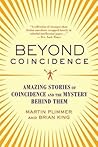
― Beyond Coincidence: Amazing Stories of Coincidence and the Mystery Behind Them
― Beyond Coincidence: Amazing Stories of Coincidence and the Mystery Behind Them
“We’re talking about fundamentals here; the fundamental physical laws pertaining to the day-to-day running of the universe. Physicists call them the fundamental constants—things like the masses of atomic particles, the speed of light, the electric charges of electrons, the strength of gravitational force.… They’re beginning to realize just how finely balanced they are. One flip of a decimal point either way and things would start to go seriously wrong. Matter wouldn’t form, stars wouldn’t twinkle, the universe as we know it wouldn’t exist and, if we insist on taking the selfish point of view in the face of such spectacular, epic, almighty destruction, nor would we. The cosmic harmony that made life possible exists at the mercy of what appear, on the face of it, to be unlikely odds. Who or what decided at the time of the Big Bang that the number of particles created would be 1 in 1 billion more than the number of antiparticles, thus rescuing us by the width of a whisker from annihilation long before we even existed (because when matter and antimatter meet, they cancel each other out)? Who or what decided that the number of matter particles left behind after this oversize game of cosmic swapping would be exactly the right number to create a gravitational force that balanced the force of expansion and didn’t collapse the universe like a popped balloon? Who decided that the mass of the neutron should be just enough to make the formation of atoms possible? That the nuclear force that holds atomic nuclei together, in the face of their natural electromagnetic desire to repulse each other, should be just strong enough to achieve this, thus enabling the universe to move beyond a state of almost pure hydrogen? Who made the charge on the proton exactly right for the stars to turn into supernovas? Who fine-tuned the nuclear resonance level for carbon to just delicate enough a degree that it could form, making life, all of which is built on a framework of carbon, possible? The list goes on. And on. And as it goes on—as each particularly arrayed and significantly defined property, against all the odds, and in spite of billions of alternative possibilities, combines exquisitely, in the right time sequence, at the right speed, weight, mass, and ratio, and with every mathematical quality precisely equivalent to a stable universe in which life can exist at all—it adds incrementally in the human mind to a growing sense, depending on which of two antithetical philosophies it chooses to follow, of either supreme and buoyant confidence, or humble terror. The first philosophy says this perfect pattern shows that the universe is not random; that it is designed and tuned, from the atom up, by some supreme intelligence, especially for the purpose of supporting life. The other says it’s a one in a trillion coincidence.”
― Beyond Coincidence: Amazing Stories of Coincidence and the Mystery Behind Them
― Beyond Coincidence: Amazing Stories of Coincidence and the Mystery Behind Them
“But don’t you see,” I exclaimed. “Everything is synchronicity. Nothing happens by chance.” As I said these words in my dream, a tremendous energy flooded my brain and shocked me awake, forcing me to consider this intuitive answer. What if it were true? What if, moment by moment, we create our own realities through our consciousness?”
― Beyond Coincidence: Amazing Stories of Coincidence and the Mystery Behind Them
― Beyond Coincidence: Amazing Stories of Coincidence and the Mystery Behind Them
“Professor Chris French says research proves that people who are psychologically healthy and think of themselves as lucky people are actually less in touch with reality than depressives. “The truth is that life really is pretty awful,” he says. “The depressives have got it right. The people who don’t suffer from depression are the ones who have what we call ‘unrealistic optimism.’ We give people questionnaires to fill in and ask them what are the chances of certain negative things happening to them—of being run over by a bus or contracting a particular illness. Most people assume that the bad things won’t happen to them and the good things will. And the truth is that they are being overly optimistic. The depressives tend to be much more accurate. But by living your life as if you were a lucky person, good things will tend to happen to you because you will be willing to take risks. By not living in an overcautious, worried, anxious way, you will get more out of life. This is a nice example of a situation where an irrational belief can be psychologically healthy.”
― Beyond Coincidence: Amazing Stories of Coincidence and the Mystery Behind Them
― Beyond Coincidence: Amazing Stories of Coincidence and the Mystery Behind Them